wayground logo

Free Printable Worksheets

Font size

S
M
L
XL
Worksheets

1st Six Weeks Test Review

Total questions: 155

Worksheet time: 2hrs 6mins

Name
Class
Date
1.

Matter that has volume, but no shape

a)
Matter
b)
Volume
c)
Liquid
d)
Atom
2.
Temperature at which a solid changes to a liquid  is
a)
Volume
b)
Atom
c)
Matter
d)
Melting Point
3.
When a gas (vapor, steam) cools and changes into a liquid  
a)
gas
b)
balance
c)
physical property
d)
condensation
4.
Anything that takes up space and has mass is
a)
Matter
b)
Volume
c)
Liquid
d)
Atom
5.
A balloon is filled with gas. Inside the balloon the gas particles .......
a)
Are avoiding each other
b)
Are moving slowly
c)
Are moving very quickly
d)
Are not moving
6.
What process takes place when a puddle of water dries up on a sidewalk?
a)
melting
b)
freezing
c)
condensation
d)
evaporation
7.
How are the molecules arranged in a solid?
a)
Tightly close together
b)
Loosely
All over the place
c)
All over
There are none
8.

Which of the following is an intensive property?

a)

Volume

b)

Weight

c)

Density

d)

Mass

9.

Which of the following is an extensive property of liquid coffee in a mug?

a)

Total mass of caffeine in the coffee

b)

The color of the coffee

c)

The density of the coffee

d)

The smell of the coffee

10.

The melting point of ice is 00 C. This is an example of ________.

a)

physical intensive property

b)

physical extensive property

c)

chemical intensive property

d)

chemical extensive property

11.

The mass of a lead cube is 64 grams. This is an example of

a)

physical intensive property

b)

physical extensive property

c)

chemical intensive property

d)

chemical extensive property

12.

Salt dissolving in water is an example of a __________________.

a)

physical change

b)

chemical change

c)

physical property

d)

chemical property

13.

The ability of a substance to go through oxidation (rust, tarnish) is this type of property:

a)

Physical property

b)

Chemical property

c)

Condensation

d)

Sublimation

14.

In the ice cream lab, we combined milk, sugar, and vanilla to form a ______________________________.

a)

Homogeneous Mixture

b)

Heterogeneous Mixture

c)

Suspension

d)

Compound

15.

Cabbage juice is a natural indicator that changes color in the presence of an acid or a base. When cabbage juice is mixed with hydrochloric acid, the solution changes to a green/yellow color. This is an indication of a ________________ change.

a)

Physical

b)

Chemical

c)

Extensive

d)

Intensive

16.

A precipitate is formed by mixing two aqueous solutions (homogeneous solutions) together and the resulting product is a solid suspended in an aqueous solutions (a heterogeneous mixture). This reaction is an example of a -

a)

Physical Change

b)

Chemical Change

c)

Oxidation Reaction

d)

Extensive Property

17.

Which of the following is a sign of a chemical change

a)

A solid sublimating

b)

A gas condensing

c)

Grapes fermenting

d)

A liquid evaporating

18.

In the ice cream lab, we added rock salt to the ice which formed a homogeneous mixture after the ice had melted. What is another term for a homogeneous mixture?

a)

Solution

b)

Colloid

c)

Suspension

d)

Precipitate

19.
Particles (molecules) in a ______________________ have more energy than the other states of matter.
a)
gas
b)
solid
c)
liquid
20.
Particles of a liquid
a)
are tightly packed together and stay in a fixed position.
b)
have no viscosity.
c)
decrease in volume with increasing temperature.
d)
are free to move around one another but still touch.
21.

What happens when a puddle of water is sitting in the sun and the water disappears into a gas?

a)

evaporation

b)

burning

c)

melting

d)

freezing

22.

Dry ice changing from a solid state directly to a gas is called

a)

deposition

b)

melting

c)

evaporation

d)

sublimation

23.
A liquid changes to a gas during _________.
a)
Condensation
b)
Evaporation
c)
Precipitation
d)
Sublimation
24.
Which of the following statements describe gas the BEST.
a)
Gas has a packed shape.
b)
Gas cannot change shape.
c)
Gas has a definite shape.
d)
Gas spreads out to fill a space.
25.

When water vapor is cooled, it condenses to become a _______.

a)

Solid

b)

Liquid

c)

Gas

d)

None of the Above

26.

Salt is dissolved in water. This is an example of what type of property and what type of change?

a)

chemical change, extensive property

b)

chemical property, intensive change

c)

physical change, intensive property

d)

physical property, extensive property

27.

The boiling point of water is 273 K. This is an example of ________.

a)

physical intensive property

b)

physical extensive property

c)

Chemical change

d)

Chemical property

28.
Which of the following is a chemical property?
a)
how something tastes
b)
ability to explode
c)
ability to float in water
d)
size of an object
29.
Which is an example of a physical property?
a)
ability to react with acid
b)
 color
c)
flammability
d)
ability to react with oxygen
30.
A substance that contains only one type of atom is a(n)
a)
compound
b)
element
c)
heterogeneous mixture
d)
homogeneous mixture
31.

potting soil

a)

A. MIXTURE

b)

B. COMPOUND

c)

C. ELEMENT

d)

D. SUSPENSION

32.

A substance made by mixing other substances together and being able to then separate is the definition of a

a)

Compound

b)

Solution

c)

Mixture

d)

Element

33.
The difference between elements and compounds is that...
a)
elements can be separated by physical means and compounds cannot.
b)
elements cannot be separated by physical means and compounds can.
c)
elements contain only one kind of atom and compounds contain more than one kind of atom.
d)
elements contain more than one kind of atom and compounds contain only one kind of atom.
34.

A physical change can sometimes result in a color change. Which of the following situations show this?

a)

Milk turns yellow and chunky when it spoils.

b)

Dough becomes darker when it is baked into cake.

c)

A red candy dissolves and turns water pink.

d)

A match turns black when it is burned.

35.
What is happening when my ice cream changes from a solid to a liquid?
a)
freezing
b)
melting
c)
burning
d)
evaporation
36.
What term describes a solid changing to a gas?
a)
Deposition
b)
Sublimation
c)
Evaporation
d)
Freezing
37.

What is happening when my water bottle in the ice box goes from a liquid state to a solid state?

a)

melting

b)

evaporating

c)

freezing

d)

cutting

38.
My glass of ice water is sitting in the sun and has droplets of water on the outside of the glass. What is happening?
a)
condensation
b)
evaporation
c)
melting
d)
freezing
39.
Particles of a liquid
a)
are tightly packed together and stay in a fixed position.
b)
have no viscosity.
c)
decrease in volume with increasing temperature.
d)
are free to move around one another but still touch.
40.
Particles (molecules) in a ______________________ have more energy than the other states of matter.
a)
gas
b)
solid
c)
liquid
41.
When a gas changes directly to a solid, the process is known as what?
a)
Sublimation
b)
Condensation
c)
Deposition
d)
Evaporation
42.

After it rains and the sun comes out, the water puddles in the parking lot disappear by the process of ______________.

a)

Evaporation

b)

Condensation

c)

Sublimation

d)

Deposition

43.
Molecules are closest together in a 
a)
Solid
b)
Liquid
c)
Gas
44.
If an unknow substance cannot be broken down into simpiler substances, it is ...
a)
a compound
b)
an element
c)
a suspension
d)
a solution
45.
If a mixture has components you can see it is a...
a)
solution
b)
compound
c)
homogeneous mixture
d)
heterogeneous mixture
46.

A type of matter with a fixed composition

a)

Substance

b)

Solid

c)

Solution

d)

Mixture

47.

A substance that is made up of atoms that are all alike is a(an) _____________. For example, aluminum foil is made of only aluminum atoms.

a)

Compound

b)

Substance

c)

Element

d)

Solution

48.

A substance in which the atoms of two or more elements are chemically combined is a(an) _______. For example, water is composed of two hydrogen atoms and one oxygen atom.

a)

Element

b)

Compound

c)

Solution

d)

Condensation

49.

A ___________ is a heterogenous mixture made of a liquid and solid particles that settle. For example, when allowed to sit for a while, sand will sink to the bottom when mixed with water.

a)

Suspension

b)

Colloid

c)

Solution

d)

Compound

50.

A heterogenous mixture with particles that never settle is called a ___________. For example, Milk is a mixture with particles that do not settle and you cannot see through.

a)

Sublimation

b)

Colloid

c)

Suspension

d)

Solution

51.

A mixture that remains uniformly mixed and has particles that are so small they cannot be seen with a microscope is called a ______________.

a)

Homogeneous Mixture

b)

Heterogenous Mixture

c)

Colloid

d)

Evaporation

52.

A __________ is the same thing as a homogeneous mixture. For example, Powerade is a homogenous mixture.

a)

Solution

b)

Colloid

c)

Suspension

d)

Solid

53.
What are the states of matter?
a)
solid, liquid, and juice
b)
solid and liquid
c)
solid and gas
d)
solid, liquid, and gas
54.

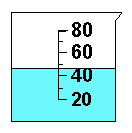
Which value below best expresses the volume measured in this beaker to the correct number of significant figures?

a)

48 mL

b)

48.2 mL

c)

48.25 mL

d)

40 mL

55.

Which value below best expresses the length measured on the ruler to the correct number of significant figures?

a)

3.2 cm

b)

3.12 cm

c)

3 cm

d)

3.219 cm

56.

What mass does the balance display to the correct number of significant figures?

a)

27.70 grams

b)

127.7 grams

c)

72 grams

d)

27 grams

57.

What is the length of this line to the correct number of significant figures?

a)

5 cm

b)

4.3 cm

c)

4.30 cm

d)

4.80 cm

58.

What is the length of this crayon to the correct number of significant figures?

a)

7.100 inches

b)

6.0 cm

c)

7.09 cm

d)

4.5 cm

59.

What is the mass to the correct number of significant figures?

a)

90 g

b)

100 g

c)

190.40 g

d)

194.0 g

60.

Where do we read the level of liquid?

a)

The highest point the liquid touches

b)

The bottom of the meniscus

c)

Half way between, we make an educated guess and round it

d)

Somewhere about there

61.

What is the volume of the liquid in this graduated cylinder to the correct number of significant figures?

a)

19 mL

b)

25 mL

c)

24.1 mL

d)

1.9 mL

62.

What is the scale on this graduated cylinder?

a)

.1 mL per line

b)

.2 mL per line

c)

.5 mL per line

d)

1 mL per line

63.

What is the temperature measurement in oC to the correct number of significant figures?

a)

30°C

b)

35°C

c)

35.8°C

d)

36.3°C

64.

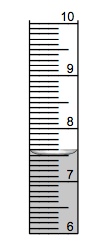
What is the volume of the liquid in this graduated cylinder?

a)

8.50 mL

b)

7.50 mL

c)

8.0 mL

d)

7.1 mL

65.

What is the mass on this triple beam?

a)

220 g

b)

221.5 g

c)

222.0 g

66.

What temperature does the thermometer show?

a)

80.1° F

b)

81.0° F

c)

82.0° F

d)

85.5° F

67.

Measure to the nearest cm

a)

39.09 cm

b)

39.17 cm

c)

31.08 cm

d)

40.1 cm

68.

What is the length of the screw?

a)

5.11 cm

b)

6.0 cm

c)

5.0 mm

d)

5.1 m

69.

What is the volume of liquid in this graduated cylinder?

a)

40.0 mL

b)

40.3 mL

c)

43.0 mL

d)

44.0 mL

70.

What is the mass on this triple beam?

a)

506.7 g

b)

576.06 g

c)

576 g

71.

What is the mass on this triple beam?

a)

143 g

b)

40.3 g

c)

43.0 g

d)

43.9 g

72.

What is the volume of Object X?

a)

10.0 cm3

b)

15.0 cm3

c)

20.0 cm3

d)

25.0 cm3

73.

When measuring the length of this crayon, how many significant figures should be your measurement?

a)

1

b)

2

c)

3

d)

4

74.
If a laboratory fire erupts, immediately
a)
notify your instructor
b)
 run for the fire extinguisher
c)
throw water on the fire
d)
 open the windows
75.
Approved eye protection devices (such as goggles) are worn in the laboratory
a)
 to avoid eye strain
b)
to improve your vision
c)
only if you don’t have corrective glasses
d)
 any time chemicals, heat or glassware are used
76.
If you wear contact lenses in the school laboratory
a)
take them out before starting the lab
b)
you do not have to wear protective goggles
c)
 advise your science instructor that you wear contact lenses
d)
 keep the information to yourself
77.
 If you do not understand a direction or part of a lab procedure, you should 
a)
skip it and go on to the next part.
b)
ask the instructor before proceeding
c)
try several methods until something works
d)
figure it out as you do the lab
78.
 After completing an experiment, all chemical wastes should be
a)
taken home
b)
dumped in the sink
c)
disposed of according to your instructor’s directions
d)
left at your lab station for the next class
79.
You are heating a substance in a test tube. Always point the open end of the tube 
a)
away from all people
b)
toward another classmate
c)
toward your lab partner
d)
toward yourself
80.
You are heating a piece of glass and now want to pick it up. You should 
a)
pour cold water on it
b)
use tongs
c)
pick up the end that looks cooler
d)
use a rag or paper towels
81.
You are heating a piece of glass and now want to pick it up. You should 
a)
pour cold water on it
b)
use tongs
c)
pick up the end that looks cooler
d)
use a rag or paper towels
82.
You have been injured in the laboratory (cut, burn, etc.). First you should
a)
apply first aid yourself
b)
tell the science instructor at once
c)
see a doctor after school
d)
visit the school nurse after class
83.
When gathering glassware and equipment for an experiment, you should
a)
 All of the choices
b)
clean any glassware that appears dirty
c)
examine all glassware to check for chips or cracks
d)
read all directions carefully to know what equipment is necessary
84.
 Personal eyeglasses provide as much protection as
a)
none of these answers
b)
splashproof chemical goggles
c)
safety glasses
d)
a face shield
85.
Long hair in the laboratory must be 
a)
tied back or kept entirely out of the way with a hair band, hairpins, or other confining device
b)
always neatly groomed
c)
held away from the experiment with one hand
d)
cut short
86.
In a laboratory, the following should not be worn. 
a)
all of the answers
b)
dangling jewelry
c)
sandals
d)
loose clothing
87.
 The following footwear is best in the laboratory. 
a)
shoes appropriate for the weather
b)
open-toed shoes
c)
closed-toed shoes
d)
sandals
88.
 Horseplay or practical jokes in the laboratory are 
a)
okay if you are working alone
b)
not dangerous
c)
okay
d)
always against the rules
89.
If an acid is splashed on your skin, wash at once with 
a)
weak base
b)
soap
c)
plenty of water
d)
oil
90.
Hot glass looks the same as cold glass.
a)
True
b)
False
91.
Return all unused chemicals to their original containers.
a)
True
b)
False
92.
All chemicals in the lab are to be considered dangerous
a)
True
b)
False
93.
Laboratory work can be started immediately upon entering the laboratory even if the instructor is not yet present
a)
True
b)
False
94.
Read all procedures thoroughly before entering the laboratory
a)
True
b)
False
95.
Identify the following lab equipment:
a)
hot plate
b)
electronic balance
c)
bunsen burner
d)
scales
96.
Identify the equipment shown
a)
Ring Stand
b)
Flask
c)
Beaker
d)
Bunsen Burner
97.
What is measured with a graduated cylinder?
a)
Passage of time
b)
Distance from one thing to another
c)
Weight of an object
d)
Volume of liquid
98.

Identify the equipment shown here:

a)

beaker

b)

erlenmyer flask

c)

test tube

d)

filter flask

99.
Identify the equipment shown
a)
scoopula
b)
ring stand
c)
beaker
d)
crucible
100.

What is the temperature measurement in oC?

a)

30°C

b)

39°C

c)

35.8°C

101.

What is the purpose of this lab equipment?

a)

to hold misbehaving students

b)

to capture chemical vapor and fumes

c)

to perform all lab experiments

d)

to measure the mass of a solid

102.

What is the purpose of this lab equipment?

a)

to wash chemicals off of a persons body or out of their eyes

b)

to extinguish a fire

c)

to shut off the gas supply in the lab

d)

to pull the lever and see what happens

103.

What is the purpose of this lab equipment?

a)

to transfer small amounts of liquid

b)

to measure solids

c)

to clean a test tube

d)

to squirt liquid at other people

104.

The diameter of a carbon atom is 0.000000000154 m. What is this number expressed in scientific notation?

a)

1.54 x 10¹² m

b)

1.54 x 10⁻¹² m

c)

1.54 x 10¹⁰ m

d)

1.54 x 10⁻¹⁰ m

105.
Express 23400 in proper scientific notation. 
a)
2.34 x 10⁴
b)
2.3 x 10³
c)
2.30 x 10⁵
d)
2.34 x 10³
106.
identify the following lab equipment
a)
test tube clamp
b)
tongs
c)
ring stand
d)
buret clamp
107.

What is the purpose of this lab equipment?

a)

to measure the mass of an object

b)

to heat glassware

c)

a stand used to hold my phone

d)

a multiple use tool used for holding many pieces of glassware and other devices

108.

Identify the equipment shown

a)

test tube clamp

b)

crucible tongs

c)

ring stand

d)

beaker tongs

109.
a)

beaker

b)

graduated cylinder

c)

Erlenmeyer flask

d)

test tube

110.
a)
thermometer
b)
graduated cylinder
c)
test tube
d)
watch glass
111.
a)

hot plate

b)

triple beam balance

c)

buret

d)

digital balance

112.
How many millimeters are in 1,064 cm? (Show all work with units on your paper to receive credit)
a)
10,640 mm
b)
106.4 mm
c)
10.64 mm
d)
106,400 mm
113.
Convert 600. Kg to dg. (Show all work with units on your paper to receive credit)
a)
6.0 x 10⁴ dg
b)
6.00 x 10⁶ dg
c)
6.00 x 10⁻⁶ dg
d)
6.00 x 10⁻³ dg
114.
Write the following number in scientific notation: 0.00000026345
a)
2634.5x10-10
b)
2634.5x1010
c)
2.6345x10⁻⁷
d)
2.6345x10⁷
115.
Write the following in standard notation:
 -5.1002x10⁻⁴
a)
0.00051002
b)
-0.00051002
c)
51002
d)
-51002
116.
How many significant figures does the following number have: 100.00210
a)
7
b)
5
c)
10
d)
8
117.
6,000 milliliters = ______ liters (Show all work with units on your paper to receive credit)
a)
60 L
b)
600 L
c)
6 L
d)
6,000 L
118.
What is the measurement 1042 Liters rounded to 2 significant figures? 
a)
1040 L
b)
1.1 x 10³ L
c)
1.0 x 10L
d)
1050 L
119.
When performing the calculation 34.530 g + 12.1 g + 1222.34 g the final answer must have
a)
Three significant figures
b)
One decimal place
c)
Two decimal places
d)
Three decimal places
120.
Jack is 2.5 x 10⁸ nanometers tall. If there are
1.0 x 10⁷ nanometers in one centimeter, how many centimeters tall is Jack? (Show all work with units on your paper to receive credit)
a)
25 cm
b)
2.5 x 1015 cm
c)
2.5 x 10⁻¹⁵ cm
d)
2.5 x 105 cm
121.
How many significant figures does the following number have: 0.002040
a)
6
b)
4
c)
3
d)
2
122.
How many significant figures does the following number have: 0.998005
a)
9
b)
10
c)
6
d)
5
123.
How many significant figures does the following number have: 100.00210
a)
7
b)
5
c)
10
d)
8
124.
How many significant figures does the following number have: 100.3
a)
4
b)
3
c)
5
d)
2
125.
What is 98.907 rounded to 1 significant figure?
a)
98.9
b)
90
c)
100
d)
98.91
126.
What is 0.000328 rounded to 1 significant figure?
a)
0
b)
0.0003
c)
0.00033
d)
0.000328
127.

Determine the number of Significant Figures in 1.0 x 101 g.

a)

5

b)

4

c)

3

d)

2

128.
Solve. Round using SigFig math rules.
98.7°C - 97.25°C 
a)
1°C
b)
1.4°C
c)
1.45°C
d)
1.450°C
129.
Round 0.010229 to four sig figs
a)
1022
b)
1023
c)
0.01023
d)
0.01022
130.
How many significant figures will be in the answer to the following question:
7.62 x 6.98 x 3.2645
a)
1
b)
2
c)
3
d)
4
131.
Calculate 1.23 m x 0.89 m and give your answer with the appropriate number of significant figures.
a)
1.0 m2
b)
1.1 m2
c)
1.0947 m2
d)
1.09 m2
132.
Calculate 123000 m x 3234 m and give your answer with the appropriate number of significant figures.
a)
3.97 x 10⁻⁷ m2
b)
39800000 m2
c)
398 m2
d)
3.98 x 10⁸ m2
133.
Calculate 12.47 m ÷ 3.2 s and give your answer with the appropriate number of significant figures.
a)
4 m/s
b)
3.9 m/s
c)
3.90 m/s
d)
3.897 m/s
134.
How would you write 4.3756 x 10in standard form?
a)
437,560,000
b)
0.00043756
c)
43,756
d)
4,3756
135.
Round 1047.78 to three sig figs
a)
104
b)
105
c)
1050
d)
1050.00
136.
Calculate 12.34 + 1.234 + 0.1234 and give your answer with the appropriate number of significant figures.
a)
13.6974
b)
13.697
c)
13.70
d)
13.7
137.
Multiply:
(3.4 x 10⁵)(1.2 x 10⁻³)
a)
4.08 x 10⁻⁸
b)
4.8 x 10²
c)
4.08 x 10²
d)
4.08 x 10⁻¹⁵
138.
Determine the number of Significant Figures in 13410000 m.
a)
4
b)
3
c)
8
d)
1
139.
Determine the number of Significant Figures in 13410000 m.
a)
4
b)
3
c)
8
d)
1
140.
Determine the number of Significant Figures in 0.000204 kg.
a)
4
b)
3
c)
6
d)
1
141.
Determine the number of Significant Figures in 101.00 mL.
a)
5
b)
4
c)
3
d)
2
142.
Convert to scientific notation with 3 sig figs:
520,000,000  
a)
520 x 106
b)
5.20 x 10⁷
c)
5.20 x 10⁸
d)
0.52 x 10⁹
143.
Convert the following to scientific notation. 
0.000480 
(keep the same number of sig figs)
a)
4.80 x 10⁴
b)
4.80 x 10⁻⁴
c)
4.8 x 10⁻³
d)
4.8 x 10⁻⁴
144.
Determine the number of Significant Figures in 13410000 m.
a)
4
b)
3
c)
8
d)
1
145.
You know that 12 inches = 1 foot.  Convert 60 inches to feet.
a)
720 feet
b)
5 feet
c)
5 inches
d)
72 feet
146.

Convert 3.5 gallons into cups. (1gal = 16cups)

a)

56 cups

b)

0.21875 cups

c)

19.5 cups

d)

48 cups

147.
How many gallons are in a pool that holds 758,000 Liters?
(1 gallon = 3.79 Liters)
a)
200
b)
20,000
c)
200,000
d)
2,000,000
148.
How many minutes are in a year?
a)
I can't count that high.
b)
525,600min
c)
52,560min
d)
31,536,000min
149.
The Olympic record for the high jump is just over 2.6 yards. What is that distance in feet?  (3 ft=1 yd)
a)
0.867 ft
b)
7.8 ft
c)
8.07 ft
d)
8.27 ft
150.
How many yards are in 1 mile?
(Hint:  3 ft = 1 yd and 5280 ft = 1 mi)
a)
1670 yds
b)
5280 yd
c)
1760 yds
d)
5820 yds
151.
How many dimes equals 14 quarters?
a)
140 dimes
b)
35 dimes
c)
70 dimes
d)
20 dimes
152.

How many kilograms of calcium are there in 173 pounds of calcium? (1 pound = 454 grams; 1 kg = 1000 g)

a)

1.10 kg

b)

78.5 kg

c)

110 kg

d)

78500 kg

153.

Match the following

a)

Luster

1.

Intensive Property

b)

Length

2.

Extensive Property

c)

Deposition

3.

Phase change from a gas to a solid

d)

Condensation

4.

Phase change from a gas to a liquid

e)

Vanilla Ice Cream

5.

Solution

154.

What unit should be in the denominator (bottom right box of the picket fence) of the conversion factor in the picture?

a)
yards
b)
leagues
c)
feet
d)
fathoms
155.

What unit should be in the numerator (top right box of the picket fence) of the conversion factor in the picture?

a)

lbs

b)

kg

c)

ft

d)

leagues