wayground logo

Free Printable Worksheets

NEW

Font size

S
M
L
XL
Worksheets

plate tectonics, volcano and rock cycle

Total questions: 57

Worksheet time: 2hrs 54mins
Name
Class
Date
1.
The type of plate boundary where two plates come together is a .....
a)
Convergent Boundary
b)
Divergent Boundary
c)
Transform Boundary
d)
Plate Boundary
2.
Which of the following causes Earth's tectonic plates to move?
a)
Energy from the Sun
b)
Magnetic Pole Reversal
c)
Convection currents in the mantle
d)
Faults in Mountain Ranges
3.
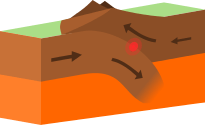
What type of plate boundary is this?
a)

Subduction

b)
Divergent
c)
Convergent
d)
Transform
4.
The Great Rift Valley in Africa and the Mid-Ocean Ridge were all created by this boundary
a)
Divergent
b)
Convergent
c)
Reform
d)
Transform
5.
Which type of rock results from melting and cooling of magma?
a)
Igneous
b)
Metamorphic
c)
Sedimentary
d)
Extrusive
6.

Which type of rock forms from heat and pressure?

a)

Igneous

b)

Sedimentary

c)

Organic

d)

Metamorphic

7.
A metamorphic rock changes into an igneous rock by what two processes?
a)
Melting and cooling
b)
Extreme heat and pressure
c)
Compaction and cementation
d)
Weathering and erosion
8.
Which type of rock results from melting and cooling of magma?
a)
Igneous
b)
Metamorphic
c)
Sedimentary
d)
Extrusive
9.

The process by which water, wind, ice, and changes in temperature break down rock into fragments called sediments.

a)

Deposition

b)

sedimentary

c)

Weathering

d)

Igneous Rock

10.
Rock that forms when minerals form from solutions or sediment from older rocks get pressed and cemented together.
a)
Sedimentary Rock
b)
Metamorphic Rock
c)
Igneous Rock
11.
The process by which metamorphic rocks are formed...
a)
heat and pressure
b)
compaction and cementation
c)
melting and cooling
12.
What are the two types of crust
a)
continental and oceanic
b)
ocean and upper
c)
lower and upper
d)
pizza and subway
13.
The name rock is given when it is broken down into smaller pieces.
a)
texture
b)
weathering
c)
sediment
d)
erosion
14.
Transform boundaries are most likely to produce what geological event?
a)
volcanoes
b)
deep sea trenches
c)
underwater mountain ranges
d)
earthquakes
15.
What type of event will occur at this boundary?
a)
Earthquake
b)
Volcano Eruption
c)
Tornado
d)
Mountain Building
16.

This term is used to describe the supercontinent when all the plates were together.

a)

Pangaea

b)

America

c)

Lithosphere

d)

Asthenosphere

17.
Fossils are found in what type of rock?
a)
Igneous
b)
Sedimentary
c)
Metamorphic
d)
None of these
18.
Obsidian is shiny, smooth and usually black. It is an igneous rock, and forms when:
a)
Magma cools slowly underground
b)
Lava cools slowly underground
c)
Magma cools quickly on the surface
d)
Lava cools quickly on the surface
19.
What type of rock is forming in this image?
a)
Igneous
b)
Sedimentary
c)
Metamorphic
d)
None of these
20.

The volcano Kilauea on the big island

of Hawai’i is erupting and lava is ejected

from the volcano vent. The lava solidifies

to form what type of rock?

a)

Sedimentary

b)

Metamorphic

c)

Igneous

21.

True or False? Magma is lava that has

been ejected from beneath the Earth’s

crust through a volcano.

a)

True

b)

False

22.

The long tube in the ground that connects the magma chamber to Earth's surface is called the _____________.

a)

Crater

b)

Pipe

c)

Vent

d)

Magma Chamber

23.

Once magma reaches the Earth's surface it is called.......

a)

Silica

b)

Lava

c)

Rock

d)

Molten

24.

When a volcano erupts quietly, lava moves slowly outward, what kind of mountain forms?

a)

A Shield Volcano

b)

A Cinder Cone Volcano

c)

A Composite Cone Volcano

25.

What do we call molten hot liquid rock while it is still below the Earth's surface?

a)

Magma

b)

Igneous

c)

Cinder

d)

Lava

26.

At what type of plate boundary are most above sea volcanoes found?

a)

Divergent

b)

Convergent

c)

Transform

27.

Between what 2 types of crust are most above sea volcanoes located? (throwback to Unit 1)

a)

Continental - Continental

b)

Oceanic - Oceanic

c)

Oceanic - Continental

28.

This is where the volcanic materials that erupt are stored

a)

Vent

b)

Conduit

c)

Side Vent

d)

Magma Chamber

29.

How fast a lava is able to flow is based on its

a)

Location

b)

Viscosity

c)

Amount

d)

Weight

30.

A fluid's thickness and resistance to flow is called....

a)

Viscosity

b)

Consistency

c)

Thickness

d)

Magma

31.
A dead volcano is called what?
a)
active
b)
dormant
c)
extinct
32.
A sleeping volcano is called what?
a)
active
b)
dormant
c)
extinct
33.
Volcanoes can be found...
a)
on land
b)
under water
c)
on islands
d)
all of the above
34.
Approximately 70% of the world's composite volcanoes are located around the Pacific Ocean in a region called the ____________. 
a)
Ring of Fire
b)
Volcano Ring
c)
Nucleus of Volcanoes
d)
Center of Fire
35.
What process is used to form sedimentary rocks?
a)
Lava cools and hardens to form a rock.
b)
Bits of sand and gravel form layers that turn into rock from pressure.
c)
Extreme heat and pressure from inside the Earth turn rocks into new rocks.
d)
Magma trapped under the Earth's surface cools and solidifies.
36.
Which of the words below describe mud, sand, and tiny bits of rocks that cement together to form a type of rock?
a)
stalactites
b)
magmas
c)
metamorphs
d)
sediments
37.
How are all rocks related to one another based upon the rock cycle diagram?
a)
Igneous rocks only come from sedimentary and metamorphic rocks
b)
Sedimentary rocks cannot make other sedimentary rocks
c)
All rocks can create any other type of rock
d)
Heat and pressure must be applied to make sedimentary rock
38.
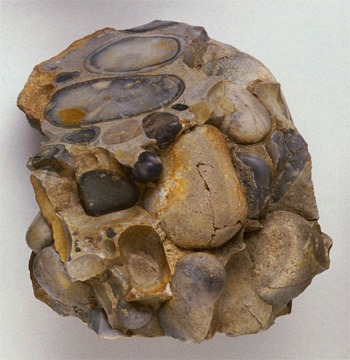
This rock was formed by smaller pieces of rock that settled at the bottom of a lake millions of years ago. What type of rock is this?
a)
Sedimentary
b)
Igneous
c)
Metamorphic
39.

In the Starburst Lab, we made models of all types of rocks. Which type of rock is able to turn into a metamorphic rock?

a)

Only sedimentary

b)

Only igneous

c)

Both igneous and sedimentary

d)

Neither igneous or sedimentary

40.

What must happen to a metamorphic rock before it becomes a sedimentary rock rock?

a)

It must be broken down into sediment

b)

It must be melted into magma

c)

Its minerals must dissolve in water

d)

It must be exposed to high temperature and pressure

41.
What is the correct order of making and dropping off of sediments?
a)
weathering, erosion, deposition 
b)
erosion, weathering, deposition
c)
weathering, deposition , erosion
42.
What are the 3 major types of rocks?
a)
Igneous, Metamorphic, Sedimentary
b)
Metamorphic, Igneous, Cementation
c)
Brown, Red, Gray
d)
Streak, Hardness, Breakage
43.

If a rock cools slowly, it may

a)

preserve dinosaur bones

b)

have chunks of pebbles

c)

be smooth as glass

d)

form crystals

44.

The only igneous rock that can float is

a)

obsidian

b)

gabbro

c)

pumice

d)

diorite

45.

Weathering is the

a)

process of rocks breaking down

b)

melting of rocks

c)

baking of rocks

d)

cementing of particles

46.

Cementation is the

a)

pressing together of sediment layers

b)

transportation of sediment

c)

baking of rock near magma

d)

cooling of lava

47.
What are solid rock fragments that are ejected during a volcanic eruption?
a)

Lahar

b)
Magma
c)
Pyroclastic Material
d)
Silica
48.
What is the definition of dormant?
a)
sleeping
b)
extinct
c)
active
d)
invisible
49.
How are lava and magma most different?
a)
their location
b)
their heat
c)
their color
d)
what they eat for lunch
50.

Lakes that form near volcanoes considered to be....

a)

Craters

b)

Conduits

c)

Vents

d)

Calderas

51.
What is letter A in the picture?
a)
Vent
b)
Crater
c)
Conduit
d)
Tephra
52.
What is letter B in the picture?
a)
Magma Chamber
b)
Crater
c)
Vent
d)
Conduit
53.
What is letter D in the picture?
a)
Crater
b)
Vent
c)
Conduit
d)
Tephra
54.
What is letter F in the picture?
a)
Pyroclastic Flow
b)
Crater
c)
Vent
d)
Tephra
55.
What is the resistance of a liquid, such as lava, to flow?
a)
Elasticity
b)
Pyroclasticity
c)
Silica
d)
Viscosity
56.
What do you call a large crater formed by the collapse of a volcano?
a)
Caldera
b)
Cinder Cone
c)
Composite Volcano
d)
Shield Volcano
57.
Whenever a subduction zone is formed usually a ______ is formed.
a)
Mountain
b)
mid-ocean ridge 
c)
Rift
d)
trench