wayground logo

Free Printable Worksheets

Font size

S
M
L
XL
Worksheets

Ch. 1 REVIEW QUIZIZZ

Total questions: 70

Worksheet time: 4hrs 30mins

Name
Class
Date
1.
What two types of measurements make up DENSITY
a)
Mass and Volume
b)
Temperature and Mass
c)
Grams and Centimeters
d)
Volume and Weight
2.
Look at this image.  Which object has the LOWEST density in water? How
a)
The Ping Pong Ball because it floats to the top 
b)
The bolt because it has sunk to the bottom
c)
The soda cap because it is not just full of air like the Ping Pong ball
3.
Jack has a rock. The rock has a mass of 14g and a volume of 2cm3. What is the density of the rock?
a)
7 mL
b)
7 g/cm3
c)
28 g/cm3
d)
1/7 g/cm3
4.
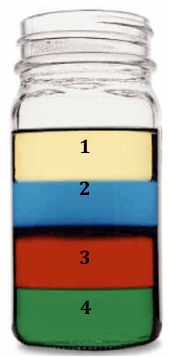
Why do the liquids form different layers?
a)
They have different densities.  
b)
They have different masses.  
c)
They have different volumes.  
d)
They are different temperatures.  
5.
What units can be used to express density?
a)
g/mL
b)
grams
c)
millimeters
d)
milliliters
6.
Frank has a paper clip. It has a mass of 9g and a volume of 3cm3. What is its density?
a)
3 g/cm3
b)
1/3 g/cm3
c)
27 g/cm3
d)
39 g/cm3
7.
What units are used to measure mass?
a)
g
b)
cm3
c)
g/cm3
d)
cm3/g
8.
An object should float in a liquid if it is 
a)
Denser than the liquid 
b)
Less dense than the liquid
c)
Lighter than metal
d)
 Shaped like a ball 
9.
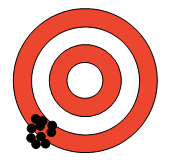
This bullseye demonstrates...
a)
High Accuracy & High Precision
b)
High Accuracy & Low Precision
c)
Low Accuracy & High Precision
d)
Low Accuracy & Low Precision
10.
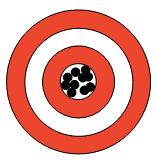
?
a)
High Accuracy & High Precision
b)
High Accuracy & Low Precision
c)
Low Accuracy & High Precision
d)
Low Accuracy & Low Precision
11.

240 cm = ___________ m

a)

2400

b)

24

c)

2.4

d)

0.24

12.

1000 m = ___________ km

a)

100

b)

10

c)

1

d)

0.1

13.

2,804 mg = ___________ g

a)

0.2804

b)

2.804

c)

28.04

d)

280.4

14.

0.932 g = ___________ mg

a)

9.32

b)

93.2

c)

932

d)

9,320

15.

68 cm = ___________ mm

a)

0.68

b)

6.8

c)

68

d)

680

16.

159.7 g = ___________ kg

a)

0.1597

b)

1.597

c)

15.97

d)

1597

17.

56 L = ___________ mL

a)

560

b)

5,600

c)

56,000

d)

560,000

18.

330 cm = ___________ m

a)

3,300

b)

33

c)

3.3

d)

0.33

19.

32.9 km = ___________ cm

a)

32,900

b)

329,000

c)

3,290,000

d)

32,900,000

20.
The International System of Unites
a)
is a device used only to measure volume
b)
is used only for measuring length
c)
is based on units of 10
d)
is based on units of 12
21.
how many meters are in 1 kilometer?
a)
10 m
b)
100 m
c)
1,000 m
d)
10,000 m
22.
A hippo's mass would most likely be described using with units?
a)
kilometers
b)
milligrams
c)
kilograms
d)
triple beam balance
23.
What is the base unit for temperature in in the metric system?
a)
meters
b)
degrees Celsius
c)
degrees Fahrenheit
d)
centimeters
24.
To find the volume of a rock, a student submerges the rock in beaker and finds the difference between the initial volume and the final volume. What is this process called?
a)
volume by displacement
b)
volume by gravity
c)
mass by volume
d)
weight
25.
The amount of space taken up by an object is
a)
Volume
b)
Density
c)
Distance
d)
pH
26.
The basic metric unit for volume is the _.
a)
gram
b)
meter
c)
liter
27.
The basic metric unit for distance is the _.
a)
gram
b)
meter
c)
liter
28.
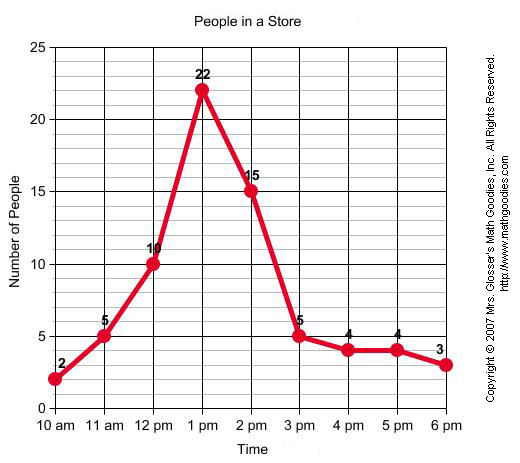
When was the greatest amount of shoppers at the store?
a)
10am
b)
1pm
c)
6pm
d)
2pm
29.
The X axis is _______?
a)
vertical
b)
diagonal
c)
criss-cross
d)
horizontal
30.
The Y axis is _______?
a)
Vertical
b)
Horizontal
c)
criss-cross
d)
diagonal
31.
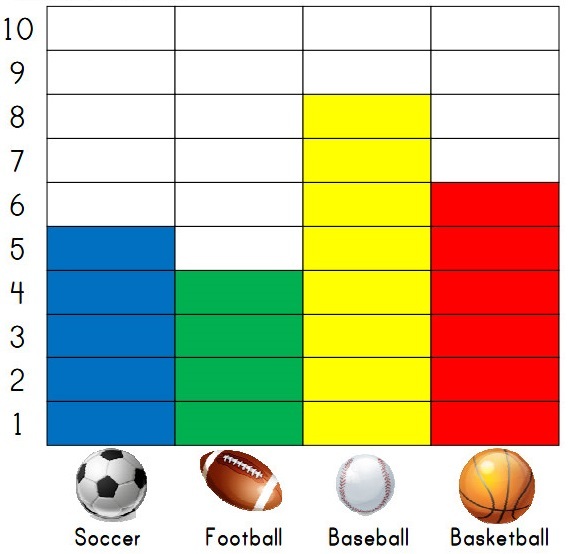
What type of graph is this?
a)
bar graph
b)
pictograph
c)
tally chart
32.
I have two objects with the same volume but different masses.  Which object will be more dense?
a)
The object with less weight.
b)
The object with more weight.
c)
The object with more mass.
d)
The object with less mass.
33.
What is the formula for density?
a)
density = mass x volume
b)
density = mass / volume
c)
density = mass + volume
d)
density = mass - volume
34.
Put the liquids in order from most dense to least dense?
a)
4, 3, 2, 1
b)
1, 2, 3, 4
c)
3, 4, 2, 1, 
d)
4, 3, 1, 2
35.
Archimedes used density to discover if the crown of gold was real because
a)
Substances have their own unique densities
b)
Substances can change densities depending on their size
c)
Substances can change densities depending on their mass
d)
Substances can change densities depending on their volume
36.
The tool used to measure the mass of a substance or object is a ______________.
a)
balance
b)
graduated cylinder
c)
ruler
d)
thermometer
37.
Which units of measurement are used for volume?
a)
grams
b)
centimeters
c)
grams/milliliter
d)
milliliter
38.
Which lab tool might you use to measure the volume of a liquid?
a)
electric scale
b)
bunsen burner
c)
test tube
d)
graduated cylinder
39.
The base unit for volume is the
a)
second
b)
gram
c)
meter
d)
liter
40.
The base unit for mass is the
a)
meter
b)
gram
c)
kilogram
d)
liter
41.
What does the abbreviation km stand for?
a)
kilo
b)
kilometer
c)
kilogram
d)
meter
42.
The basic metric unit for mass is the _.
a)
gram
b)
meter
c)
liter
43.
What would be the best unit of measurement to measure the length of a toothbrush?
a)
millimeters
b)
meters
c)
centimeters
d)
kilometers
44.
A measure of how much matter an object has is--
a)
weight
b)
gravity
c)
mass
d)
volume
45.

In this graph, scientists counted how many seeds were made by a fruit depending on how the flower was pollinated. (Self pollinated, by a bee or by the farmer/manual) What is the MANIPULATED/Independent variable?

a)

The number of seeds

b)

The type of fruit

c)

How the flower was pollinated (self, bee, manual)

46.

In this graph, scientists counted how many seeds were made by a fruit depending on how the flower was pollinated. (Self pollinated, by a bee or by the farmer/manual) What is the RESPONDING/dependent variable?

a)

The number of seeds

b)

The type of fruit

c)

How the flower was pollinated (self, bee, manual)

47.

In this graph, scientists counted how many seeds were made by a fruit depending on how the flower was pollinated. (Self pollinated, by a bee or by the farmer/manual) What is the CONTROL/constant variable?

a)

The number of seeds

b)

The type of fruit

c)

How the flower was pollinated (self, bee, manual)

48.

The MANIPULATED/Independent variable is:

a)

The item the scientist or "I" am testing in the experiment

b)

The item that is changing BECAUSE of the experiment

c)

The item(s) that have to stay the same or constant in the experiment

49.

The RESPONDING/dependent variable is:

a)

The item the scientist or "I" am testing in the experiment

b)

The item that is changing BECAUSE of the experiment

c)

The item(s) that have to stay the same or constant in the experiment

50.

The CONTROL/Constant variable is:

a)

The item the scientist or "I" am testing in the experiment

b)

The item that is changing BECAUSE of the experiment

c)

The item(s) that have to stay the same or constant in the experiment

51.

A seventh grade science class has been working for two months on an intensive plant lab in the garden, experimenting with growing greens under plastic coverings and under cloth coverings to find out which material better protects plant growth in the winter. Cress is a type of edible plant. Their data is shown in this graph.


What is the X axis for this graph?

a)

Length in cm

b)

Weeks

c)

Cress Growth

d)

Plastic/Cloth

52.

What is the Independent/Manipulated variable?

a)

Length in cm

b)

Weeks

c)

Cress Growth

d)

Plastic or Cloth covering

53.

What is the Dependent/Responding Variable?

a)

Length in cm

b)

Weeks

c)

Cress Growth

d)

Plastic or Cloth covering

54.

What is something you would have to keep constant in this experiment? (select all that apply)

a)

amount of sunlight all plants get

b)

amount of water all plants get

c)

type of plants

d)

Plastic or Cloth covering

55.

What does the "T" in TULLIP stand for?

a)

title

b)

time

c)

test

d)

type

56.

What does the "U" in TULLIP stand for?

a)

unequal

b)

unfixed

c)

units

d)

upper

57.

What do the "L's" stand for in TULLIP?

a)

lie, legend

b)

letters, legend

c)

labels, letters

d)

labels, legend

58.

What does the "I" stand for in TULLIP?

a)

indicate

b)

interval

c)

invert

d)

independent

59.

What does the "P" stand for in TULLIP?

a)

pay

b)

picture

c)

plot

d)

perfect

60.
What is the mass on this triple beam?
a)
220g
b)
222g
c)
20g
61.
What is the mass on this triple beam?
a)
270g
b)
202g
c)
273g
62.

What is the mass on the triple beam balance?

a)

384 g

b)

834 g

c)

380.4 g

d)

438 g

63.

What is the mass on the triple beam balance?

a)

917 g

b)

791 g

c)

190.7 g

d)

197 g

64.
Measure to the nearest cm
a)
39.1 cm
b)
39.7 cm
c)
38.1 cm
d)
40.1 cm
65.
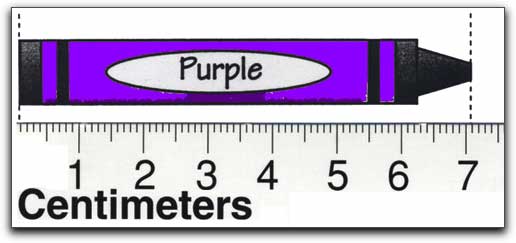
What is the length of this crayon to the nearest tenth of a centimeter?
a)
7 cm
b)
7.1
c)
7.0 cm
d)
7.1 cm
66.
What is the length of the straw?
a)
8 cm 
b)
0 cm 
c)
7 cm 
d)
1 cm 
67.

What is the length of the object in centimeters?

a)

3.4 cm

b)

4.3 cm

c)

3.5 cm

d)

1 1/4 inches

68.
A block has a mass of 54g and a volume of 20cm3.  What is the density of the block?
a)
74 g/cm3
b)
1080 g/cm3
c)
34 g/cm3
d)
2.7 g/cm3
69.
Will an object with a density of 1.01 g/cm3 float or sink?
a)
float
b)
sink
70.
What are the correct units of measurement for density?
a)
g/cm
b)
cm3
c)
g/mL
d)
g/lb