wayground logo

Free Printable Worksheets

Font size

S
M
L
XL
Worksheets

Water Cycle/Water Properties

Total questions: 70

Worksheet time: 55mins

Name
Class
Date
1.
What is the main driving force to the Water Cycle?
a)
Weather
b)
The Sun
c)
Oceans
d)
Evaporation
2.
Which of these is an example of precipitation?
a)
snow
b)
ice
c)
clouds
d)
vapor
3.
What is it called when WATER is FORMED from an LIQUID to  WATER VAPOR (GAS)?
a)
EVAPORATION
b)
PRECIPITATION
c)
TRANSPIRATION
d)
CONDENSATION
4.
What is it called when plants give off water vapor as a waste product?
a)
condensation
b)
evaporation
c)
sublimation
d)
transpiration
5.
What is the water cycle?
a)
the 3 forms of water
b)
the movement of water on, above, or below the surface of the Earth
c)
when water melts
d)
when clouds form
6.
During which stage do clouds form?
a)
condensation
b)
evaporation
c)
precipitation
d)
transpiration
7.
The chemical compound of water is
a)
HO
b)
H2O
c)
H3O
d)
HO2
8.
What word describes when water is attracted to other substances?
a)
cohesion
b)
adhesion
c)
capillary action
d)
surface tension
9.
The attraction that causes water and other liquids to form drops on thin films (like wax paper) is called ________________. This is also water’s ability to be attracted to other water molecules.
a)
adhesion
b)
capillary action
c)
cohesion
d)
surface tension
10.
Water is a universal solvent because it...
a)
It can be found anywhere
b)
It freezes when it gets cold
c)
floats when frozen
d)
Dissolves most substances
11.
Which characteristic of water will allow a paperclip to remain floating on water when the paperclip is gently placed on top of the water?
a)
adhesion
b)
surface tension
c)
solvent properties
d)
nonpolar
12.
Large bodies of water do not quickly fluctuate in temperature. Why?
a)
Water is a solvent.
b)
Water has a high heat capacity.
c)
Water acts as a buffer.
d)
Water is non-polar.
13.
What two elements make up water?
a)
Helium and oxygen
b)
Hydrogen and oxygen
c)
helium and carbon
d)
oxygen and carbon
14.
The fact that ice floats on liquid water is due to the fact that water's solid is ___________ than it's liquid form
a)
less polar
b)
more polar
c)
less dense
d)
more dense
15.
How much of Earth's water is salt water?
a)
50%
b)
66%
c)
75%
d)
97%
16.
The tightness across the surface of water that enables paper clips to float is ____________.
a)
adhesion
b)
capillary action
c)
surface tension
d)
polarity
17.
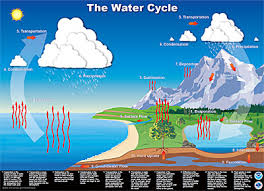
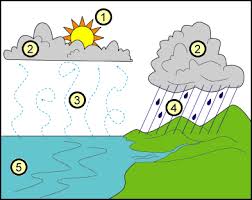
Number 2 in the water cycle diagram is ___________.
a)
The Sun
b)
condensation
c)
precipitation
d)
evaporation
18.
Which statement explains why water molecules stick together?
a)
both sides are negative
b)
one side has a positive charge and the other side has a negative charge
c)
one side has a negative charge adn the other side has a neutral charge
d)
both sides are positive
19.
Large bodies of water help to keep nearby climates from being too hot or too cold  because they...
a)
absorb heat in the spring and slowly release that heat in the fall
b)
absorb heat in the fall and slowly release that heat in the spring
c)
absorb heat in the summer and slowly release that heat in the winter
d)
absorb heat in the winter and slowly release that heat in the summer
20.
Human waste that was dumped into rivers and caused diseases led to the development of what?
a)
storm drains to collect litter
b)
larger and wider drinking wells
c)
waste disposal landfils
d)
water and sewage treatment plants
21.
What is precipitation?
a)
The part of the water cycle when the sun heats up water, turning it from a liquid into water vapor or steam. It rises from the ground into the air.
b)
The part of the water cycle when the water vapor in the air gets cold. The water turns back into a liquid and forms clouds.
c)
The part of the water cycle when clouds get heavy and can no longer hold the liquid water. This causes the water to fall from the sky to the earth as rain, snow, sleet, or hail.
22.
Which represents the distribution of water on Earth?
a)
3% freshwater, 97% salt water
b)
97% freshwater, 3% salt water
c)
71% freshwater, 29% salt water
d)
29% freshwater, 71% salt water
23.
Which BEST describes how the total amount of water present in the hydrosphere varies over time?
a)
The total amount of water in the hydrosphere decreases over time due to the process of evaporation.
b)
The total amount of water in the hydrosphere remains the same over time, but changes form due to the water cycle.
c)
The total amount of water in the hydrosphere increases over time due to the process of precipitation.
d)
The total amount of water in the hydrosphere both decreases and increases over time due to competing processes such as evaporation and precipitation.
24.
Which end of the water molecule has a slightly positive charge?
a)
the oxygen end
b)
the hydrogen end
c)
both ends are slightly positive
d)
neither end is positive
25.
What is a water molecule composed of?
a)
1 Hydrogen atom and 2 Oxygen atoms
b)
2 Hydrogen atoms and 1 Oxygen atom
c)
3 Oxygen atoms
d)
2 Helium atoms and 1 Oxygen atom
26.
What property of water allows it to be such a versatile solvent that it is often called the "universal solvent?"
a)
Purity
b)
Polarity and high surface tension
c)
High heat capacity
d)
Expansion upon freezing
27.
What is a river?
a)
A large body of freshwater
b)
A saltwater inlet of the ocean
c)
A natural large stream of flowing freshwater
d)
An underground waterway
28.

A liquid that can dissolve a substance

a)

solvent

b)

solute

c)

solution

29.

A substance that dissolves into liquid

a)

solvent

b)

solute

c)

solution

30.

A mixture produced when one substance dissolves into another substance

a)

solute

b)

solvent

c)

solution

31.

The heat required to raise the temperature of a given substance by one degree

a)

specific heat

b)

capillary action

c)

density

32.

the uneven sharing of charges (+ and -) across a molecule

a)

cohesion

b)

universal solvent

c)

adhesion

d)

polarity

33.
When a pot of water on the stove is heated up to form steam this phase change is called
a)
Evaporation
b)
Condensation
c)
Deposition
d)
Sublimation
34.
When solid dry ice becomes a gas this is called
a)
sublimation
b)
deposition
c)
condensation
d)
evaporation
35.
When the temperature of matter decreases the particles ...
a)
speed up and move farther apart
b)
speed up and move closer together
c)
slow down and move farther apart
d)
slow down and move closer together
36.
A phase change when a gas becomes a solid is called 
a)
Sublimation
b)
Deposition
c)
Fusion
d)
condensation
37.
The drops of water that appear on the outside of a glass of cold juice on a warm day are an example of?
a)
sublimation
b)
condensation
c)
evaporation
d)
melting
38.
Which phase changes require energy to be added in order for it to occur?
a)
evaporation, condensation, sublimation
b)
sublimation, melting, evaporation
c)
deposition, melting, evaporation
d)
melting, condensation, sublimation
39.
Which phase changes require energy to be removed in order for it to occur?
a)
deposition, condensation, freezing
b)
sublimation, freezing, condensation
c)
deposition, freezing, evaporation
d)
melting, condensation, sublimation
40.
Which phase changes require energy to be added in order for it to occur?
a)
evaporation, condensation, sublimation
b)
sublimation, melting, evaporation
c)
deposition, melting, evaporation
d)
melting, condensation, sublimation
41.
Which phase changes require energy to be removed in order for it to occur?
a)
deposition, condensation, freezing
b)
sublimation, freezing, condensation
c)
deposition, freezing, evaporation
d)
melting, condensation, sublimation
42.
Which phase changes require energy to be added in order for it to occur?
a)
evaporation, condensation, sublimation
b)
sublimation, melting, evaporation
c)
deposition, melting, evaporation
d)
melting, condensation, sublimation
43.
Which phase changes require energy to be removed in order for it to occur?
a)
deposition, condensation, freezing
b)
sublimation, freezing, condensation
c)
deposition, freezing, evaporation
d)
melting, condensation, sublimation
44.
5. What is it called when a solid turns directly into a gas?
a)
Sublimation
b)
Condensation
c)
Liquid
45.
7. All phase changes (changing states) requires energy to be added or taken away.
a)
True
b)
False
46.
Change from gas to liquid...
a)
condensation
b)
evaporation
c)
expansion
d)
movement
47.
Change from Gas to Solid is called........
a)
Sublimation
b)
Deposition
c)
Fusion
d)
condensation
48.
What happens to particles when they are heated?
a)
They speed up and spread out
b)
They slow down and compress
c)
They stop moving
d)
They move closer together and speed up
49.
What is deposition?
a)
Phase change from gas to solid
b)
phase change from liquid to solid
c)
Phase change from solid to gas
d)
Phase change from liquid to gas
50.
What is sublimation?
a)
phase change between solid and liquid
b)
pahse change from gas to solid
c)
phase change from solid to gas
d)
phase change from solid to solid
51.
Melting is ...
a)
liquid to solid
b)
solid to liquid
c)
solid to gas
d)
gas to liquid
52.
The phase change from water vapor to liquid water is known as...
a)
evaporation
b)
precipitation
c)
condensation
d)
sublimation
53.
Boiling is ...
a)
liquid to gas
b)
gas to solid
c)
gas to liquid
d)
solid to liquid
54.

What is another name for the water cycle?

a)

Perspiration Cycle

b)

Carbon Cycle

c)

Hydrologic Cycle

d)

Life Cycle

55.

The ocean holds 96.5% of Earth's water and is the primary pathway into the water cycle

a)

True

b)

False

56.

The moon is an energy source necessary for evaporation to occur

a)

True

b)

False

57.

Gravity is not a factor in the water cycle

a)

True

b)

False

58.

Water that is not absorbed into the soil or evaporated into the atmosphere

a)

Infiltration

b)

Runoff

c)

Water Storage

d)

Watershed

59.

The process where water soaks into soil or porous rock

a)

Infiltration

b)

Runoff

c)

Water Storage

d)

Watershed

60.

If a warm wind passes over snow, the snow can be heated rapidly. When this happens, the snow can change directly into water vapor without first becoming liquid water. What is the correct term for this process?

a)

deposition

b)

evaporation

c)

melting

d)

sublimation

61.

Which of these changes of state would involve water absorbing energy?

a)

condensation

b)

deposition

c)

evaporation

d)

freezing

62.

Which term best describes a change of state from a liquid to a gas caused by the sun's energy?

a)

evaporation

b)

sublimation

c)

deposition

d)

precipitation

63.
Taking energy away from a substance will make its particles move
a)
more slowly
b)
more quickly
c)
at the same speed
64.
When a gas forms directly from a solid, skipping the liquid phase. it is called
a)
deposition
b)
sublimation
c)
evaporation
d)
condensation
65.
The change from a gas to a liquid is called 
a)
condensation
b)
evaporation
c)
sublimation
d)
deposition
66.

The change in state from liquid to gas is called

a)

vaporization

b)

sublimation

c)

condensation

d)

deposition

67.
In which state of matter are particles moving the slowest?
a)
solid
b)
liquid
c)
gas
d)
gummy bears
68.
The state that matter exists in depends on its 
a)
volume 
b)
weight
c)
temperature 
d)
mass
69.
What is the melting point of water?
a)
212°C
b)
100°C
c)
32°C
d)
0°C
70.
How do you make matter change state?
a)
Add energy to it
b)
Take energy away from it
c)
Both of these