
 Worksheets
G10 Q2 EXAM REVIEWER
Total questions: 95
Worksheet time: 32mins


LETTER e:
Uterus
Vulva
Ovaries
Vulva

LETTER g:
Vulva
Vagina
Ovaries
Uterus

LETTER f:
Ovaries
Uterus
Vulva
Vagina

LETTER h:
Uterus
Vagina
Vulva
Ovaries

LETTER a:
Urethra
Testicles
Scrotum
Penis

LETTER b:
Urethra
Testicles
Scrotum
Penis

LETTER d:
Scrotum
Penis
Testicles
Urethra

LETTER c:
Urethra
Testicles
Penis
Scrotum

A reproductive system is represented in the diagram
given. Which structure is correctly paired with its
reproductive function?
A – pathway of gametes
B – synthesis of progesterone
C – production of sperm
D – regulation of homeostasis
Which structure is correctly paired with its function?
ovary — provides milk for newborns
testis — development of sperm
placenta — storage of released eggs
uterus — produces estrogen

Base your answer to question 12 on the picture given which represents systems in a human male and on your knowledge of biology.
Which sequence represents the path of sperm leaving the body?
A-C-G
A-C-B
E-F-H
D-F-G


The tube through which sperm passes from the testicles to the ejaculatory ducts is called the ________________.
vas deferens
penis
scrotum
cowper's
Where are the seminiferous tubules?
Between the vas deferens and urethra
They connect the glands to the vas deferens
Inside the testes
Between the testes and epididymis
Produces the hormone insulin and glucagon, which controls the level of glucose in the blood.
Thyroid Gland
Pancreas
Thymus Gland
Pituitary Gland
Endocrine glands secrete _
Hormones
Neurotransmitters
A wide range of chemical substances
What is the endocrine system?
A system of vessels that circulates blood around the body.
A group of bones and tissue that provides support and structure for the body.
A group of glands that work together with the nervous system to coordinate all body functions
A group of organs that is responsible for eliminating wastes.
Which of the following are chemicals that travel in the blood and cause changes in different parts of the body?
Hormones
Glands
Parathyroid
Adrenal Gland
The response to stress is called
Stay or Stray Response
Fight or Stay Response
Flee or Stray Response
Fight or Flight Response
Hormone regulation operates under which type of feedback mechanism?
positive feedback
negative feedback
zero feedback
Hormones are not regulated
All of the following are hormones of the anterior pituitary except_______.
Human growth hormone (GH)
Follicle-stimulating hormone (FSH)
Parathyroid hormone(PTH)
Thyroid-stimulating hormone (TSH)
Which hormones stimulate the gonads to mature?
FSH and LH
androgens
estrogens
adrenaline
During the menstrual cycle, what happens when there is no fertilized egg to start a pregnancy?
The egg stays embedded on the uterus lining.
Nothing happens.
The egg will disappear.
The uterus sheds its lining.
What hormone stimulates the growth of an ovum inside the follicles of the ovary?
Oxytocin
Growth hormone
FSH (Follicle-stimulating hormone)
LH (Luteinizing hormone)
What hormone stimulates the growth of an ovum inside the follicles of the ovary?
Oxytocin
Growth hormone
FSH (Follicle-stimulating hormone)
LH (Luteinizing hormone)
What hormone plays a crucial role in signaling ovulation, and stimulating production of other hormones in preparation for pregnancy?
Oxytocin
Progesterone
FSH (Follicle-stimulating hormone)
LH (Luteinizing hormone)
What hormone stimulates the production of sperm cells?
Spermatogenesis
Testosterone
FSH (Follicle-stimulating hormone)
LH (Luteinizing hormone)
What hormone is responsible for the the Leydig cells within the testes to produce testosterone, which encourages sperm production and leads to secondary sexual characteristics.
Spermatogenesis
Estrogen
FSH (Follicle-stimulating hormone)
LH (Luteinizing hormone)
Hormones are needed to regulate the reproductive system.
True
False


The nerves that extend from the brain and spinal cord, make up the _____________________.
Central Nervous System(CNS)
Somatic Nervous System
Autonomic Nervous System
Peripheral Nervous System(PNS)
Which part of a Neuron detects neurotransmitters?
Dendrites
Nucleus
Axon Terminal
Myelin Sheath
What part of a neuron is responsible for sending an impulse to the next neuron?
Axon Terminal
Dendrites
Cell Body
Axon
What is a synapse ?
the brain and the spinal cord
a tiny gap between dendrites of two neurons
all the nerves of the body
none of the above
Which part of the peripheral nervous system deals with "flight or fight" activities?
somatic
autnomic
sympathetic
parasympathetic
In what process is mRNA synthesized?
Transcription
Translation
DNA Replication
Mitosis
Where does TRANSCRIPTION occur?
Nucleus
Ribosome
Cytoplasm
Mitochondria
Which of the following is a codon?

ATG
AUG
AUT
How many nucleotides equal 1 amino acid?
1
2
3
4
How many codons equals 1 amino acid?
1
2
3
4
What is the purpose for anti-codons?
to ensure the correct amino acid is dropped off
to match the strand of DNA
to decode a sequence of 4 nucleotides into an amino acid
to make me hate biology

A polypeptide is a sequence of ____________________ held together by a ______________ bond.
amino acids; peptide
fatty acids; ionic
proteins; hydrogen
fatty acids; covalent
How do you know when to STOP translating a strand of mRNA?
look for STOP on the decoder
stop at the end of the strand
you don't
when Ms. H tells me to
How do you know when to begin translating a strand of mRNA?
look for AUG
start at the beginning
look for ATG
when Ms. H tells me to
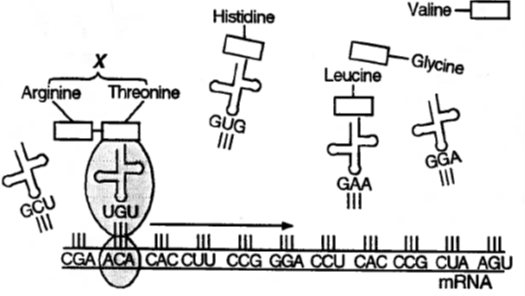
TRANSLATE this RNA sequence: AUGCAAUGA
Met-Glu-Stop
Met-His-Stop
Thr-Glu-Stop
Thr-Pro-Stop


Mutations can benefit humans because they can:
Cause illness
Make an organism more suited to live in its environment.
Make organisms live shorter lives
Cause organisms to grow extra limbs.
Mutations can be negative because
They can cause cancer
They can cause birth defects
They can help an organism thrive in its environment.
They can affect offspring.
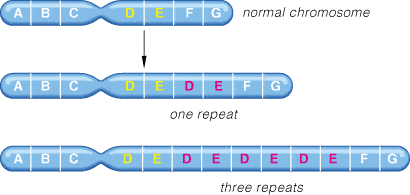
A mutation can occur if a base pair is ____________, deleted, or substituted for another.
modified
added
transferred
Genetic Drift, unlike natural selection, is all up to
camouflage.
chance.
fitness.
evolution

What happens if a population grows past its carrying capacity?
The population keeps growing
The population starts to die off
The entire species will go extinct
The carrying capacity just increases
Food, water, sunlight, air, soil are resources that are often __________.
limiting factors
wet
carrying capacity
found in rocks
Something in the environment that keeps a population from steadily increasing is known as
a limiting factor
population density
the carrying capacity
reproduction
Which factor that limits a population’s size is important especially when population numbers become large and dense?
seasonal changes
extreme weather
competition for food
sea level height
A scientist was studying a population of fish in a pond over a period of 10 years. He observed that
the population increased each year for 3 years, and then remained nearly constant for the rest of
the study. The best explanation for this observation is that the population had
stopped reproducing
reached carrying capacity
mutated into a different species
run out of food and all died

