wayground logo

Free Printable Worksheets

Font size

S
M
L
XL
Worksheets

U2 Matter Review

Total questions: 46

Worksheet time: 32mins

Name
Class
Date
1.
Are made from a combination of 2 or more elements...
a)
Molecules
b)
Pure Substances
c)
Compounds
d)
Elements
2.
A combination that can be separated by physical processes is a .....
a)
Pure Substance
b)
Glucose
c)
Element
d)
Mixture
3.
A mixture that is NOT evenly distributed is called ....
a)
Compounded
b)
Homogenous
c)
Heterogenous
d)
Salty
4.
Mixture, such as mixed nuts or dry soup mix, in which different materials are unevenly distributed and are easily identified.
a)
suspension
b)
homogeneous mixture
c)
heterogeneous mixture
d)
colloid
5.
Substance with atoms that are all alike.
a)
element
b)
compound
c)
homogeneous mixture
d)
heterogeneous mixture
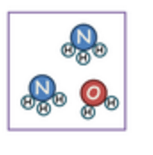
6.
This picture represents: 
a)
Element
b)
Compound
c)
Mixture of Elements
d)
Mixture of Compounds
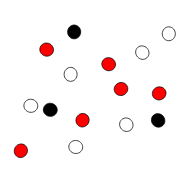
7.
This picture represents: 
a)
Element
b)
Compound
c)
Mixture of Elements
d)
Mixture of Compounds
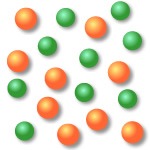
8.
This picture represents: 
a)
Element
b)
Compound
c)
Mixture of Elements
d)
Mixture of Compounds
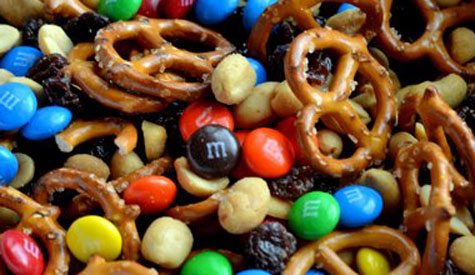
9.
What type of mixture is this?
a)
homogenous mixture
b)
chemical
c)
heterogeneous mixture 
d)
solid mix
10.
All matter is made up of .....
a)
Compounds
b)
Atoms
c)
Molecules
d)
Sunshine
11.
This picture represents which of the following?
a)
element
b)
compound
c)
mixture
12.
A mixture that is so evenly mixed you can't see the parts.  Such as Kool-Aid
a)
Homogeneous Mixture
b)
Heterogeneous Mixture
c)
Pure Substance
13.
Which of the following is an element?
a)
Sugar
b)
Salt
c)
Water
d)
Oxygen
14.

Which one of the following is the name for separation technique in the picture below

a)

distillation

b)

filtration

c)

evaporation

d)

chromatography

15.
Water and alcohol are easily separated by distillation because of their
a)
different densities
b)
different boiling points
c)
different colours
d)
different melting points
16.
Which one of the following would you use to separate sand from iron filings?
a)
a bar magnet
b)
 filter paper
c)
distillation apparatus
d)
chromatography paper
17.

Dyes in water soluble markers may be separated by means of

a)

Distillation

b)

Filtration

c)

Chromatography

d)

Evaporation

18.
Which of the following terms identifies the change from a liquid to gas?
a)
Vaporization
b)
Condensation
c)
Deposition
d)
Sublimation
19.
When the temperature of matter increases the particles...
a)
speed up and move closer
b)
speed up and move farther apart
c)
slow down and move closer together
d)
slow down and move farther apart
20.
No definite shape, but has a definite volume
a)
Gas
b)
Liquid
c)
Solid
21.
Definite shape and a definite volume.
a)
Gas
b)
Liquid
c)
Solid
22.
Phase change from a gas to a liquid.
a)
condensation
b)
evaporation
c)
melting
d)
deposition
23.
Phase change from a solid to a gas.
a)
sublimation
b)
deposition
c)
condensation
d)
evaporation
24.
What happens to the energy of particles in a substance as it changes from gas, to liquid, to solid?
a)
KE decreases
b)
KE increases
c)
KE stays the same
d)
KE goes up and then goes down
25.
The speed of the molecules determines the _____.
a)
volume
b)
density
c)
pressure
d)
temperature
26.
The molecules in the picture are tightly held together with little movement. They have shape and energy.  Therefore, the picture represents _________.
a)
solid
b)
liquid
c)
gas
d)
plasma
27.
What does this picture represent? 
a)
solid
b)
liquid
c)
gas
d)
plasma
28.
What does this picture represent? 
a)
solid
b)
liquid 
c)
gas
d)
plasma
29.
Which of the following is a chemical property?
a)
Density
b)
Temperature
c)
Reactivity with HCl
d)
Mass
30.
Which of the following is a physical property?
a)
Flammability
b)
Reactivity with H2O2
c)
Color
d)
Toxicity
31.
Chemical properties are observed:
a)
by changing the substance
b)
without changing the substance
32.

Which of the following is not a physical change?

a)

cooking bacon

b)

glass breaking

c)

sugar disolving

d)

ice melting

33.

How could you prove that dissolving table salt in water is a physical change, not a chemical change?

a)

The solution would taste salty so you would know the salt is still present

b)

Boiling the liquid would separate the water and salt.

c)

Freeze the solution to see if it turns blue.

d)

Poor the solution in a cup to see if bubbles form.

34.

_______ is related to the energy of motion of the particles of matter.

a)

Temperature

b)

Thermal Energy

c)

Friction

d)

Exothermic

35.

Which of the following is an example of a physical change?

a)

Sublimation

b)

Burning

c)

Rusting

d)

Oxidation

36.

New substances are produced by a _______ change.

a)

Chemical

b)

Physical

37.
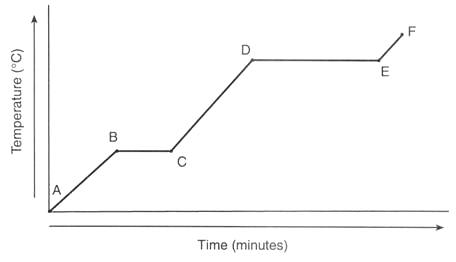
What line segment represents only the solid state?
a)
A-B
b)
B-C
c)
C-D
d)
D-E
38.
In which segment is the kinetic energy remaining constant?
a)
A-B
b)
B-C
c)
C-D
d)
E-F
39.
What state(s) of matter are present at D-E?
a)
Solid-liquid
b)
Liquid
c)
Liquid-gas
d)
Gas-Solid
40.
Between which points is the temperature of the substance remaining constant?
a)
A-B only. 
b)
A-B, C-D, E-F
c)
B-C only. 
d)
B-C, D-E
41.
Between which points is the temperature of the substance increasing?
a)
A-B only. 
b)
A-B, C-D, E-F
c)
B-C only. 
d)
B-C, D-E
42.


What two types of measurements make up DENSITY

a)

Volume and Weight

b)

Temperature and Mass

c)

Mass and Volume

43.
Jack has a rock. The rock has a mass of 14g and a volume of 2cm3. What is the density of the rock?
a)
7 mL
b)
7 g/cm3
c)
28 g/cm3
d)
1/7 g/cm3
44.
What is the formula for density?
a)
density = mass x volume
b)
density = mass / volume
c)
density = mass + volume
d)
density = mass - volume
45.
What is the volume of the fish?
a)

18.0 ml

b)

6.0 ml

c)

38.0 ml

46.

Calculate the density in the following question: A flower pot has a mass of 95 g and a volume of 92 mL.

a)

1.03 g/mL

b)

0.97 g/mL

c)

1.01 g/mL

d)

0.99 g/mL