wayground logo

Free Printable Worksheets

Font size

S
M
L
XL
Worksheets

Biochemistry Review

Total questions: 99

Worksheet time: 2hrs 13mins

Name
Class
Date
1.
Glycerol and fatty acids combine to form...?
a)
Carbohydrates
b)
Lipids
c)
Proteins
d)
Nucleic Acids
2.
Proteins are made of smaller units called:
a)
Glucose 
b)
Cellulose 
c)
Fatty acids
d)
Amino acids
3.
Organic compounds are always based on what two elements?
a)
hydrogen and oxygen
b)
nitrogen and oxygen
c)
hydrogen and carbon
d)
nitrogen and carbon
4.
The four organic compounds found in living things are?
a)
Carbohydrates, Lipids, Nucleic Acids, and Oxygen
b)
Carbohydrates, Lipids, Proteins, and Carbon
c)
Carbohydrates, Lipids, Proteins, Nucleic Acids
d)
Carbon, Lipids, Proteins, Nucleic Acids
5.
Enzymes are examples of this organic compound...
a)
Carbohydrate
b)
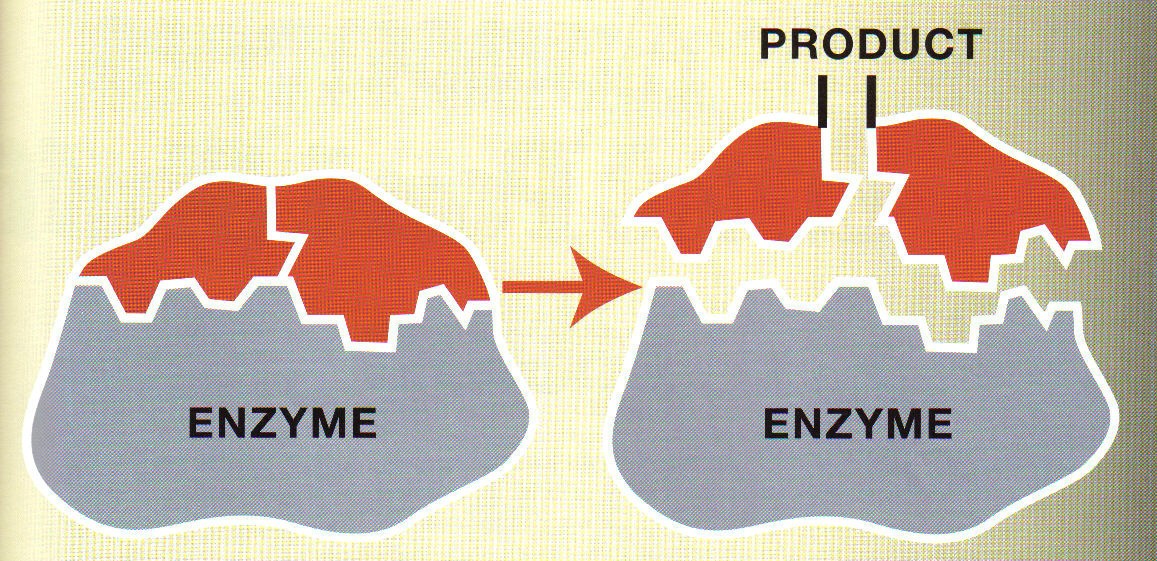
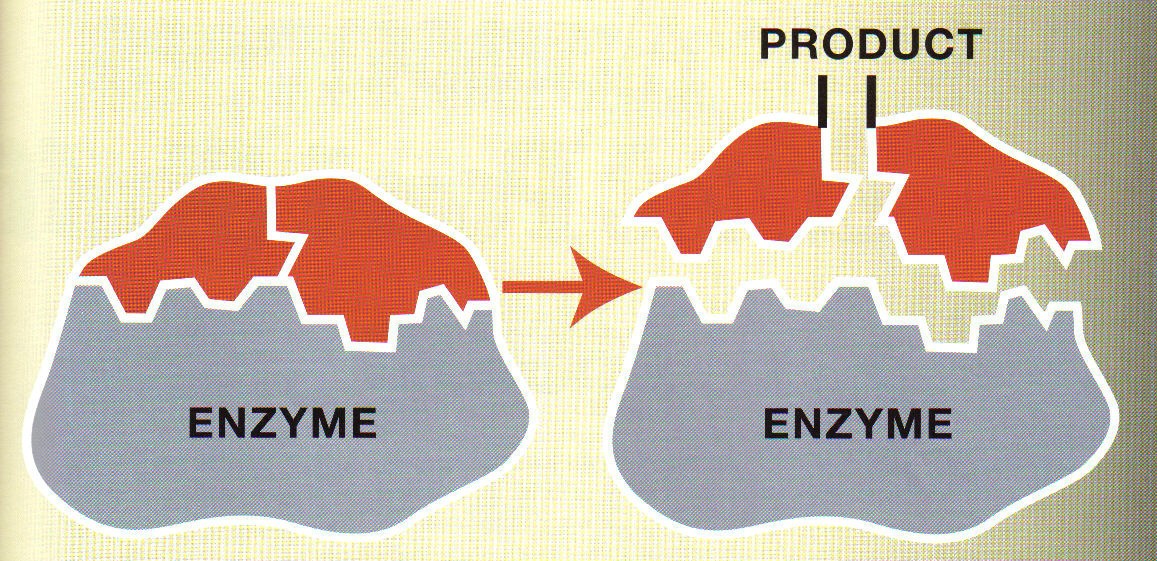
Lipid
c)
Protein
d)
Nucleic Acid
6.
This is an example of 
a)
Lipid 
b)
Carbohydrate 
c)
Protein
d)
Nucleic Acid
7.
Proteins are tested for by using....
a)
Benedict's solution
b)
Biuret solution
c)
Iodine solution
d)
Sudan III solution
8.
What is an Enzyme?
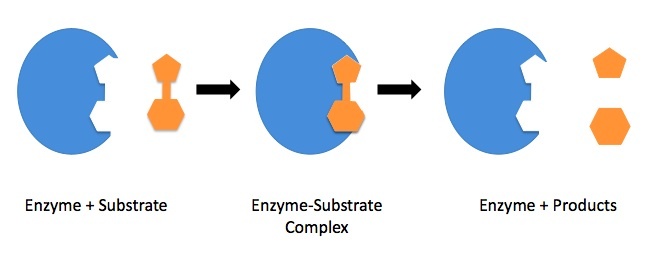
a)
energy needed to get a reaction started
b)
large compound formed from combinations of many monomers
c)
proteins that act as biological catalyst to speed up reactions
9.
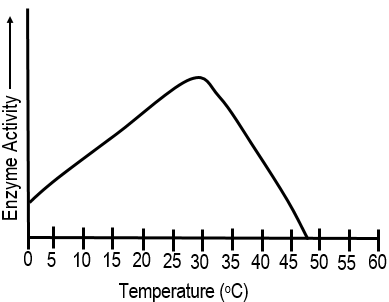
The effect of temperature on the relative rate of action of an enzyme is represented in the graph below. 
The optimum temperature for the action of this enzyme is approximately
a)
15⁰C
b)
22⁰C
c)
37⁰C
d)
50⁰C
10.
Which statement best describes the enzyme represented in the graphs below? 
a)
This enzyme works best at a temperature of 35⁰C and a pH of 8
b)
This enzyme works best at a temperature of 50⁰C and a pH of 12
c)
This enzyme works best at a temperature of 35⁰C and a pH of 12
11.
Based on the graph, what is the optimal temperature for this enzyme? 
a)
15oC
b)
40oC
c)
30oC
d)
45oC
12.
Which compound below is Organic?
a)
C6H12O6
b)
CO₂
c)
NH3
d)
O2
13.
In a molecule of DNA the sub-units are called
a)
nucleotides
b)
simple sugars
c)
lipids
d)
proteins
14.
Which of the following is NOT a function of proteins
a)
Assist in blood clotting
b)
Fight infections and diseases
c)
Assist in the processing of glucose
d)
None of the above
15.
Which of the following is NOT a function of proteins
a)
Acts as a catalyst to speed up reactions
b)
Fight infections and diseases (Immunity)
c)
carries oxygen within red blood cells
d)
Store genetic Information
16.
Which of the following is not one of the four properties of water?
a)
Universal Solvent
b)
Non-polar
c)
Expansion upon freezing
d)
Cohesion
17.
Which of the following contains the genetic code for protein synthesis?
a)
carbohydrate
b)
lipid
c)
protein
d)
nucleic acid
18.
Why will salt form a solution with water but sand will not?
a)
Salt is polar, while sand is non-polar
b)
Salt is non-polar, while sand is polar
c)
Salt and sand are polar
d)
Sand is more coarse than salt
19.

Which macromolecules has a nitrogen base and phosphate found in its structure?

a)

carbohydrate

b)

lipid

c)

protein

d)

nucleic acid

20.

What is one thing that a carbohydrate and protein have in common?

a)

They are both non-polar

b)

They both contain a nitrogen in their stucture

c)

They are polymers

d)

They are both made up of amino acids

21.

If a substance has the elements CHO and is not soluble in water, which of the macromolecules would this substance be?

a)

Carbohydrate

b)

Lipid

c)

Protien

d)

Nucleic Acid

22.
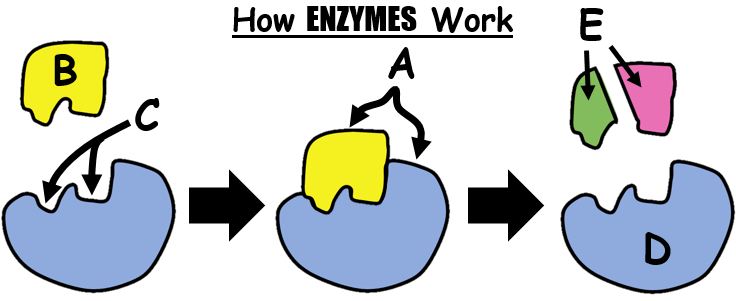
What is being represented by letter C? 
a)
Enzyme
b)
Active site
c)
Substrate
d)
Lipid
23.
Which major macromolecule is being represented in this image? 
a)
carbohydrate
b)
lipid
c)
protein
d)
nucleic acid
24.
TRUE or FALSE
Enzymes function best at a specific temperature.
a)
True
b)
False
25.
Which of the following properties of water enables it to move from the roots to the leaves of plants?
a)
Cohesive behavior
b)
Moderate temperature
c)
Expansion upon freezing
d)
Universal solvent
26.
Proteins are made of monomers called ___________
a)
Nucleotides
b)
Monosaccharides
c)
Amino Acids
d)
Glycerol and fatty acids
27.
The element _______is found in all of the organic compounds.
a)
Iron
b)
Nitrogen
c)
Carbon
d)
Oxygen
28.
DNA and RNA are examples of 
a)
Carbohydrates
b)
Lipids
c)
Proteins
d)
Nucleic Acids
29.
Monosaccharides are monomers of
a)
Carbohydrates
b)
Lipids
c)
Proteins
d)
Nucleic Acids
30.
Which macromolecule is shown?
 View Figure 2 (if not visible)
a)
lipid
b)
protein
c)
nucleic acid
d)
carbohydrate
31.
Which macromolecule is shown?
 View Figure 3 (if not visible)
a)
lipid
b)
protein
c)
nucleic acid
d)
carbohydrate
32.
Carbohydrates are made of... 
a)
C H O
b)
C H O N
c)
C H O N P
d)
C H O N S
33.
Proteins are made of... 
a)
C H O
b)
C H O N
c)
C H O N P
d)
C H O N S
34.
Which macromolecule stores energy, insulates us, and makes up the cell membrane?
a)
lipids
b)
proteins
c)
carbohydrates
d)
nucleic acids
35.
Which macromolecule is made of simple and complex sugars?
a)
lipids
b)
proteins
c)
carbohydrates
d)
nucleic acids
36.

What property of water allows aquatic organisms to survive when the temperature drops below freezing?

a)

expansion upon freezing

b)

capillary action

c)

universal solvent

d)

surface tension

37.
What two elements make up water?
a)
Helium and oxygen
b)
Hydrogen and oxygen
c)
helium and carbon
d)
oxygen and carbon
38.
What word describes when water is attracted to other substances?
a)
cohesion
b)
adhesion
c)
capillary action
d)
surface tension
39.
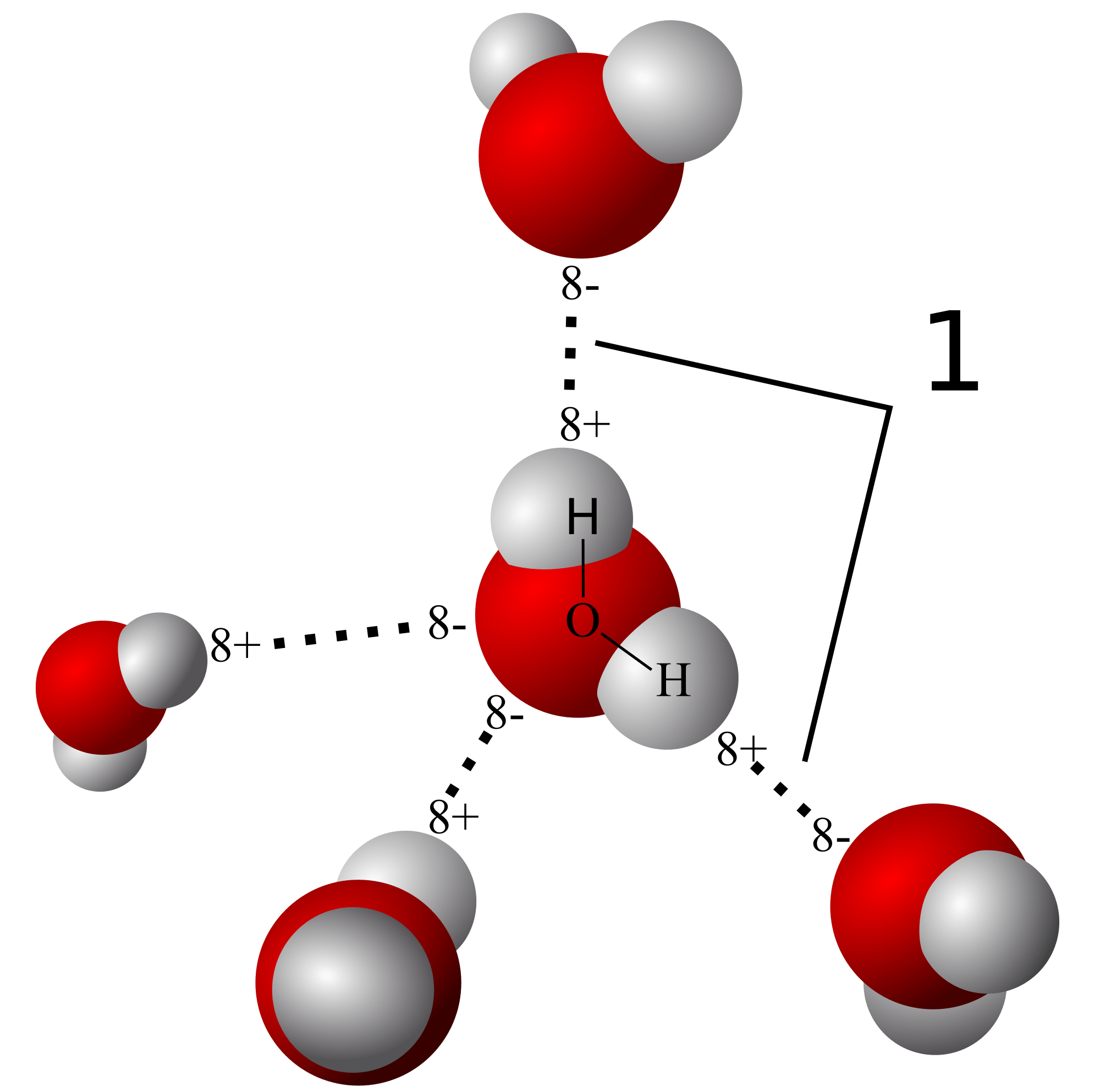
Attractions between water molecules are called
a)
Covalent bonds
b)
Ionic bonds
c)
Polar bonds
d)
Hydrogen bonds
40.
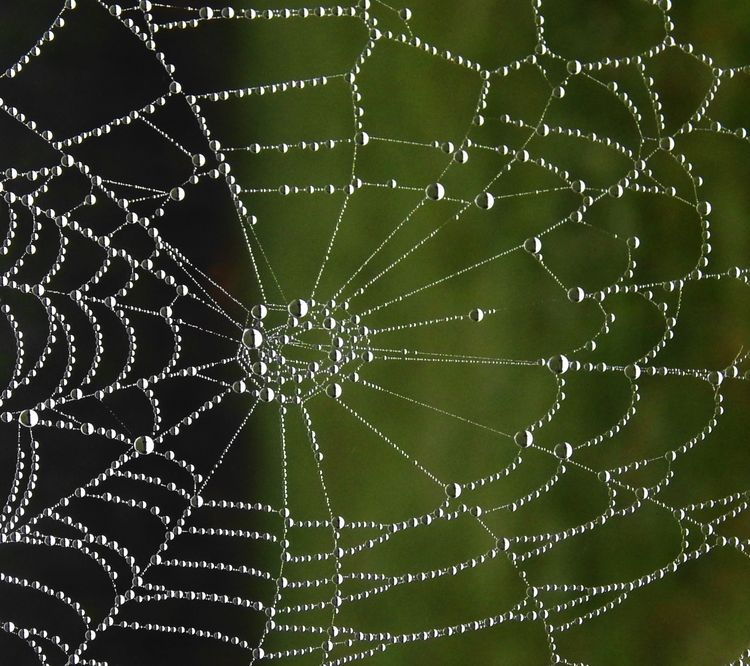
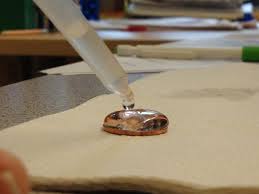
The attraction that causes water and other liquids to form drops on thin films is called ________________. This is also water’s ability to be attraction to other water molecules.
a)
adhesion
b)
capillary action
c)
cohesion
d)
surface tension
41.
molecule in which opposite ends have opposite electric charges
a)
cohesion
b)
polar molecule
c)
hydrogen bond
d)
solution
42.
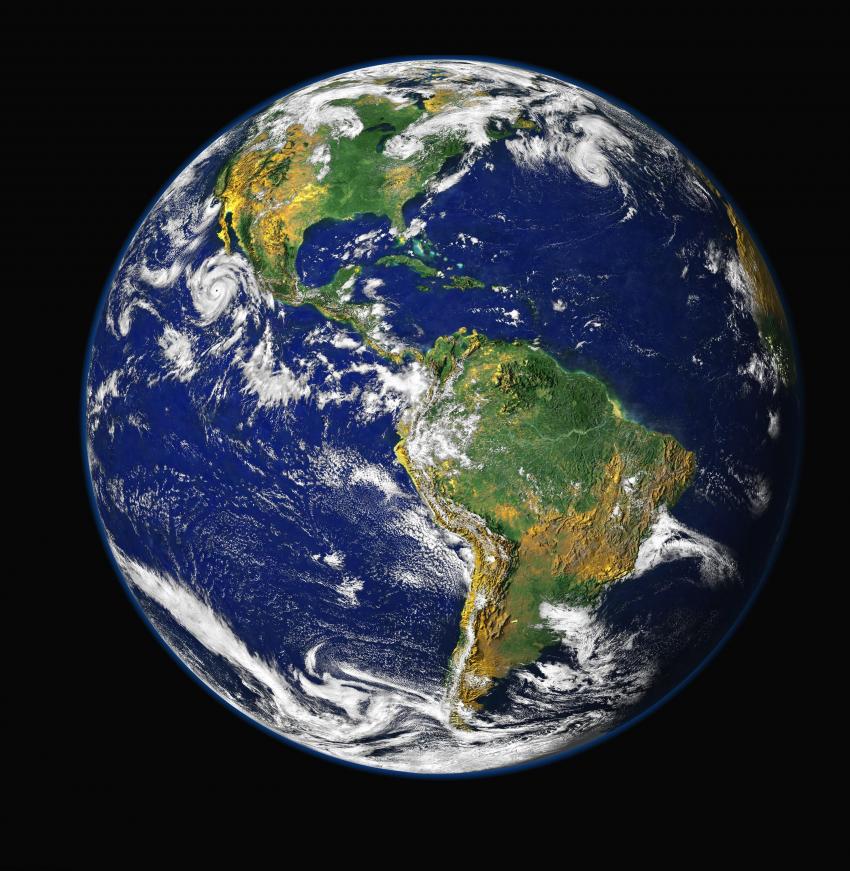
What property of water helps to moderate earth's temperature?
a)
adhesion
b)
chohesion
c)
Specific heat capacity
d)
Latent heat of vaporization
43.
__________ are nucleic acid functions
a)
store & transfer genetic info
b)
store & create energy
c)
structure & energy for cells
d)
membrane structure and nutrient transfer
44.
___________ are some functions of lipids.
a)
storing energy and  cell membrane structure
b)
providing actin & providing myosin
c)
cellulose structure and digestive assistance
d)
storing & transferring genetic info
45.
A(n) __________  is the part of the enzyme the substrate fits into.
a)
product
b)
active site
c)
enzyme
d)
substrate
46.
A substance with a pH of 4 is considered a(n)
a)
base
b)
neutral
c)
acid
47.
Combines with 3 fatty acid chains to make up a triglyceride; part of the monomer of lipids
a)
Amino Acid
b)
Fatty Acid
c)
Glycerol
d)
Nucleotide
48.
A large molecule made up of multiple monomers
a)
Polymer
b)
Polysaccharide
c)
Macromolecules
d)
Protein 
49.
The process used to split polymers; this is done by adding water
a)
Dehydration
b)
Hydrolysis
c)
Enzomatic
d)
Tetratonic
50.

How do enzymes speed up chemical reaction?

a)

Increasing activation energy

b)

Decreasing activation energy

c)

Increasing deactivation energy

d)

Decreasing deactivation energy

51.
________ is a force produced by a strong attraction between water molecules.
a)
Cohesion
b)
Adhesion
c)
Surface Tension
d)
Capillary Action
52.
The lock and key model is an analogy used to explain how a _________ fits into a ___________.
a)
Substrate, Active Site
b)
Active Site, Substrate
c)
Catalysts, Products
d)
Products, Catalysts
53.
Enzymes are _______ that speed up the rate of a chemical reaction.
a)
Polar
b)
Nonpolar
c)
Catalysts
d)
Molecules
54.
The essential roles of enzymes are _______.
a)
Used in living things as the main source of energy and use it for structural purposes
b)
Regulate the temperature and pH of the reaction.
c)
Regulating chemical pathways, making materials that cells need, releasing energy, and transferring information.
55.
What is needed to get a reaction started?
a)
Chemical Energy
b)
Biological Energy
c)
Carbohydrate Energy
d)
Activation Energy
56.
What effects enzymes?
a)
Temperature
b)
pH Level 
c)
Substrate Concentration
d)
All of the Above
57.
The graph pictured shows the reaction pathway of a reaction that __________?
a)
Absorbs Energy
b)
Releases Energy
58.
The graph pictured shows a reaction pathway of a reaction that ________.
a)
Absorbs Energy
b)
Releases Energy
59.
The picture shown depicts an enzyme. What is the red object called?
a)
Active Site
b)
Substrate
c)
Reactant
d)
Both Substrate and Reactant
60.
Large bodies of water do not quickly fluctuate in temperature. Why?
a)
Water is a solvent.
b)
Water has a high heat capacity.
c)
Water acts as a buffer.
d)
Water is non-polar.
61.
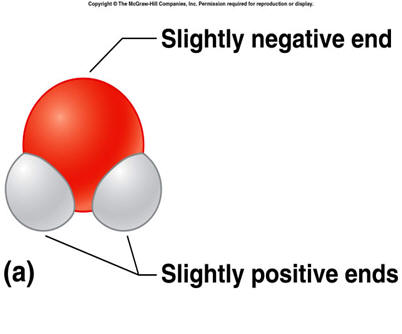
Which end of the water molecule has a slightly positive charge?
a)
the oxygen end
b)
the hydrogen end
c)
both ends are slightly positive
d)
neither end is positive
62.
Water is a universal solvent because it...
a)
It can be found anywhere
b)
It freezes when it gets cold
c)
floats when frozen
d)
Dissolves most substances
63.
What 3 letters do enzymes typically end in?
a)
-ose
b)
-ase
c)
-ese
d)
-tic
64.
After the enzyme and substrate bind together and perform the reaction, what does the substrate become?
a)
a substrate
b)
an enzyme
c)
a product
d)
an active site
65.
What macromolecule does Benedict's test for?
a)
Monosaccharide
b)
Polysaccharide
c)
Protein
d)
Lipid
66.
What color does Benedict's turn when it is positive?
a)
Blue
b)
Black
c)
Lavender
d)
Orange
67.
What test do you use to find a polysaccharide?
a)
Benedict's
b)
Biuret
c)
Iodine
d)
Solubility
68.
What type of bond is found inside of a water molecule?
a)
Covalent
b)
Hydrogen
c)
Ionic
d)
Peptide
69.
A solution has a pH of 6.4.  Which description is most appropriate?
a)
Weak Acid
b)
Strong Acid
c)
Neutral
d)
Weak Base
70.
What type of ion is found in an acid?
a)
H+
b)
OH-
c)
H2O
d)
Hydroxide
71.
Which of the following is the process used to bond the monomers together?
a)
Hydrolysis
b)
Water Removal
c)
Dehydration Synthesis
d)
Water Synthesis
72.
Which of the following helps an organism maintain homeostasis by controlling the pH level?
a)
Enzyme
b)
Buffer
c)
Acid
d)
Base
73.
What is it called when an enzyme loses it shape and no longer functions?
a)
Substrate
b)
Synthesis
c)
Polymerization
d)
Denature
74.
If you sprinkle pepper all over a surface of water and drop a little bit of soap in, the pepper will quickly move far from the soap.  Why?
a)
Soap breaks the hydrogen bonds and the remaining ones pull the pepper away.
b)
Pepper is afraid of soap.
c)
Soap cleans up the pepper.
d)
Hydrogen bonds are stronger because of the soap.
75.
An enzyme speeds up a chemical reaction in the cell but can only be used once.  True or False? 
a)
true
b)
false
76.

What does pH measure?

a)

the amount of hydrogen (H+) ions

b)

the amount of hydroxide (OH-) ions

c)

amount of water

d)

all of the above

77.
Which two subatomic particles are located in the nucleus?
a)
Protons and Electrons
b)
Protons and Neutrons
c)
Electrons and Protons
78.
Between which subatomic particles to bonds form?
a)
Quarks
b)
Protons
c)
Neutrons
d)
Electrons
79.
Which of the following lists the bonds in order from weakest to strongest?
a)
Covalent, Hydrogen, Ionic
b)
Hydrogen, Ionic, Covalent
c)
Ionic, Covalent, Hydrogen
d)
Hydrogen, Covalent, Ionic
80.
What type of substance has an equal concentration of Hand OH- ions?
a)
Acid
b)
Base
c)
Neutral
81.
What type of substance regulates the pH of the body by releasing and capturing Hions?
a)
Alkalines
b)
Buffers
c)
Neutralizers
d)
Hydrogenators
82.
The maintenance of constant internal body conditions is referred to as which of the following terms?
a)
Buffering
b)
Neturalizing
c)
Homeostasis
d)
Osmoregultion
83.
_________ is an attraction between molecules of different substances.
a)
Cohesion
b)
Adhesion
c)
Surface Tension
d)
Capillary Action
84.
Which property of water allows it to stick to other water molecules and create surface tension?
a)
Cohesion
b)
Adhesion
c)
Heat Capacity
d)
Universal Solvency
85.
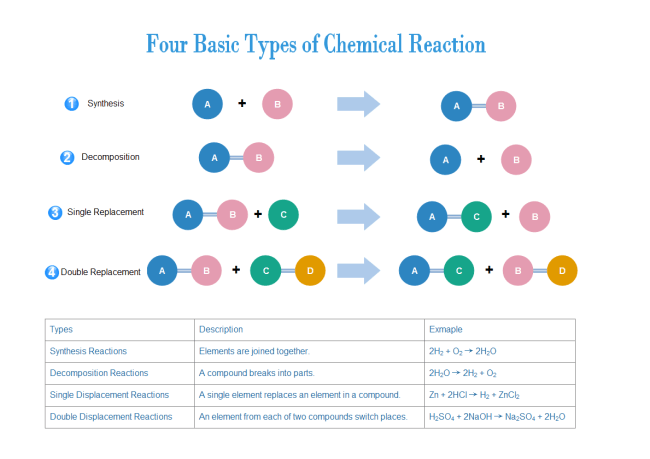
Is the diagram showing a dehydration synthesis or digestion/hydrolysis reaction? 
a)
Dehydration synthesis
b)
hydrolysis/digestion
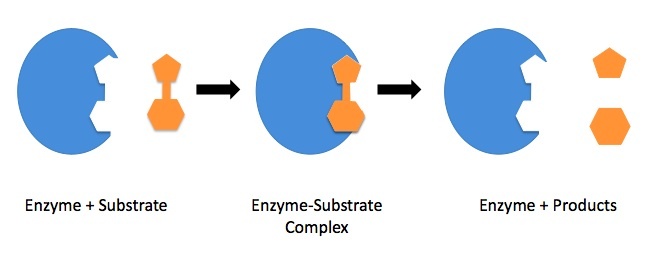
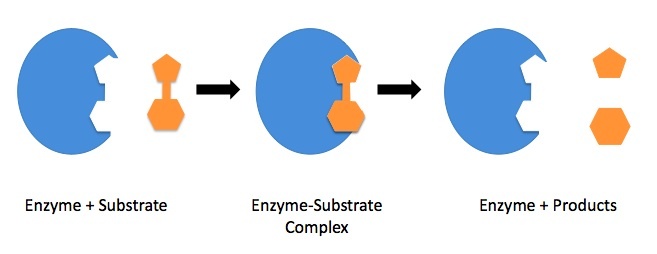
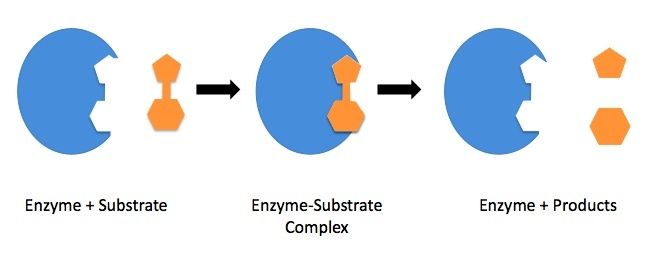
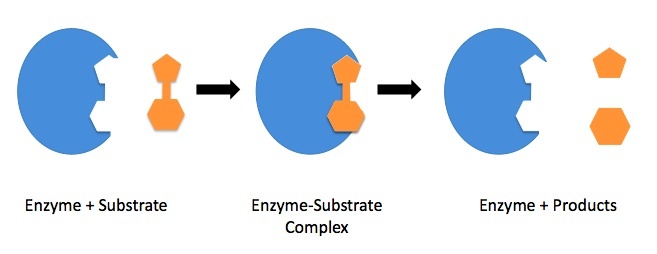
86.
In the diagram, what is letter A? 
a)
product
b)
substrate
c)
enzyme-substrate complex
d)
active site
87.
Chemical reactions always involve
a)
the breaking of bonds in reactants.
b)
the formation of new bonds in products.
c)
the breaking of bonds in reactants and the formation of new bonds in products.
d)
enzymes. 
88.
The current model of enzyme action is referred to as the:
a)
Induced Fit Model
b)
Lock & Key Model
c)
Singer-Nicolson Model
d)
Davson-Danielli Model
89.
When a molecule can occupy the same active site as the substrate, a situation called __________________ can result
a)
Competitive lnhibition
b)
Allosteric Regulation
c)
Non-Competitive Inhibition
d)
Feedback Inhibition
90.
A receptor site that a molecule can bind to that changes the shape of the active site is called a(n):
a)
Allosteric Site
b)
Active Site
c)
DiSulphide Bridge
d)
MHC Receptor
91.
A molecule binds to an enzyme and opens the active site so it can bind to the substrate. This is called:
a)
Allosteric Activation
b)
Allosteric Inhibition
c)
Competitive Activation
d)
Competitive Inhibition
92.
A molecule binds to an enzyme and decreases the ability of the active site to bind to the substrate. This is called:
a)
Allosteric Activation
b)
Allosteric Inhibition
c)
Competitive Activation
d)
Competitive Inhibition
93.
Molecules that bind to enzymes and enhance an enzyme's ability are called:
a)
CoFactors
b)
CoEnzymes
c)
Allosteric Inhibitors
d)
Allosteric Activators
94.
Organic molecules that temporarily bind to enzymes and enhance an enzyme's ability are called:
a)
CoFactors
b)
CoEnzymes
c)
Allosteric Inhibitors
d)
Allosteric Activators
95.
What is the name for the mechanism of enzyme activity?
a)
Lock and key
b)
jigsaw puzzle
c)
hammer and nail
d)
two hands pattern
96.
What makes an enzyme substrate specific?
a)
Size
b)
Shape
c)
Name
d)
Location it is found in
97.

The _____________________ mechanism describes how an enzyme changes shape once the substrate is bonded.

a)

hammer and nail

b)

induced fit

c)

jigsaw puzzle

d)

lock and key

98.

Once a new product leaves an enzyme, the enzyme is unchanged and ready for the next substrate. What is this called?

a)

fragile

b)

reusable

c)

specific

d)

catalyst

99.

A baby is locked in the car on a hot day. What is most likely to happen to the child?

a)

The child's body will adjust and cause it to maintain homeostasis

b)

The child's enzymes will denature causing chemical reactions to speed up in the body, which will lead to death.

c)

The child's enzymes will denature causing chemical reactions to slow down in the body, which will lead to death.

d)

The activation energy for chemical reactions will remain unchanged and therefore the child will live.