wayground logo

Free Printable Worksheets

Font size

S
M
L
XL
Worksheets

Evolution Revision

Total questions: 70

Worksheet time: 3600secs

Name
Class
Date
1.

When organisms are better adapted to their environment they will survive and reproduce more successfully than organisms less adapted. This process is called what?

a)

Selective breeding

b)

Natural Selection

c)

Cloning

d)

Evolution of all species

2.

Which scientist visited the Galapagos Islands and came up with the theory of natural selection?

a)

Theodor Schwann

b)

Gregor Mendel

c)

Charles Darwin

d)

Rudolf Virchow

3.

Gigantopithecus were very large primates that lived 500,000 years ago. Since none of these mammals are still today, they are said to be....

a)

Extinct

b)

Threatened

c)

Endangered

d)

Declining

4.

Scientists have collected millions of fossils of different organisms, and have developed a timeline of life on Earth. What do we call this?

a)

Mutation

b)

Natural Selection

c)

The theory of evolution

d)

Fossil Record

5.

Sometimes bones in the front limbs of animals are very similar in structure. What do we call similar bone structures that indicate a link to a common ancestor?

a)

Adaptations

b)

Gradualism

c)

Homologous Structures

d)

Extinction

6.

A physical or behavioral trait that helps an organism survive and reproduce in its environment is called a what?

a)

An adaptation

b)

A response to a stimulus

c)

A mutation

d)

Evolution

7.

What most likely caused the finches on the Galapagos Islands to have beaks that were different from the finches on the mainland?

a)

There were different types of predators on the island.

b)

There were different types of food available on the island.

c)

The finches had no water to drink.

d)

The finches on the mainland could not fly high enough.

8.

When looking at two birds of the same species, you notice that one has darker feathers than the other one. You also notice that one has a beak that is just a little longer. These slight differences within members of the same species are called.....

a)

Fossils

b)

Extinction

c)

Meiosis

d)

Variations

9.

What is the study of organisms at the early stages of development?

a)

DNA studies

b)

Comparative Embryology

c)

Extinction

d)

Fossil Record

10.

What do we call a change in a species over time?

a)

Adaptation

b)

Evolution

c)

Extinction

d)

Environmental influences

11.
In natural selection, the selective agent is the
a)
humans
b)
mutations
c)
breeders
d)
environment
12.
Which of the following is a fossil?
a)
a plant that has recently died
b)
a group of organisms that can reproduce
c)
a structure or organ that no longer functions
d)
a trace of an organisms that existed in the past
13.
Mutations are important because they bring about
a)
death of the organism in which they develop
b)
genetic variation needed for a population to evolve
c)
benefits for the individual, not for the population
d)
Hardey-Weinberg equilibrium within a population
14.

What is the term for a feature that allows an organism to survive better in its environemtn?

a)

variation

b)

adaptation

c)

homologous structure

d)

vestigial structure

15.
What is the process in which humans breed organisms for certain traits?
a)
natural selection
b)
inheritance
c)
artificial selection
d)
descent withOUT modification
16.
Natural selection results in change over time by acting on traits that are
a)
heritable
b)
new
c)
mutated 
d)
better than the best
17.
Charles Darwin came up with this theory 
a)
Natural Selection
b)
Mutation
18.
To adjust to a changing environment
a)
Mutation
b)
Adapt
19.
Most of the species found in fossil form are _______________. 
a)
Alive
b)
Extinct
20.
Darwin wrote that organisms with traits that are best suited to the environment will ________________
a)
increase in number
b)
become extinct
21.
Some organisms that share a common ancestor have features that have different functions, but similar structures.  These are known as
a)
vestigial structures
b)
analogous structures
c)
homologous structures
d)
fossil structures
22.
What increases genetic variation when animals move from one population to another
a)
genetic drift
b)
sexual selection
c)
bottleneck effect
d)
gene flow
23.
This mechanism of evolution occurs when populations migrate.
a)
Extinction
b)
Gene flow
c)
Genetic drift
d)
Natural Selection
24.
What is another name for natural selection?
a)
survival of the smartest
b)
survival of the fastest
c)
survival of the biggest
d)
survival of the fittest
25.
A biological ____________ is a group of interbreeding populations that is reproductively isolated from other groups.
a)
species
b)
family
c)
phylogeny
d)
hybrid
26.
______ _________ explains how two or more organisms could evolve similar traits even though they are not related to each other.
a)
convergent evolution
b)
reproductive isolation
c)
derived characters
d)
hybrid vigor
27.
A __________ is a branching diagram that shows evolutionary relationships.
a)
cladogram
b)
table
c)
derived character
d)
relationship tree
28.
The scientific name for humans is _______ ____
a)
Homo sapiens
b)
Homo neandertal
c)
homo Sapiens
d)
homo sapiens
29.
__________ characters are similar characteristics that have evolved separately in two unrelated organisms.
a)
analogous
b)
homologous
c)
cladistic
d)
phylogenic
30.
_________ characters may or may not be similar between two organisms but they developed from a common ancestor.
a)
homologous
b)
analogous
c)
cladistic
d)
phylogenic
31.
______________ is the process by which populations change in response to their environment.
a)
natural selection
b)
adaptation
c)
reproductive isolation
d)
divergence
32.
__________ enable an organism to survive in its environment.
a)
adaptations
b)
natural selections
c)
divergence
d)
extinctions
33.
________ structures are reduced in size or function.
a)
vestigial
b)
homologous
c)
cladistic
d)
phylogenic
34.
________ are populations of the same species that differ genetically because of adaptation.
a)
subspecies
b)
homologues
c)
analogs
d)
genuses
35.
Scientists DO NOT classify organisms based upon
a)
geographic isolation
b)
structure
c)
breeding patterns
d)
DNA
36.

Cheetah's all have 99% identical DNA. Which is/are true?

a)

They are more likely to evolve into a new species than other cats due to gene flow.

b)

They are likely to go extinct because they have so little variation.

c)

They likely underwent a bottleneck in their history.

d)

The founder's effect made it so they have several different subspecies.

e)

Cheetahs never prosper and winners never cheat.

37.

Some evidence that supports theropods as ancestors to birds is:

a)

some theropods had gizzards and hollow bones like birds

b)

their DNA is very similar

c)

they have all of the intermediate fossils between them

d)

theropods all had feathers

e)

scientists found collagen in fossils of theropods

38.
A structure that is inherited from ancestors but has long lost much or all of its original use.
a)
vestigial structure
b)
miniscule structure
c)
analogous structure
39.
In natural selection, the selective agent is the
a)
humans
b)
mutations
c)
breeders
d)
environment
40.
a bird that can easily outcompete other birds for food and that can produce many eggs has a high
a)
sexuality
b)
mutation rate
c)
fitness
d)
adaptability
41.
which of the following is an example of a vestigial structure?
a)
the wings of a red-tailed hawk
b)
the hind limbs of a house cat
c)
the fins of sharks
d)
the wings of an ostrich
42.
Some organisms that share a common ancestor have features that have different functions, but similar structures.  These are known as
a)
vestigial structures
b)
analogous structures
c)
homologous structures
d)
fossil structures
43.
If an organism has a vestigial structure, that structure likely once had a function in a(n)
a)
close relative
b)
early ancestor
c)
unrelated organism
d)
embryological stage
44.
Genetic variation can arise from a random change in the DNA of a gene.  The change is called a(n)
a)
mutation
b)
gene flow
c)
gene pool
d)
allele
45.
How would you describe these two features?
a)
Homologous structure
b)
Analogous structure
c)
Structural adaption
d)
Functional adaption
46.

How many layers is fossil 'A' found in?

a)

1

b)

2

c)

3

d)

4

47.

Which fossils are found in layer 5.

a)

A, B

b)

A, C

c)

C only

d)

C, D

48.

Do no rush, examine the diagram. How has life evolved starting with the oldest fossils?

a)

Life started in the ocean and over time organism became to appear with no common ancestors. Fish evolved first, then reptiles, then mammals and finally birds.

b)

Life started in the ocean then slowly evolved through natural selection to life on land. Fish evolved first, then reptiles, then mammals and finally birds.

c)

Life started on land and over time humans began to evolve into fish, then reptiles, and birds.

d)

Life started in the ocean as four-legged amphibians which then evolved to palm trees, then to dinosaurs, and eventually into humans.

49.

The diagram shows data on the evolution of horses. The data in the diagram is evidence that -

a)

a new species of horse suddenly appeared

b)

horses slowly developed over time

c)

horses have similar stages of rapid embryological development

d)

horses have a common ancestry with other hooved animals

50.

The graph shows the number of taxa of reptiles whose fossilized tracks have been found. Which statement is best supported by these data?

a)

competition for food and shelter among reptile species was very low during the Triassic period

b)

a great extinction occurred during the Jurassic period

c)

environmental conditions for speciation were most favorable for reptiles during the Permian period

d)

reptiles adapted to a terrestrial environment during the Cretaceous period

51.

This diagram of the fossil record represents changes in mollusks over millions of years. How can the pattern of change in the fossil record best be explained?

a)

The mollusks were well adapted to their stable environment. A large, sudden change occurred in their environment. After the change the mollusks with the bigger shells were better adapted to the new environment

b)

The mollusks were well adapted to their stable environment. The mollusks hybridized with a smaller species of mollusk. A new species of mollusk with a bigger shell resulted

c)

The mollusks were not well adapted to their environment. The length of the mollusks' shells changed gradually over time. The mollusks in the original population that had small shells died over a period of many years

d)

The mollusks were well adapted to their environment. Humans introduced a new species of mollusk that was not adapted to this environment. The introduced mollusk outcompeted the native mollusk species

52.

The cladogram shows the evolution of land plants as indicated by fossil records. Which discovery would challenge the validity of this cladogram?

a)

A large aquatic vascular plant about 200 million years old

b)

A species of algae that has existed for less than one million years

c)

A moss species that has existed for less than 380 million years

d)

A fossil of a fern more than 425 million years old

53.

After examining the fossil record, scientists have determined that scorpions today are much smaller than their extinct ancestors. For example, Jaekelopterus rhenaniae, a giant scorpion species that lived 255 million to 460 million years ago, was 2.5 meters long. Which of the following conclusions is supported by this information?

a)

Scorpions living today have increased their numbers since they first appeared

b)

Scorpions in the fossil record are smaller than their descendants are

c)

Scorpions have changed as a result of natural selection

d)

Scorpions do not appear in their original state in the fossil record

54.
Any body shape, body process, or behavior that helps an organism survive in its environment.
a)
geologic time scale
b)
fossil record
c)
adaptation
d)
geologic time scale
55.
All of the fossils that scientists have recovered from the ground.
a)
geologic time scale
b)
natural selection
c)
fossil record
d)
mass extinction
56.
Which is an example of adaptation?
a)
White fur on a polar bear
b)
the shape of a stick insect
c)
the spines on a cactus 
d)
all of these
57.
A single species from which different species arise.
a)
common ancestor
b)
fossil
c)
eras
d)
biodiversity
58.
The measure of the number of different species in an area.
a)
biography
b)
biology
c)
biodiversity
d)
biodegrade
59.
Which of these is an example of a behavioral adaptation?
a)
wings on a bird
b)
the migration of a bird
c)
the beak on a bird
d)
the feathers of a bird
60.
Geographic isolation for a long period of time can lead to the creation of a new _______.
a)
fossil
b)
environment
c)
species
61.
What causes organisms to adapt?
a)
fossil records
b)
other animals
c)
their environment
62.
The fossil record includes_______.
a)
only fossils of extinct species
b)
all the fossils ever made
c)
only the fossils that scientist have uncovered
63.
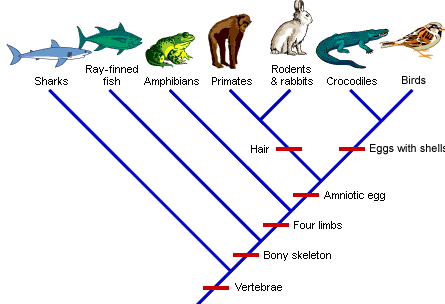
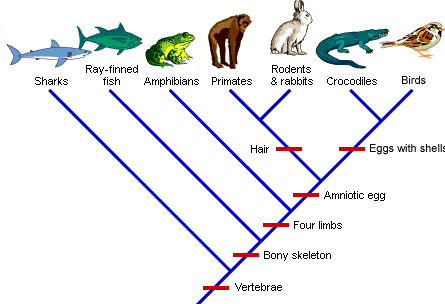
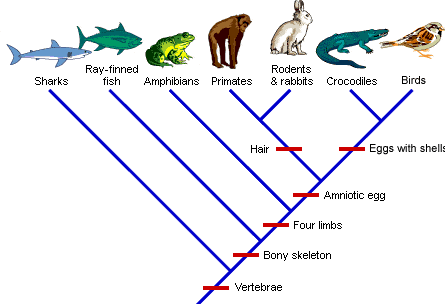
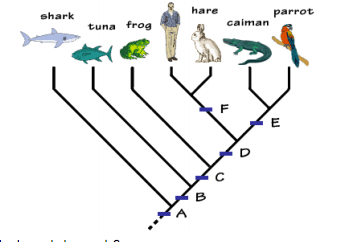
According to this cladogram, sharks are MOST closely related to which organism? 
a)
Amphibians
b)
Ray finned fish
c)
Crocodiles
d)
Birds
64.
Which two orgainsms have hair? 
a)
Sharks & Ray Finned Fish
b)
Primates & Rodents
c)
Birds & Crocodiles
d)
Rabbits & Birds
65.
According to this cladogram, birds are LEAST related to: 
a)
Amphibians
b)
Sharks
c)
Ray Finned Fish
d)
Crocodiles
66.
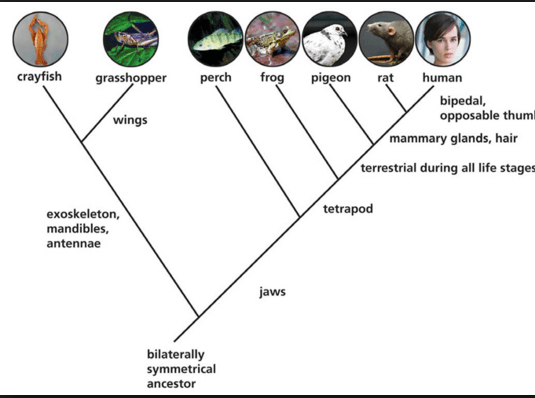
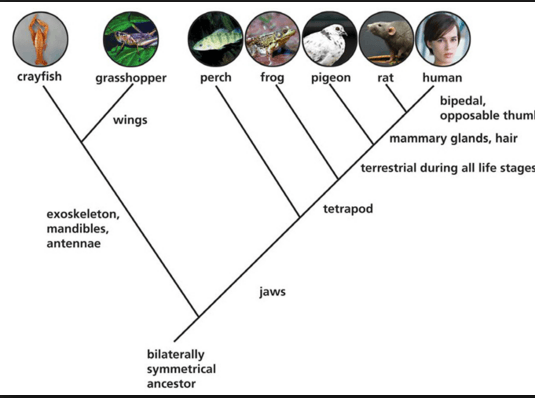
According to the cladogram, which organism is most distantly related to the human?
a)
crayfish
b)
grasshopper
c)
perch
d)
frog
67.
Which trait do only humans have, according to the cladogram?
a)
jaws
b)
mammary glands & hair
c)
terrestrial during all life stages
d)
bipedal & opposable thumbs
68.
On the cladogram, which organism is the closest relative of the human?
a)
Frog
b)
Hare
c)
Caiman
d)
Parrot
69.
You look at two species and see very similar DNA. What does this likely tell you?
a)
These are the same animal.
b)
These animals have a common ancestor.
c)
These animals are not likely related.
d)
These animals are likely becoming one species.
70.
Individuals that are well adapted to their environment will survive and produce:
a)
Fewer mutations
b)
Stronger genes
c)
More offspring
d)
Better traits