wayground logo

Free Printable Worksheets

Font size

S
M
L
XL
Worksheets

Biology 1st Quarter Review

Total questions: 120

Worksheet time: 2hrs 46mins

Name
Class
Date
1.
Which kingdom is autotrophic AND has a cell wall?
a)
Bacteria
b)
Fungi
c)
Plantae
d)
Protista
2.
Which domain is capable of living in extreme environments like hot springs, geysers, or very salty waters?
a)
Bacteria
b)
Archaea
c)
Eukarya
3.
Which domain includes all animals and plants?
a)
Archaea
b)
Eukarya
c)
Bacteria
4.
Almost all bacteria are...
a)
Unicellular
b)
Multicellular
5.
Which two kingdoms are entirely multicellular?
a)
Animalia and Plantae
b)
Animalia and Protista
c)
Protista and Plantae
6.
Which kingdoms have some organisms that can make their own food (autotrophic)?
a)
Plantae and Animalia
b)
Fungi and Plantae
c)
Protista and Plantae
7.
What is the genus name here:
Canis lupus
a)
Canis
b)
lupus
8.
Mold, yeast, and mushrooms all belong to the Kingdom _______.
a)
Archaebacteria
b)
Fungi
c)
Eubacteria
d)
Protista
9.
Animals must eat other organisms for food, so they are classified as--
a)
heterotrophs
b)
autotrophs
c)
eukaryotic
d)
prokaryotic
10.

Who was the first scientist to develop a classification system for living organisms?

a)

Aristotle

b)

Carolus Linnaeus

c)

Robert Hooke

d)

Charles Darwin

11.

The science of classifying, describing and naming organisms is called:

a)

Astronomy

b)

Genetics

c)

Botany

d)

Taxonomy

12.
According to this cladogram, sharks are MOST closely related to which organism? 
a)
Amphibians
b)
Ray finned fish
c)
Crocodiles
d)
Birds
13.
Who first proposed binomial nomenclature as a way of classifying organisms?
a)
Carolus Linnaeus
b)
Carl's Jr.
c)
Charles Darwin
d)
Henry Groseclose
14.
On the cladogram, which organism is the closest relative of the human?
a)
Frog
b)
Hare
c)
Caiman
d)
Parrot
15.

A dichotomous key for trees is provided. Hikers found a tree that has large brown cones and single sharp needles. What species of tree have the hikers found?

a)

Juniper

b)

Pine

c)

Spruce

d)

Fir

16.
Choose the correct order of taxa from LARGEST to SMALLEST
a)
Species, Genus, Family, Order, Class, Phylum, Kingdom
b)
Family, Kingdom, Order, Phylum, Class, Order, Species, Genus
c)
Kingdom, Phylum, Class, Order, Family, Genus, Species
d)
Phylum, Order, Species, Family, Genus, Kingdom
17.
The three Domains are:
a)
Plant, Animal, Bacteria
b)
Bacteria, Archaea, Eukarya
c)
Fungi, Animal, Plant
d)
Invertebrates, Vertebrates, Plants
18.
The main language of scientific names is:
a)
Greek
b)
English
c)
Latin
d)
Arabic
19.
Moss, Sunflowers, Pine trees, and algae are all in this kingdom:
a)
Fungi
b)
Anamalia
c)
Plantae
d)
Bacteria
20.
The scientific name for an organism is made from the:
a)
class and family name
b)
genus and species name
c)
domain and kingdom name
d)
kingdom and phylum name
21.
Which organisms are closely related? 
a)
American badger and leopard
b)
coyote and gray wolf
c)
european otter and leopard
d)
coyote and american badger
22.
Use the phylogenetic tree.  Which hypothetical organism is the most recent ancestor for Organisms A and G?
a)
1
b)
2
c)
3
d)
4
23.
Panthera leo, the scientific name for a lion, is a member of which species?
a)
leo
b)
Animalia
c)
Panthera
d)
mammalia
24.
Which taxonomic category is higher than the others?
a)
class
b)
genus
c)
order
d)
phylum
25.
Canis lupus, the scientific name for a wolf, is in which genus?
a)
Canis
b)
lupus
c)
Animalia
d)
mammalia
26.
The table shows some characteristics of four kingdoms.
Which characteristics would a taxonomist use to classify organisms as Archaebacteria or as Eubacteria?
a)
the internal organization of the cell
b)
the number of cells in an individual
c)
the chemical composition of the cell wall
d)
the nutritional requirements of the organism
27.
Examine the phylogenetic tree.
Which two organisms are most closely related?
a)
wolves and sharks
b)
starfish and sharks
c)
protists and sharks
d)
gorillas and sharks
28.
Examine the dichotomous key.
What features does a Platyspiza have?
a)
stout and heavy beak with a curved lower beak
b)
long, slender beak with a flat and straight lower beak
c)
flat and straight beak with a bend in the lower edge of the upper beak
d)
long and slender beak with the lower edge of the upper beak being flat
29.
In natural selection, the selective agent is the
a)
humans
b)
mutations
c)
breeders
d)
environment
30.
Mutations are important because they bring about
a)
death of the organism in which they develop
b)
genetic variation needed for a population to evolve
c)
benefits for the individual, not for the population
d)
Hardey-Weinberg equilibrium within a population
31.

What is the term for a feature that allows an organism to survive better in its environemtn?

a)

variation

b)

adaptation

c)

homologous structure

d)

vestigial structure

32.
Darwin wrote that organisms with traits that are best suited to the environment will ________________
a)
increase in number
b)
become extinct
33.
Who is the father of evolution?
a)
Darwin
b)
Mendel
c)
Newton
d)
Einstein
34.
What is another name for natural selection?
a)
survival of the smartest
b)
survival of the fastest
c)
survival of the biggest
d)
survival of the fittest
35.
What is the study of organisms at the early stages of development?
a)
DNA studies
b)
embryology 
c)
extinction
d)
fossil record
36.
______ _________ explains how two or more organisms could evolve similar traits even though they are not related to each other.
a)
convergent evolution
b)
reproductive isolation
c)
derived characters
d)
hybrid vigor
37.
Which of the following is a term for a group of similar organisms that can reproduce fertile offspring?
a)
individual
b)
population
c)
species
d)
fossil
38.

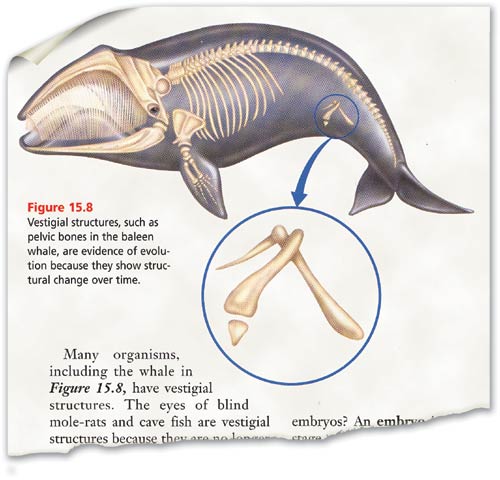
If an organism has a vestigial structure, that structure likely once had a function in a(n)

a)

close relative

b)

early ancestor

c)

unrelated organism

d)

embryological stage

39.
Finches on the Galapagos Islands had different beaks in order to help them do what?
a)
Build nests
b)
Fight off predators
c)
Collect food sources
d)
Compete with rivals
40.
A remnant or trace of an organism from the past is called a _______.
a)
Ancestor
b)
Skeleton
c)
Fossil
d)
Imprints
41.
Structures with the same parts have different functions; suggests that organisms share a common ancestry
a)
vestigial structures
b)
homologous structures
c)
adaptive radiation
d)
fossil
42.
Which of the following is an example of a vestigial structure?
a)
the wings of a red-tailed hawk
b)
the hind limbs of a house cat
c)
the fins of sharks
d)
the tailbone of a human
43.
Why are advantageous traits more likely to be passed onto offspring?
a)
Because they are more likely to survive and reproduce.
b)
Because they come from dominant alleles.
c)
Because they come from recessive alleles.
d)
Because the trait is an acquired phenotype.
44.
Individuals that are better able to cope with the challenges of their environment tend to  
a)
Decrease in population over time.
b)
Leave more offspring than those less suited to the environment.
c)
Leave fewer offspring than those less suited to the environment.
45.
European rabbits were introduced to Australia in 1859. The rabbits reproduced rapidly in their new habitat, displaced other animals, and overgrazed vegetation. In an attempt to reduce the rabbit population, a virus was introduced in 1951. This virus is usually deadly to European rabbits. When the virus was first introduced, the rabbits died in large numbers, but the death rate decreased over time. Which of the following best explains the decrease in the rabbit death rate? 
a)
Young rabbits learned to avoid being infected with the virus.
b)
The lifespan of the virus was too short to affect rabbits over a long period of time.
c)
Natural selection favored rabbits that were resistant to the virus. 
d)
No correct choices.
46.
Which of the following statements gives the most likely explanation for the presence of two very similar species of squirrels living on opposite sides of the Grand Canyon?
a)
One squirrel traveled across the canyon and started a new population on the other side.
b)
One squirrel traveled across the canyon and interbred with a different population on the other side.
c)
Members of one single squirrel species were geographically separated by the formation of the canyon.
d)
Members of two different squirrel species migrated from two different places to opposite sides of the canyon. 
47.
The Asian shore crab invaded parts of the eastern coast of the United States about 15 years ago. The Asian shore crab preys on blue mussels. In the time since the Asian shore crab arrived, the average shell thickness of the blue mussel population has increased. Which of the following is the most likely reason that this increase in shell thickness has occurred? 
a)
Blue mussels with thick shells attract more crabs that mussels without thick shells.
b)
Blue mussels with thick shells grow in larger colonies than mussels without thick shells.
c)
Blue mussels with thick shells catch more food per day than mussels without thick shells.
d)
Blue mussels with thick shells survive and reproduce more successfully than mussels without thick shells.
48.
The hypothesis that evolution of a species occurs in periods of rapid change separated by periods of little or no change is called
a)
divergence
b)
gradualism
c)
punctuated equilibrium
d)
isolation
49.
The hypothesis that evolution of a species occurs gradually over time as a slow and constant process is known as
a)
speciation
b)
punctuated equilibrium
c)
gradualism
d)
microevolution
50.
The formation of new species is a process known as ____________________, which is typically the product of divergence. 
a)
gradualism
b)
speciation
c)
reproductive isolation
d)
subspecies
51.
Genetic variation can arise from a random change in the DNA of a gene.  The change is called a(n)
a)
mutation
b)
gene flow
c)
gene pool
d)
allele
52.

The "Best" form of evidence for evolutionary relationships is-

a)

Molecular- DNA

b)

Fossils

c)

Homologous Structures

d)

Analogous Structures

53.

What is shown ?

a)

embryology

b)

fetalology

54.
Two organisms that are closely related would have
a)
very similar DNA sequence
b)
exactly the same DNA sequences
c)
no proteins in common
d)
completely different DNA sequence
55.
Some organisms have genes that improve their ability to survive and reproduce. If the gene also help their offspring survive and reproduce, then which of the following will most likely increase?
a)
The number of genes in a species
b)
The frequency of genes in a population
c)
The frequency of genes in one individual 
56.
Which of the following statements best explains why some mosquitoes survived after the first spraying?
a)
Some mosquitoes had a genetic mutation that made them resistant to the insecticide
b)
A.  All mosquitoes had a genetic mutation that made them resistant to the insecticide
c)
A.  None of the mosquitoes had a genetic mutation that made them resistant to the pesticide
57.
A graph regarding the effect of agricultural bioengineering on insect pests is shown below How has natural selection affected species of insect pests?
a)
A.  Natural selection has not affected the number of species that are resistant to pesticides
b)
A.  Natural selection has rapidly increased the number of species that are resistant to pesticides
c)
A.  Natural selection has only affected the number of species that are resistant to pesticides
58.
The table shows the survival rate of two types of beetles in the same environment over a period of three years.  

Which statement about the beetles in this environment is best supported by the data?
a)
Brown beetles have a shorter life cycle than green beetles have
b)
Green beetles are more fit for their environment than brown beetles
c)
 brown beetles are undergo more unfavorable mutations than green beetles
59.
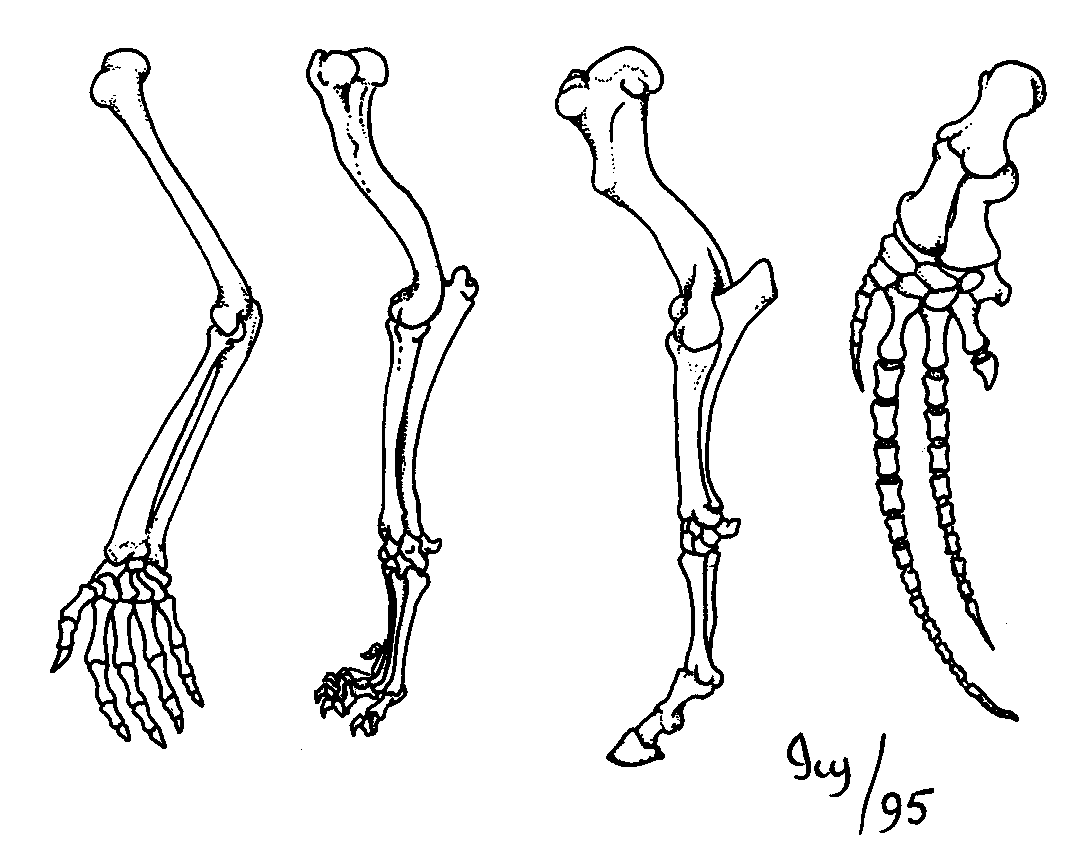
The similarities of the bones in the diagram provide evidence that---
a)
The organisms shown lived in the same natural envionrment
b)
The organisms shown may have developed from a common ancestor
c)
The organisms shown have the same genetic diseases
d)
All vertebrate species have identical forelimbs
60.
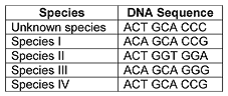
According to this data, the unknown bacterial species is most closely related to: 
a)
Species I
b)
Species II
c)
Species III
d)
Species IV
61.
Which statement accurately describes the way that adenosine triphosphate (ATP) transfers energy within a cell? 
a)
An ATP molecule reacts with water and loses a phosphate group, breaking a bond and releasing energy. 
b)
ATP molecules break up sugars such as glucose into energy-rich compounds like lactose.
c)
ATP molecules ionize oxygen molecules, which give up electrons that can then be used for energy.
d)
ATP molecules split carbon dioxide molecules, and the carbon is used as fuel by the cell.
62.
Which statement is true about bacterial cells? 
a)
They have organelles.
b)
They are eukaryotes
c)
The cells have no nucleus.
d)
The cells are very large.-
63.
Two different species of bacteria are examined. Scientists find that species X always produces CO2 and H2O during cellular respiration. Species Y always produces ethyl alcohol and CO2. Which conclusion can be made from these observations? 
a)
Only species Y is aerobic
b)
Only species Y is anerobic
c)
Both species X and Y are aerobic. 
d)
Both species X and Y are anaerobic. 
64.
What does a Primary Consumer eat?
a)
Tertiary Consumers
b)
Secondary Consumers
c)
Producers
65.
An organism that lives by breaking apart dead organic matter into simpler parts is...
a)
scavenger
b)
consumer
c)
decomposer
d)
carnivore
66.
An animal that eats other animals is a....
a)
carnivore
b)
omnivore
c)
herbivore
d)
decomposer
67.
What does a food web represent?
a)
All connections of energy flow throughout all organisms in a ecosystem.
b)
The specific ways that mutualism is carried out.
c)
A single pathway or energy flow between organisms. 
d)
How carnivores get their food. 
68.
Which of the following is a herbivore?
a)
cricket
b)
frog
c)
hawk
d)
shrew
69.
__________ is an organism that eats BOTH plants and animals for energy.
a)
Omnivore
b)
Darnivore
c)
Carnivore
d)
Herbiovre
70.
Lions only eat buffalo, antelopes, zebras and crocodiles. They are called __________.
a)
Omnivore
b)
Herbivore
c)
Carnivore
d)
Delivore
71.
If the grasshopper were to be removed completely from the food web, what organism would be most effected?
a)
The squirrel
b)
The shrew
c)
The deer
d)
The rabbit
72.
Which organism recieves the least amount of energy from the producer?
a)
Owl
b)
Grasshopper
c)
Lilypad
d)
Mouse
73.
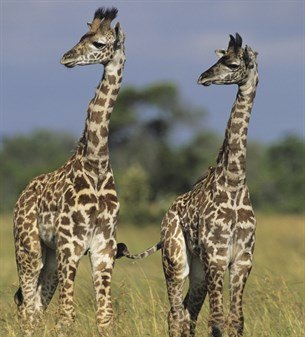
This giraffe is an example of a _______________________________.
a)
Carnivore
b)
Omnivore
c)
Autotroph
d)
Herbivore
74.
In this image, the grass is the ______________.
a)
Primary Consumer
b)
Secondary Consumer
c)
Heterotroph
d)
Producer
75.
On average how much energy is passed to a higher level in the food web?
a)
90%
b)
25%
c)
10%
d)
50%
76.

If a disease strikes the snakes the rabbits will

a)

increase

b)

decrease

c)

not be affected

77.
The arrows in a food chain or web represents what?
a)
They point to the organism that is being eaten.
b)
It shows how sunlight flows within an ecosystem.
c)
They show what direction the energy is flowing between organisms. 
d)
They represent how water is transferred within a habitat.
78.
Which organelle performs PHOTOSYNTHESIS?
a)
Chloroplast
b)
Mitochondria
79.
Which of the following is the correct equation for PHOTOSYNTHESIS?
a)
6CO2 + 6H2O --> 6O+ C6H12O6
b)
6CO+ C6H12O6 + 6H2O --> O
c)
6O2 + 6H2O --> 6CO+ C6H12O6
d)
C6H12O6 + 6O2 ---> 6H2O + 6CO2 
80.
What is the correct equation for cellular respiration?
a)
6O2 + C6H12O6 -> 6CO2 + 6H2O + ATP
b)
6O2 + C6H12O6 + ATP -> 6CO2 + 6H2O
c)
6CO2 + 6H2O -> 6O2 + C6H12O6 + ATP
d)
6CO2 + 6H2O + ATP -> 6O2 + C6H12O6
81.

The maximum number of individual organisms that an ecosystem can comfortably support is

a)

exponential growth

b)

carrying capacity

c)

population

d)

tolerance

82.
Identify the process shown in this diagram.
a)
Extinction
b)
Toxin Accumulation
c)
Pollution
d)
Biomagnification
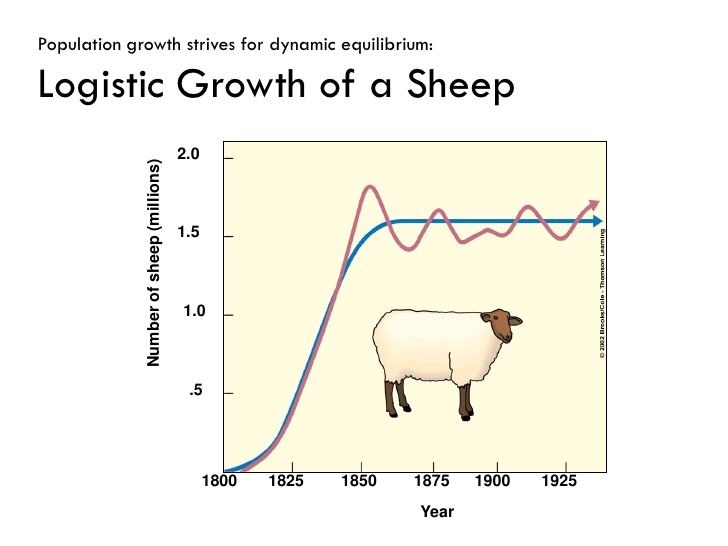
83.
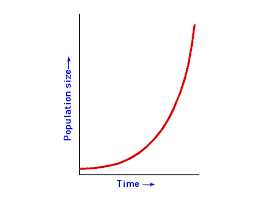
What type of growth is shown in the diagram?
a)
exponential growth
b)
logistic growth 
c)
predator-prey cycle
d)
boom-bust curve
84.
What is the carrying capacity for this sheep population?
a)
1.8 million
b)
1.25 million
c)
1.6 million
d)
1.o million
85.
What point on the graph represents the carrying capacity?
a)
A
b)
B
c)
C
d)
D
86.
Which limiting factor would increase due to the number of individuals in a population?
a)
Unusual weather
b)
Natural disaster
c)
Disease
87.
Which of the following symbiotic relationships is considered parasitic?
a)
Ticks feeding on a dog
b)
Bees transporting pollen from flowers
c)
Pilotfish swimming under sharks
d)
Birds eating the insects fromo the back of hippo
88.
Maria and her classmates are observing animals at the pond. They notice that wood storks and ibisies both feed on fish. Which of these describes the relationship between these two birds.
a)
Parasitism
b)
Competition
c)
Predator and prey
d)
Producer and consumer
89.
Which of these describes a mutually beneficial relationship between two organisms?
a)
A dog with worms in its intestine
b)
A turtle and a snail that both eat grass live in a river
c)
A honeybee pollinating a plant and receiving nectar for food
d)
A small fish attached to a shark, eating tiny pieces of the shark's food as it floats
90.
Which biomolecule is responsible for insulation and energy storage?
a)
Protein
b)
Nucleic Acid
c)
Lipid
d)
Carbohydrate
91.
All polymers are made up of...
a)
monosaccharides
b)
monomers
c)
proteins
d)
None of these
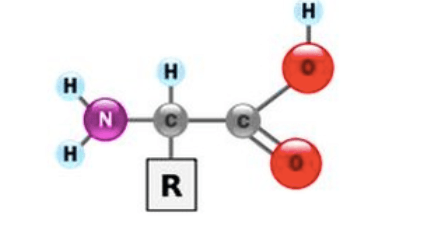
92.
Which biomolecule is this a picture of?
a)
Protein
b)
Nucleic Acid
c)
Lipid
d)
Carbohydrate
93.
Name this biomolecule
a)
carbohydrate
b)
lipid
c)
nucleic acid
d)
protein
94.
Fats and oils are composed of what two groups of molecules?
a)
 glucose and fructose 
b)
starch and sugar 
c)
water and cellulose
d)
fatty acids and glycerol 
95.
What is the function of nucleic acids?
a)
Stores energy
b)
Stores genetic information
c)
Movement
d)
Physical structure
96.
Which 2 molecules contains the elements C-H-O and function pertains to energy?
a)
Lipids and Protein
b)
Carbohydrates and Nucleic Acids
c)
Protein and Carbohydrates
d)
Carbohydrates and Lipids
97.
Which biomolecule is a main source of quick energy?
a)
Nucleic Acid
b)
Protein
c)
Lipid
d)
Carbohydrate
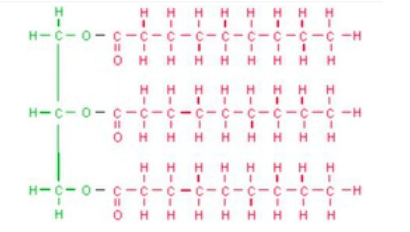
98.
Which biomolecule is this a picture of?
a)
Protein
b)
Nucleic Acid
c)
Lipid
d)
Carbohydrate
99.
Which biomolecule is this a picture of?
a)
Protein
b)
Nucleic Acid
c)
Lipid
d)
Carbohydrate
100.
What type of molecule is this?
a)
Nucleic acid
b)
Protein
c)
Carbohydrate
d)
Lipid
101.
Enzymes are considered to be 
a)
Lipids
b)
Carbohydrate
c)
Protein
d)
Nucleic Acid
102.

In what organelle of plant cells does photosynthesis occur?

a)

mitochondria

b)

centrioles

c)

chloroplast

d)

ribosomes

103.

In which leaf tissue does photosynthesis occur?

a)

mesophyll

b)

epidermis

c)

xylem

d)

phloem

104.
What role do pigments play in photosynthesis?
a)
Make plants green, which is calming
b)
Capture sunlight
c)
Absorb water in roots
d)
Take in CO2
105.
What is the main function of chloroplast?
a)
Mitosis
b)
Meiosis
c)
Translation
d)
Photosynthesis
106.
The waxy, waterproof layer that covers most leaves is called the what?
a)
spore
b)
cuticle
c)
seed coat
d)
xylem
107.

The xylem in a plant transports WHAT throughout the plant?

a)

Sunlight

b)

Oxygen

c)

Blood

d)

Water

108.
What type of respiration requires oxygen?
a)
Aerobic
b)
Anaerobic
109.
Which type of respiration is most efficient?
a)
Aerobic
b)
Anaerobic
110.
Which equation shows the reaction for anaerobic respiration
a)
carbon dioxide + water --> glucose and oxygen
b)
glucose + Oxygen --> lactic acid and energy
c)
glucose + oxygen --> carbon dioxide and water and energy
d)
glucose --> lactic acid and energy
111.
A weightlifter is using heavy weights in short bursts for a competition. Because his muscle cells are not able to take in enough oxygen to make very much ATP the weightlifter begins to get fatigue in his muscles. Which of the following processes is most likely going on in the muscles of the weightlifter as he competes in his event
a)
As the cells run out of oxygen they switch to anaerobic respiration, which allows the cell to make small amounts of ATP in the absence of oxygen. 
b)
As the cells run out of oxygen, they die off gradually and the weightlifter's muscles have fewer contracting muscle cells.
c)
The cells will never run out of oxygen if the weightlifter is breathing.
d)
As the cells run out of oxygen, they will continue to make the same amount of ATP, since oxygen is not required to make ATP. 
112.

Which of the following structure is where cellular respiration occurs in the cell?

a)

nucleus

b)

cytoplasm

c)

mitochondria

d)

vacuoles

113.
Which of the following is an example of COURTSHIP behavior?
a)
growling at foe
b)
barking for attention
c)
nursing young
d)
showing bright feathers
114.
When animal learns to ignore harmless stimuli like a scarecrow, what type of learning is this? 
a)
innate learning
b)
classical conditioning 
c)
habituation 
d)
trial and error learning 
115.

Which behavior is genetically based and NOT linked to past experiences?

a)

innate behavior

b)

habituation

c)

operant conditioning

d)

classical conditioning

116.

Studies show what 2 factors influence an animal’s behavior?

a)

food & space

b)

genetics & experience

c)

experience & food

d)

genetics & food

117.
A dichotomous key for insects is given. To what order does an insect with two pairs of scaly wings belong?
a)
Coleoptera
b)
Heteroptera
c)
Diptera
d)
Lepidoptera
118.
Using this dichotomous key, identity the name of the circled fish.
a)
band-tail puffer
b)
spotted goat fish
c)
peacock flounder
d)
trumpet fish
119.
 Genetic Drift is more likely to happen in... 
a)
aquatic populations
b)
small populations
c)
terrestrial populations
d)
older populations
120.
Genetic drift is change in the allele frequency of a population due to...
a)
random chance
b)
natural selection
c)
non-random mating (sexual selection)
d)
artificial selection