wayground logo

Free Printable Worksheets

NEW

Font size

S
M
L
XL
Worksheets

AP Chemistry Unit 3 Review

Total questions: 48

Worksheet time: 48mins

Name
Class
Date
1.

Ethane, C2H6, has the following bonding:

a)

ionic

b)

metallic

c)

nonpolar covalent

d)

polar covalent

2.

Copper (II) nitride, Cu3N2, has the following bonding:

a)

ionic

b)

metallic

c)

nonpolar covalent

d)

polar covalent

3.

Cesium chloride, CsCl(s) has the following bonding:

a)

lattice of positive and negative ions held together by electrostatic forces

b)

closely packed lattice with delocalized electrons throughout

c)

strong single covalent bonds with weak intermolecular forces

d)

strong multiple covalent bonds with weak intermolecular forces

4.

Carbon dioxide, CO2, has the following bonding:

a)

lattice of positive and negative ions held together by electrostatic forces

b)

closely packed lattice with delocalized electrons throughout

c)

strong single covalent bonds with weak intermolecular forces

d)

strong multiple covalent bonds with weak intermolecular forces

5.

Which of the following typically has the lowest melting point?

a)

Metals

b)

Covalent network solids

c)

Ionic compounds

d)

Covalent molecules

6.

Which of the following probably has the highest solubility in water?

a)

Metals

b)

Covalent network solids

c)

Ionic compounds

d)

Covalent molecules

7.

Which of the following probably has the highest solubility in hexane, C6H14?

a)

Metals

b)

Polar covalent molecules

c)

Ionic compounds

d)

Nonpolar covalent molecules

8.

Of the following molecules, which is the most polar?

a)

CO

b)

CO2

c)

O2

d)

HF

e)

F2

9.

Which of the following has the lowest melting point?

a)

Zn

b)

SiO2

c)

CaCl2

d)

C2H6

10.

Which of the following is most likely to be soluble in water?

a)

NaF

b)

C12H22O

c)

Mn

d)

Cl2

11.
Intermolecular force present in HCl?
a)
dipole dipole
b)
dispersion
c)
H-bond
d)
ionic
12.
Type of intermolecular force present in I2, Br2, and Cl2.
a)
dipole dipole
b)
H-bond
c)
dispersion
d)
metallic
13.
Which of the following has the highest boiling point?
a)
H2
b)
NH3
c)
N2
d)
O2
14.
What information do we look for on the periodic table if we  want to examine intermolecular forces?
a)
atomic mass
b)
atomic number
c)
electronegativity
d)
ionization 
15.
What explains the very high melting and boiling point of water
a)
Strong dipole-dipole bonds between water molecules
b)
Strong hydrogen bonds between water molecules
c)
Dispersion forces which are present in all molecules
d)
Asymmetrical shape of the polar bonds.
16.
Which of these typically increases when intermolecular forces increase?
a)
Boiling Point
b)
Melting Point
c)
Viscosity
d)
All of these
17.
Rank these in order of strength:
covalent bond
London forces
hydrogen bond
dipole-dipole attraction
a)
dipole-dipole>covalent bond>hydrogen bond>London
b)
London>dipole-diple>hydrogen bond>covalent bond
c)
covalent bond>hydrogen bond>dipole-dipole>London
d)
hydrogen bond>dipole-dipole>London>covalent bond
18.
What best explains the difference in melting points between Cl2 (-101.5) and F2 (-219)?
a)
Increased mass (polarizability) of chlorine
b)
Increased electronegativity of fluorine
c)
Increased number of electrons in chlorine
d)
Decrease metallic character of fluorine
19.
Which of the following statements correctly explains why hydrogen bonding is such a strong intermolecular force?
a)
There is an attraction between a small, weakly electronegative hydrogen atom and a large, strongly electronegative atom of fluorine, nitrogen, or oxygen
b)
There is an attraction between a small, highly electronegative hydrogen atom and a large, highly electronegative fluorine atom
c)
There is an attraction between the hydrogen and oxygen atoms only
d)
There is an attraction between the hydrogen and nitrogen atoms only
20.
How many sigma bonds does this have? 
a)
1
b)
2
c)
3
d)
4
21.
What is the hybridization on Nitrogen?
a)
sp
b)
sp2
c)
sp3
d)
None of these
22.

According to kinetic molecular theory, in which of the following gases will the root mean square speed of the molecules be the highest at 200ºC?

a)

SF6

b)

H2O

c)

HCl

d)

Cl2

e)

None, the molecules of all gases have the same root mean square speed at any given temperature.

23.

Consider a sample of helium gas in a container fitted with a piston, as pictured below. The piston is frictionless, but has a mass of 10.0 kg. How many of the following processes will cause the piston to move away from the base and decrease the pressure of the gas? Assume ideal behavior.

I. heating the helium

II. removing some of the helium from the container

III. turning the container on its side

IV. decreasing the pressure outside the container

a)

0

b)

1

c)

2

d)

3

e)

4

24.
A sample of gas with a volume of 30.0 mL at 25.0oC is heated to 50.0oC.  What is the new volume of the gas?
a)
60.0 mL
b)
15.0 mL
c)
27.5 mL
d)
32.5 mL
25.

The density of an unknown gas is 2.00 grams per Liter at 3.00 atmosphere pressure and 127oC. What is the molar mass of this gas?

a)

(254/3) R

b)

188 R

c)

(800/3) R

d)

600 R

26.

A gaseous mixture containing 7.0 moles of nitrogen, 2.5 moles of oxygen, and 0.5 moles of helium exerts a total pressure of 0.90 atmosphere. What is the partial pressure of the nitrogen?

a)

0.13 atm

b)

0.27 atm

c)

0.63 atm

d)

0.90 atm

27.

Samples of F2 gas and Xe gas are mixed in a container of fixed volume. The initial partial pressure of the F2 gas is 8.0 atmospheres and that of the Xe gas is 1.7 atmospheres. When all of the Xe gas reacted, forming a solid compound, the pressure of the unreacted F2 gas was 4.6 atmospheres. The temperature remained constant. What is the formula of the compound?

a)

XeF

b)

XeF3

c)

XeF4

d)

XeF6

28.

NH4NO3(s) → N2O(g) + 2 H2O(g)


A 0.03 mol sample of NH4NO3(s) is placed in a 1 L evacuated flask, which is then sealed and heated. The NH4NO3(s) decomposes completely according to the balanced equation above. The total pressure in the flask measured at 400 K is closest to which of the following? ( The value of the gas constant, R, is 0.082 L atm mol–1 K–1)

a)

3 atm

b)

1 atm

c)

0.5 atm

d)

0.1 atm

29.

Which of the following is an assumption of the kinetic-molecular theory of gases?

a)

Collisions between gas particles are inelastic.

b)

Gases consist of closely spaced particles.

c)

Gas particles move around in an orderly manner.

d)

The temperature of a gas depends on the average kinetic energy of the gas particles.

30.

1. Under which conditions does a real gas behave very much like an ideal gas?

a)

high temperature and low pressure

b)

high temperature and high pressure

c)

low temperature and high pressure

d)

low temperature and low pressure

31.

1. Liquids are more ordered than gases because liquids have ?

a)

Weaker Intermolecular Forces And Lower Mobility Of The Particles

b)

stronger intermolecular forces and lower mobility of the particles.

c)

weaker intermolecular forces and greater mobility of the particles

d)

stronger intermolecular forces and greater mobility of the particles

32.
Water exists as a _____________ at 700 mmHg and 50 °C.
a)
solid
b)
liquid
c)
gas
d)
supercritical fluid
33.
What is true regarding CO2 for temperatures above 31 °C?
a)
It can never be liquified.
b)
It decomposes.
c)
It has a high pressure.
d)
It is a plasma.
34.
What is the normal melting point of this substance?
a)
150 °C
b)
100 °C
c)
-50 °C
d)
0 °C
35.

Chromatography separates solutions on the basis of _____ while distillation separates solutions on the basis of ______.

a)

IMFs; solubility

b)

solubility; conductivity

c)

IMFs; boiling point

d)

boiling point; solubility

36.
You have a 0.5 M MgSO4 stock solution available.  Calculate the volume of the stock solution needed to make 2.0 L of 0.20 M MgSO4.
a)
0.8 L
b)
5 L 
c)
0.1 L
d)
0.5 L
37.
Which of the following solutions made from one mole of the following solutes in 100.0 mls of water has the lowest freezing point?
a)
MgBr2
b)
Al2(CO3)3
c)
NH4C2H3O2
d)
N2O4
38.

A dissolved solute that does not form ions is

a)

a nonelectroyte

b)

a weak electrolyte

c)

a strong electrolyte

d)

insoluble

39.

Which does not affect the rate at which a solid solute dissolves?

a)

the vapor pressure of the solvent

b)

the temperature of the solvent

c)

the surface area of the solid

d)

the speed at which the solution is stirred

40.

Which of the following occurs as temperature increases?

a)

solubility decreases

b)

solubility increases

c)

solubility remains the same

d)

molarity doubles

41.
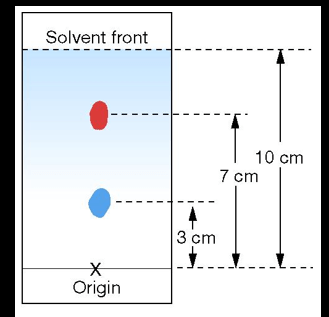
A student extracts the colour from some green smarties and uses paper chromatography to separate components colours. She finds blue has a Rf =0.38 and yellow Rf =0.75 this suggests 
a)
the yellow is more strongly adsorbed onto the stationary phase and is less solublein the mobile phase.
b)
the yellow is more strongly adsorbed onto the stationary phase and is more soluble in the mobile phase.
c)
the blue is more strongly adsorbed onto the stationary phase and is less solublein the mobile phase.
d)
the blue is more strongly adsorbed onto the stationary phase and is less solublein the mobile phase.
42.
A high Rvalue indicates strong
a)
strong affinity to the stationary phase
b)
strong affinity to the mobile phase
c)
no affinity to the stationary phase
d)
 no affinity to the stationary phase
43.
The Rvalue  for the blue component is 
a)
0.3
b)
0.7
c)
10
d)
3
44.
The Rvalue  for the red component is 
a)
0.3
b)
0.7
c)
10
d)
7
45.
A certain photon of light has a wavelength of 4.22x10⁻⁷nm. What is the frequency? (v=c/λ)
a)
7.11x10¹⁴ Hz
b)
7.11Hz
c)
1.41x10⁻¹⁵
d)
-1.41x10¹⁵
46.
Select the correct order of waves on the EMS 
a)
Radio, Micro, Infra, Visible, Ultra, X-ray, Gamma
b)
Gamma, X-ray, Ultra, Vis, Infra, Micro, Radio
c)
Vis, Micro, Infra, Ultra, X-ray, Gamma, Radio
d)
Micro, Radio, Vis, Infra, Ultra, X-ray, Gamma
47.
As the frequency of an electromagnetic wave increases, the amount of energy in that wave...
a)
increases.
b)
decreases.
c)
stays the same.
48.
What is the Energy of a blue light with the frequency of 6.91x10¹⁴Hz? (E=hv)
a)
4.56x1049J
b)
9.55x10-49J
c)
4.56x10⁻¹⁹J
d)
5.82x10¹⁹J