wayground logo

Free Printable Worksheets

NEW

Font size

S
M
L
XL
Worksheets

Atoms, Elements, Compounds, and Chemical Bonds Review

Total questions: 50

Worksheet time: 37mins

Name
Class
Date
1.

What are the 3 subatomic particles of an atom?

a)

carbon atom, proton, electron

b)

quarks, neutrons, protons

c)

nucleus, protons, electrons

d)

protons, neutrons, electrons

2.

Generally, the number of neutrons ____ the number of protons in an atom.

a)

=

b)

<

c)

>

3.

Which subatomic particle has a negative charge?

a)

proton

b)

neutron

c)

electron

4.

Which subatomic particle has a positive charge?

a)

proton

b)

neutron

c)

electron

5.

Which subatomic particle has a neutral or no charge?

a)

proton

b)

neutron

c)

electron

6.
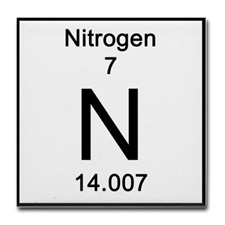
What is the number of protons that the element in this image contain?
a)
14
b)
7
c)
15
d)
18
7.
all matter is made of what 
a)
energy 
b)
atoms 
c)
electrons 
d)
compounds 
8.
an atom with atomic number 6 would have how many protons 
a)
6
b)
12
c)
3
d)
cannot be determined 
9.
a)
2
b)
8
c)
3
d)
13
10.
a)
2
b)
6
c)
10
d)
16
11.
What subatomic particle(s) would be found orbiting the nucleus?
a)
Neutrons only
b)
Electrons only
c)
Protons and Neutrons
d)
Protons and Electrons
12.

Valence electrons are the number of

a)

protons in the atom

b)

electrons in the atom

c)

protons + neutrons in the nucleus

d)

electrons in the outside shell of the atom

13.
The smallest part of an element is known as the 
a)
Periodic Table
b)
Atom
c)
Group
d)
Period
14.
Where are neutrons located in the atom?
a)
shells/orbitals
b)
rings
c)
center
d)
nucleus
15.
what is the central core of an atom called?
a)
nucleus
b)
neutron
c)
protron
16.
Can a mixture be separated? 
a)
No
b)
Yes
c)
Only sometimes
17.
Another example of a mixture is 
a)
Water and oil
b)
Cereal and Milk 
c)
Sand and water 
d)
All of the above
18.
What is an ion?
a)
A Charged Atom
b)
A Large Atom
c)
A Small Atom
d)
A Cute Atom
19.
Why are ions formed?
a)
To make our lives difficult
b)
Because atoms want 8 valence electrons
c)
Because atoms have the same number of protons and electrons
d)
Because atoms gained neutrons
20.
Cations are...
a)
Positive
b)
Negative
c)
Neutral
d)
Purring
21.
Anions are...
a)
Positive
b)
Negative
c)
Neutral
d)
Crying
22.
An atom becomes _________ when it gains electrons.
a)
Positive
b)
Negative
c)
Neutral
d)
Invinsible
23.
What is the chemical symbol for the element hydrogen
a)
H
b)
He
c)
h
d)
he
24.
The Modern Periodic Table of Elements is arranged by
a)
atomic mass
b)
atomic number
c)
valence electrons
d)
number of isotopes
25.
The atoms we study in 6th grade are neutral, which means they have the same number of
a)
protons and electrons
b)
protons and neutrons
c)
electrons and neutrons
26.
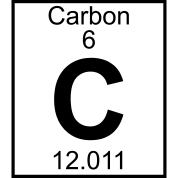
What does the C represent?
a)
atomic mass
b)
atomic number
c)
element name
d)
chemical symbol 
27.
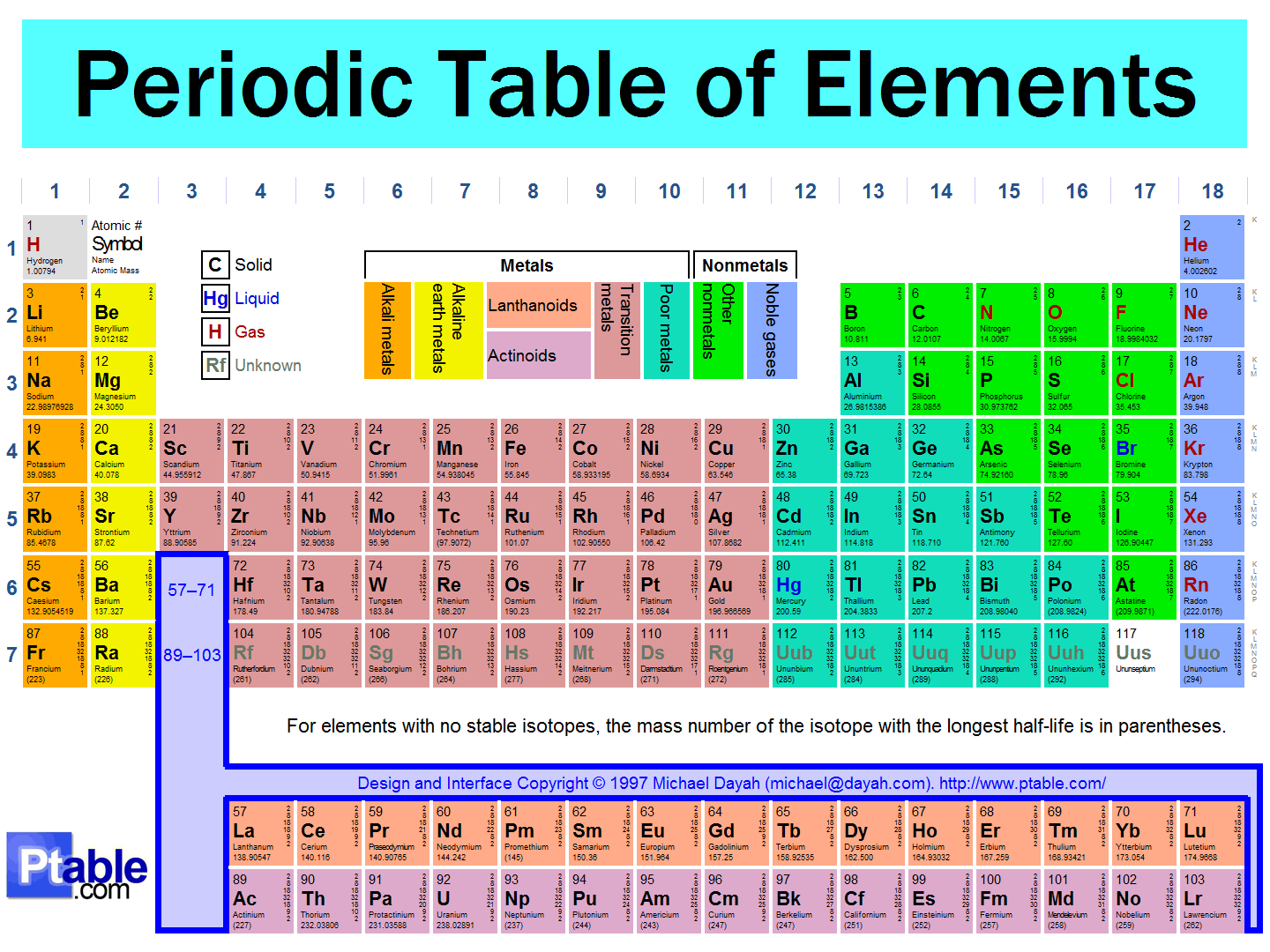
These are found on the Periodic Table.
a)
Compounds
b)
Elements
c)
Mixtures
28.

The horizontal (side to side) rows in the Periodic Table are called

a)

groups

b)

families

c)

periods

d)

atomic numbers

29.

The vertical (up and down) columns in the Periodic Table are called

a)

groups

b)

towers

c)

periods

d)

atomic numbers

30.

What is the goal of the Lewis Dot Structure?

a)

To determine the electron position.

b)

To show the element's valence electrons & bonding capabilities.

c)

To find the atomic mass of an element.

d)

To search for the number of electrons in an individual atom.

31.
Choose the set that goes from lowest to highest electronegativity?
a)
Cu, Mg, Sr, Ca
b)
F, Cl, Br, Si
c)
Cs, Rb, Ca, Mg
d)
Zn, Cd, Ag, Cu
32.
Electronegativity is...
a)
how good an atom is at attracting electrons
b)
the ability of an atom to lose electrons
c)
the energy required to remove an electron from a specific atom
d)
how easy it is to make friends. 
33.
Who arranged the elements in their periodic table in order of atomic mass?
a)
Dr.Eckart
b)
Mendeleev
c)
Bill Nye
d)
J.W Dobrieiner
34.
What group are halogens in?
a)
8A
b)
7A
c)
2A
d)
6A
35.

How many electrons does the first shell hold?

a)

1

b)

2

c)

4

d)

8

36.

How many electrons can be in the 2nd energy level hold?

a)

1

b)

2

c)

4

d)

8

37.
Compounds are made up of two or more atoms physically combined.
a)
True
b)
False
38.
How many elements are represented in the compound?
Na2CO3
a)
1
b)
2
c)
3
d)
4
39.
Which of the following is not a compound?
a)
HCl
b)
Cl
c)
NaCl
d)
CO2
40.
The air around was is  a mixture of gases.
a)
True
b)
False
41.

How many atoms of hydrogen are in a sugar molecule with the formula C6H12O6

a)

12

b)

6

c)

24

d)

18

42.

___________is the basic unit from which all matter is made.

a)

Element

b)

Atoms

c)

Molecule

d)

Matter

43.

How many Hydrogen atoms are in 4H2O?

a)

6

b)

8

c)

2

d)

4

44.

How many Magnesium atoms are in 10MgCl2?

a)

10

b)

5

c)

20

45.

How many Nitrogen atoms are in the in H2C3O4N5?

a)

2

b)

3

c)

4

d)

5

46.
Which is the correct formula for:
 three hydrogen (H)
one sulfur (S)
four oxygen (O)
a)
H3SO4
b)
HSO4
c)
H4S3O
d)
H2O
47.

How many atoms of each element are in NaCl?

a)

Na=1, Cl=1

b)

Na=2. Cl=2

c)

Na=1, Cl-2

48.

How many elements are in... N2O ?

a)

1

b)

2

c)

3

d)

4

49.

Caffeine is represented here: C8H10N4O2 ... How many atoms are present?

a)

4

b)

18

c)

24

d)

32

50.

C8H10N4O2 has how many elements?

a)

24

b)

4

c)

1