wayground logo

Free Printable Worksheets

Font size

S
M
L
XL
Worksheets

Year 9 - Chemistry - Revision

Total questions: 111

Worksheet time: 2hrs 31mins

Name
Class
Date
1.

is this chemical equation balanced?

a)

yes

b)

no

2.

what is this ?

a)

a Molecule

b)

an atom

c)
d)
3.

What are the three components found in an atom?

a)

Protons

b)

energy

c)

electrons

d)

neutrons

e)

nucleus

4.

Protons are..

a)

negative charged

b)

neutral charged

c)

positive charged

5.

a neutron is..

a)

positive charged

b)

neutral charged

c)

negative charged

6.

an electron is..

a)

negative charged

b)

positive charged

c)

neutral charged

7.

What is an isotope?

a)

A particle

b)

A poisonous dart frog

c)

Isotopes are variants of a particular chemical element which differ in neutron number.

d)

Dust

8.

Bases that are soluble in water are called ////

a)

dissolvers

b)

vitamins

c)

quatrins

d)

Alkalis

9.

What is an acid?

a)
b)

In chemistry, a salt is a solid chemical compound consisting of an ionic assembly of cations and anions. Salts are composed of related numbers of cations and anions so that the product is electrically neutral.

c)

a substance with particular chemical properties including turning litmus red, neutralizing alkalis, and dissolving some metals; typically, a corrosive or sour-tasting liquid of this kind. Often contrasted with alkali and base.

d)
10.
The compounds or elements present at the end of a reaction 
a)
reactants
b)
catalyst
c)
products
d)
energy 
11.
The compounds and elements that are present at the beginning of a reaction:
a)
reactants
b)
catalyst
c)
products
d)
energy 
12.
Magnesium + Hydrochloric acid -->
a)
Magnesium hydride
b)
Sodium chloride
c)
Magnesium chloride
d)
Magnesium sulfate
13.
Which of the following is NOT a mixture? 
a)
NaCl + H2O
b)
C6H12O6 + H2O
c)
C6H12O6
d)
SiO2 +H2O
14.
What is an example of an element that doesn't like to react with anything?
a)
Neon
b)
Oxygen
c)
Hydrogen
d)

Carbon

15.
The name of the chemical symbol Ar is ...
a)
Argon
b)
Argean
c)
Agreon
d)
Armanon
16.
Is this equation balanced?
a)
yes
b)
no
c)
Not enough information
17.
Balance this equation
_Al +_HCl --> _H+_AlCl3
a)
2, 6, 3, 2
b)
it is already balanced
c)
4, 12, 3, 4
d)
2, 1, 4, 5
18.
At the end of chemical reactions, what is the total mass of the reactants compared to the total mass of the products?
a)
the product is doubled
b)
the product is half the mass of the reactants
c)
the mass is the same
d)
the mass changes depending on the reaction
19.

In an exothermic reaction, heat is ...

a)

absorbed

b)

released

20.
What is a Chemical Reaction?
a)
When two liquids hit each other
b)
When a liquid has foam
c)
When two substances mix and produce new products
d)
When a reaction forms with soda and candy
21.
What happens to the bonds when 2 substances react
a)
They break so new bonds can form
b)
Nothing the bonds are too strong
c)
They change colour
22.
To be a neutralization reaction, a reaction MUST
a)
At least contain an acid
b)
At least contain a base
c)
Produce CO2
d)
React an acid with a base, and produce water
23.
If an acid is combined with a base of equal strength, the result will most likely be
a)
a neutral solution.
b)
a stronger acid.
c)
impossible to tell without testing the pH.
d)
a stronger base
24.
The pH of a solution is tested, and it is found to be a basic solution. Of the following choices, what could the pH have been?
a)
3
b)
9
c)
7
d)
5
25.

Solutions that have more OH– ions than H+ ions are

a)

Acids

b)

Bases

c)

Enzymes

d)

Neutral

26.

Negative ions form when atoms _________ valence electrons.

a)

lose

b)

Gain

c)

Share

d)

No change in electrons

27.
Which of the following is not an example of a chemical reaction
a)
burning of wood
b)
freezing of water
c)
rotting of fruit
d)
explosion of dynamite
28.
Name the elements in
NaHCO3
a)
sodium, hydrogen, carbon, oxygen
b)
sulfur, hydrogen, cobolt
c)
sodium, hydrogen, cobolt
d)
sulfur, hydrogen, carbon trioxide
29.
The atomic number of an element tells you
a)
how many protons and neutrons it has
b)
how many protons and electrons it has
c)
its place on the periodic table
d)
the mass of the nucleus
30.
The mass of an atoms nucleus is the sum of 
a)
protons + neutrons
b)
electrons + neutrons
c)
electrons + protons
31.
The amount of reactants should equal the amount of products.  This is the rule for
a)
chemical reactions
b)
acid base reactions
c)
conservation of mass
d)
neutralisation reactions
32.

Name this element and identify its atomic number.

a)

Carbon, 12.01

b)

Calcium, 6

c)

Carbon, 6

d)

Calcium 12.01

33.

Identify the group number and family name of these elements.

a)

Group 1 - Hydrogen Family

b)

Group 2 - Hydrogen Family

c)

Group 8 Hydrogen Family

d)

Group 1 - Alkaline Metals Family

34.

Suggest the group and period of Sodium simply by referring to it's electron configuration.

a)

Group 7, Period 3

b)

Group 1, Period 3

c)

Group 1. Period 1

d)

Group 7, Period 7

35.

Determine the Atomic Number of this element:

a)

6

b)

7

c)

8

d)

5

36.

Determine the number of neutrons.

a)

125

b)

82

c)

207

d)

207.2

37.

A stable carbon atom has an Atomic Mass of 12. Suggest the name of this.

a)

Carbon ion

b)

Carbon-14 radioisotope

c)

Carbon-6 radioisotope

d)

Carbonic acid

38.

What is the mass of its products?

a)

3.5 grams

b)

4.6 grams

c)

2.4 grams

d)

7.0 grams

39.

Which of the statements below about the periodic table is true?

a)

All elements found in period 3 are metals

b)

The elements are arrange in increasing atomic number

c)

The elements in groups 17 and 18 are metals

d)

The elements are arranged in increasing atomic mass

40.

Element X has 8 protons, 9 neutrons and 8 electrons. From this data we can conclude that its:

a)

atomic number is 17

b)

mass number is 25

c)

atomic number is 8

d)

mass number is 16

41.

If the two ions K+ and SO42- are combined, the formula of the resulting compound would be:

a)

KSO4

b)

K2SO­4

c)

K(SO4)2

d)

K4SO

42.

Important in the understanding of how electrons orbit the nucleus is that:

a)

Positive and negative charges attract one another

b)

Positive and negative charges repel one another

c)

Both positive and negative charges are attracted to particles with no charge

d)

Both positive and negative charges are repelled by particles with no charge

43.

What is the atomic number?

a)

16

b)

8

c)

0

44.

what is the atomic number?

a)

17

b)

35

c)

Cl

45.

What is the mass number?

a)

9

b)

4

c)

Be

46.

How many electrons does this atom have?

a)

2

b)

4

c)

6

d)

8

47.

How many electrons does this element have?

a)

20

b)

10

c)

4

d)

2

48.

what would the electron configuration be for this element?

a)

2,6

b)

6,2

c)

2,4,2

d)

2,8

49.

What would the electron configuration be for this element?

a)

2,8,7

b)

2,6,8

c)

4,8,5

d)

7,8,2

50.

how many protons does this element have?

a)

8

b)

16

c)

0

d)

3

51.

how many protons does this element have?

a)

12

b)

24

c)

45

d)

10

52.

how many electrons does this neutral atom have?

a)

8

b)

16

c)

17

d)

7

53.

how many electrons does this neutral atom have?

a)

4

b)

9

c)

10

d)

5

54.

Atoms that lose or gain electrons to become charged are called _________.

a)

atoms

b)

elements

c)

ions

d)

valences

55.

Outer shell electrons are also called _________________ electrons.

a)

atoms

b)

electrons

c)

valence

d)

inner most

56.

The arrangement of electrons in the shells is called the __________________ ___________________.

a)

atomic number

b)

atomic mass

c)

electron configuration

d)

electron diagram

57.

The number of electrons in a neutral atom is the same as the ______________ ________________.

a)

atomic number

b)

atomic mass

58.

The octet rule state an atom is stable when the outer shell is _________, usually containing 8 electrons

a)

full

b)

empty

59.
Which side of a chemical equation is the product side?
a)
Left (before the yields sign)
b)
Right (after the yields sign)
60.
Which is the best definition for an ion?
a)
An atom has a net charge greater or less than zero.
b)
An ion has the same number of electrons as an atom of the same element.
c)
An ion has a net charge greater or less than zero.
d)
There is no difference
61.
If an element has 5 protons and 5 electrons, what is its net charge?
a)
+5
b)
-5
c)
0
d)
-1
62.
The group of an element tells us...
a)
The number of protons
b)
The number of electron shells
c)
The number of valence electrons
d)
The number of total electrons
63.
Ionic Bonds are formed between...
a)
two metals
b)
two non-metals
c)
metal and a non-metal
d)
different every time
64.
Acids have pH values of
a)
7
b)
less than 7
c)
more than 7
d)
14
65.
The positive particles of an atom are 
a)
electrons 
b)
positrons 
c)
neutrons 
d)
protons 
66.
the central region of an atom where its neutrons and protons are is its 
a)
nucleus 
b)
electron cloud
c)
core 
d)
center 
67.
When an atom loses a valence electron, it becomes a(n) _____________ ion.
a)
positive
b)
negative
c)
neutral
d)
polyatomic
68.
When an atom gains a valence electron, it becomes a(n) _____________ ion.
a)
positive
b)
negative
c)
neutral
d)
polyatomic
69.
What is the charge of an atom that has lost one electron?
a)
-1
b)
-2
c)
+1
d)
+2
70.
What is the charge of an atom that has gained one electron?
a)
-1
b)
-2
c)
+1
d)
+2
71.
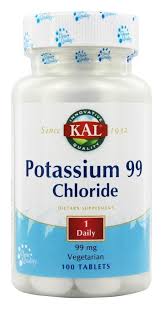
How many neutron are in the atom "K"?
a)
7
b)
2
c)
39
d)
20
72.
A universal indicator measures ___________.
a)
Acidity
b)
pH
c)
Ions
Ions
d)
Alkali levels
73.
A chemical reaction that produces energy is a /an
a)
endothermic reaction
b)
exothermic reaction 
c)
energy
d)
chemical reaction 
74.

What is the formula for magnesium chloride?

a)

MgCl

b)

Mg2Cl

c)

MgCl2

d)

Mg(ClO3)2

75.

Because the overall charge in a compound must be ____________, the charge of iron in Fe2O3 can be calculated as 3+.

a)

2+

b)

1+

c)

0

d)

1-

76.
Which of these is covalent?
a)
NaCl
b)
Pb(NO3)2
c)
CO2
d)
AlCl3
77.
When an atom loses a valence electron, it becomes a(n) _____________ ion.
a)
positive
b)
negative
c)
neutral
d)
polyatomic
78.
Predict the bond that will form between Be and F.
a)
Ionic
b)
Covalent
79.
What type of bond is this?
a)
ionic
b)
covalent
80.
Where are metals located on the periodic table?
a)
Blue
b)
Green
c)
Red
81.
Where are the nonmetals located on the periodic table? 
a)
Blue
b)
Red
c)
Green
82.
LiF
a)
Ionic Bond
b)
Covalent Bond
c)
Both bonds
d)
Neither bond
83.

Group 15 elements have what charge in ionic form?

a)

-1

b)

-3

c)

+3

d)

+4 or -4

84.
When balancing equations a ____ can be placed to the left of a formula of a substance to make the equations balanced
a)
charge
b)
subscript
c)
random number
d)
coefficient
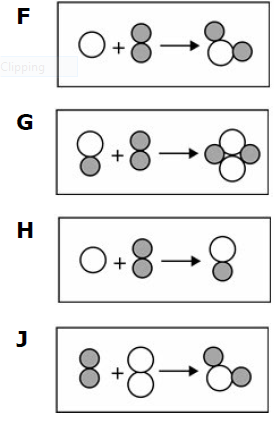
85.
Which of the following models best demonstrates a balanced chemical equation?
a)
F
b)
G
c)
H
d)
J
86.
All of the following reactions are correctly balanced except-
a)
A
b)
B
c)
C
d)
D
87.
Balance this equation
_Al +_HCl --> _H+_AlCl3
a)
2, 6, 3, 2
b)
it is already balanced
c)
4, 12, 3, 4
d)
2, 1, 4, 5
88.
What is the atomic number of this atom?
a)
1
b)
3
c)
4
d)
7
89.
What is the mass number of this atom?
a)
4
b)
5
c)
9
d)
none of the above
90.
What is the atomic number of this atom?
a)
9
b)
10
c)
19
d)
27
91.
What is the mass number of this atom?
a)
9
b)
10
c)
19
d)
27
92.
Most of the mass in an atom is made up of _____________________?
a)
protons and electrons
b)
protons and neutrons
c)
neutrons and electrons
d)
electrons and quarks
93.
Atoms of the same element which have a different number of neutrons are called _________________.
a)
ions
b)
isotopes
c)
quarks
d)
molecules
94.
an element has nucleon number 12 and atomic number  6. the number of neutrons in it is:
a)
6
b)
10
c)
4
d)
8
95.
In a correctly written symbol what would be located in the "A" position?
a)
number of neutrons
b)
atomic number
c)
number of electrons 
d)
mass number
96.
What are valence electrons?
a)
electrons on the first orbital always
b)
nucleus
c)
the outermost shell
d)
the number of electrons on the outermost orbital
97.
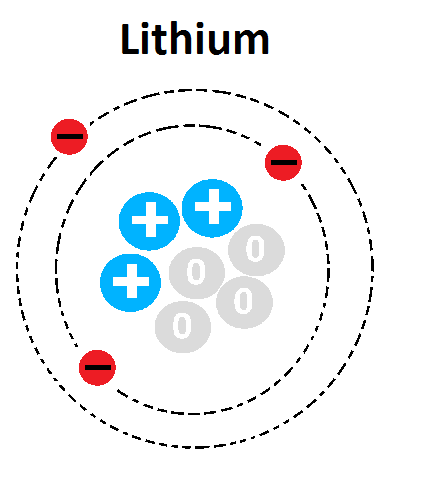
How many neutrons does the isotope of lithium have?
a)
8
b)
3
c)
4
d)
5
98.
Changing the number of electrons in an atom changes its...
a)
element type.
b)
charge.
c)
isotope type.
d)
atom type.
99.
Changing the number of neutrons in an atom changes its...
a)
element type.
b)
mass (weight).
c)
charge.
d)
atom type.
100.
When there are more protons than electrons in an atom it is a...
a)
positive ion.
b)
negative ion.
c)
unstable isotope.
d)
neutral atom.
101.
How many electrons can the first energy level hold?
a)
1
b)
2
c)
8
d)
0
102.
What is a cation
a)
a metal with a negative (-) charge
b)
a non-metal with a negative (-) charge 
c)
a metal with a positive (+) charge 
d)
a non-metal with a positive (+) charge
103.
Why does K become positive when it bonds to Cl to form KCl?
a)
Because it loses an electron to have a full valence shell 
b)
Because it gains an electron to have 2 valence electrons
c)
Because it loses an electron to become negatively charged
d)
Because Cl gives away its 7 electrons to Na to form an equal charge 
104.
Ionic compounds tend to be _________ whereas covalent compounds tend to be ______ or _____
a)
solids // liquids or gases
b)
liquids // solids or gases
c)
gases // solids or liquids
d)
solids // solids or liquids 
105.
Why does CO2 not have a charge? 
a)
The metal gives away an electron to the non-metal
b)
The metal takes the electron from the non-metal
c)
The non-metals equally share electrons
d)
The metal and the non-metal equally share electrons
106.
Which of the following is NOT an ionic compound:
a)
CaO
b)
NaOH
c)
BaCl2
d)
Br2
107.
In general, this type of bond will form a compound with a high melting point.
a)
Ionic
b)
Covalent
108.
A group of covalently bonded atoms that acts together as one charged atom is a ______.
a)
crystal
b)
molecule
c)
negative ion
d)
polyatomic ion
109.
A neutralisation reaction is a reaction between 
a)
Acid and a Base 
b)
Acid and water 
c)
Base and water 
d)
None of the above 
110.
The formula HCl stands for ____.
a)
hydrochloric acid
b)
hydrogen peroxide
c)
sodium hydroxide
d)
the hydronium ion
111.
Why must chemical equations be balanced?
a)
So that the equation doesn't explode
b)
The reaction won't happen until it is balanced
c)
Matter cannot be created or destroyed
d)
None of these