wayground logo

Free Printable Worksheets

Font size

S
M
L
XL
Worksheets

DNA Structure and Replication

Total questions: 70

Worksheet time: 3hrs 25mins

Name
Class
Date
1.

Which of the following is found in the cells of all living things?

a)

chloroplasts

b)

nucleus

c)

mitochondrion

d)

genetic material

2.

Which of the following molecules holds the information needed to direct cellular processes?

a)

phenylalanine

b)

adenosine triphosphate

c)

chlorophyll

d)

deoxyribonucleic acid

3.

The information in DNA is written according to the genetic code and carried by the -

a)

sequence of nitrogen bases/nucleotides

b)

direction of the phosphate groups

c)

hydrogen bonds between nitrogen bases

d)

enzymes which unwind the double helix

4.

What do we call the shape a DNA molecule takes?

a)

double-stranded

b)

double helix

c)

sugar-phosphate backbone

d)

pentagon

5.

What are the names of the large structures of DNA which are used to package the genetic information within cells?

a)

enzymes

b)

ribosomes

c)

chromosomes

d)

vitamins

6.

Which of the following is the correct pairing of nitrogen bases?

a)

A-T, G-C

b)

A-G, T-C

c)

A-C, G-T

d)

A-A, T-T

7.

What is the appropriate base pairing sequence to match this strand?


5' ATGTTCACT 3'

a)

3' ATGTTCACT 5'

b)

3' TACAAGTGA 5'

c)

3' TCACTTGTA 5'

d)

3' ATGTTGAGT 5'

8.

True or False: The genetic code is different for every organism.

a)

True

b)

False

9.

Which numbered component is a nucleotide?

a)

1

b)

2

c)

3

d)

4

10.

Which numbered component is a deoxyribose sugar?

a)

1

b)

2

c)

3

d)

4

11.

Which numbered component is a phosphate group?

a)

1

b)

2

c)

3

d)

4

12.

Which numbered component represents nitrogen bases?

a)

1

b)

2

c)

3

d)

4

13.

The picture shows an x-ray diffraction of DNA. The x-ray diffraction of DNA

led to the idea that the structure of DNA is in the form of —

a)

globular proteins

b)

beta sheets

c)

a double helix

d)

polypeptide chains

14.

In a sample of DNA, it is determined that 22% of the bases are adenine and 22% of the bases are thymine. What conclusion were scientists eventually able to draw from this data?

a)

adenine and thymine are identical

b)

adenine pairs with thymine

c)

adenine is in DNA and thymine is in RNA

d)

the sample contained RNA contaminants

15.
What type of cell has a nucleus? 
a)
eukaryotic
b)
prokaryotic 
16.

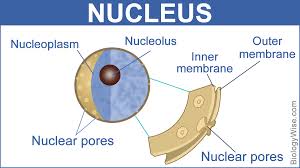
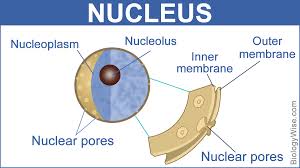
Directs all cell activities through the DNA located there.

a)

Endomembrane System

b)

Nucleus

c)

Ribosomes

d)

Mitochondria

17.

Made up of two layers (an inner and an outer), this acts like a cushiony outer shell of protection.

a)

nucleoplasm

b)

nuclear pores

c)

nuclear membrane

d)

nucleolus

18.

Tiny holes in the nuclear membrane that allow different cellular materials to come in and go out of the cell.

a)

nucleus

b)

nucleoplasm

c)

nucleolus

d)

nuclear pores

19.

Helps assemble ribosomes, which are combinations made of protein and RNA (ribonucleic acid ).

a)

nuclear membrane

b)

nuclear pores

c)

nucleoplasm

d)

nucleolus

20.

A double stranded helix that holds the code for all the cells in the body.

a)

RNA

b)

DNA

c)

Chromatin

d)

Nucleus

21.

What is the nucleus?

a)

A part of the cell that tells everything else what to do.

b)

An organ that makes you healthy.

c)

A wall that protects everything in the cell.

22.

What is the function of the nucleus?

a)

The nucleus gives the cell energy

b)

The nucleus protects the cell from outside things

c)

The nucleus controls what happens in the cell

d)

The nucleus does not have a job in the cell

23.

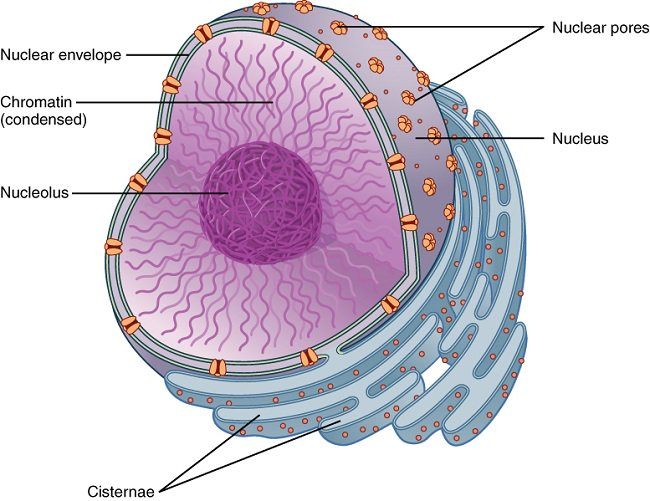
Identify "B"

a)

Nucleus

b)

Nuclear pores

c)

Chromatin

d)

Ribosomes

24.

How is DNA packaged into Chromosomes?

a)

Wrapped around nucleosomes

b)

Chromatin coiled and condensed

c)

Long and loose

d)

In a double strand

25.

What is the function of nuclear pores?

a)

for the nucleus to breath

b)

to allow in/out of nucleus

c)

to store new DNA inside the nucleus

d)

to remove old DNA from nucleus

26.
Who is responsible for producing this image?
a)
Francis Crick
b)
James Watson
c)
Rosalind Franklin
d)
Watson and Crick
27.
How did Rosalind Franklin's photo 51 affect the work of Watson and Crick?
a)
It was used to determine the physical structure of DNA
b)
It was used to identify the four bases that make up DNA
c)
It was used to determine the theory of independent assortment
d)
It was used to show DNA was the molecule of inheritance
28.
What did Erwin Chargaff conclude from his experiments?
a)
Nitrogen bases are held together by peptide bonds
b)
A and T, C and G always occur in equal amounts
c)
Proteins are the carriers of genetic information
d)
C and G rarely occur in eukaryotic organisms
29.
What was Watson and Crick's main scientific accomplishment?
a)
Building the first accurate model of DNA
b)
Isolating strains of pneumonia causing bacteria
c)
Determining base pairing rules
d)
Discovering the process of genetic transformation
30.
From his work with mice and pneumonia-causing bacteria, Frederick Griffith discovered what?
a)
Replication
b)
Transcription
c)
Transformation
d)
Translation
31.
By using radioactive isotopes, Hershey and Chase were able to conclude that _____ is the carrier of genetic information.
a)
DNA
b)
Protein
c)
Carbohydrate
d)
Lipid
32.
Rosalind Franklin's "Photo 51" allowed Watson and Crick to determine the _______ of DNA.
a)
Shape
b)
Backbone
c)
Nitrogen bases
d)
Hydrogen bonds
33.
The work of Erwin Chargaff allowed Watson and Crick to determine the rules of.......
a)
protein synthesis
b)
transcription
c)
hydrogen bonding
d)
nitrogen base pairing
34.
The work of scientists including Griffin, Avery, Hershey & Chase, and Franklin helped us to determine that _______ are responsible for carrying genetic material.
a)
Amino Acids
b)
Proteins
c)
Nucleic Acids
d)
Carbohydrates
35.
Who was responsible for the model shown?
a)
Oswald Avery
b)
Watson and Crick
c)
Erwin Chargaff
d)
Rosalind Franklin
36.
This scientist(s) found a "transforming principle" that changed harmless bacteria into harmful bacteria
a)
Mendel
b)
Avery
c)
Chargraff
d)
Griffith
37.
This scientist(s) conducted experiments that involved injecting mice with S bacteria and R bacteria.
a)
Avery
b)
Griffith
c)
Watson & Crick
d)
Hershey & Chase
38.
Avery added an enzyme known to break down proteins to his extract, and saw that the bacteria were ____________________
a)
still transformed
b)
not transformed
c)
all killed
d)
all sick
39.
Avery added an enzyme known to break down DNA to his extract, and saw that the bacteria were __________________
a)
still transformed 
b)
not transformed
c)
all sick
d)
all killed
40.
By using radioactive isotopes, Hershey and Chase were able to conclude that __ is/are the carrier(s) of genetic information.
a)
nucleic acid
b)
Proteins
c)
Carbohydrates
d)
Lipids
41.
Which enzyme has the job of unzipping the double helix?
a)
Helicase
b)
Polymerase
c)
Ligase
d)
Primerase
42.
Which enzyme fixes the Okazaki fragments in the lagging strand?
a)
Helicase
b)
Polymerase
c)
Ligase
d)
Primerase
43.
If a strand reads:
3' A A A T T T C 5'
The matching strand would read...
a)
5' T T T A A A G 3'
b)
3' T T T A A A G 5'
c)
5' A A A T T T C 3'
d)
3' U U U A A A G 5'
44.
What are the gaps between the newly synthesized DNA on the lagging strand called?
a)
Okazaki fragments
b)
Polymer gaps
c)
Helicase fragments
d)
Acidic gaps
45.
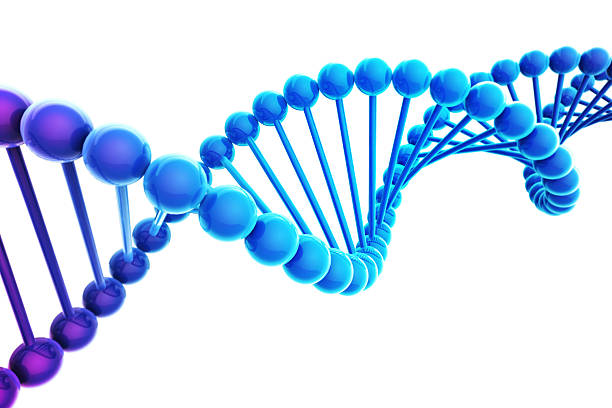
This picture is illustrating the ____ nature of DNA.
a)
anti-parallel
b)
deoxyribosic
c)
helical
d)
radioactive
46.
The enzyme that splits open the DNA creates what's called a fork - where the DNA separates into the lagging strand and the ______ strand.
a)
leading
b)
leveraging
c)
Okazaki
d)
ligase
47.
Polymerase is able to replicate the new DNA ______ along the leading strand.
a)
continuously
b)
only in short fragments
c)
very slowly
d)
prokaryotically
48.
A DNA nucleotide contains all of the following, except...
a)
Deoxyribose
b)
Phosphate group
c)
Nitrogenous base
d)
Cholesterol
49.
DNA replication turns one strand of DNA into two new strands of DNA. What percent of each new strand is the old strand?
a)
Half of each new DNA is the old DNA
b)
The old strand of DNA was digested, so none
c)
The new DNA is entirely made up of the old DNA
d)
About every sixth base comes from the old DNA
50.
Sometimes, DNA is called "semi-conservative." Why might this be?
a)
The old strand is "conserved" and used to make the new strands
b)
Uracil is "conserved" in that it is only used to make the new strands
c)
ATP is "conserved" via the usage of facilitated diffusion
d)
Ligase is "conserved" in that it is denatured by the process
51.
Which sequence of DNA bases would pair with this partial strand
CAT TCA CTG
a)
ATG TGA CAG
b)
TAC ACT GTC
c)
GTA AGT GAC
d)
CAT TCA CTG
52.
Place the following in sequential order
1. Recoil
2. Straightens the double helix
3. Breaks Hydrogen bonds
4. Adds Free nucleotides
a)
1, 2, 3, 4
b)
3, 4, 2, 1
c)
3, 2, 4, 1
d)
2, 3, 4, 1
53.
Why does DNA replicate?
a)
To create another copy for the new cell
b)
To create a duplicate copy in case the original gets damaged
c)
To create a new copy to replace the damaged original
54.

DNA replication results in

a)

2 completely new DNA molecules

b)

2 DNA molecules that each contain a strand of the original

c)

1 new DNA molecule and 1 old

d)

1 new molecule of DNA

55.

The new DNA strand formed after DNA replication is an exact copy of its parent strand

a)

True

b)

False

56.

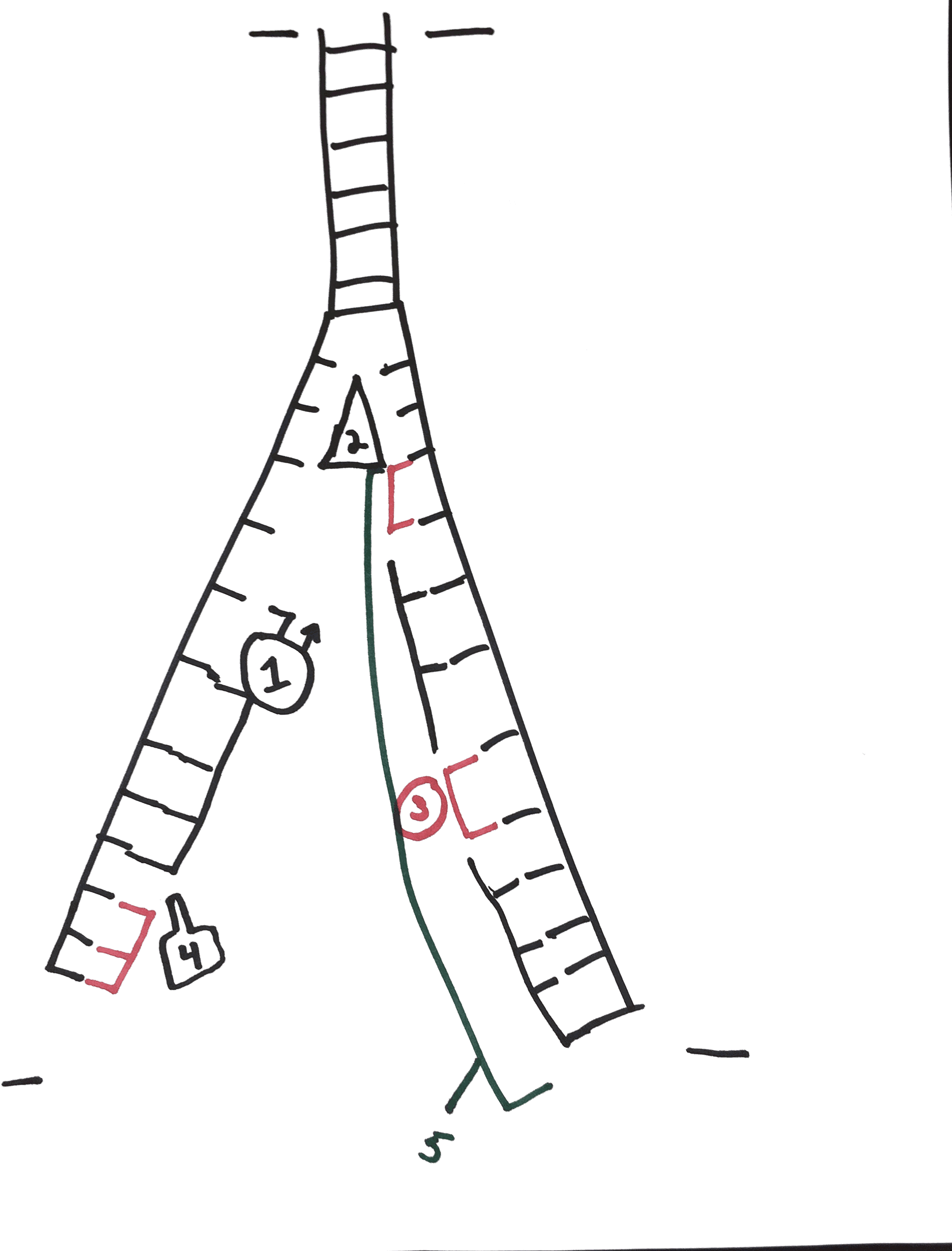
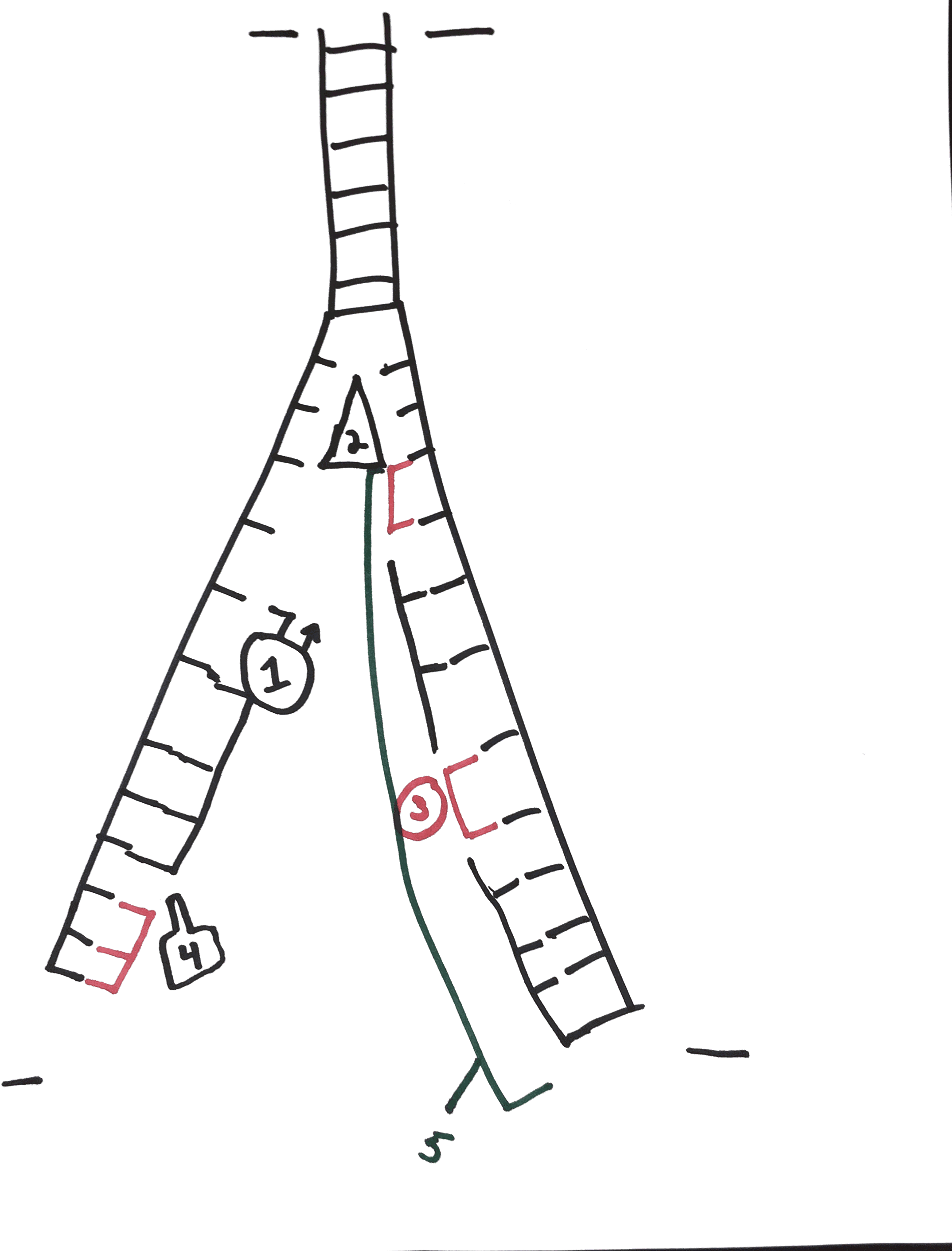
#1 in the picture above (builder)

a)

Helicase

b)

Primase

c)

Polymerase

d)

Ligase

57.

#4 in the picture

a)

Polymerase

b)

Primase

c)

Helicase

d)

Ligase

58.

Which is the first step?

a)

DNA Helicase unwinds original DNA strand

b)

RNA Primase lays down RNA primer for new nucleotide bases.

c)

DNA polymerase builds new strands by bring in new nucleotide bases.

d)

Ligase knits together fragments on lagging strand

59.

Which is the second step?

a)

DNA Helicase unwinds original DNA strand

b)

RNA Primase lays down RNA primer for new nucleotide bases.

c)

DNA polymerase builds new strands by bring in new nucleotide bases.

d)

Ligase knits together fragments on lagging strand

60.

Which is the third step?

a)

DNA Helicase unwinds original DNA strand

b)

RNA Primase lays down RNA primer for new nucleotide bases.

c)

DNA polymerase builds new strands by bring in new nucleotide bases.

d)

Ligase knits together fragments on lagging strand

61.

If a person suffered from a disorder where their DNA fragments were unable to fill in the missing slots in between the fragments of the lagging strand, they would most likely have a disorder that affected which enzyme?

a)

DNA Helicase

b)

DNA Ligase

c)

DNA polyermase

d)

RNA Polymerase

62.

Okazaki fragments appear on which strand of DNA during DNA replication?

a)

lagging

b)

leading

63.

Tiny holes in the nuclear membrane that allow different cellular materials to come in and go out of the cell.

a)

nucleus

b)

nucleoplasm

c)

nucleolus

d)

nuclear pores

64.

Helps assemble ribosomes, which are combinations made of protein and RNA (ribonucleic acid ).

a)

nuclear membrane

b)

nuclear pores

c)

nucleoplasm

d)

nucleolus

65.

String-like structures inside the nucleus made up of proteins and deoxyribonucleic acid, better known as DNA.

a)

cytoplasm

b)

ribosomes

c)

mitochondria

d)

chromatin

66.

Helps assemble ribosomes, which are combinations made of protein and RNA (ribonucleic acid ).

a)

nuclear membrane

b)

nuclear pores

c)

nucleoplasm

d)

nucleolus

67.

The type of bond that holds the nucleotides together in DNA is..

a)

ionic

b)

covalent

c)

hydrogen

68.

The sides of the DNA ladder (sugar and phosphate) are held together by ____________________ bonds.

a)

covalent

b)

ionic

c)

metallic

d)

hydrogen

69.

The three functions of DNA are....

a)

to store information

b)

to transmit information

c)

to copy information

d)

to damage information

70.

DNA coils around ___________________ to help it compact and fit inside of the nucleus.

a)

ribosomes

b)

histones

c)

polymerase

d)

helicase