Wayground logo

Free Printable Worksheets

Font size

S
M
L
XL
Worksheets

Year 7 Semester 2 Review

Total questions: 81

Worksheet time: 1hrs 3mins

Name
Class
Date
1.
This photos shows water molecules in which state of matter...
a)
Solid
b)
Liquid
c)
Gas
2.
Which of the following describes water molecules in the liquid state?
a)
Water molecules that are not moving at all.
b)
Water molecules that are moving at an extremely rapid rate.
c)
Water molecules that are broken apart a little bit and moving slightly.
d)
Water molecules that are made of hydrogen and oxygen.
3.
How does adding thermal energy to water in a liquid state affect the molecules?
a)
Adding thermal energy to a liquid causes the molecules to break apart form a crystal formation and begin to move.
b)
Adding thermal energy to a liquid causes the molecules to break apart even more and move at rapidly.
c)
Adding thermal energy to a liquid causes the molecules to slow down and begin to bond.
4.
This photo shows water molecules in which state of matter?
a)
Gas
b)
Liquid
c)
Solid
5.
How does removing thermal energy in a gaseous state affect the molecules?
a)
Removing thermal energy from a gas causes the molecules to slow down and bond in a crystal formation.
b)
Removing thermal energy from a gas causes the molecules to move very rapidly.
c)
Removing thermal energy from a gas causes the molecules to slow down and begin to bond with each other.
6.
Which of the following describes water molecules in the solid state?
a)
Water molecules that are moving at an extremely rapid rate.
b)
Water molecules that are made of hydrogen and oxygen.
c)
Water molecules that are not moving at all.
d)
Water molecules that are broken apart a little bit and moving slightly.
7.
Which atoms bond together to create a water molecule?
a)
Oxygen and Hydrogen
b)
Carbon and Oxygen
c)
Hydrogen and Helium
d)
Helium and Carbon
8.
What are water's unique properties?
a)
It is what humans drink.
b)
It is everywhere.
c)
It is clear.
d)
It can be all 3 states of matter.
9.
What is a water molecule composed of?
a)
1 Hydrogen atom and 2 Oxygen atoms
b)
2 Hydrogen atoms and 1 Oxygen atom
c)
3 Oxygen atoms
d)
2 Helium atoms and 1 Oxygen atom
10.
This photo shows water molecules in which state of matter?
a)
Liquid
b)
Solid
c)
Gas
11.
How does removing thermal energy to water in a liquid state affect the molecules?
a)
Removing thermal energy from a liquid causes the molecules to stay the same.
b)
Removing thermal energy from a liquid causes the molecules to move rapidly and break apart more.
c)
Removing thermal energy from a liquid causes the molecules to stop moving and bond in a crystal formation.
12.
A water molecule looks like _____.
a)
smiley face
b)
mickey mouse
c)
a long chain of atoms
d)
grumpy cat
13.
What is the chemical formula for water?
a)
2HO
b)
H2O
c)
HO2
d)
H2O2
14.
Which letter represents hydrogen?
a)
A
b)
B
c)
C
d)
D
15.
Which letter represents oxygen?
a)
A
b)
B
c)
C
d)
D
16.
Because water has a positive and a negative end, and is attracted to other molecules it is called a ______ molecule.
a)
mickey mouse
b)
polar (tiny magnet)
c)
special
d)
miracle
17.
The property where water molecules are attracted to other water molecules.
a)
adhesion
b)
capillary action
c)
cohesion
d)
universal solvent
18.
The property where water molecules are attracted to other types of molecules (surfaces).
a)
adhesion
b)
capillary action
c)
cohesion
d)
universal solvent
19.
The property where water can dissolve almost all substances on Earth.
a)
adhesion
b)
capillary action
c)
cohesion
d)
universal solvent
20.
Why can some insects walk on water?
a)
The water sticks to the insect.
b)
The insect is too light to break the surface tension.
c)
The insect has hydrophobic oils on its legs.
d)
Insects can't walk on water.
21.

Which would NOT increase the rate at which a sugar cube dissolves?

a)

Reducing the amount of solvent

b)

Crushing the sugar cube

c)

Stirring the solution

d)

Heating the solvent

22.

You can make a solute dissolve more quickly in a solvent by

a)

adding more solute.

b)

adding ice.

c)

heating the solvent.

d)

removing some solvent.

23.

A solution that contains all of the solute it can hold at a given temperature is

a)

diluted.

b)

saturated.

c)

supersaturated.

d)

unsaturated.

24.

The amount of solute that can be dissolved in a specific amount of solvent at a given temperature is its

a)

concentration.

b)

density.

c)

dilution.

d)

solubility.

25.
A solution is a kind of ________. 
a)
mixture 
b)
compound 
c)
element 
d)
stuff 
26.
The _____is the part that gets dissolved. 
a)
solute 
b)
solvent 
c)
solution 
d)
Sacajawea 
27.
A solution is a ________ mixture. 
a)
heterogeneous 
b)
homogeneous 
c)
dumb 
d)
mixed 
28.

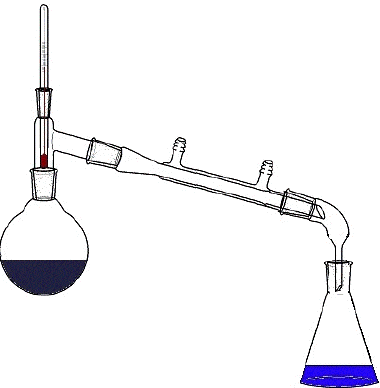
To separate a mixture of salt and water what separation tool/method is used?

a)

Filter

b)

Sieve

c)

Magnet

d)

Evaporation

29.

If you spilled nails in a sandbox, what separation tool/method could you use to clean out the sandbox so it would be safe for children to play in?

a)

Filter

b)

Screen

c)

Magnet

d)

Evaporation

30.

Which of the following is a method of separating solutions?

a)

hand seperation

b)

filtering

c)

screening

d)

evaporation

31.

Sand and gravel may be separated from each other through using..

a)

a filter funnel

b)

a sieve

c)

an evaporating basin

d)

a distillation

32.

The best way to separate trail mix would be:

a)

filter

b)

by hand

c)

sieve

d)

evaporation

33.

What tool is this?

a)

sieve

b)

filter

34.

This type of paper allows liquid to pass through it. What tool is it?

a)

sieve

b)

filter

35.
What is the relationship between mixtures and solutions?
a)
All mixtures are solutions.
b)
Mixtures and solutions are the same.
c)
Mixtures must be solid and solutions must be liquid.
d)
All solutions are mixtures
36.
Pouring a mixture through a paper which allows only the liquid to pass through is called __________________.
a)
Filtration
b)
Sifting
c)
Chromatography
d)
Evaporation
37.
Pouring a mixture through a paper which allows only the liquid to pass through is called __________________.
a)
Filtration
b)
Sifting
c)
Chromatography
d)
Evaporation
38.
Water and alcohol are easily separated by distillation because of their
a)
 different melting points
b)
different colours
c)
different densities
d)
different boiling points
39.
A system made up of organisms interacting with one another
a)
biology
b)
abiotic
c)
biotic
d)
ecosystem
40.
Organisms that make up the living part of an ecosystem.
a)
abiotic
b)
biotic factors
c)
ecology
d)
ecosystems
41.
Nonliving things found in an ecosystem.
a)
factories
b)
factor trees
c)
biotic factors
d)
abiotic factors
42.
Deserts, mountains, and rivers are all examples of ________.
a)
vacation spots
b)
tundra
c)
ecosystems
d)
wetlands
43.
Ecosystems are always______.
a)
always changing
b)
always balanced
c)
never changing
d)
never balanced
44.
Which animal is the apex predator?
a)
hawk
b)
lizard
c)
snake
d)
grass
45.
Trophic levels are represented by 
a)
squares
b)
circles
c)
pyramids
d)
lines
46.
Which animal is not the apex predator but, a predator to a mouse?
a)
hawk
b)
rabbit
c)
snake
d)
grass
47.
Why is a shark a carnivore.
a)
because it eats seaweed
b)
because it eats dead animals
c)
because it eats sand 
d)
because it eats other animals
48.
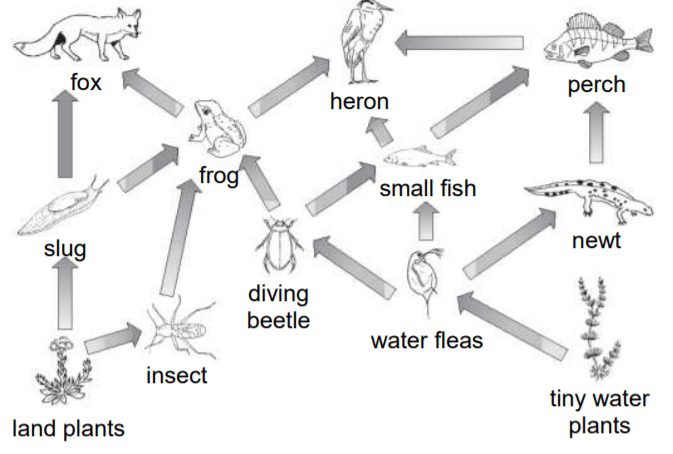
The arrows in a food chain or web represents what?
a)
They point to the organism that is being eaten.
b)
It shows how sunlight flows within an ecosystem.
c)
They show what direction the energy is flowing between organisms. 
d)
They represent how water is transferred within a habitat.
49.
An organism that gets energy from breaking down dead organisms, non-living material or waste is a(an) ___________.
a)
producer
b)
consumer
c)
decomposer
d)
autotroph
50.
Organisms that create their own energy from sunlight or chemicals
a)
Herbivore
b)
Omnivore
c)
Autotroph
d)
Heterotroph 
51.
Eat primary consumers (can be carnivores and omnivores)
a)
Tertiary Consumers
b)
Secondary Consumers
c)
Quaternary Consumers 
d)
Top Predators 
52.
An organism that obtains energy from eating meats
a)
Omnivores
b)
Carnivores
c)
Herbivores
d)
Animals 
53.
An organism that obtains energy by consuming plants and animals.
a)
Omnivores
b)
Carnivores
c)
Herbivores
d)
Humans 
54.
An organism that uses an outside source of energy like the sun to create energy-rich food molecules.
a)
Consumer
b)
Producer
c)
Decomposer
d)
Parasite 
55.
The process of plants using energy from the sun to create the first trophic level is called?
a)
Photosynthesis
b)
Chemosynthesis
c)
Cellular Respiratation
d)
Primary Producers
56.

Producers are ...

a)

plants

b)

able to do photosynthesis

c)

also called autotrophs

d)

all of these are true

57.

Arrows in a food web represent...

a)

eating

b)

sunlight

c)

energy

d)

matter

58.

Photosynthesis is important because...

a)

it makes carbon dioxide

b)

it makes food for the food webs

c)

it makes water

d)

it's not important

59.

All of these are types of consumers except...

a)

omnivores

b)

carnivores

c)

decomposers

d)

herbivores

60.

In photosynthesis, which are the products?

a)

carbon dioxide, water

b)

oxygen, glucose

c)

sunlight, oxygen

d)

water, soil

61.

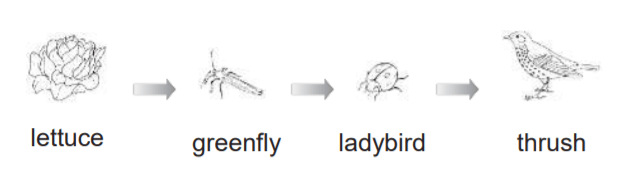
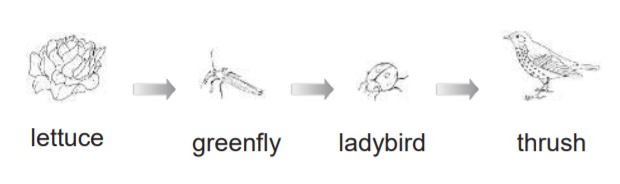
Who is the producer?

a)

lettuce

b)

greenfly

c)

ladybird

d)

thrush

62.

Who is the herbivore?

a)

lettuce

b)

greenfly

c)

ladybird

d)

thrush

63.
a)

This is a food chain

b)

This is a food web

c)

This is an energy pyramid

64.

The original source of energy for a food web is...

a)

plants

b)

sun

c)

producers

d)

decomposers

65.

The energy transformation for photosynthesis

a)

chemical to water

b)

light to radiant

c)

thermal to chemical

d)

radiant to chemical

66.

Decomposers get energy from...

a)

the sun

b)

eating plants

c)

eating animals

d)

dead things and waste

67.
What is the genus name here:
Canis lupus
a)
Canis
b)
lupus
68.
Choose the correct way to write the scientific name for humans:
a)
homo sapiens
b)
Homosapiens
c)
Homo sapiens
d)
Homo Sapiens
69.
The scientific name for water bear is Hypsibius dujardini.  What is its genus?
a)
Hypsibius 
b)
dujardini
c)
water 
d)
tardigrade
70.
The scientific name for water bear is Hypsibius dujardini.  What is its species?
a)
Hypsibius 
b)
dujardini
c)
water 
d)
tardigrade
71.
In a properly written scientific name, which part is lowercase?
a)
species
b)
genus
72.
In a properly written scientific name, which part is capitalized?
a)
species
b)
genus
73.
The 8 levels of classification, most broad to most specific.
a)
Domain, Genus, Family, Order, Class, Phylum, Kingdom, Species
b)
Domain, Species, Kingdom, Genus, Phylum, Family, Class, Order
c)
Domain, Kingdom, Phylum, Class, Order, Family, Genus, Species
d)
Order, Kingdom, Species, Domain, Phylum, Family, Class, Genus
74.
Giving living things a two part name is called
a)
Taxonomy
b)
Binomial Nomenclature
c)
Classification
d)
Kingdom Phylum
75.

The largest grouping of organisms is ____________________ and the smallest is _________________________________.

a)

Domain, species

b)

Domain, kingdom

c)

Species, domain

d)

Kingdom, species

76.
Which kingdom would this organism belong to?
a)
Protist
b)
Plant
c)
Animal
d)
Fungi
77.
What organism possesses these traits?
a)
A. Eubateria
b)
B. Fungi
c)
C. Plantae
d)
D. Monera
78.
The hyphae seen in bread mold is characteristic of which kingdom?
a)
Fungi
b)
Bacteria
c)
Archaea
d)
Plants
79.

Kingdom that can be single celled or many celled, plantlike or animal-like, may eat food for energy or even make their own food for energy

a)

Eubacteria

b)

Plant

c)

Animal

d)

Protists

80.

Many celled organism where all species move and get energy by eating food

a)

Plants

b)

Animals

c)

Protists

d)

Fungi

81.

Fuzzy, black mold growing on bread or green mold on fruit are examples of which kingdom?

a)

Protists

b)

Archaebacteria

c)

Eubacteria

d)

Fungi