Wayground logo

Free Printable Worksheets

Font size

S
M
L
XL
Worksheets

Honors Chem 3.1-3.7 REVIEW

Total questions: 110

Worksheet time: 2hrs 2mins

Name
Class
Date
1.
Covalent bonds are between...
a)
Metal and Non-metal
b)
Non-metal and Non-metal
c)
Metal and Metal
2.
Is hydrogen considered a metal or a non-metal?
a)
A metal
b)
Nonmetal
c)
Metalloid
3.
What is a valence electron?
a)
The sum of neutrons and protons.
b)
The # of electrons in the last shell.
c)
A type of bond.
d)
A popular compound.
4.
Ionic bonds are between...
a)
Metal and Non-metal
b)
Non-metal and Non-metal
c)
Metal and Metal
5.
Atoms are most stable when their outer shell is complete.
a)
true
b)
false
6.
How are covalent bonds formed?
a)
Sharing of electrons
b)
Transfer of electrons
7.
How are ionic bonds formed?
a)
Transfer of electrons
b)
Sharing of electrons
8.
Why do elements bond?
a)
To be friends
b)
To create a new element
c)
To become stable
9.
The following statements are true for ionic bonding EXCEPT
a)
bonding between metal and non metal
b)
electrostatic forces between opposite charges
c)
transferring of electrons
d)
sharing of electrons
10.
Ionic or covalent?
NaBr
a)
Ionic
b)
Covalent
11.
Ionic or covalent?
H2O
a)
Ionic
b)
Covalent
12.
Ionic compounds form because _______ charges attract.
a)
opposite
b)
like
13.
Which is most likely to form an ion of -1?
a)
an element from group 17
b)
a metal
c)
an element from group 1
d)
an element with atoms that have eight valence electrons
14.
Which of the following compounds does NOT contain molecules?
a)
H2
b)
NaCl
c)
CO2
d)
H2O
15.
In the compound MgCl2, the subscript 2 indicates that
a)
There are two magnesium ions for each ion of chlorine
b)
The chloride ion is twice the size of the magnesium ion
c)
Magnesium and chlorine form a double covalent bond.
d)
There are two chloride ions for each magnesium ion.
16.
Beryllium, Be, and chlorine, Cl, form an ionic compound. In order for the compound to be neutral, what must the formula look like?
a)
Be2Cl
b)
2BeCl
c)
BeCl2
d)
Be2Cl2
17.
MgO is an ionic compound. What is its name?
a)
Manganese Oxide
b)
Magnesium Oxide
c)
Magnesium Monoxide
d)
Magnesium(II) Oxide
18.
What is the proper name for the covalent compound, CCl4
a)
Carbon Chloride
b)
Carbon Quadrachloride
c)
Carbon Tetrachloride
d)
Carbon Dichloride
19.
What is the proper name for the covalent compound N3F8?
a)
Nitrogen Flouride
b)
Nitrogen Fosfate
c)
Trinitrogen Octaflouride
d)
Nitrogen Pentaflouride
20.

Why do all bonds form?

a)

so the number of protons equals the number of electrons

b)

so an atom can become unstable

c)

to fill the outermost energy level

21.

An atom with 3 valence electrons "wants" a full shell, so it can either gain 5 or lose 3. Which is more likely to occur?

a)

Gain 5

b)

Lose 3

c)

Nothing

22.

How many Aluminum atoms are in Al2O3?

a)

3

b)

5

c)

2

d)

1

23.

Mg3N2

a)

Magnesium nitride

b)

Magnesium (II) nitride

c)

Trimagnesium dinitrogen

24.

How many valence electrons does hydrogen have?

a)

1

b)

2

c)

3

d)

4

25.

When an atom loses an electron, it becomes a

a)

positive ion

b)

negative ion

c)

neutral ion

d)

neutral atom

26.

What is the proper name for CH4?

a)

Monocarbon hydride

b)

Carbon tetrahydride

c)

Monocarbon tetrahydride

27.

What is the proper name for S2O2?

a)

Sulfur oxide

b)

Sulfur dioxide

c)

Sulfur (II) oxide

d)

Disulfur dioxide

28.

Zinc (II) Fluoride

a)

ZnF2

b)

ZnF

c)

Zn2F

d)

Zn2F4

29.

Sliver (I) Phosphide

a)

Ag3P

b)

Ag3PO4

c)

Ag3PO3

d)

AgP

30.
Na2S
a)
Sodium Sulfide
b)
Sodium Sulfate
c)
Sodium Sulfite
d)
Disodium Sulfide
31.
Manganese II Oxide
a)
MnO
b)
Mn2O
c)
Mn2O4
d)
MnO2
32.
The formula for iron(III) oxide is
a)
FeO
b)
Fe3O
c)
Fe2O3
d)
Fe3O2
33.

What is the name of Li3P?

a)

Trilithium phosphide

b)

Lithium III Phosophide

c)

Lithium Phosphate

d)

Lithium Phosphide

34.
What is the formula for magnesium chloride?
a)
MgCl
b)
Mg2Cl
c)
MgCl2
d)
Mg(ClO3)2
35.

What is the formula for selenium tetrafluoride

a)

SeF4

b)

SeF

c)

FSe4

d)

FSe

36.
Name BCl3
a)
boron chloride
b)
boron (III) chloride
c)
boron trichloride
d)
boron chlorine
37.

Give the name for OCl2

a)

oxygen dichloride

b)

oxygen chloride

c)

oxygen (II) chloride

d)

oxygen chlorate

38.
Give the formula for phosphorus trifluoride
a)
P3F
b)
PF
c)
PF3
d)
P3F3
39.
Name SO2
a)
monosulfur dioxide
b)
sulfur dioxide
c)
sulfur oxide
d)

sulfur (II) oxide

40.
PBr5
a)
Phosphorus Bromide
b)
Phosphorus Pentabromide
c)
Pentaphosphorus bromide
d)
Phosphorus Bromine
41.
Disulfur trioxide
a)
S3O2
b)
SO
c)
S2O3
d)
S2O
42.
Write the formula for Dinitrogen Pentaoxide.
a)
N5O2
b)
N2O5
c)
(N2O)5
d)
O5N2
43.
Which of the following molecular shapes would have a bond angle of 180 Degrees?
a)
Bent
b)
Trigonal Planar
c)
Tetrahedral
d)
Linear
44.
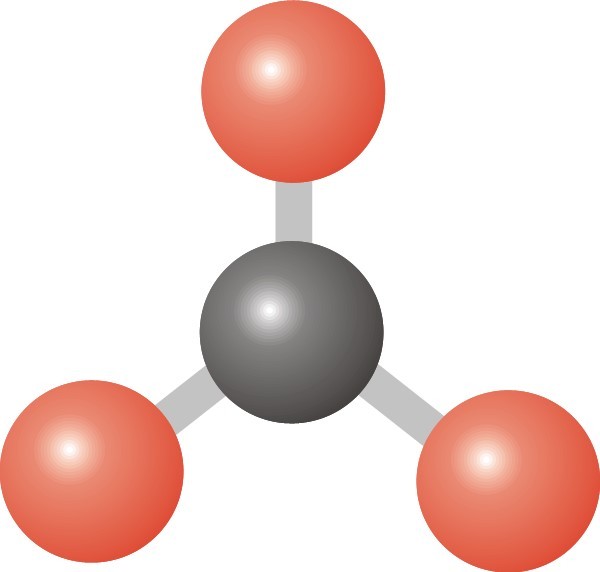
Which molecule would have this shape?
a)
BF3
b)
CH4
c)
PCl5
d)
CO2
45.
The bond angle for a trigonal planar molecule is 
a)
90 Degrees
b)
109.5 Degrees
c)
120 Degrees
d)
180 Degrees
46.
Which of these has a linear molecular shape?
a)
SCl2
b)
SiH4
c)
NH3
d)
O2
47.
What is the VSEPR theory used to predict?
a)
Bond Strength
b)
Polarity
c)
Molecular Shape
d)
Electronegativity
48.
According to VSEPR, molecules adjust their shapes to keep which of the following as far away as possible?
a)
Pairs of valence electrons
b)
Inner shell electrons
c)
Mobile Electrons
d)
Electrons closest to the nucleus
49.
What molecule could this be? 
a)
BF3
b)
CH4
c)
H2O
d)
CO2
50.
VSEPR stands for ________ theory.
a)
Valence Structure of Electron Pyramids and Regression
b)
Varied Structures of Electrons Paired and Replaced
c)
Varied Shell Energy of Protons and Radiation
d)
Valence Shell Electron Pair Repulsion
51.
 A lone pair is defined as
a)
A pair of bonding electrons
b)
One non-bonding electron
c)
A pair of non-bonding electrons
d)
A pair of electrons on the central atom
52.
How many electrons are shared in a triple bond?
a)
6
b)
3
c)
6 pairs
d)
5
53.
How many electrons are shared in a triple bond?
a)
6
b)
3
c)
6 pairs
d)
5
54.
Choose the correct shape for this molecule:
a)
Trigonal planar
b)
Trigonal pyramidal
c)
Tetrahedral
d)
Linear
55.
Choose the correct shape for this molecule:
a)
Trigonal planar
b)
Trigonal pyramidal
c)
Bent
d)
Linear
56.
Choose the correct shape for this molecule:
a)
Bent
b)
Trigonal pyramidal
c)
Trigonal planar
d)
Linear
57.
Choose the correct shape for this molecule:
a)
Trigonal planar
b)
Trigonal pyramidal
c)
Bent
d)
Tetrahedral
58.
Choose the correct shape for this molecule:
a)
linear
b)
Trigonal pyramidal
c)
Bent
d)
Tetrahedral
59.
Choose the correct shape for this molecule:
a)
Bent
b)
Trigonal pyramidal
c)
Tetrahedral
d)
Trigonal planar
60.
Will this molecule be polar or nonpolar? PH3
a)
polar
b)
nonpolar
61.
Will this molecule be polar or nonpolar? CCl4
a)
polar
b)
nonpolar
62.

A tightly-bound group of atoms that is covalently bonded, yet carries a net charge:

a)

monatomic ion

b)

polyatomic ion

63.

When naming a transition metal ion that can have more than one common ionic charge, the numerical value of the charge is indicated by a __________.

a)

prefix

b)

suffix

c)

superscript after the name

d)

Roman numeral following the name

64.

Which of the following is NOT a cation?

a)

iron (III) ion

b)

sulfate

c)

Ca2+

d)

sodium ion

65.

An -ate or -ite at the end of a compound name usually indicates that the compound contains _____________.

a)

fewer electrons than protons

b)

neutral molecules

c)

only two elements

d)

a polyatomic anion

66.

What is the correct formula for potassium sulfite?

a)

KHSO3

b)

KHSO4

c)

K2SO3

d)

K2SO4

67.

Which of the following compounds contains the lead(II) ion?

a)

PbO

b)

PbCl4

c)

Pb2O

d)

Pb2S

68.

Molecular compounds are usually _________.

a)

composed of two or more transition elements

b)

composed of positive and negative ions

c)

composed of two or more nonmetallic elements

d)

exceptions to the law of definite proportions

69.

What is the correct name for the compound CoCl2?

a)

cobalt(I) chlorate

b)

cobalt(I) chloride

c)

cobalt(II) chlorate

d)

cobalt(II) chloride

71.

What is the correct formula for barium chlorate?

a)

Ba(ClO)2

b)

Ba(ClO2)2

c)

Ba(ClO3)2

d)

BaCl2

71.

What is the correct formula for barium chlorate?

a)

Ba(ClO)2

b)

Ba(ClO2)2

c)

Ba(ClO3)2

d)

BaCl2

72.
Name the following ionic compound: LiNO3
a)
lithium nitrate
b)
lithium III nitrate
c)
lithium nitride
d)
lithium oxide
73.
Name the following ionic compound: MgSO4
a)
magnesium sulfoxide
b)
magnesium sulfide
c)
magnesium sulfate
d)
magnesium oxide
74.
What is the charge on the hydroxide ion?
a)
0
b)
-1
c)
-2
d)
-3
75.
The proper formula for magnesium hydroxide:
a)
MgOH
b)
Mg2OH
c)
Mg(OH)2
d)
Mg2OH2
76.

How many atoms total are in AlPO4?

a)

4

b)

5

c)

6

d)

7

77.
What is the formula for sodium nitrate?
a)
Na3NO
b)
NaNO
c)
Na3NO3
d)
NaNO3
78.
What is the formula for copper(I) sulfate?
a)
CuSO3
b)
CuSO4
c)
Cu2SO3
d)
Cu2SO4
79.
What is the formula for iron(II) carbonate?
a)
Fe2CO3
b)
FeCO3
c)
Fe2CO2
d)
FeCO4
80.
What is the formula for calcium carbonate?
a)
CaCO
b)
CaCO2
c)
CaCO3
d)
Ca3CO3
81.
Name this compound: 
Ca2CO3
a)
Calcium carbon oxide
b)
Calcium (II) carbonate
c)
Calcium carbonate
d)
Carbonate (I) calcide
82.
Find the formula zinc sulfate
a)
ZnSO3
b)
ZnSO4
c)
ZnS
d)
Zn(SO4)2
83.
What is the formula for copper (II) hydroxide?
a)
CuOH
b)
Cu(OH)2
c)
Cu2OH
d)
Cu2O
84.
What is the name of the polyatomic ion PO43-
Hint: Look at your periodic table of ions in the top box.
a)
phosphate
b)
phosphite
c)
carbonate
d)
hydroxide
85.
When are parenthesis used when writing ionic names?
a)
The compound contains at least one polyatomic ion.
b)
The compound contains multiple polyatomic ions.
c)
The compound has multiple cations.
d)
Formulas never contain parenthesis.
86.
What is the name for NH4+? This is the only common positive polyatomic ion.
a)
Chlorate
b)
Sulfate
c)
Ammonium
d)
Permanganate
87.
What is the formula for Nitrate? Careful- there are multiple ions with similar names.
a)
NH4+
b)
ClO2-
c)
NO2-
d)
NO3-
88.
The polyatomic ion:  SO42- has the name
a)
Phosphate
b)
Sulfate
c)
Sulfite
d)
Sulfur tetra oxide
92.
What does a Roman numeral tell you about a cation?
a)
how many of the cation are in the formula
b)
the charge on the ion
c)
the number of different ions of that eement there are
d)
whether it is positive or negative
92.
What does a Roman numeral tell you about a cation?
a)
how many of the cation are in the formula
b)
the charge on the ion
c)
the number of different ions of that eement there are
d)
whether it is positive or negative
92.
What does a Roman numeral tell you about a cation?
a)
how many of the cation are in the formula
b)
the charge on the ion
c)
the number of different ions of that eement there are
d)
whether it is positive or negative
92.
What does a Roman numeral tell you about a cation?
a)
how many of the cation are in the formula
b)
the charge on the ion
c)
the number of different ions of that eement there are
d)
whether it is positive or negative
93.
If copper (II) and phosphate bond together, the resulting chemical formula would be:
a)
Cu2(PO4)3
b)
CuPO4
c)
Cu3(PO4)2
d)
Cu3PO4
94.
The chemical compound for sodium phosphate would be:
a)
NaPO4
b)
Na2PO4
c)
Na3PO4
d)
Na(PO4)3
95.
Ammonium and oxygen would combine to form:
a)
(NH4)2O
b)
NH4O2
c)
(NH4)O2
d)
NH6O3
96.
Name the following ionic compound: MgSO4
a)
magnesium sulfoxide
b)
magnesium sulfide
c)
magnesium sulfate
d)
magnesium oxide
97.
What is the chemical formula for aluminum oxide?
a)
AlO
b)
Al2O3
c)
Al3O2
d)
Al-3O-2
98.
Name the following ionic compound: LiNO3
a)
lithium nitrate
b)
lithium III nitrate
c)
lithium nitride
d)
lithium oxide
99.
Name the following ionic compound: Cr(NO2)3
a)
chromium nitrite
b)
chromium nitride
c)
chromium III nitride
d)
chromium III nitrite
100.
Formula for Beryllium Iodide?
a)
BI2
b)
Be2I
c)
BeI2
d)
IBe2
101.
Formula for Strontium Nitride?
a)
NSr3
b)
SrN
c)
Sr2N3
d)
Sr3N2
102.
What is the name of the compound Ca2N3
a)
Calcium Nickite
b)
Calcium Nitrate
c)
Calcium Nitride
d)
Nitrogen Calcide
103.
Which of the following is chromate?
a)
CrO42-
b)
CrO32-
c)
CrO22-
d)
CrO2-
104.

When adding a subscript to a polyatomic ion, you should...

a)

multiply any subscripts on the polyatomic ion by the subscript you are adding

b)

put parentheses around the polyatomic ion before adding a subscript

c)

write the new subscript next to any subscripts on the polyatomic ion

d)

put the polyatomic ion in square brackets before adding the subscript

105.

Group 5A elements form an anion with what charge?

a)

-1

b)

-3

c)

+3

d)

15

106.

What is the difference between the polyatomic ion suffixes - ate and -ite?

a)

The sulfate ion has 1 less oxygen atom than the sulfite ion.

b)

The sulfate ion has 1 more oxygen atom than the sulfite ion.

c)

The sulfate ion has 1 less sulfur atom than the sulfite ion.

d)

The oxygen atoms have different charges.

107.
Which is the correct name of K₂Cr₂O₇?
a)
Potassium (VII) Chromate
b)
Potassium Dichromate
c)
Potassium Chromide
d)
Potassium Chromium Oxide
108.
What is the correct formula of barium cyanide?
a)
BaCN₂
b)
BrC
c)
Ba(CN)₂
d)
BaN
109.
Which is the correct name of CuBr₂
a)
Copper Bromide
b)
Copper (II) Bromide
c)
Copper Bromine
d)
Copper (I) Bromide
110.
What is the correct name for the N³⁻ ion?
a)
Nitrate ion
b)
Nitrogen ion
c)
Nitride ion
d)
Nitrite ion