Worksheets
Semester 1 Exam Review 6th Period
Total questions: 136
Worksheet time: 2hrs 16mins
Maria did an experiment to find out whether tulips grow faster under fluorescent lighting or incandescent lighting. Under fluorescent lighting, Maria's plants grew 1.5 cm taller in two months. She gave her notes to Alex, who did the same experiments with similar results. Which term describes Alex's experiment?
plagiarism
replication
pseudo science
repitition

What type of investigation does this represent?
model
experimentation
observation
recording

What is the outcome (DEPENDENT) variable?
plant height
time in days
sunflower
daisy
Identifying the Test (Independent) Variable and Outcome (Dependent) Variable in an experiment will help you interpret results. What is the difference between the Test (Independent) and the Outcome (Dependent) Variable in an experiment?
Test Variable changes due to the outcome variable, the Outcome Variable is what is measured in an experiment.
Test Variable changes due to the outcome variable, the Outcome Variable is what stays the same in an experiment.
The Test Variable is what we change in an experiment, and the Outcome Variable is what changes as a result of that change.
The Test Variable is what is measured in an experiment, and the Outcome Variable is what changes as a result of that change.
Fred and Barney were given an assignment to go to a school basketball game and write down everything they each saw, heard, smelled, and touched. Afterwards the two students were to compare and contrast their findings and write up a summary of their combined data. In this case when they wrote down what they saw, heard, smelled and felt was considered?
They were creating a hypothesis
They were making inferences
They were writing down their observations
None of the above
Cindy placed three beehives with the same mass into separate (but identical) glass containers. Hive A was kept at 10 degrees Celsius (˚C), Hive B was kept at 29 ˚C, and Hive C was kept at 37 ˚C. For the next month she measured the amount of honey each hive produced. Hive B produced more than the other two hives.
What is the Manipulated (INDEPENDENT) variable in her experiment?
The temperature of each hive
The number of hives
The mass of each hive
The amount of honey produced
What is the best definition of the term "theory", as it’s used in science?
What is the best definition of the term "theory", as it’s used in science?
It is well tested set of ideas that explains events that occur in nature.
A theory is based on laws that can be proven true.
It is a hypothesis that has been confirmed
What is the difference between a scientific theory and a scientific law?
A theory is a well-tested range of representations and a law is a concrete physical representation.
A theory is a well-tested range of observations of why something works and a law is a well-tested concrete explanation how things work
A theory is a well-tested range of observations of how something works and a law is a well-tested concrete explanation of why things work
A theory is a hypothesis that is yet to be proven false and a law is a hypothesis that will always be true.
A prevailing theory about heredity is challenged by newly discovered information from a few experiments. As a result, what might happen to the scientific knowledge about heredity?
A new theory will immediately be established.
All that is known about heredity will be erased
Nothing because scientific knowledge cannot change once it is established.
Scientific knowledge may change and grow over time.

The picture below shows a microscopic view of cork tissue, which Robert Hooke used to identify the first cell in 1665. Today, it is known that this discovery helped lead to the cell theory. What happened for the cell theory to be created?
Hooke formed an explanation that was so convincing that the scientific community easily agreed that he was correct and made the cell theory.
The scientific community elected the best cell biologist to perform one more experiment on Hooke's work, and he created the cell theory.
The scientific community took Hooke to a court of law, and after many arguments they eventually ruled in favor of the cell theory.
Many scientists performed studies that tested and built upon Hooke's work, eventually forming a unified understanding of cells.
Scientists need to know how gravity acts on a space shuttle so they can put the space shuttle into orbit. They use an equation that describes how gravity relates to the mass of two objects and the distance between the two objects. Which term describes this equation?
observation
model
scientific law
scientific theory
Which of the following describes a scientific law?
Motorists may not travel faster than the posted speed limit.
The net force on a vehicle is equal to its mass times its acceleration.
Drivers must have a valid driver's license to operate a motor vehicle.
Vehicles require one car length per 10 miles per hour of speed to safely stop.
Hannah observes that the sun always seems to rise in the east. She talks with others and finds that everyone has the same observation. Which statement is a scientific law?
The sun rises in the east.
Why does the sun rise in the east?
The sun appears in the east because of Earth’s rotation pattern.
If the sun appears in the east, then I am in the Western Hemisphere
Which phrase defines a scientific theory?
A well supported explanation
An untested idea
An educated guess
An accepted description
Scientists conduct many types of scientific investigations. Their efforts often include fieldwork, surveys, models, and experiments. Which statement about scientific investigations is true?
Their primary purpose is to compare or describe the world.
They rarely involve the collection of data under controlled conditions.
They follow exactly the same steps because there is only one scientific method.
They include multiple trials to increase the consistency of the data that are collected.
A constant is:
something that is changed on purpose
something that scientists do not yet understand
something that stays the same
something that changes because of something else
A student hypothesized that the amount of sunlight a sunflower plant receives determines the number of sunflower seeds the plant produces. In her experiment, the number of seeds produces is the______
Test (independent) variable
Outcome (dependent) Variable
Control Variable
Control group

Based on the data shown in the graph, which of the statements below mostly closely fits the data.
Students performed worse on test #2 than they did test #9
Students performed better on test#2 than they did on test#9
Students performed better on test#1 than they did on test#7
all of the above
A scientist wanted to know more about these blue birds at a beach. He goes to the beach and he writes down everything he sees the birds doing and all the sounds they make. This is an example of which scientific tool?
observation
analysis
hypothesis testing
replication
Read the law of conservation of energy in the box below.
The total energy of an isolated system
is constant; energy may be changed from one form to another, but may not be
created nor destroyed.
Why is this a scientific law?
because it explains a concept in science, and any topic in science can be turned into a scientific law
because it describes a specific relationship under given conditions in the natural world
because it can be controlled by human actions
because it describes energy and how it transfers


What was the dependent variable?
Which word best describes the lithosphere?
liquid
rigid
bendable
metal

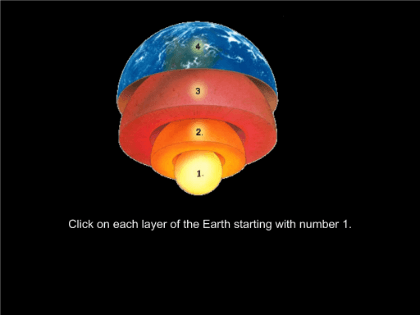
Which compositional layer is represented by the yellow layer?
inner core
outer core
mantle
crust

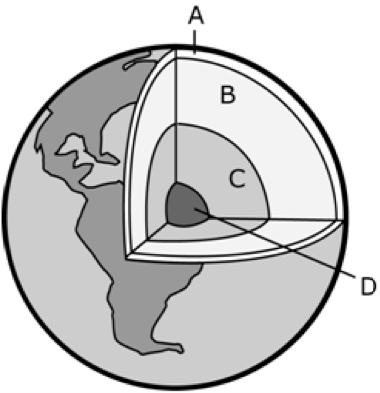
Which letter in the diagram identifies the layer of Earth made up of solid nickel and iron?
layer A
layer B
layer C
layer D
Sally is researching the differences that exist in each layer of the Earth. Which of the following best describes Earth's crust?
Solid, rocky
Liquid, metallic
Semisolid, convecting
Dense, extremely hot
Which of the following is true regarding the composition of the lithosphere?
The lithosphere is mostly liquid, with some medium-density materials, such as silicon.
The lithosphere is more plastic and flows slowly compared to the solid crust of Earth.
The lithosphere includes the core and the lower portion of the mantle.
The lithosphere includes the crust and the uppermost portion of the mantle, which is sold and rigid.
The layers of Earth can be classified by their thickness, composition, and state. Which of Earth's layers is best described as a molten state of medium density made of mostly silicon and oxygen?
crust
outer core
mantle
inner core
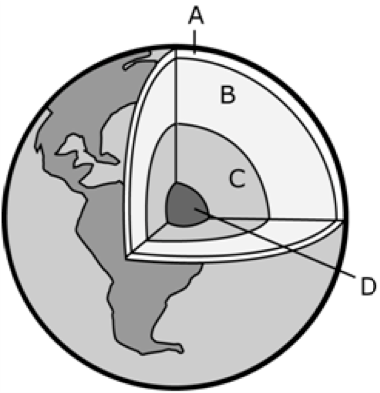
What letter in the diagram identifies the layer that is composed of moving continental and oceanic plates?
layer A
layer B
layer C
layer D

inner core

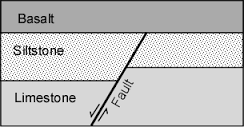


Which rock is formed form the cooling of volcanic ash on Earth's surface?
intrusive igneous
foliated metamorphic
extrusive igneous
organic sedimentary
Rocks that form from colling magma inside Earth?
Igneous intrusive
Igneous extrusive
Metamorphic foliated
Metamorphic nonfoliated


Fossils are found in ____________ rocks.
metamorphic
magma
igneous
sedimentary

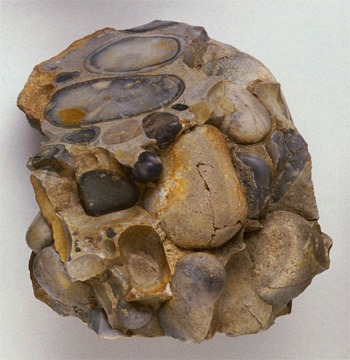


Which of the following is an accurate description of the movement of the tectonic plates in the diagram?
Plate A is sliding past plate B.
Plate A and plate B are diverging.
Plate A is denser than plate B, which results in subduction.

What processes can be used to complete the diagram of the rock cycle?
A. 1 = cooling, 2 = weathering and erosion, 3 = pressure
B. 1 = weathering and erosion, 2 = pressure, 3 = cooling
C. 1 = weathering and erosion, 2 = cooling, 3 = pressure
D. 1 = weathering and erosion, 2 = weathering and erosion, 3 = weathering and erosion

Why do metamorphic rocks rarely contain fossils?
These rocks are formed underwater, and the water dissolves the fossils.
The rock formation occurs from extremely hot magma deep inside the crust where organisms do not live.
These rocks undergo extremely high pressure or temperature changes when formed, which would destroy fossils
These rocks are usually formed from extremely hot magma or with severe lava explosions, which would destroy fossils.

Which of the following is a true statement about the rock cycle?
Heat, pressure, cooling, weathering, erosion, and deposition change rock
The formation of rock within the cycle ends after metamorphic rocks form.
Weathering occurs in igneous rocks but never in sedimentary or metamorphic

A student used a magnifying lens to examine two different rocks. Which crystals most likely formed from molten material that cooled rapidly?
crystals in rock 1, because large grains usually form near Earth's surface
Crystals in rock 1, because large grains usually form deep within Earth
crystals in rock 2, because small grains usually form near Earth's surface
crystals in rock 2, because small grains usually form deep within Earth

What must happen to a sedimentary rock in order for it to change into an igneous rock?
It must be weathered and eroded.
It must melt, then cool and harden.
It must become cemented to other rocks.
It must be put under pressure until new minerals form in it

Which of the following is NOT true about the role tectonic forces play in the rock cycle?
When plates slide over and under each other, the heat and pressure form igneous rocks.
When plates pull apart, rocks melt, and magma forms igneous rocks.
When plates push together, rocks are buried and form metamorphic rocks.
When rocks push upward and form mountains, the erosion of the mountains can produce sediment.

Which statement correctly describes the rock cycle?
Igneous rock can only form by heat and pressure.
Metamorphic rock can only form by crystallization.
Magma can only form by compaction and cementation.
Sediment can only form by weathering, erosion, and deposition
Which of the following processes is most necessary to form sedimentary rocks?
cooling
subduction
deposition
metamorphism

Shale is a rock formed when silt is compacted together. When shale is buried and experiences heat and pressure, it becomes slate. What type of change occurs in this process?
Sedimentary rock becomes metamorphic rock
Metamorphic rock becomes sedimentary rock.
Metamorphic rock becomes new metamorphic rock
Sedimentary rock becomes new sedimentary rock.

Which of these statements about the rock cycle is true?
Each type of rock can change into any other type of rock through the rock cycle.
The rock cycle can change the texture but not the composition of rocks.
High temperatures are needed at each stage of the rock cycle
All stages of the rock cycle occur beneath Earth's surface.

Granite is a rock formed from the cooling of magma. When granite is exposed to elements such as wind and water, it weathers and erodes and the particles are deposited. Pressure causes these and other particles to form sandstone at Earth's surface. What type of change occurs in this process?
Sedimentary rock becomes igneous rock
Igneous rock becomes sedimentary rock
Sedimentary rock becomes new sedimentary rock
Igneous rock becomes new igneous rock.

Which process can change metamorphic rock into new metamorphic rock?
The metamorphic rock undergoes cementation
The metamorphic rock melts and cools at Earth's surface
The metamorphic rock experiences increased heat and pressure

A certain rock formed on Earth's surface. Which of these conclusions can be drawn about the rock?
A. It must be an igneous rock
It cannot be an igneous rock.
It must be a metamorphic rock
It cannot be a metamorphic rock.
Plate Tectonics supports the idea that all continents were once fused together called _____________ .
The rock cycle
Supercontinent
The crust
Pangea
______________________ continually adds materials to the ocean floor creating ocean floor.
Sea-floor spreading
Ocean trenches
Divergent mid-ocean ridges
Convergent mid-ocean ridges
This plate boundary moves land apart, creating an ocean trench or a valley on land : ________________________
Divergent boundary
Transform boundary
Convergent boundary
Mid-Ocean voundary
Boundary between two colliding plates, often associated with mountain building, ocean trenches and volcanic islands
plate boundary
magma
divergent boundary
convergent boundary
A deep crack in the Earth's surface associated with divergent boundary between two continental plates
lava
rift
ridge
trench
proposed by Alfred Wegener, that the continents were once joined together and have since drifted apart
theory of plate tectonics
tectonic plates
plate boundary
theory of continental drift

Example of divergent boundary between two oceanic plates.
Mid-Atlantic Ridge (Atlantic Ocean)
Andes Mountains (S. America)
East Africa Rift Valley
None of the above

New oceanic crust (sea floor) is created at this boundary.
Divergent Oceanic
Divergent Continental
Convergent Oceanic
Transform

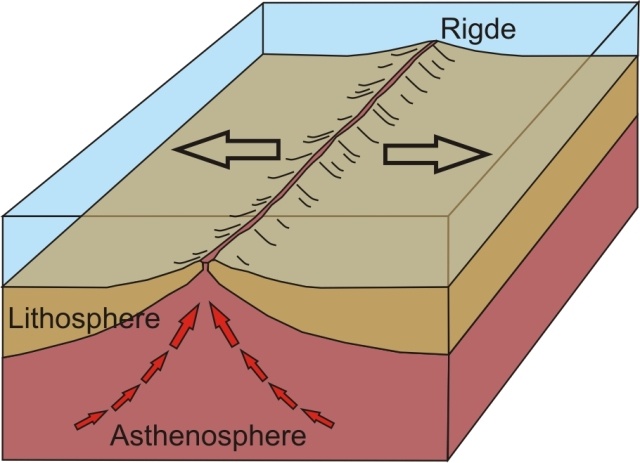
In some areas of the world, like California and Japan, earthquakes are a common occurrence. How can this best be explained?
The strong ocean currents are undermining both areas causing earthquakes.
Both areas are located near the edge of the Pacific Ocean, the unstable sand causes earthquakes.
Both areas are subjected to strong ocean wind and waves that causes earthquakes.
Both areas are on the boundary of active plates, the motion of the plates causes earthquakes.
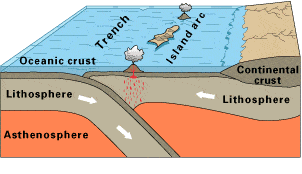
Observe this diagram of a plate boundary. One statement BEST describes what is happening. It is that
the oceanic crust is melting.
the denser ceanic crust is subducting under the less dense oceanic crust
volcanic islands are forming.
the tectonic plates are moving away from each other.
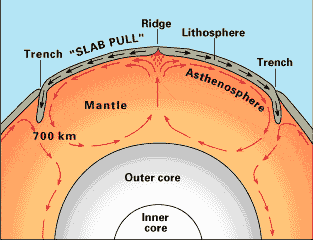
What is the source of energy that drives plate movement?
the subducton of the sea floor
the different densities of the oceanic and crustal plates
convection currents in the asthenosphere
the friction force between the plates that move past each other
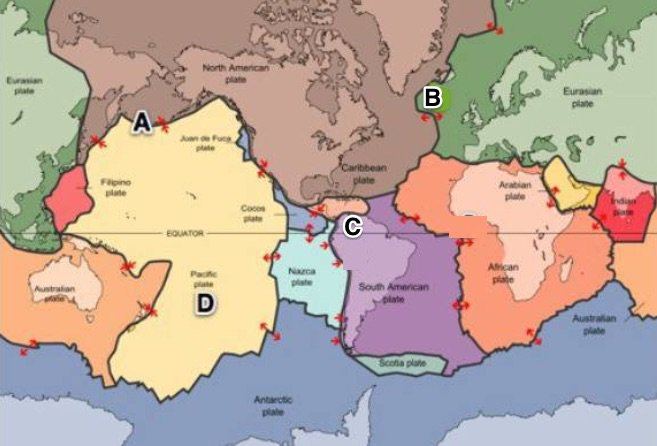
Where would sea floor spreading most likely occur?
At convergent boundaries (oceanic vs. oceanic)
At convergent boundaries (oceanic vs. continental)
At divergent plate boundaries (oceanic vs. oceanic)
At transform plate boundaries
Continental plates are ______ dense and ________ than ocean plates.
more; thinner
more; thicker
less; thinner
less; thicker
Ocean plates are _______ dense and _______ than continental plates
less; thinner
more; thinner
more; thicker
more; thicker

According to the graph, what material’s recycling would reduce the largest portion of America’s trash?
Metals
paper
plastics
Yard trimmings
What is global warming
the normal temperature fluctuations of Earth's climate cycle
the melting of the polar ice caps
the trend of increasing temperatures on Earth
the changes in Earth's biosphere that affect the atmosphere
1. What is one of the greatest threats to biodiversity on Earth?
habitat destruction
loss of drinking water
decrease in food supply
pollution
How does land use cause a reduction in biodiversity?