
 Worksheets
Exploration to Early Republic
Total questions: 158
Worksheet time: 1hrs 19mins
The Atlantic slave trade developed because...
plantation owners used large numbers of enslaved African workers to fill their labor needs
King Alfonso of the African kingdom of Kongo encouraged the Portuguese to increase the slave trade
factory owners in the North needed large numbers of workers to make goods for trade
Spain and Portugal outlawed slavery in 1510
Which of the following was a primary reason France sought to colonize North America?
To profit from trading in furs and other goods
To reduce overpopulation in Europe
To create communities founded on religious tolerance
To create joint ventures with other European powers
Which statement about the institution of slavery in Colonial America is most accurate?
Slavery was on the decline in the South by the time of the American Revolution.
The New England colonies had the largest slave populations.
Slaves were especially numerous in areas suitable for large plantations.
Slavery was banned in most Southern colonies.
What effect did geographic factors have on the economy of the New England colonies?
They increased the region’s dependence on slaves as a source of labor.
They promoted the growth of fishing and shipping in addition to farming.
They supported the planning of rice and tobacco.
They encouraged the establishment of large plantations.
How did the arrival of Africans in colonial America generally differ from the arrival of Europeans?
Africans generally came to the Americas to escape political corruption.
Most Africans came to the Americas for economic opportunity.
Few Africans came to the colonies in comparison to Europeans.
Africans usually came to the colonies against their will.
What was one impact of European exploration on Native American Indians?
European farming techniques were quickly adopted.
Many Native American Indians were resettled throughout Europe.
Diseases brought by Europeans caused large numbers of deaths.
Conflicts between Native American Indian tribes ended.
As part of the system of mercantilism, Great Britain...
established laws against monopolies
encouraged the development of manufacturing in the colonies
limited the colonies ability to trade with other countries
outlawed the slave trade industry
As part of the system of mercantilism, Great Britain...
established laws against monopolies
encouraged the development of manufacturing in the colonies
limited the colonies ability to trade with other countries
outlawed the slave trade industry
Which of the following best explains the regional differences in the growth of African-American populations shown on the table?
The African-American population grew faster in cooler climates.
Most slaves were given freedom and moved to the Middle Colonies.
New England farmland was best suited for unskilled laborers.
Southern plantations imported African-American slaves as field laborers.
The economic theory that states “a nation can become wealthy and powerful by accumulating gold and silver” is...
Mercantilism
Triangular Trade
Individualism
Social mobility
How were the reasons for establishing the Southern Colonies most different from the reasons for establishing the New England Colonies?
Most southern colonists hoped to build wealth while most New Englanders sought religious freedom.
Most southern colonists hoped to build ships while most New Englanders sought religious persecution.
Most New England colonists hoped to establish large plantations while most southern colonists became merchants.
Most southern colonists sought greater economic opportunity while most New England settlers were already wealthy
Catholics immigrated to the Maryland colony in the seventeenth century primarily to — 8.23(A)
profit from natural resources
avoid crop failures and famine
produce cash crops to pay off debts
escape persecution
Which statement best explains the significance of the Mayflower Compact? 8.3(B)
It limited the power of future colonial governments.
It weakened the influence of religion in government.
It established a form of self-government based on a social contract.
It guaranteed liberties for colonists through local government.

Which characteristic is correctly matched with a number in the table? 8.11(A)
1: Indigo
2: Moderate
3: Rocky soil
4: Ships

Which factor most encouraged the growth of this trade? 8.12(B)
The invention of the steam engine
The profitability of cash-crop agriculture
The development of the factory system
The establishment of protective tariffs
Which of the following contributed most to the expansion of the transatlantic slave trade during the 1700s? 8.12(B)
A lack of skilled labor in the American colonies
Demand for slaves in the American colonies that produced cash crops
A lack of protective tariffs in the American colonies
Demand for slaves in the industrialized American colonies

This diagram describes events in colonial America that are related to — 8.25(A)
the eventual adoption of the U.S. Constitution
the formation of a government controlled by religious officials
the creation of a national system of checks and balances
the establishment of the principle of religious freedom

Which feature of colonial self-government does this charter establish? 8.20(A)
Direct democracy
An elected legislature
Separation of powers
Checks and balances
Which of the following is a reason why representative government developed in the colonies?
distance from Great Britain
the king wanted them to govern themselves
colonists got rich from mercantilism
the beginning of the slave trade
What is a social contract?
Something you sign when you buy something.
An agreement between members of society.
Getting in touch with other people.
An official announcement.
Which statement is true?
The colonists manufactured their own goods.
The colonists bought raw materials from Great Britain.
Great Britain needed the colonies to supply them with raw materials.
Great Britain had plenty of raw materials and didn't need more.
Which colonial region had the largest number of enslaved people?
New England Colonies
Middle Colonies
Southern Colonies
Which colonial region was settled mainly for religious reasons by people who had been persecuted in Europe?
New England Colonies
Middle Colonies
Southern Colonies
How did the colonists feel about mercantilism?
Thought it gave Britain the advantage.
Thought it was fair.
Thought it gave the colonists the advantage.
What is the name for a document that lists the laws of a place and explains how the government is set up?
Proclamation
Declaration
Constitution
Contract
Which colonial region had the longest growing season and was good for cash crops?
New England Colonies
Middle Colonies
Southern Colonies
What was the section of Triangular Trade that contained the slave trade called?
Middle Passage
Columbian Exchange
Mercantilism
What ocean did the colonists cross from Great Britain to the Americas?
Pacific
Indian
Atlantic

An economic theory that a nation becomes strong by strictly controlling trade
mercantilism
charter
alliance
legislature

What is the purpose of a colony?
to provide vacation resorts for royaltyThis is a wrong answer
to create a place for political freedom
to be a refuge for the poor
to make the ruling country rich

Jamestown's economy finally improved when the colonists began growing
sugar cane
tobacco
corn
potatoes

What connected the colonies, Africa and the West Indies and was a part of the slave trade?
Great Awakening
mercantilism
monopoly
Triangular Trade Route

Pennsylvania was founded by William Penn as a haven for
persecuted Quakers
persecuted Puritans
English debtors
Catholics

The most important products in the Southern colonies were
corn, wheat and potatoes
tobacco, rice and indigo
iron works and copper
fish and lumber

Farming was unproductive in New England because of the
many harbors
long growing season
thin, rocky soil
forests and trees
Which of the following played a key role in the European Age of Exploration that emerged in the 15th and 16th centuries?
Advancements in sea-faring technology
New lands with the possibility for European expansion
An interest in developing a sea route to Asia for trade
All of the Above
What was the primary purpose of the Spanish colonies there were established in North America in the early 1500s?
To foster friendship between Spaniards and Native Americans
To establish religious freedom for Spaniards fleeing Europe
To grow crops for Spain
To find gold and to spread Christianity


What was the first constitution of the United States?
Articles of Confederation
U.S. Constitution
Mayflower Compact
Declaration of Independence
What was the meeting in Philadelphia in 1787 where delegates decided to throw out the Articles of Confederation and draft the Constitution?
Ratification Convention
Constitutional Convention
First Continental Congress
Second Continental Congress
Which weakness of the Articles of Confederation led to Shays’s Rebellion?
The national government lacked the power to regulate trade.
The national government lacked a national court system.
The national government lacked central leadership
The national government lacked the power to tax
Shay's Rebellion started as a protest against...
unfair taxes and farmer debt
the death penalty
no judicial system
debtors' prisons


Which is a weakness of the Articles of Confederation?
Congress couldn't collect taxes
No national courts to settle state disputes
Difficult to pass new laws or amendments
All of the these


The Boston Massacre was...
an event that led to thousands of colonial deaths.
the result of the Intolerable Acts.
the turning point in the Revolutionary War.
used by colonists to increase support for the Revolution.
The purpose of the Stamp Act was to tax...
playing cards.
legal documents.
newspapers.
All of the above
Which answer best describes the Intolerable Acts?
gave colonists more freedom.
a series of laws placed on colonists because of the Boston Tea Party.
acts that the colonists placed on themselves
it only closed Boston Harbor
The primary purpose of the Declaration of Independence was to...
create a new framework of government.
list colonial complaints against King George III.
declare colonial independence from Great Britain.
celebrate the Fourth of July.
Who were the Patriots?
Colonists who wanted to stay part of the British Empire
Colonists who wanted to tax British soldiers
Colonists who wanted to be independent from the British Empire
Colonists who wanted to move to Great Britain
Who were the Loyalists?
Colonists who wanted to stay part of the British Empire
Colonists who wanted to tax British soldiers
Colonists who wanted to be independent of the British Empire
Colonists who wanted to move west of the Appalachian Mountains
Why did the British tax the colonies so heavily after the French and Indian War?
To get extra tea and sugar
To force the Patriots to surrender
To create anger in the colonies
To pay off war debt
The Battle of Lexington/Concord was the...
turning point of the Revolutionary War.
first battle of the Revolutionary War
first battle of the Civil War
last battle of the Revolutionary War
What battle was the turning point of the Revolutionary War?
Yorktown
Gettysburg
Saratoga
Lexington/Concord
Who was the leader of the Continental Army?
George Washington
Alexander Hamilton
General Cornwallis
Thomas Jefferson
What was the significance of the Battle of Yorktown?
It was the last major battle of the Revolutionary War.
It was the turning point of the Revolutionary War.
It was the first battle of the Revolutionary War.
George Washington killed many lobsterbacks.
What was the significance of the Treaty of Paris (1783)?
The British recognized the United States as an independent nation
The British ceded Canada to the United States.
The French agreed to sell the Louisiana territory to the United States.
Enslaved Africans gained their freedom in present-day Haiti.
Washington’s army and French fleet surround main British army in the south. Last major battle before British surrender.
Trenton
Lexington and Concord
Yorktown
Saratoga
Bunker Hill
This Continental victory convinces the French to enter the war against Britain.
Trenton
Lexington and Concord
Yorktown
Saratoga
Bunker Hill
At sea, Great Britain's powerful navy enjoyed a major advantage. British vessels formed an effective ________, keeping ships from entering or leaving American harbors and limited delivery of supplies and troops to Patriot forces.
mercenary
inflation
blockade
tyranny
Why did Parliament pass the Sugar and Stamp Acts on the colonist?
to pay for gifts to Native Americans to keep them west of the Appalachians
to control the kinds of businesses and contracts colonists entered into
to reverse the effects of the boycott of British goods
to pay part of the cost of defending the frontier (French and Indian War) and colonial governments
How did the Intolerable Acts punish Massachusetts economically?
forbade trade with other colonies
forced people to feed and house troops in their home
replaced elected officials with appointed officials
closed the port of Boston until the colonist paid for the tea
According to Thomas Jefferson, what inalienable rights did all men have?
protection, property, and self-government
life, liberty and property
life, liberty and pursuit of happiness
3 square meals, a bed to sleep in, and a roof over your head
What drove the colonists to declare independence from Great Britain?
taxes
no representation in Parliament
quartering of soldiers in their homes and closing of Boston harbor
all of the choices
Who wrote the Declaration of Independence?
Thomas Jefferson
Thomas Paine
Abigail Adams
Deborah Sampson

What is the job of the legislature?
The legislature handles problems for the government.
The legislature makes sure the territory runs smoothly.
The legislature makes the laws.
The legislature plans parties for the settlers.
What area contained present day Ohio, Indiana, Illinois, Wisconsin, Michigan, and parts of Minnesota.
Canada
U.S.A.
13 colonies
Northwest Territory
Strengthened the power of the judiciary by making it the final authority in interpreting the Constitution.
Gibbons v. Ogden (1824)
Marbury v. Madison (1803)
Georgia v. Worchester
Which of the following law was passed in order to prevent foreign interference with American trading ships?
Alien & Sedition Acts
Embargo Act
Neutrality Proclamation
Barbary Act
After what war did the U.S. experience a period of prosperity and cooperation known as the "Era of Good Feelings"?
Revolutionary War
World War II
Civil War
War of 1812
Which of the following was NOT an effect of the War of 1812?
Improved relations with Native Americans.
Increased manufacturing capabilities.
Increased sense of nationalism.
Everyone was in one political party
Which President put down the Whiskey Rebellion?
George Washington
John Adams
Andrew Jackson
James Madison
A political party created and influenced by Alexander Hamilton that wanted to strengthen the federal government and promote industry and trade
Thomas Jefferson
Alexander Hamilton
Federalist Party
Democratic-Republican Party
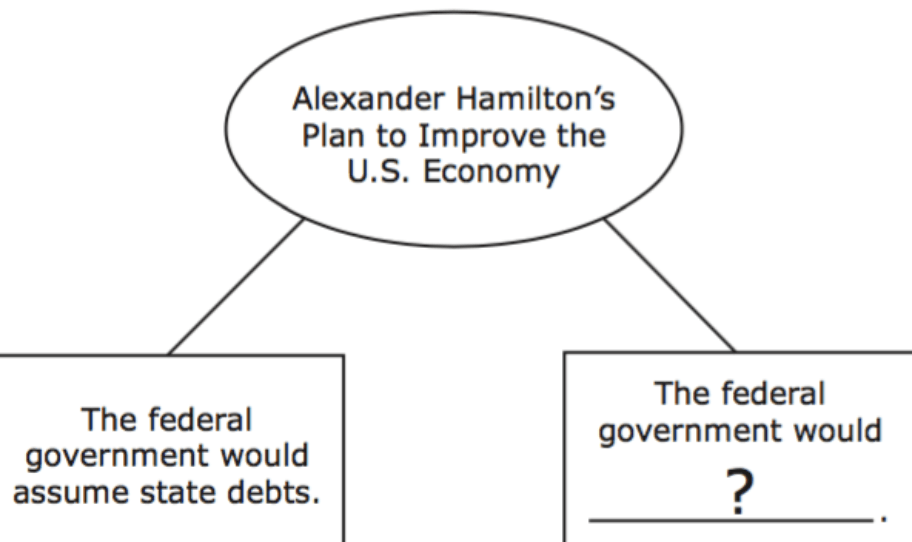
Which action completes this diagram
oversee state government agencies
Regulate the creation of new businesses
establish a national bank
eliminate protective tariffs
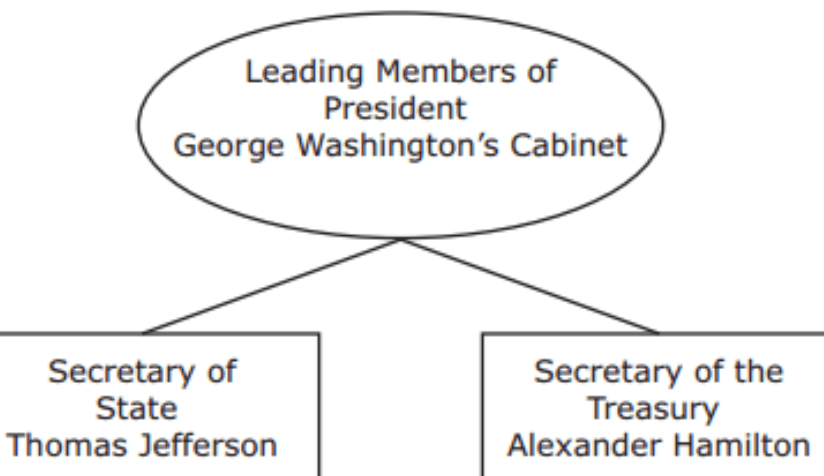
Disagreements between these two cabinet members led to -
the creation of reservations for American Indians
a struggle to ratify the Bill of Rights
the establishment of the first U.S. political parties
a compromise over slavery in western territories
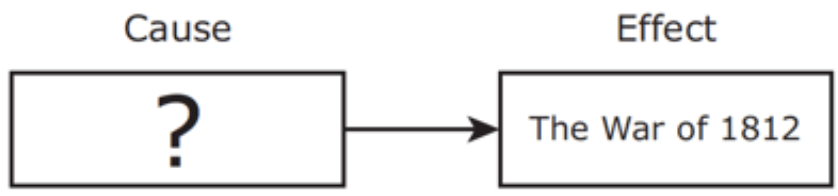
Which action completes this graphic organizer?
French naval attacks on U.S. harbors
British invasion of countries allied with the U.S.
French embargoes on trade with the U.S.
British impressment of U.S. sailors
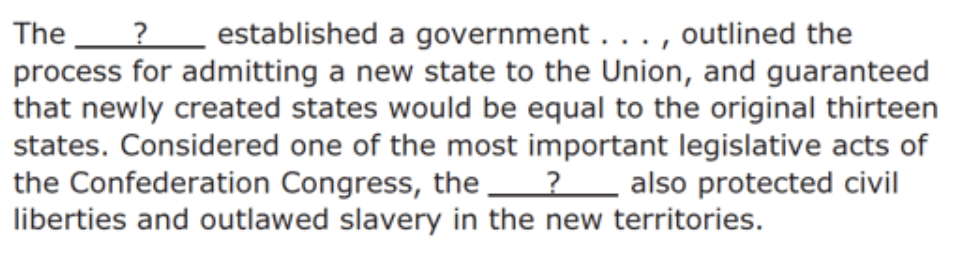
Which document completes this excerpt?
Declaration of Independence
Treaty of Ghent
Northwest Ordinance
Louisiana Purchase Treaty
How did the provision if the Northwest Ordinance affect U.S. expansion?
By funding a transportation network in uninhibited regions
By establishing a process for territories to govern themselves
By promoting the growth of southern plantation economies
By creating a national bank to loan money to land investors
The decision in Marbury V. Madison was significant in U.S. history because it
reinforced federal authority over American Indian affairs
confirmed the power of Congress to regulate interstate commerece
established the practice of judicial review by the Supreme Court
Upheld the power of the Electoral college to choose the vice president
the governments right to rule comes from the people
Popular Sovereignty
Federalism
Individual Rights
Which is the idea that power to govern comes from the people?
Popular Sovereignty
Individual Rights
Republicanism
Federalism
Each branch has controls over the other two branches, making sure one branch doesn't become too powerful.
Separation of Powers
Checks and Balances
Popular Sovereignty
Limited Government
A limited government is created to-
let people twist and bypass the law whenever they want to.
enable the president to have less work.
protect people from tyranny.
give all power to the people.
The personal freedoms, protections, and equality under the law guaranteed by the Bill of Rights are--
Republicanism
popular sovereignty
checks and balances
individual rights
The people exercise their rights by voting for their political representatives.
Federalism
Popular Soverignity
Republicanism
Democratic
The Bill of Rights contains certain _____________________, or personal liberties and privileges.
rules
complaints
amendments
individual rights
Which amendment states that all Americans have the right to bear arms?
Amendment 2
Amendment 7
Amendment 4
Amendment 6
Which branch creates laws?
Legislative
Executive
Judicial
Which branch interprets the law and makes sure it is fair?
Judicial
Executive
Legislative
Which branch enforces the law?
Legislative
Executive
Judicial
Which amendment relates to Federalism?
Amendment 1
Amendment 10
Amendment 6
Amendment 8

The first 10 amendments to the Constitution are called the...
Articles of Confederation
Virginia Compromise
Bill of Rights
Declaration of Independence
Rights in the Constitution cannot be used to take away other rights
Amendment 10
Amendment 6
Amendment 7
Amendment 9

