wayground logo

Free Printable Worksheets

Font size

S
M
L
XL
Worksheets

1st Semester Review (Use your notes!)

Total questions: 81

Worksheet time: 20hrs 15mins

Name
Class
Date
1.
How much force is needed to accelerate a 3kg skateboard at 5m/s2. 
a)
8N
b)
1.6N
c)
0.6N
d)
15N
2.
How much force is needed to accelerate a 25kg bowling ball at 2m/s2
a)
50N
b)
5N
c)
12.5N
d)
100N
3.
In a car accident, a passenger not wearing a seat belt may crash through a windshield because of his or her inertia.
a)
False
b)
True
4.
An object will remain at rest unless a balanced force acts upon it.
a)
False
b)
True
5.
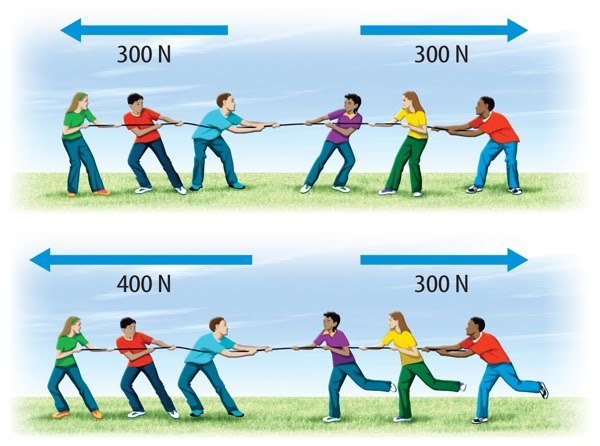
Which one is balanced?
a)
top
b)
bottom
c)
both
6.
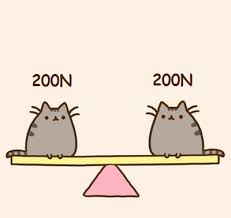
Is it BALANCED? 
a)
Yes
b)
No
7.
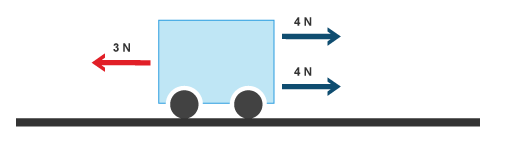
What is the FORCE? 
a)
5 N
b)
10 N
c)
400 N
d)
0 N
8.
What is the unit for FORCE? 
a)
N (Newtons)
b)
lbs (pounds)
c)
g (grams)
d)
m/s (meters per second)
9.
Forces that have a force of Zero (0).
a)
Balanced force
b)
Unbalanced force
10.
A magician pulls a tablecloth out from under dishes and glasses on a table without disturbing them.
a)
Newton's 1st Law
b)
Newton's 2nd Law
c)
Newton's 3rd Law
d)
None of them
11.

Which law states that an object at rest stays at rest and an object in motion stays in motion unless an unbalanced force acts on it?

a)

1st Law

b)

2nd Law

c)

3rd Law

12.

Henry sees a basketball and decides to put in motion. What kind of force does Henry use to move the ball?

a)

small

b)

balanced

c)

equal

d)

unbalanced

13.
How long did it take this object to travel 10 m?
a)
0 s
b)
10 s
c)
15 s
d)
20 s
14.
How long did it take this object to travel back to its reference/starting point?
a)
20 s
b)
30 s
c)
60 s
d)
100 s
15.
At 60 seconds, how far had this object traveled? 
a)
0 m
b)
10 m
c)
20 m
d)
40 m
16.
a)
1st
b)
2nd
c)
3rd
d)
law of motion
17.
A magician pulls a tablecloth out from under dishes and glasses on a table without disturbing them.
a)
Newton's 1st Law
b)
Newton's 2nd Law
c)
Newton's 3rd Law
18.
A person not paying attention while skateboarding hits a rock. The skateboard stops...they don't.
a)
The Law of Inertia (1st law)
b)
The Law of Acceleration (2nd law)
c)
The Law of Conservation of Momentum
d)
Action Reaction Law (3rd law)
19.
What Unit do we Measure Force in? 
a)
Newtons
b)
Joules
c)
Force
d)
Kilograms
20.
With unbalanced forces, the object will move in the direction that the _______ force is being applied.
a)
larger 
b)
smaller 
c)
equal 
d)
less
21.
Sand Andreas Fault formed at this type of boundary-
a)
Transform Boundary
b)
Convergent Boundary
c)
Divergent Boundary
d)
Hot Spot
22.
Mid Ocean Ridge forms at type of boundary-
a)
Transform Boundary
b)
Convergent Boundary
c)
Divergent Boundary
d)
Hot Spot
23.
Volcanoes form with at type of boundary-
a)
convergent continent to continent
b)
divergent continental 
c)
convergent continent to ocean
d)
transform
24.
Islands form with at type of boundary-
a)
convergent ocean to ocean
b)
convergent continental to continental 
c)
convergent ocean to continental
d)
transform
25.
Himilayan Mountains
a)
converging continent to continent
b)
earthquake in subduction zone
c)
converging ocean to continent
d)
transformational
26.
This is an example of -
a)
convergent
b)
divergent
c)
transform
27.
This is an example of -
a)
convergent
b)
divergent
c)
transform
28.
This is an example of -
a)
convergent
b)
divergent
c)
transform
29.
This image represents this type of boundary
a)
divergent
b)
transform
c)
convergent
d)
tectonic
30.
This is the theory that states that all the continents started as a single massive continent and have been MOVING apart for over 200 million years and the man that proposed it.
a)
The Big Bang Theory, Einstein
b)
The Pangea Theory, Hutton
c)
The Tectonic Plate Theory, Darwin
d)
The Continental Drift Theory, Wegner
31.
The movement of plates at a divergent boundary
a)
move towards each other
b)
slide past each other
c)
move up and down
d)
move away from each other
32.
 A land feature that is produced at a convergent boundary is
a)
a valley
b)
an ocean
c)
a canyon
d)
a volcano
33.
Who is the German Scientist that came up with the theory of the Continental Drift? 
a)
Albert Einstein 
b)
Ms. Stukel 
c)
Galileo
d)
Alfred Wegener
34.
Where did Wegener find plant fossils that today would not be able to survive on that type of land?
a)
North America
b)
Antarctica
c)
China 
d)
India
35.
What is the force that moves the continents? 
a)
Conduction 
b)
Convection 
c)
Radiation 
d)
Conveyor belts 
36.
If contour lines are close together, then the slope is
a)
gentle
b)
steep
c)
flat
d)
going up and down
37.
When you move from one contour line to another, the elevation
a)
stays the same
b)
goes up or down
c)
disappears
d)
is below sea level
38.
On a topographic map of a mountain, you walk a longer distance to get to the top when the contour lines are
a)
spread out
b)
close together
c)
going down
d)
going up
39.
What is the profile view to Topographic Map #2?
a)
B
b)
C
c)
D
d)
E
40.
A mountaineer is planning an expedition. He wants to follow the easiest possible path, which means he needs to find the most gentle slope up the mountain. Which route should the mountaineer choose?
a)
Route A
b)
Route B
c)
 Route C
d)
Route D
41.
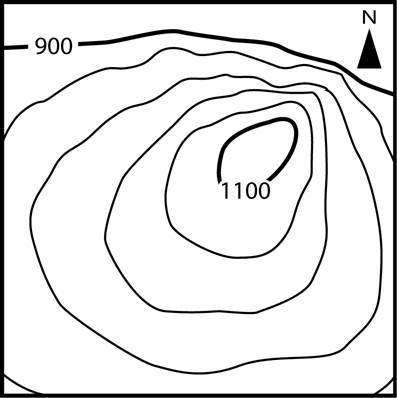
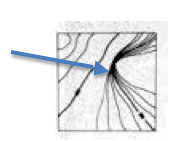
Provided is a topographic map of a hill with contour lines drawn showing elevation in meters.
The steepest slope on this hill can be found on the side that is facing which direction?
a)
Southwest
b)
Northeast
c)
Northwest
d)
Southeast
42.
What feature is at the arrow?
a)
volcano
b)
mountain
c)
cliff
d)
river
43.
This landform was probably caused by - 
a)
high tides.
b)
wind.
c)
human activity.
d)
running water.
44.

This is a meteor crater. Which of the following is a prediction of how the crater will change over the next 1,000 years?

a)

The crater will become more shallow as the sides erode into the center.

b)

The crater will become deeper as animals make the crater home and burrow deep into the rock.

c)

The crater will not change over 1,000 years.

d)

The crater will fill in with lava.

45.

What process created the main feature in this image

a)

Fluvian

b)

Aeolian

c)

Volcanic

d)

Impact

46.

This is the reason we experience day and night

a)

rotation

b)

revolution

47.

When one side of the Earth is having daytime, the other side is having ______________.

a)

nighttime

b)

daytime

c)

spring

d)

fall

48.

Takes 24 hours to complete one time.

a)

rotation

b)

revolution

49.
Why does the area around the equator stay the same temperature all year?
a)
The equator rotates slower than the poles.
b)
The equator remains the same distance from the sun.
c)
The equator always receives direct sunlight.
d)
The equator has 18 hour days.
50.
What are the reasons for the season?
a)
Earth's tilt & rotation
b)
Earth's tilt & revolution
c)
Earth's rotation & rovolution
d)
Earth's tilt & resolution
51.
In spring/summer, the axis of the earth is pointed away or toward the sun?
a)
towards
b)
Neither away or toward
c)
away
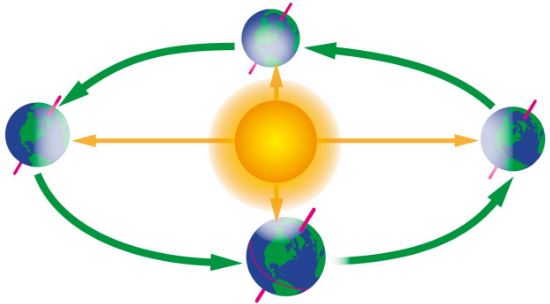
52.
At position A, which hemisphere would have summer?
a)
Northern hemisphere
b)
Southern hemisphere
53.

Given the image above - what season in the Northern Hemisphere currently experiencing?

a)

Summer

b)

Fall

c)

Spring

d)

Winter

54.

What season is the northern hemisphere experiencing in the image above?

a)

Winter

b)

Summer

c)

Autumn

d)

Spring

55.

The image above shows an Equinox - when both Hemispheres get equal sunlight. Which two seasons could it be in the image above?

a)

Spring and Fall

b)

Summer and Winter

c)

Winter and Spring

d)

Fall and Summer

56.

Is this a solstice or equinox?

a)

solstice

b)

equinox

57.

Is this a solstice or equinox?

a)

solstice

b)

equinox

58.

A student was studying different seasons that occur due to the tilt in Earth's axis. He drew a diagram to show the position of Earth with respect to the Sun to explain how the direct rays strike Earth when it is summer in the Northern hemisphere. Which image did the student draw?

a)
b)
c)
d)
59.
During the phases of the Moon, the Moon appears to change shape.  This change in appearance is due to the Moon...
a)
physically changing size and shape.
b)
moving closer and then farther away from Earth.
c)
reflecting a different amount of light due to alignment with Earth and the Sun.
d)
having craters on its surface.
60.
What Moon phase is this?
a)
Full Moon
b)
Waxing Gibbous
c)
New Moon
d)
Half Moon
61.
What phase comes AFTER this one?
a)
Waxing Crescent
b)
Waning Gibbous
c)
Waxing Gibbous
d)
Third Quarter
62.
When the moon waxes, it ________.
a)
adds a thick covering to its crust
b)
seems to get bigger in size
c)
goes from a full moon back to a new moon
d)
shaves its legs
63.
The Moon orbits Earth in a ________________ direction
a)
clockwise
b)
counterclockwise
c)
upwards
d)
downwards
64.
How much of the moon is always lit?
a)
can't tell
b)
always changes
c)
half
d)
3/4
65.
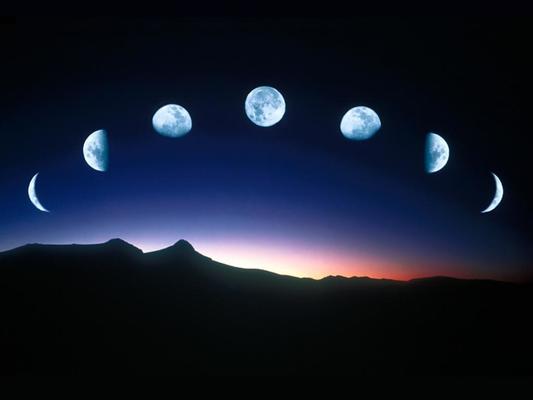
Name the phase of the moon for letter a
a)
First Quarter
b)
Last Quarter
c)
Waxing Gibbous
d)
Waning Gibbous
66.
Name the phase of the moon for letter f
a)
Waning Gibbous
b)
Waxing Gibbous
c)
Waning Crescent
d)
Waxing Crescent
67.
Which body has the greater effect on Earth's tides?
a)
Sun
b)
Saturn
c)
Moon 
d)
Venus
68.

Wha type of tide would this arrangement of earth-moon-sun create?

a)

full moon tide

b)

new moon tide

c)

neap tide

d)

spring tide

69.
What type of tides would this arrangement of earth-moon-sun create?
a)
neap tide
b)
spring tide
c)
new moon tide
d)
full moon tide
70.
a)
Warm Front
b)
High Air Pressure
c)
Cold Front
d)
High Temperatures
71.
a)
Low Clouds
b)
Low Temperatures
c)
Light Wind
d)
Low Air Pressure
72.
a)
High Air Pressure
b)
High Temperatures
c)
Heavy Rain
d)
Hail
73.
a)
High Pressure
b)
Warm Front
c)
Cold Front
d)
Mountains
74.
High Pressure is associated with this type of weather...
a)
Cloudy/Overcast Weather
b)
Cold Weather
c)
Warm Weather
d)
Fair Weather
75.
Which statement correctly defines wind?
a)
Wind is the movement of air from areas of low pressure to areas of high pressure
b)
Wind is the movement of air to a colder area in the atmosphere.
c)
Wind is the movement of air from areas of high pressure to areas of low pressure.
d)
Wind is the movement of air pushed around and bouncing off Earth's surface.
76.
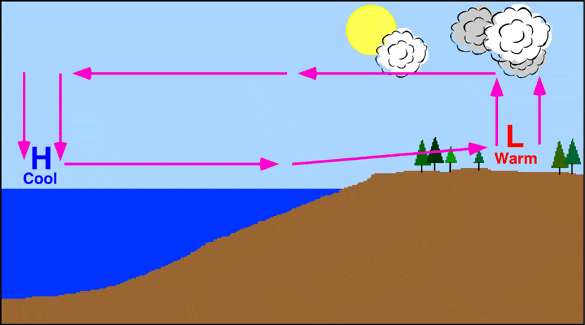
Is this a land or a sea breeze?
a)
land breeze
b)
sea breeze
77.
Use the diagram to determine which statement is correct.
a)
The air at location 3 is more dense than the air at location 6.
b)
The air at location 2 is rushing in to take the place of the colder air at location 3.
c)
Location 1 heats up and cools down slower than location 7.
d)
High pressure air at location 2 is taking the place of the low pressure air at location 3.
78.
Which diagram shows the formation of a land breeze?
a)
diagram Y
b)
diagram X
c)
neither 
d)
both
79.
The Coriolis Effect is caused by
a)
Earth rotating around the sun
b)
Earth rotating on its axis
c)
The tides
d)
Gravity
80.
Warm ocean currents generally come from
a)
The North Pole
b)
The South Pole
c)
The Equator
d)
Both A and B
81.
A horizontal movement of ocean water that is caused by wind and that occurs at or near the ocean's surface.
a)
Gulf Stream
b)
Global Conveyor Belt
c)
Surface Current
d)
Gyre