
 Worksheets
8th Grade Module 1
Total questions: 80
Worksheet time: 1hrs 12mins
An attractive force that exists between all objects that have mass.
vector
speed
gravity
friction
The gravitational force exerted on an object is _____.
field
weight
mass
gravity
The starting point you choose to describe the location or position of an object is _____.
motion
speed
reference point
contact force
The difference between the initial or starting position and the final position is _____.
Newton's second law of motion
The law of action and reaction
net force
displacement
An object at rest will stay at rest, and and object in motion will stay in motion unless an unbalanced force acts on the object. This is stated in which law?
Newton's first law
Newton's second law
Newton's third law
normal force
The acceleration of an object is equal to the net force exerted on the object divided by the object's mass. This is stated in which law?
Newton's first law
Newton's second law
Newton's third law
normal force
When an object applies a force on another object, the second object applies a force of the same strength on the first object, but the force is in the opposite direction. This is stated is which of Newton's laws?
Newton's first law
Newton's second law
Newton's third law
normal force
A push or pull on an object is _____.
speed
force
acceleration
vector
A force that one object applies to another object without touching it is _____.
normal force
force pair
acceleration
noncontact force
A measure of the change in velocity during a period of time is _____.
acceleration
vector
displacement
force
A quantity that has both magnitude and direction is a _____.
velocity
vector
acceleration
force pair
The forces two objects apply to each other?
force pair
friction
acceleration
vector
The speed and direction of a moving object is _____.
speed
force
friction
velocity
The combination of all forces acting on an object is _____.
force
speed
net force
force pair
A contact force that resists the motion of two surfaces is _____.
friction
force pair
vector
speed
A push or pull of an objects that are touching each other.
noncontact force
contact force
net force
speed
The tendency of an object to resist a change in motion.
speed
inertia
time
vector
The SI unit for mass is _____.
kg
N
m/s2
g
The SI unit for force is _____.
kg
N
m/s2
g
The SI unit for acceleration is _____.
kg
N
m/s2
g
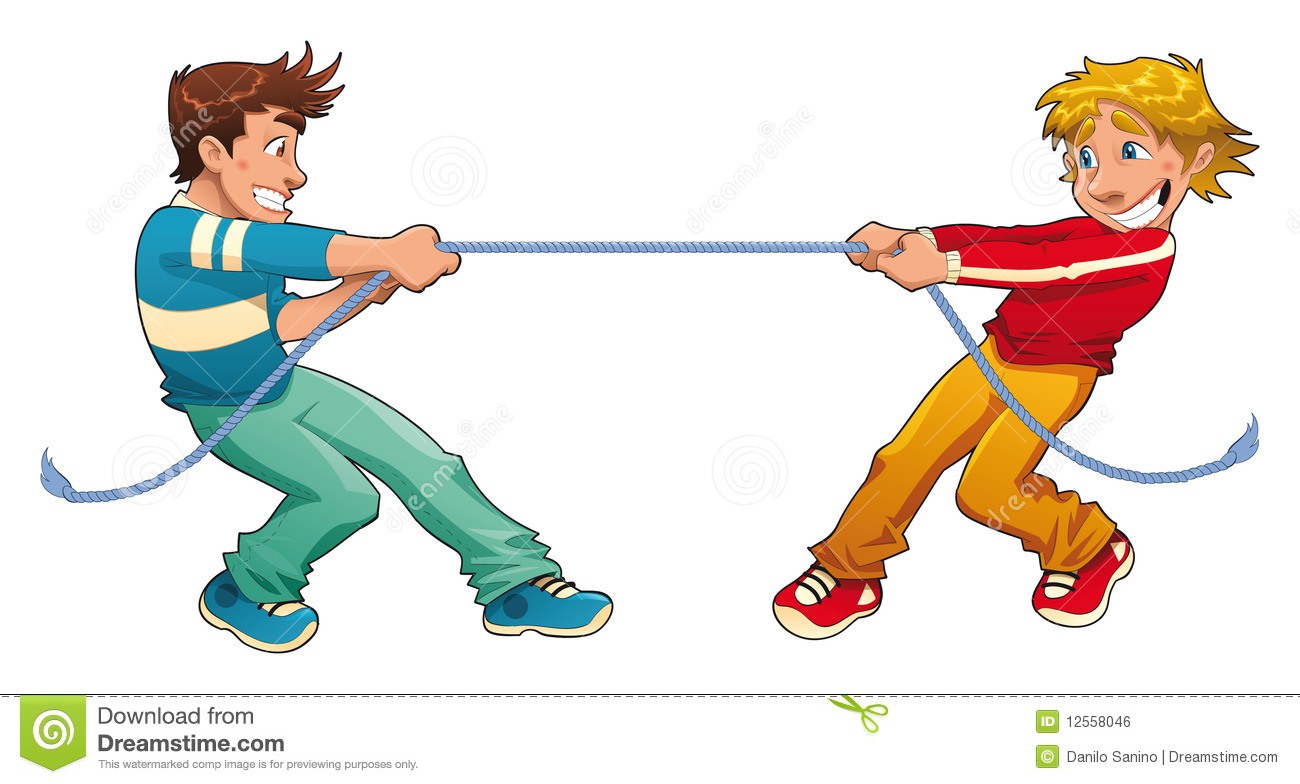
If these boys are pulling with the exact same amount of force. What will happen?
The boy in blue will win.
They will not move at all.
The boy in red will win.
Both will fall down.


? = mass x acceleration
or
? = m x a
is used to find
1st
Law of Motion
2nd
Law of Motion
3rd
Law of Motion

You push off and the boat moves the opposite direction. This is Newtons ____ law.
1st
2nd
3rd

If you kick a soccer ball with 1000 Newtons of force it will go a lot farther than kicking a bowling ball with the same force.
1st
2nd
3rd
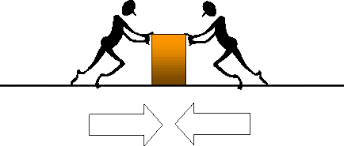
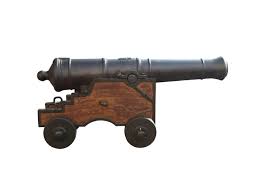
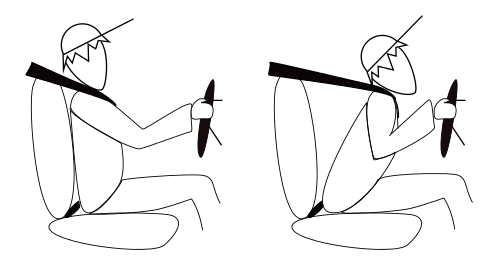


You push against a wall and the wall is pushing back on you.
Newton's 1st Law
Newton's 2nd Law
Newton's 3rd Law
A 20 kg bike accelerates at 10 m/s2. What was the force?
30 Newtons
2 Newtons
200 Newtons
10 Newtons
An object in motion stops when.....
It falls of an edge.
it is acted upon by an outside force.
It is eaten
It never stops
15 m/s2
5 m/s2
.5 m/s2
10 m/s2
What is the equation for speed?
Speed = distance/time
Speed = time/distance
Speed = distance x time
Speed = time x distance
What do you need to know about an object to calculate its velocity?
Speed and time
Speed and distance
Speed and direction
Time and direction
A bird flying south at 64 km/hr is an example of:
Speed
Velocity
The International Space Station orbiting the Earth from west to east at 7.66 km/s is an example of:
Speed
Velocity
A robot traveling 2 m/s is an example of:
Speed
Velocity
A cheetah runs 220 km in 2 hours. What is the cheetah's speed?
110 km/hr west
110 km/hr
440 km/hr
440 km/hr west
Two people are pulling on a chain in opposite directions with forces of 500 N and 600 N. The forces would best be described as ___.
unbalanced force
balanced force
gravitational force
action-reaction force
A test booklet is sitting at rest on a desk. Compared to the force of the booklet on the desk, the force of the desk on the booklet is the same.
true
false
A student walks 20 m north, 10 m south, and then 3 m north. To have a displacement of 0 m, the student should walk ____ m toward the ____.
13; south
13; north
20; south
20; north

Reference point can also be described as what?
An ending point
A starting point
A description
A location
What is the changing of position over time?
motion
reference point
acceleration
speed
_______ is the length of the path between two points.
distance
reference
statistic
law

Which would NOT make a good reference point?
Ross N Robinson Middle School
A chair
A moving child
the flag pole


What is this graph showing?
Constant Speed
Acceleration (speeding up)
Negative Acceleration (slowing down)
No motion

Be careful!!!!! This is a speed-time graph
What does this line represent?
constant speed
not moving
speed increasing
speed increasing at a constant rate
Any change in SPEED or DIRECTION is referred to as _____.
Acceleration
Speed
Velocity
Motion

What is the relationship between force and mass?
inverse relationship
direct relationship
What is the relationship between force and acceleration?
inverse relationship
direct relationship
What is the relationship between mass and acceleration?
inverse relationship
direct relationship
If acceleration of an object is zero, that means there are no forces acting on the object.
true
false
What is the net force of one person pulling 25 N to the west and another person pulling 25 N to the west?
0 N net force
25 N net force to the west
50 N net force to the west
625 N net force to the west
Newton's 3rd Law of Motion is also known as the Law of _____.
inertia
acceleration
action and reaction
Newton's 2nd Law of Motion is also known as the Law of _____.
inertia
acceleration
action and reaction
The amount of ground that is covered is known as _____.
distance
displacement
A scalar quantity includes _____.
magnitude (size)
direction
both magnitude and direction
neither magnitude nor direction
Average velocity and Instantaneous velocity are always the same.
True
False
Average velocity and Instantaneous velocity are the same if the object has constant motion.
True
False

The speedometer of a car is reading the car's _____ speed.
average
instantaneous
17 m/s, East
Vector
Scalar
Displacement is
position of object
final position minus initial position
distance divided by time
initial position plus final position

