wayground logo

Free Printable Worksheets

Font size

S
M
L
XL
Worksheets

LS Test 4

Total questions: 77

Worksheet time: 3hrs 18mins

Name
Class
Date
1.
Mr. Smith set up an experiment to see how the mass of a ball affects the distance ball rolls off a ramp (cm). Identify the independent variable.
a)
Distance traveled by the ball
b)
Height of the ramp
c)
Mass of the ball
d)
The current weather in Florida
2.
Mr. Smith set up an experiment to see how the mass of a ball affects the distance it rolls off a ramp (cm). Identify the dependent variable.
a)
Distance traveled by the ball
b)
Height of the ramp
c)
Mass of the ball
d)
The current weather in Florida
3.
Mr. Smith set up an experiment to see how the mass of a ball affects the distance ball rolls off a ramp (cm). Identify a possible CONSTANT for this experiment.
a)
Distance traveled by the ball
b)
Height of the ramp
c)
Mass of the ball
d)
The current weather in Florida
4.
Mr. Smith set up an experiment to see how the mass of a ball affects the distance it rolls off a ramp (cm). Identify a scientific title to fit this experiment.
a)
Distance traveled by the ball vs. the Mass of a ball.
b)
The effect of the Height of the ramp on the distance the ball will roll from a ramp.
c)
The effect of the Mass of the ball on the distance a ball rolls off of the ramp.
d)
The current weather in Florida vs. the mass of a ball.
5.
A student wants to test the effects of different types of exercise on heart rate.  What is the dependent variable?
a)
heart rate
b)
type of exercise
c)
amount of exercise
d)
time of day exercise occurs
6.
This variable in an experiment is the one being deliberately changed by the scientist. 
a)
dependent variable
b)
independent variable
c)
data
d)
control group
7.
Experiment: Does changing the wing shape to make it more narrow affect the distance a paper airplane will fly?

The wing shape is the ___________  variable.
a)
independent
b)
dependent
8.
Find the IV:  You experiment to see if the type of liquid changes how fast it can drain out of the tornado tube
a)
Amount of liquid
b)
Type of liquid
c)
Technique of swirl
d)
Speed to drain
9.
Find the DV:  You experiment to discover if your pulse rate is affected by caffeine
a)
Pulse rate
b)
Temperature of room
c)
Amount of caffeine
d)
Amount of exercise
10.
What is a independent variable 
a)
The variable that is changed by the scientist
b)
 The variable that never changes
11.
The control group is the...
a)
group you are testing
b)
"normal" group
12.
Why do we want to test one variable at a time?
a)
Because it is hard to setup a data table with more
b)
To know what is causing the changes. This helps us understand cause and effect.
c)
It is what has always been done
13.
When looking at a specimen on your slide, you should always start with the
a)
low objective lens
b)
medium objective lens
c)
high objective lens
d)
super extra high power lens
14.
The__________ sharpens the image under high magnification.
a)
the diaphragm
b)
fine adjustment knob
c)
coarse adjustment knob
d)
the ocular
15.
The _______focuses the image under low power.
a)
revolving nosepiece
b)
fine adjustment knob
c)
coarse adjustment knob
d)
arm/neck
16.
The ________ of the microscope would show you the MOST zoomed in image, or the SMALLEST field of view.
a)
low power objective
b)
medium power objective
c)
high power objective
d)
stage
17.
Find total magnification for:
Eyepiece = 20X 
Objective lens = 20X
 
a)
20x
b)
40x
c)
200x
d)
400x
18.
The higher the magnification, the ________ you see of the specimen.
a)
more
b)
less
c)
higher
d)
lower
19.
Lenses consist of low 4X, medium 10X, and high 40X
a)
Eyepiece
b)
Ocular Lens
c)
Objective Lenses
d)
Illuminators
20.
A microscope is an instrument that.
a)
makes faraway objects look closer.
b)
makes small objects appear larger.
c)
decreases the size of small objects.
d)
increases the size of small objects.
21.

The 3 parts of the Cell Theory are...?

a)

All living things are composed of cells

Cells are the basic units of structure and function in living things

All cells are produced from other cells

b)

All living things are composed of cells

Cells are the basic units of dance and vibes in living things

All cells are destroyed from other aliens

c)

All living things are composed of Jell-O

Cells are the basic units of structure and function in living things

All cells are produced from factories in Canada

d)

All living things are composed of cells

Cells do karate and practice eating whole pies in their free time

All cells are produced from other cells
22.

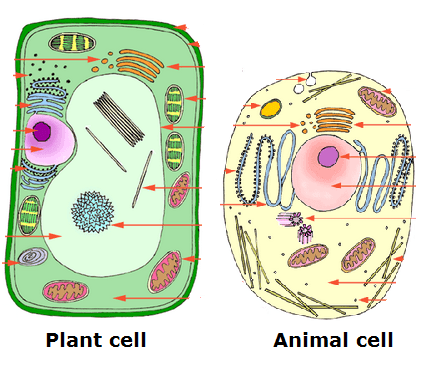
What distinguishes a plant cell from an animal cell? (How do you tell them apart) Hint: There's 3 ways (Check all 3)

a)

Central Vacuole

b)

Mitochondria

c)

Cell Wall

d)

Ribosomes

e)

Chloroplasts

23.

I am the "brain" of the cell or the "control center" for everything happening within the cell. I am a...

a)

Golgi Body/Apparatus

b)

Nucleus

c)

Ribosome

d)

Lysosome

24.

Photosynthesis takes place within me. I am a...

a)

Mitochondria

b)

Cell Wall

c)

Chlorine

d)

Chloroplast

25.

I decide what goes in and out of the cell. I am found in BOTH plant and animal cells. I am a...

a)

Cell Wall

b)

Cell Membrane

c)

Cytoplasm

d)

Golgi Apparatus

26.

I provide plant cells their rigid shape. I am the...

a)

Basketball that Nic Quarne left in Mr. Woller's room last week

b)

Cytoskeleton

c)

Cell Membrane

d)

Cell Wall

27.

Animal and Plant Cells are...

a)

Shopkoytes

b)

Eukaryotes

c)

Prokaryotes

d)

The building blocks of non-living things

28.
Animal cells DO NOT have ...
a)
mitochondria
b)
lysosomes
c)
vacuoles
d)
chloroplasts
29.
Which organelles are filled with enzymes that aid in intra-cellular digestion, breaking down wastes and old organelles?
a)
mitochondria
b)
Golgi body
c)
lysosomes
d)
ribosomes
30.
Where are proteins made in the cell? 
a)
Golgi body
b)
mitochondrion
c)
nucleus
d)
ribosomes
31.
These are passageways in the cell that carry proteins from one part of the cell to another.
a)
Golgi body
b)
endoplasmic reticulum
c)
ribosome
d)
lysosome
32.

This structure packages and distributes proteins throughout the cell.

a)

Golgi Body

b)

Lysosome

c)

Ribosome

d)

Mitochondria

33.
What are organelles that store food, water, and waste material?
a)
vacuoles
b)
cytoplasm
c)
cell wall
d)
Golgi bodies
34.
What directs all the activities of the cell?
a)
cell wall
b)
cytoplasm
c)
nucleus
d)
cell wall
35.
The two kinds of cells are prokaryotes and eukaryotes. How are they different?
a)
Prokaryotes have a nucleus.
b)
Eukaryotes have a nucleus.
c)
Prokaryotes are plant cells.
d)
All bacteria are eukaryotes.
36.
What is the process that plant and algae cells use to make food?
a)
chemosynthesis
b)
photosynthesis
c)
decomposition
d)
protein synthesis
37.
You are made up of...
a)
eukaryotic cells
b)
prokaryotic cells
c)
plant cells
d)
bacterial cells
38.
Which organelle is shown?
a)
chloroplast
b)
mitochondrion
c)
endoplasmic reticulum
d)
Golgi body
39.
Function of this organelle?
a)
protein synthesis
b)
transport proteins
c)
modify, package, and ship proteins
d)
storage of water, food or wastes
40.

Large balloon-shaped organelle?

a)

nucleus

b)

vacuole

c)

chloroplast

d)

lysosome

41.
What is the function of this organelle?
a)
protein synthesis
b)
photosynthesis
c)
cellular respiration
d)
energy production
42.
This organelle absorbs energy from the sunlight and uses it to make food
a)
Nucleus 
b)
Vacuole
c)
Chloroplasts
d)
Golgi Apparatus
43.

This is the powerhouse of a cell

a)

Cytoplasm

b)

Rough ER

c)

Ribosome

d)

Mitochondria

44.
This is a jelly-like substance in which all of the organelles float around
a)
Cell Membrane
b)
Cytoplasm
c)
Cell Wall
d)
Smooth ER
45.
The DNA of a cell can be found here
a)
Nucleus
b)
Cytoplasm
c)
Rough ER
d)
Mitochondria
46.
This is the outside wall of an animal cell
a)
Smooth ER
b)
Cell Wall
c)
Cell Membrane
d)
Cytoplasm
47.

Proteins that are used inside the cell are made here

a)

Chloroplasts

b)

Rough ER

c)

Ribosomes

d)

Vacuole

48.

This organelle contains digestive enzymes which helps remove waste from the cell

a)

Lysosome

b)

Ribosome

c)

Smooth Er

d)

Vacuole

49.
Directs all cell activities through the DNA located there.
a)
Lysosomes
b)
Nucleus
c)
ribosomes
d)
Mitochondria
50.
What is organelle 7?
This organelle sorts and packages proteins and other substances.
a)
Golgi Body
b)
Organelle
c)
Vacuole
d)
Cytoplasm
51.
Number 4 is where food is made through photosynthesis.
a)
Ribosome
b)
Chloroplast
c)
Lysosome
d)
Golgi Body
52.
The organelle in number 9 releases energy in the cell.
a)
Mitochondria
b)
Lysosome
c)
Golgi Body
d)
Cell Wall
53.
What is number 8? 
This organelle is a jelly-like substance which flows inside the cell.
a)
Cell Membrane
b)
Cytoplasm
c)
Organelle
d)
Mitochondria
54.

Which type of cell is this?

a)

Prokaryote

b)

Eukaryote

55.
What type of cell has a nucleus? 
a)
eukaryotic
b)
prokaryotic 
56.
Plants and animal cells are examples of ___ cells 
a)
prokaryotic cells 
b)
eukaryotic cells 
57.
This is a picture of:
a)
Prokaryote
b)
Eukaryote
58.

Bacteria are considered what?

a)

Eukaryotes

b)

Prokaryotes

59.

Prokaryotes do NOT have....

a)

membrane bound organelles

b)

DNA or RNA

c)

Cell membrane

d)

Life

60.

Which does only eukaryotic cells contain?

a)

nucleus

b)

DNA

c)

cell membrane

d)

ribosomes

61.

What is a group of cells that are alike and work together?

a)

a cell team

b)

a tissue

c)

a cell family

62.

A group of tissues that work together is a(n) ______________________.

a)

cell

b)

organ

c)

organ system

63.

The dark structure in the middle of each cell is a

a)

nucleus

b)

lysosome

c)

mitochondria

64.

Organs that work together are part of a(n) ________________________.

a)

cells

b)

tissue

c)

organ system

65.

Muscle tissue is made of ...

a)

muscle cells

b)

skin tissue

c)

stem cells

66.

What is the correct order of organization?

a)

cells->tissue->organs->organ systems-> organism

b)

tissue->cells->organs->organ systems-> organism

c)

organs->organ systems-> organism->cells->tissue

67.

organ systems make up.....

a)

Tissues

b)

Organs

c)

Organ systems

d)

organisms

68.

In 1674, he observed pond water

and most of his specimens were of unicellular

organisms such as bacteria and algae.

a)

Leeuwenhoek

b)

Hooke

c)

Schleidan

d)

Schwann

69.

He added to the cell theory by

stating that, “all cells come from cells”

a)

Virchow

b)

Leeuwenhoek

c)

Schleidan

d)

Hooke

70.
Who looked at cork and named the cell?
a)
Robert Hooke
b)
Van Leeuwenhoek
c)
Robert Brown
d)
Francesco Redi
71.
"All animals are made of cells". This fact was discovered by...
a)
Matthias Schleiden
b)
Theodor Schwann
c)
Robert Hooke
d)
Rudolf Virchow
72.
All plants are made of cells.  This was discovered by....
a)
Matthias Schleiden
b)
Rudolf Virchow
c)
Robert Hooke
d)
Aristotle
73.
Robert Hooke, Anton van Leeuwenhoek, Theodor Schwann, Rudolf Virchow, and Matthias Schliden were all responsible for what theory?
a)
The Theory of Gravity
b)
The Theory of Relativity
c)
The Cell Theory
d)
The Theory of Continental Drift
74.
What tool do you use to view the cells?
a)
metric ruler
b)
centrifuge
c)
microscope
d)
pipette
75.

Does the type of shoes affect the running speed? Which of the following would be a correct hyposthesis for this question?

a)

If the subject wears boots, then the subject will jump the fastest.

b)

If the subject wears heels, then the subject will run the slowest.

c)

The subject wears Nike, then the subject will run the fastest.

d)

If I wear jeans, then I will run the slowest.

76.
Every hypothesis begins with what word?
a)
Does
b)
If
c)
Which
d)
Then
77.

Does the amount of water affect the plant's height?

Which hypothesis is correct?

a)
If the plant receives 20ml of water, then the plant will grow the shortest.
b)
The plant will receive 20 ml of water, then the plant will grow the tallest.
c)
If the plant receives, then the plant will grow the tallest.
d)
If the plant receives 10 ml of soda, then it will grow tall.