wayground logo

Free Printable Worksheets

Font size

S
M
L
XL
Worksheets

Unit 2 Test Review

Total questions: 155

Worksheet time: 2hrs 21mins

Name
Class
Date
1.
Enzymes are considered to be 
a)
Lipids
b)
Carbohydrate
c)
Protein
d)
Nucleic Acid
2.
What is the purpose  of an enzyme?
a)
give permission for the reaction
b)
raise activation energy
c)
speed up reactions
d)
control how many reactions occur
3.
Where do substrates bind on an enzyme?
a)
voltage-gated channels
b)
surface receptor
c)
calcium channels
d)
active site
4.
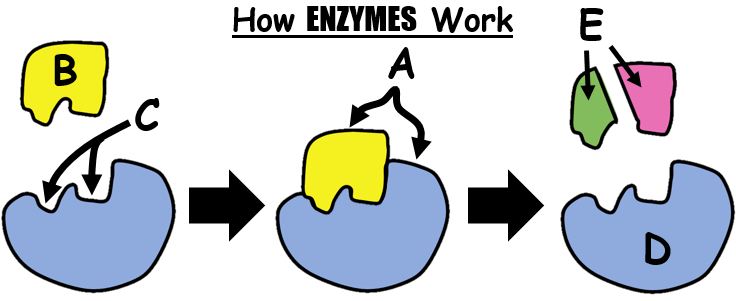
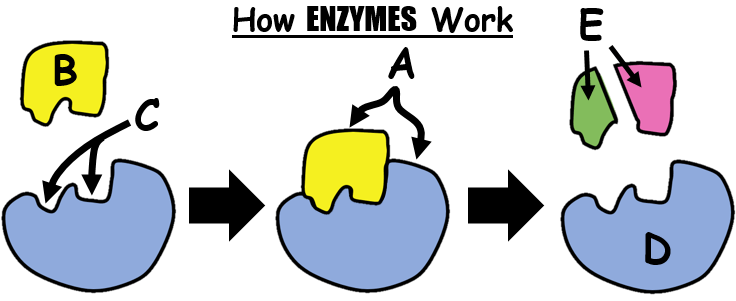
What is structure A?
a)
Substrate
b)
Active site
c)
Enzyme
d)
Products
5.
What 3 letters do enzymes typically end in?
a)
-ose
b)
-ase
c)
-ese
d)
-tic
6.
What is the name for the mechanism of enzyme activity?
a)
Lock and key
b)
jigsaw puzzle
c)
hammer and nail
d)
two hands pattern
7.
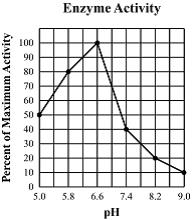
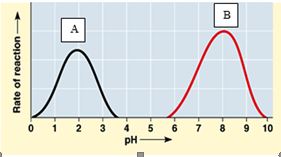
Which of the following conclusions can be drawn from this graph?
a)
The optimum pH of the enzyme is 6.6.
b)
The optimum pH of the enzyme is 5.8
c)
The enzyme’s activity increases as pH increases 5.0 to 9.0
d)
The enzyme’s activity is greater around pH of 8.0 .
8.
What makes an enzyme substrate specific?
a)
Size
b)
Shape
c)
Name
d)
Location it is found in
9.
At 40 degrees Celsius, your biological enzymes will...
a)
Functional optimally
b)
Denature
c)
Wait until the temp. increases
d)
Wait until the temp. decreases
10.
Enzymes are capable of increasing the rate of a chemical reaction within a living cell.  Enzymes accomplish this through which of the following means?
a)
reducing the number of products   
b)
reducing the activation energy
c)
increasing the temperature of the cell
d)
increasing the concentration of reactants 
11.
Each enzyme only has 1 substrate that will fit its active site.  What is this called?
a)
reusable
b)
catalyst
c)
specific
d)
fragile
12.
After the enzyme and substrate bind together and perform the reaction, what does the substrate become?
a)
a substrate
b)
an enzyme
c)
a product
d)
an active site
13.
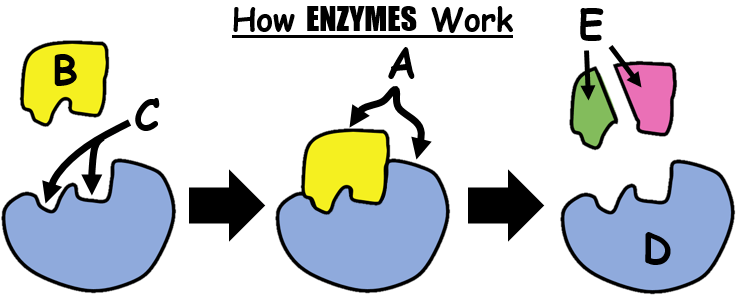
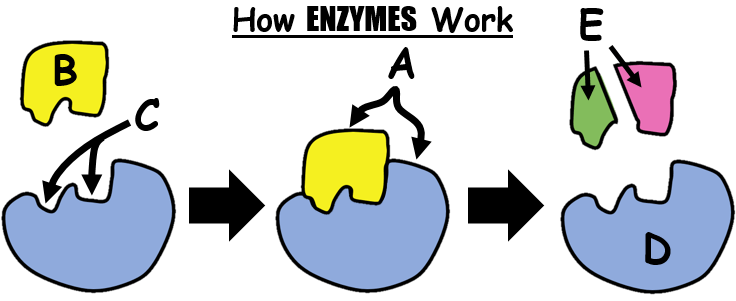
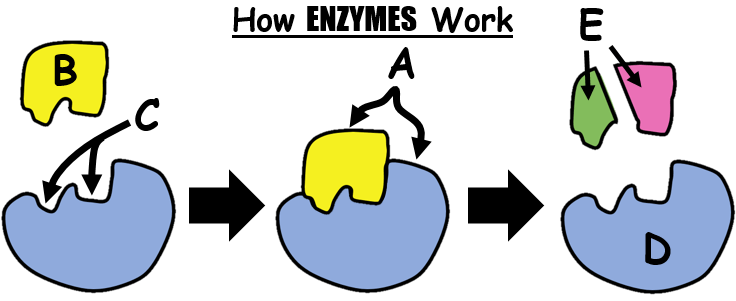
In the diagram, what is letter A? 
a)
product
b)
substrate
c)
enzyme-substrate complex
d)
active site
14.
Letter D...
a)
active site
b)
enzyme
c)
substrate
d)
products
15.
Letter B...
a)
active site
b)
enzyme
c)
substrate
d)
products
16.
Letter C...
a)
active site
b)
enzymes
c)
substrate
d)
products
17.
Letter E...
a)
active site
b)
enzyme
c)
substrate
d)
products
18.
Chemical reactions always involve
a)
the breaking of bonds in reactants.
b)
the formation of new bonds in products.
c)
the breaking of bonds in reactants and the formation of new bonds in products.
d)
enzymes. 
19.
An enzyme speeds up a chemical reaction in the cell but can only be used once.  True or False? 
a)
true
b)
false
20.
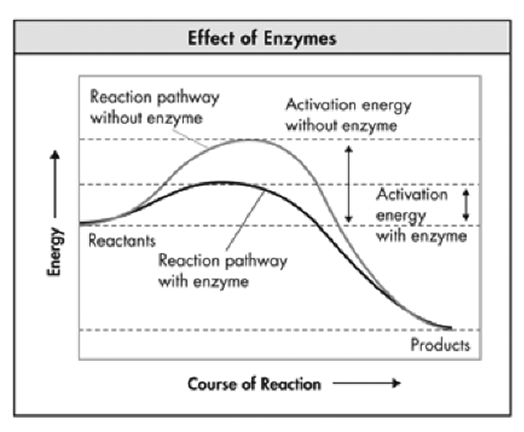
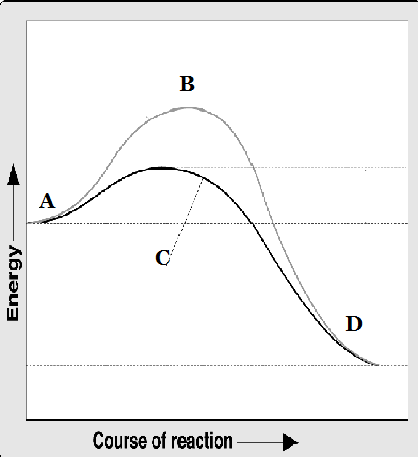
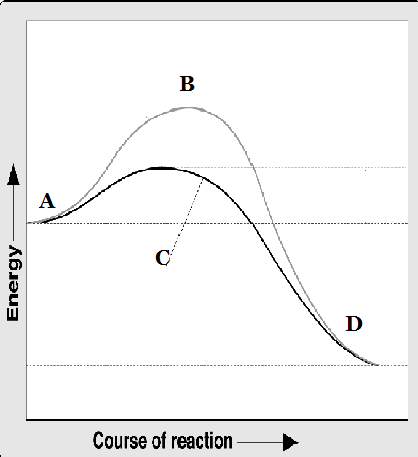
The graph shows how enzymes affect reactions in cells. Which statement best summarizes the information shown in the graph?
a)
Enzymes increase the energy of the reactants.
b)
Enzymes decrease the energy level of the products.
c)
Enzyme decrease the activation energy of the reaction.
d)
Enzymes reverse the direction of the reaction.
21.
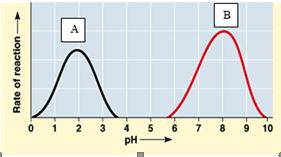
Which enzyme is most efficient in a basic solution?
a)
A
b)
B
22.
The "lock and key hypothesis" attempts to explain the mechanism of?
a)
Vacuole formation
b)
Pinocytosis
c)
Sharing of electrons
d)
Enzyme specificity 
23.
What is a Cataylst?
a)
A substance that speeds up a rate of chemical reaction.
b)
Molecules that make enzymes work harder and faster 
c)
reaction of an enzyme
d)
A substance that slows down a rate of chemical reaction.
24.
The diagram shows the series of a reactions that convert lactose into a usable form .
If enzyme 4 is denatured (stops working), the levels of which substance will increase?
a)
Lactose
b)
Galactose
c)
Glucose-1-Phosphate
25.
The portion labeled "B" represents the
a)
reaction with enzyme
b)
reaction without enzyme
c)
reactants
d)
products
26.
The portion labeled "D" represents the
a)
reaction with enzyme
b)
reaction without enzyme
c)
reactants
d)
products
27.

What is the optimal pH of enzyme A?

a)

8

b)

2

c)

5.7-10

d)

10

28.
What is the pH range of enzyme A?
a)
2
b)
0-3.7
c)
3.7
d)
0
29.
Enzymes are composed of which macromolecule.
a)
lipids
b)
protein
30.
Some bacteria live in hot springs. Their cells contain enzymes that function best at temperatures of 70 °C or higher. At the temperature of 50 °C, how will the enzymes in these bacterial cells most likely be affected?
Enzymes work best at an optimal temperature.
a)
The enzymes will lose their bond structure and fall apart
b)
The enzymes will not increase the rate of reactions as much as they would at 70 °C. 
31.
What is the relationship between enzymes and activation energy? 
a)
When an enzyme catalyzes a reaction, it decreases the activation energy of the reaction.
b)
When an enzyme catalyzes a reaction, it does not affect the activation energy of the reaction.
32.
Meat tenderizer contains an enzyme that breaks down meat. If meat is coated with tenderizer and then placed in a refrigerator, how would the enzyme be affected? Temperature can effect how an enzyme works
a)
It would break down the meat more slowly
b)
It would change the shape of the meat.
33.
If the enzyme has a pH ranging from 7 to 9 what effect would a pH of 3 have on the enzyme?
Enzymes work best at an optimal temperature and pH
a)
make it inactive
b)
no change
34.
The graph shows how the activity of an enzyme changes over a range of pH values. Which of the following conclusions can be drawn from this graph?
a)
pepsin works best at a pH near 2
b)
pepsin works best at a pH of 9
35.
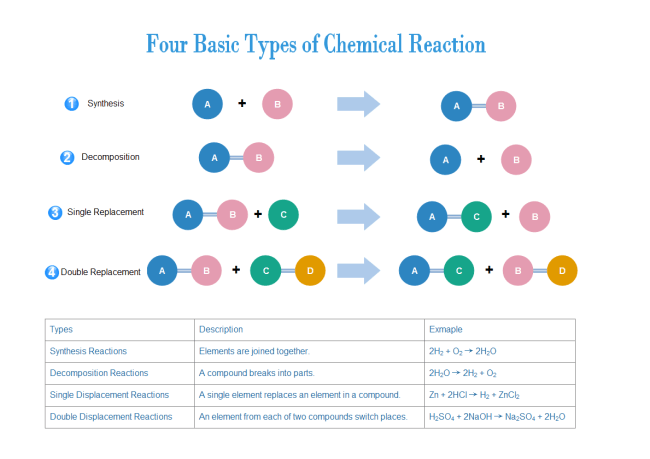
The diagram below illustrates a biochemical process that occurs in organisms. What is another name for the substance labeled "catalyst"? 
a)
Enzyme
b)
Antibody
36.
The human body maintains a temperature of around 98.6 degrees at all times. Enzymes are involved in almost every chemical reaction in the body. Which of the following describes the connection between these two statements? 
a)
The body is kept relatively warm to prevent too much enzyme action
b)
Enzymes function best at a specific temperature.
37.
Which of the following best explains why enzymes are necessary for many cellular reactions? 
Enzymes speed up reactions
a)
The reactions are too slow to meet the needs of the cell if enzymes are missing.
b)
The reactions take up too much space in the cell if the enzymes are missing.
38.
Enzymes interact with the substrate at the 
a)
active site
b)
product
39.
Enzymes can break down the substrate starch into new
a)
products
b)
enzymes
40.
Enzymes are specific and often are compared to the interaction between a -
a)
lock and key 
b)
lock and chanin
41.
Enzyme -_______________ the activation energy required for a reaction.
a)
lower, decrease
b)
raise, increase
42.
The following enzyme has been altered by a change in pH or temperature and is said to be -
a)
denatured
b)
eradicated
43.

Enzymes lower activation energy required.

a)

True

b)

False

44.

Select all the statement/terms that are associated with enzymes.

a)

Protein

b)

Catalyst

c)

Lower Activation Energy

d)

Specific- Lock and Key

45.

Enzymes work best at a certain temperature and pH.

a)

True

b)

False

46.

Enzymes are PROTEINS.

a)

True

b)

False

47.
Before cells can divide, what must be copied?
a)
mitochondria
b)
cytoplasm
c)
DNA
d)
Cell Wall
48.
The division of the nucleus is known as:
a)
Synthesis
b)
Mitosis
c)
G1
d)
G2
49.
The individual strands on duplicated chromosomes are called_____________
a)
Centromeres
b)
daughters
c)
Chromatids
d)
Karyotypes
50.
The ___________ holds the replicated sister chromatids together.
a)
centriole
b)
chromosomes
c)
centromere
d)
cycles
51.
The cell spends most of it's life in ________________.
a)
mitosis
b)
cytokinesis
c)
Interphase
d)
None of the above
52.
In the S stage of interphase_______________
a)
the cell grows
b)
the nucleus divides
c)
the cell membrane divides
d)
the DNA is replicated
53.
When a plant cell goes through cell division,  _____________.
a)
the 2 new nuclei are separated by the cell membrane pinching off.
b)
4 new cells are formed
c)
a cell plate forms, dividing the 2 new nuclei
d)
None of the above
54.
When an animal cell goes through cytokinesis,__________
a)
a cell plate forms dividing the 2 new nuclei.
b)
the cell membrane pinches off the 2 new cells.
c)
4 new cells are formed.
d)
None of the above
55.
A human cell has 46 chromosomes before mitotic division.  How many chromosomes will the daughter cells after mitosis.
a)
12
b)
23
c)
46
d)
92
56.
Cells of organism must replicate for ?
a)
growth
b)
repair of damaged cells
c)
replacement of dying cells.
d)
All of the above
57.
Name the phase:
a)
Anaphase
b)
Telophase
c)
Metaphase
d)
Prophase
58.
Name the phase:
a)
Prophase
b)
Metaphase
c)
Anaphase
d)
Telophase
59.
Name the phase:
a)
Prophase
b)
Metaphase
c)
Anaphase
d)
Telophase
60.
Name the phase:
a)
Prophase
b)
Metaphase
c)
Anaphase
d)
Telophase
61.
The stages of mitosis in order
a)
Metaphase, Anaphase, Prophase, Telophase
b)
Prophase, Anaphase, Metaphase, Telophase
c)
Prophase, Metaphase, Anaphase, Telophase
d)
Anaphase, Prophase, Telophase, Metaphase
62.
The structure labeled A is a(n)
a)
chromatid
b)
centriole
c)
centromere
d)
chromophere
63.
The structures labeled B are
a)
centrioles
b)
chromatids
c)
centromeres
d)
chromopheres
64.
The chromosome in the diagram 
a)
has been replilcated
b)
consists of 2 copies of 1 chromosome
c)
is about to go through cell division
d)
all of the above.
65.
Interphase contains three stages, including the G1 and G2 stages.  Which of the following occurs during these gap stages? 
a)
separation of chromosomes
b)
cellular growth 
c)
DNA replication
d)
viral transformation 
66.
If a fruit fly has 8 chromosomes in each of its body cells, how many chromosomes will be in each daughter cell after mitosis? 
a)
2
b)
4
c)
8
d)
16
67.
What is diffusion?
a)
when molecules move 
b)
when molecules move from a high concentration to a low.
c)
no movement 
d)
molecules move everywhere
68.
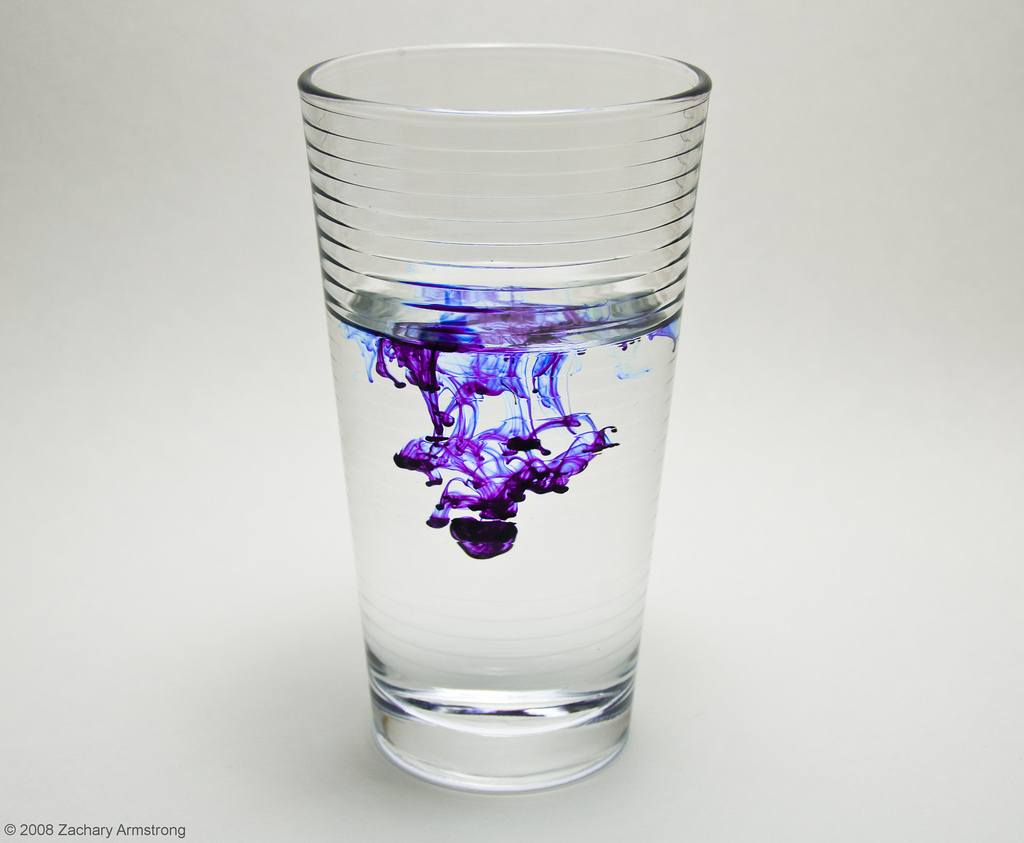
Where is there a low concentration of dye?
a)
at the bottom of cup
b)
in the color
c)
at the top of cup 
d)
no concenteraion gradient
69.
Osmosis is the movement of _____ across a membrane.
a)
food
b)
energy
c)
oxygen
d)
water
70.
During osmosis
a)
water moves from high to low concentration
b)
large or oddly shaped molecules move across a cell membrane
c)
water moves when energy is used
d)
proteins are built
71.
The diffusion of water through a semi-permeable membrane is called?
a)
Osmosis
b)
Cell wall
c)
Diffusion
d)
Respiration
72.
Where is there a high concentration of water?
a)
in the flower
b)
cannot be determined by picture.
c)
in the vase
d)
in the leaves
73.
What is the definition of  Selective Permeability?
a)
The movement of materials across the cell membrane that requires NO ENERGY from the cell.
b)
The movement of materials through (or across) the cell membrane
c)
The ability of the cell membrane to allow some things to pass through while preventing other things from passing through.
d)
The movement of molecules from an area of high concentration to a area of low concentration 
74.
What a cell needs to transport particles by active transport?
a)
Sun
b)
Wind
c)
Energy
d)
Channels
75.
When both inside and outside of a cell have the same amount of water it is said that the cell has reached a state of
a)
Osmosis
b)
Diffusion
c)
Equilibrium
76.
A person would never have pure water put into their veins in a hospital because their cells would...
a)
Shrink/Dehydrate
b)
Expand
77.
A person should never drink salty water because their cells would
a)
shrink
b)
expand
78.
If there is 5 percent water inside a cell and 5 percent water outside a cell
a)
more water will move inside the cell
b)
more water will move outside the cell
c)
There will be no movement of water cells
79.
Passive transport requires no
a)
concentration gradients
b)
osmosis
c)
motion
d)
energy
80.
The movement of molecules against a concentration gradient
a)
simple diffusion
b)
facilitated diffusion
c)
active transport
d)
osmosis
81.
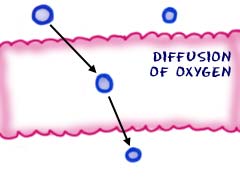
The picture is an example of...
a)
active tranport
b)
passive transport
c)
diffusion
d)
osmosis
82.
Sometimes, energy is required for ____ molecules to go in or out of the cell because they cannot fit into the membrane.
a)
big
b)
small
c)
crunchy
d)
water
83.
What is diffusion?
a)
when molecules move from a low concentration to a high concentration 
b)
when molecules move from a high concentration to a low concentration.
c)
no movement 
d)
molecules move everywhere
84.
_______ regulates what enters and leaves a cell.  
a)
Cell Membrane
b)
Nucleus
c)
Mitochondria
d)
Cytoplasm
85.
In the given scenario what will happen to the organism: salt is poured onto eggplant.
a)
Water will move out of the eggplant cells and the cells will shrink.
b)
Water will move out of the eggplant cells and the cells will swell.
c)
Water will move into the eggplant cells and the cells will swell.
86.
In the given scenario what will happen?  An egg is placed in pure water for 48 hours.
a)
The egg will gain water and swell.
b)
Water will move in and out of the cell equally, and the cell with neither shrink nor swell.
c)
The egg will lose water and shrink.
87.
Which example(s) of cell transport does not require chemical energy
a)
Drops of blue food coloring are placed in water and spread throughout the water, turning it blue.
b)
A potato slice is placed in water and water molecules from outside the potato move into the potato cells.
c)
Both Answers
d)
 Neither answers
88.
The diagram shows various molecules that move into and out of the cell. How does molecule C move out the cell?
a)
Active Transport
b)
Diffusion
c)
The use of a protein pump
d)
Manipulated osmosis
89.
An animal cell placed in a hypertonic (salty) solution will
a)
Shrink
b)
Swell
c)
Stay the same
90.
How many diamond molecules need to move to reach equilibrium?
a)
A net of 2 molecules move inside the cell.
b)
A net of 2 molecules move outside the cell.
c)
There is no net movement because the molecules are at equilibrium.
d)
The molecules do not move.
91.
Which way will the water molecules move during osmosis?
a)
Out of the cell, so the cell shrinks.
b)
Out of the cell, so the cell swells.
c)
Into the cell, so the cell shrinks.
d)
Into the cell, so the cell swells.
92.
Just like Coke is a type of soda, __________ is a type of ___________.
a)
diffusion, osmosis
b)
concentration, equilibrium
c)
equilibrium, concentration
d)
osmosis, diffusion
93.
In which case would a cell most likely shrink?
a)
when placed in a solution containing a high salt concentration
b)
when placed in a isotonic solution
c)
when placed in a solution containing a low pH
d)
when placed in a solution containing distilled water
94.
Active transport requires energy because...
a)
The cell is moving something against a concentration gradient
b)
The cell is moving something with a concentration gradient
95.
A student noticed that placing wilted lettuce in a bowl of cool water caused the lettuce to become more crisp and firm. What is the best explanation for his observation?
a)
Water moved into the lettuce cells by active transport.
b)
Water moved into the lettuce cells by osmosis.
c)
Salt moved into the lettuce cells by diffusion.
d)
Water moved out of the lettuce cells by osmosis.
96.
Diffusion and Osmosis are examples of...
a)
Active Transport
b)
Passive Transport
97.
Endocytosis and Exocytosis are examples of...
a)
Active Transport
b)
Passive Transport
98.
During diffusion
a)
substances (things) moves from high to low concentration
b)
water moves when energy is used
c)
large or oddly shaped molecules move across a cell membrane
d)
water moves from high to low concentration
99.
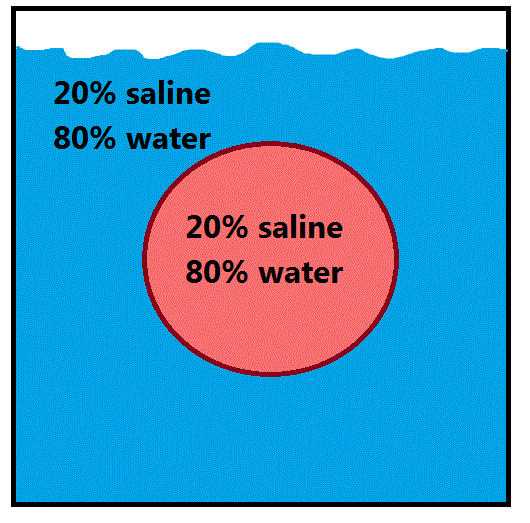
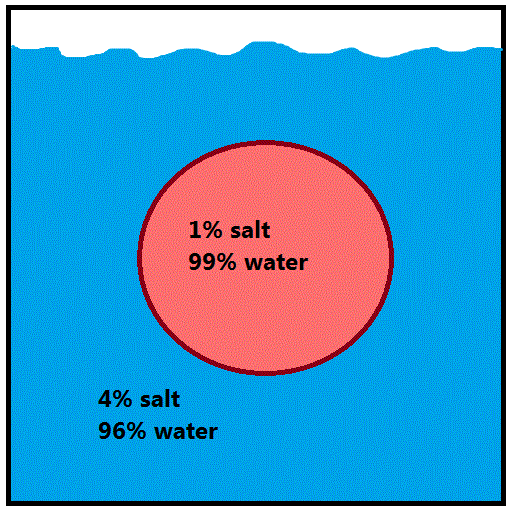
The cell below is in a _____________ solution.
a)
Hypertonic
b)
Hypotonic
c)
Isotonic
100.
The cell below is in a _________ solution.
a)
Hypotonic
b)
Hypertonic
c)
Isotonic
101.
Passive transport requires no
a)
concentration gradients
b)
osmosis
c)
motion
d)
energy
102.

What feature of a root hair cell makes it good at osmosis?

a)

It is green

b)

It has a large surface area

c)

It contains a lot of chloroplasts

d)

It contains a lot of mitochondria

103.
Ideally, your cells should be in a(n) _______ solution
a)
Hypertonic
b)
Hypotonic
c)
Isotonic
d)
Cola
104.
Water will move INTO a cell in a(n) _______ solution
a)
Hypertonic
b)
Hypotonic
c)
Isotonic
d)
Gravy
105.
An animal cell placed in a hypertonic (salty) solution will
a)
Shrink
b)
Swell
c)
Stay the same
106.

 If the volume of a cell 

increases when it is placed 

in a solution, that solution is

 said to be __________ to the 

cell

a)
 hypertonic
b)
subatomic
c)
 isotonic
d)
 hypotonic 
107.
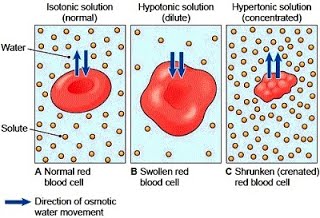
What information could be added to make this diagram a more complete model of osmosis in red blood cells?
a)
Information about the temperatures of the cell and of the solution.
b)
The relative concentrations of solute inside and outside the cell.
c)
Show that energy is required for the osmosis to occur.
d)
Show the cell holding its shape as osmosis occurs.
108.
An animal cell that is surrounded by fresh water will burst because the osmotic pressure causes
a)
water to move into the cell.
b)
water to move out of the cell.
c)
solutes to move into the cell.
d)
solutes to move out of the cell.
109.
If you enjoy rubbery carrots, place them in .....
a)
Cold Water
b)
Hot Water
c)
Distilled Water
d)
Salt Water
110.

A blood cell is placed into the jar, as seen. Where will the water go?

a)

Into the cell

b)

Out of the cell

c)

Equally in & out - it's isotonic

d)

The water is a lie

111.

Where will the water go?

a)

Into the cell

b)

Out of the cell

c)

Equally in & out - it's isotonic

d)

There is no water

112.

Why can't you drink salt water?

a)

It's hypertonic to your cells

b)

It's hypotonic to your cells

c)

It's isotonic to your cells

d)

It's paratonic to your cells

113.
What type of solution is shown in the image?
a)
Hypertonic
b)
Hypotonic
c)
Isotonic
d)
Unknown
114.
What type of solution is shown in the image?
a)
Hypertonic
b)
Hypotonic
c)
Isotonic
d)
Unknown
115.
What type of solution is shown in the image?
a)
Hypertonic
b)
Hypotonic
c)
Isotonic
d)
Unknown
116.
What type of solution is shown in the image?
a)
Hypertonic
b)
Hypotonic
c)
Isotonic
d)
Unknown
117.
What type of solution is shown in the image?
a)
Hypertonic
b)
Hypotonic
c)
Isotonic
d)
Uknown
118.
What type of solution is shown in the image?
a)
Hypertonic
b)
Hypotonic
c)
Isotonic
d)
Unknown
119.
What will happen to the cell in the image?
a)
It will shrink
b)
It will expand
c)
It will stay the same
d)
Unknown
120.
What will happen to the cell in the image?
a)
It will shrink
b)
It will expand
c)
It will stay the same
d)
Unknown
121.
What will happen to the cell in the image?
a)
It will shrink
b)
It will expand
c)
It will stay the same
d)
Unkown
122.
A concentration gradient is...
a)
Concentrations of different substances
b)
A difference in concentrations
c)
An unknown concentration
d)
A different color of concentration
123.
Which is NOT a form of active transport?
a)
Endocytosis
b)
Osmosis
c)
Exocytosis
d)
Pinocytosis
124.
When cells take in a liquid through active transport, what is it called?
a)
Exocytosis
b)
Phagocytosis
c)
Pinocytosis
d)
Osmosis
125.
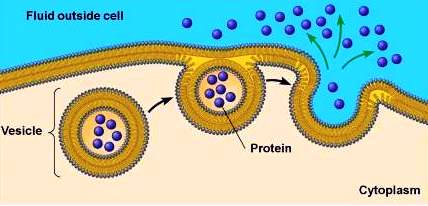
Which form of active transport is being shown?
a)
Pinocytosis
b)
Endocytosis
c)
Exocytosis
d)
Osmosis
126.
Which does NOT require energy to occur?
a)
Passive Transport
b)
Active Transport
c)
Endocytosis
d)
Exocytosis
127.
What is the difference between active and passive transport?
a)
Active does not need energy and passive uses ATP (energy)
b)
Active uses ATP (energy) and passive does not need energy
c)
Active stores transport proteins and passive releases 
d)
Active uses hormones and passive does not 
128.
This type of endocytosis is used by the cell to take in large molecules or tiny organisms. 
a)
Pinocytosis 
b)
Protein pumps
c)
Phagocytosis
d)
Exocytosis
129.

In this image, the cell is using which type of molecular transport?

a)

Osmosis

b)

Diffusion

c)

Phagocytosis

d)

Exocytosis

130.
Protein "pumps" move molecules from an area of _______ concentration to and area of _______ concentration.
a)
zero, 100%
b)
high, low
c)
some, little 
d)
low, high 
131.
Active transport...
a)
... includes diffusion
b)
... requires energy
c)
... is limited to only things leaving the cell
d)
... is limited to only things entering the cell
132.
What kind of biomolecule is the pump in the sodium potassium pump example?
a)
Protein
b)
Carbohydrate
c)
Lipid
d)
Nucleic acid
133.
Which is not a type of active transport?
a)
Receptor-mediated endocytosis
b)
Pinocytosis
c)
Sodium potassium pump
d)
Facilitated diffusion
134.
Which process describes how large particles are removed from the cell?
a)
Diffusion
b)
Osmosis
c)
Exocytosis
d)
Endocytosis
135.

Simple diffusion allows the movement of particles without the use of?

a)

Energy

b)

a Transport Protein

c)

Data

d)

Lipids

136.

Passive Transport stops when the concentration has reached equilibrium - true or false?

a)

true.

b)

false

137.
When both inside and outside of a cell have the same amount of water it is said that the cell has reached a state of ___________.
a)
osmosis
b)
equilibrium
c)
diffusion
d)
hypertonic
138.
_______ regulates what enters and leaves a cell.  
a)
Cell Membrane
b)
Nucleus
c)
Mitochondria
d)
Cytoplasm
139.
This process is known as (leaving the cell)
a)
phagocytosis
b)
endocytosis
c)
exocytosis
d)
osmosis
140.
This active transport process is known as (bacteria being engulfed)
a)
endocytosis
b)
phagocytosis
c)
exocytosis
d)
facilitated diffusion
141.
Which cell organelle is used in active transport, but not in passive transport?
a)
Nucleus
b)
Mitochondria
c)
Cell Membrane
d)
Ribosomes
142.

In order for active transport to happen.........

a)

a transport protein is needed

b)

a transport protein is needed, oxygen is needed and carbon dioxide is needed

c)

a transport protein is needed PLUS energy (ATP) is needed

d)

no energy is needed

143.
What type of solution is this cell in?
a)
Isotonic
b)
Hypertonic
c)
Hypotonic
d)
diffused
144.
What type of solution is this cell in?
a)
Isotonic
b)
Hypertonic
c)
Hypotonic
d)
diffused
145.
What type of solution is this cell in?
a)
Isotonic
b)
Hypertonic
c)
Hypotonic
d)
diffused
146.
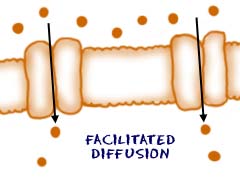
Special proteins help move particles, but NO energy is needed. This is..
a)
facilitated diffusion
b)
exocytosis
c)
active transport
d)
equilibrium
147.
a)
Passive Transport
b)
Active Transport
148.
a)
Passive Transport
b)
Active Transport
149.
a)
Passive Transport
b)
Active Transport
150.
a)
Passive Transport
b)
Active Transport
151.
Osmosis
a)
Passive Transport
b)
Active Transport
152.
High to Low
a)
Passive Transport
b)
Active Transport
153.
Diffusion
a)
Passive Transport
b)
Active Transport
154.
Facilitated Diffusion
a)
Passive Transport
b)
Active Transport
155.
a)
Passive Transport
b)
Active Transport