wayground logo

Free Printable Worksheets

Font size

S
M
L
XL
Worksheets

Physics 1st Sem Concept review

Total questions: 75

Worksheet time: 2hrs 39mins

Name
Class
Date
1.

Another word for speed and direction is

a)

inertia

b)

momentum

c)

velocity

2.

What is velocity

a)

speed

b)

speed and direction

c)

momentum

3.

One name for Newton's First Law of Motion is

a)

Inertia

b)

gravity

c)

momentum

4.

If an object changes its speed and direction it is

a)

changing

b)

moving

c)

accelerating

5.

Motion is

a)

forces

b)

a change in position

c)

none of the above

d)

acceleration

6.

Who discovered many concepts of physics, including the laws of motion?

a)

Albert Einstein

b)

Miss Radic

c)

Ben Franklin

d)

Isaac Newton

7.

What is Newton's 1st Law of Motion?

a)

An object at rest stays at rest unless acted up by an outside force and an object in motion stays in motion unless acted upon by an outside force

b)

Force = mass x acceleration

c)

For every action, there is an equal and opposite reaction

d)

Inertia

8.

What is Newton's 2st Law of Motion?

a)

an object at rest stays at rest unless acted upon by an outside force and an object in motion will stay in motion unless acted upon by an outside force

b)

Force = mass x acceleration

c)

For every action there is an equal and opposite reaction

9.

What is Newton's 3rd Law?

a)

an object at rest stays at rest unless acted upon by an outside force and an object in motion will stay in motion unless acted upon by an outside force

b)

Force = mass x acceleration

c)

For every action there is an equal and opposite reaction

10.

Which law is this an example of: If a person throws a tennis ball and a balloon with the same amount of force, the tennis ball will go farther because it has more mass.

a)

1st

b)

2nd

c)

3rd

11.

Which law is this an example of: When the baseball hits the bat, the ball moves in the opposite direction. The harder you hit the ball, the harder it flies in the opposite direction.

a)

1st

b)

2nd

c)

3rd

12.

A pencil balanced on the edge of a desk, that could fall at any moment is an example of

a)

Kinetic energy

b)

Potential energy

13.
At which point is potential energy greatest?
a)
W
b)
X
c)
Y
d)
Z
14.

Conservation of energy means that

a)

energy can be created but not destroyed

b)

energy can be destroyed but not created

c)

energy can be both created and destroyed

d)

energy can be neither created nor destroyed

15.

Kinetic energy can be described as

a)

energy in motion

b)

stored energy

c)

a chemical reaction

d)

connected energy

16.

Students are investigating changes from potential to kinetic energy by rolling a marble down a ramp made by propping up a plastic ruler on a book and letting it roll down.

Which of the following will change the potential energy the marble starts with?

a)

Adding more books beneath the ruler to increase its height

b)

Pushing the marble down the ramp

c)

Switching the plastic ruler with a wooden one

d)

Replacing the marble with a rock

17.

If a green golf ball is dropped from a height of 7 feet and a yellow golf ball is dropped from a height of 12 feet, which ball has greater potential energy before it is released?

a)

yellow

b)

green

c)

Both have the same amount of potential energy.

d)

Neither will have more potential energy than the other.

18.
A force of attraction between 2 object that is directly related to mass and indirectly related to distance.
a)
mass
b)
weight
c)
gravity
d)
kilogram
19.
As a projectile moves through the air, the motion on y axis is best described as ____,
a)
free fall acceleration
b)
uniform motion
c)
varying speeds
d)
constant velocity
20.
How can you describe the motion on the horizontal axis if you ignore air resistance?
a)
acceleration due to gravity
b)
constant velocity
c)
varying acceleration
d)
motionless
21.
As a ball rolls across a table it has a constant horizontal velocity. When the ball rolls off the table the horizontal velocity...
a)
Stays the same
b)
Accelerates at -9.8 m/s2
c)
Accelerates at an unknown value
d)
Becomes zero
22.
A ball rolls off of a horizontal table and falls to the ground. The instant the ball leaves the table its vertical velocity is...
a)
-9.8m/s
b)
Unknown
c)
0m/s
d)
9.8m/s
23.
What is the vertical acceleration of a projectile?
a)
0 m/s2
b)
9.8 m/s2 down
c)
4.9 m/s2 down
d)
12 m/s down
24.
What is the horizontal acceleration of a projectile?
a)
0 m/s2
b)
-9.8 m/s2
c)
-15 m/s2
d)
- 20 m/s
25.
If a bullet is horizontally shot at the same moment another bullet is dropped from the same height, which will hit the ground first?
a)
Shot Bullet
b)
Dropped Bullet
c)
Hit at Same Time
d)
Can not be determined
26.
What can you say about motion in the x and y direction?
a)
x is dependent on y
b)
y is dependent on x
c)
They are dependent on each other.
d)
They are independent of each other. 
27.
What force acts in the y direction that causes an object to travel in a parabolic arc?
a)
Friction
b)
Gravity
c)
Tension
d)
No force acting.
28.
What is the height of a horizontal projectile if it takes 3 seconds to hit the ground?
a)
3.00 m
b)
29.4 m
c)
44.1 m
d)
88.3 m
29.
Two objects are fired with the same horizontal velocity. One object begins at 5 m above the ground while the other begins on a 30m high platform. Which object has the greatest horizontal range?
a)
projectile at 5m
b)
projectile at 30m
c)
Both objects have the same range
d)
Unable to determine
30.
Projectile A is fired with a velocity of 20 m/s while projectile B is fired with a velocity of 40 m/s from the same height.  Which statement best describes the range  of projectile B as compared to projectile A?
a)
Projectile B goes half as far as projectile A,
b)
Projectile B goes twice as far as projectile A.
c)
Projectile B goes the same range as projectile A.
d)
Can not be compared.
31.
Projectile A is fired with a velocity of 20 m/s off a 20 m cliff, while projectile B is fired with a velocity of 40 m/s off a 10m cliff.  Which statement best describes the time of flight of projectile B as compared to projectile A?
a)
Projectile B is in the air a longer time than projectile A,
b)
Projectile B is in the air less time than projectile A.
c)
Projectile B in the air for the same amount of time as projectile A.
d)
Can not be compared.
32.

What is the motion of the car relative to the runner's frame of reference?

a)

26 m/s right

b)

34 m/s right

c)

34 m/s left

d)

26 m/s left

33.

When you're in a car, what is your frame of reference?

a)

the car

b)

the road

c)

the Earth

d)

there is none

34.
What does this graph represent?
a)
Constant Speed
b)
Acceleration
c)
Not moving
35.
Which runner won the race?
a)
A
b)
B
c)
C
d)
It was a tie
36.
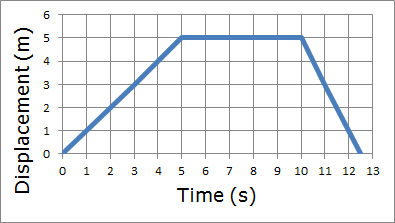
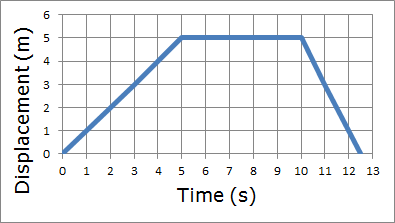
According to the graph how far does the person travel in the first 5 seconds?
a)
2 m
b)
10 m
c)
0 m
d)
5 m
37.
What is the person doing from 5 seconds to 10 seconds?
a)
Walking 
b)
Running
c)
Standing Still 
d)
Walking Fast
38.
In which of the following graphs (click the image) are both runners moving at the same speed (note that graph c is the bottom right graph, and graph d is the bottom left graph)? 
a)
Graph A
b)
Graph B
c)
Graph C
d)
Graph D
39.
What is the speed of the red line?  
a)
4 m/s 
b)
16 m/s 
c)
32 m/s 
d)
2 m/s 
40.
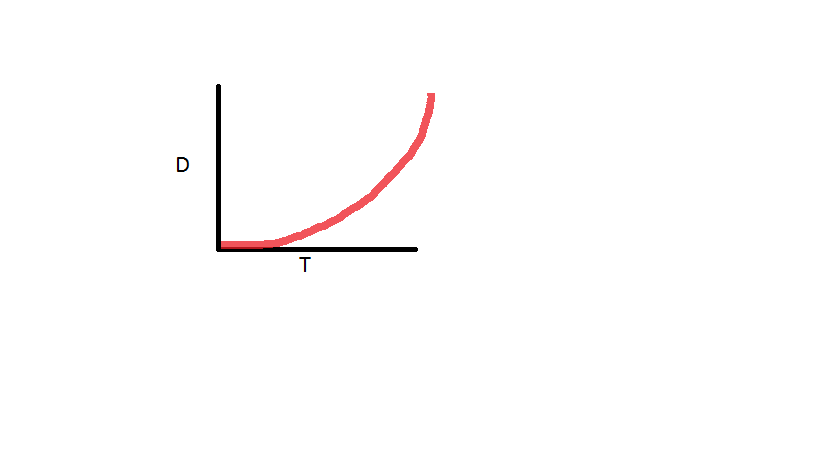
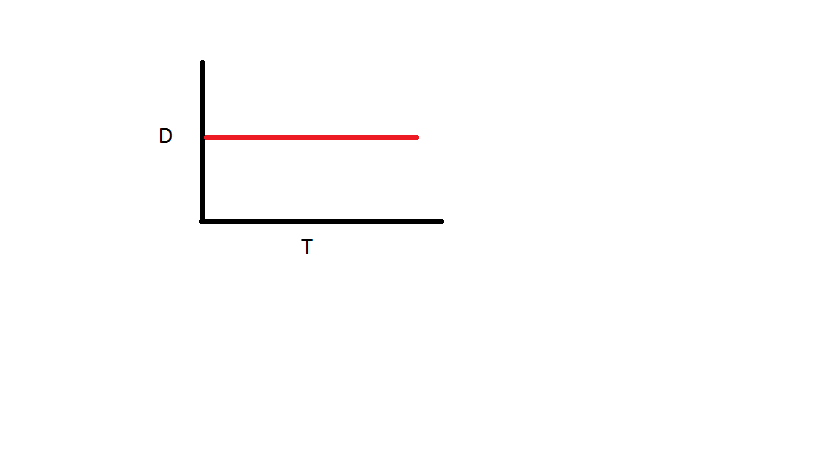
In the distance vs. time graph, what type of motion does the line represent? 
a)
Speed
b)
Velocity
c)
Acceleration
d)
Deceleration
41.
In the distance vs. time graph, what type of motion does the line represent?
a)
No motion
b)
Constant velocity
c)
Acceleration
d)
Deceleration
42.
Which graph is would represent a decrease in speed?
a)
Graph A
b)
Graph B
c)
Graph C
d)
The object is not decreasing in speed in any of these graphs
43.
Which graph represents the greatest acceleration?
a)
A
b)
B
c)
C
d)
D
44.
What is happening in this graph from point B to C?
a)
The object is going down a hill.
b)
The object is returning to its starting location.
c)
The object is slowing down.
d)
The object is staying still.
45.
Which quantity is a vector?
a)
Displacement
b)
Distance
46.

The motions of Objects A, B, and C are represented on a position-time graph. Observe their lines and rank the speeds of Objects A, B, and C from slowest to fastest.

a)

A, B, C

b)

B, A, C

c)

A, C, B

d)

C, B, A

47.

The velocity-time graphs represent the motion of four different objects. Identify any object that is changing its velocity or accelerating. Check all that apply.

a)
b)
c)
d)
48.

The velocity-time graphs represent the motion of four different objects. Identify any object that is getting faster or speeding up. Check all that apply.

a)
b)
c)
d)
49.
What is the magnitude (size) and direction of the net force?
a)
21 N to the Left
b)
3 N to the Left
c)
21 N to the Right
d)
3 N to the Right
50.
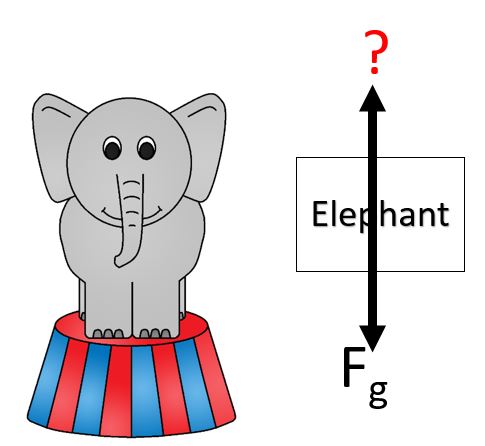
Name the missing force...
a)
weight force
b)
normal force
c)
applied force
d)
frictional force
51.
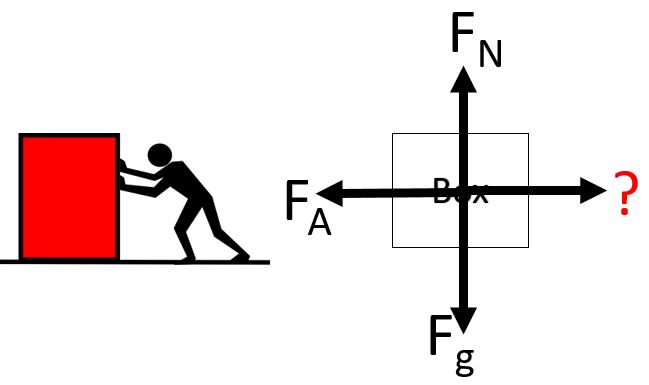
Name the missing force...
a)
frictional force
b)
weight force
c)
thrust
d)
buoyant force
52.
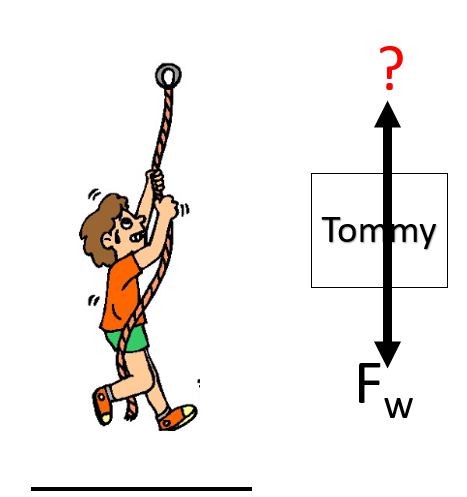
Name the missing force...
a)
tension force
b)
gravitational force
c)
normal force
d)
applied force
53.

A rightward force is applied to a dresser to accelerate it to the right across the bedroom floor.

a)
b)
c)
d)
54.

This diagram can be used to indicate which of the following? (TWO correct answers)

a)

a object at rest

b)

an object moving at a constant velocity (speed)

c)

an object accelerating

d)

(Trick question -- there is only one correct answer)

e)

an object decelerating

55.

Which way is the object moving?

a)

it's either not moving or moving at a constant speed due to balanced forces

b)

to the right

c)

to the bottom

d)

up

56.
If I double the distance between two objects, what happens to their gravitational Force?
a)
4x bigger
b)
4x smaller
c)
2x bigger
d)
2x smaller
57.
If I double the mass of one object, but don't change anything else... WHat happens to the gravitational force between two objects?
a)
Doubles
b)
Quadruples
c)
Cut in Half
d)
4x Smaller
58.
What happens to Gravitational force if I double both of the masses but don't change their distance?
a)
doubles
b)
half as big
c)
4x bigger
d)
4x smaller
59.
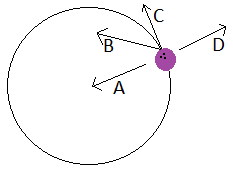
Which of the following depict the speed of the blowing ball?
a)
A
b)
B
c)
C
d)
D
60.
Which represents the acceleration of the ball?
a)
A
b)
B
c)
C
d)
D
61.
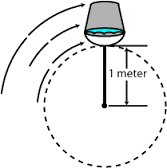
A horse gallops around a circular arena.  The centripetal force on the horse is ___.
a)
directed outward
b)
tension
c)
directed toward the center of the arena
d)
9.8 N
62.
The velocity is always _____ to the line of a circle. 
a)
outwards
b)
towards the center
c)
tangent
d)
faster
63.
You swing a bucket of water attached to a string in a circle above your head. What keeps the water in the bucket?
a)
Friction
b)
Centripetal Force
c)
Gravity
d)
Inertia
64.

As two objects get closer together, what happens to the force of gravity between them?

a)

The force of gravity increases

b)

The force of gravity decreases

c)

The force of gravity stays the same, since their masses are constant

d)

Not enough information

65.

How does the force of gravity between two objects change when the mass of one of the objects increases?

a)

Fg increases

b)

Fg decreases

c)

It depends on the distance between the objects

d)

Fg stays the same

66.

The diagram shows an object traveling at a constant speed in a circular path. Which labeled arrow represents the centripetal force acting on the object?

a)

W

b)

Z

c)

X

d)

Y

67.

45 J of work were done on the object that moved 5 meters. How much force was applied to the object?

a)

8 N

b)

225 N

c)

9 N

d)

0 N

68.
True or false: the net work done on a body is equal to its change in kinetic energy.
a)
True
b)
False
69.

_______________ is done when a force acts on an object and the object moves in the direction of the force.

a)

Work

b)

Kinetic energy

c)

Watt

d)

Joule

70.

The unit for work (aka Newton-meter)

a)

Watt

b)

Power

c)

Work

d)

Joule

71.

________________ is the rate at which work is done.

a)

Power

b)

Work

c)

Time

d)

Energy

72.
True or false: when the distance an object moves is zero the work done on the object is also zero.  
a)
True
b)
False
73.
Energy of a rock perched on a cliff is an example of...
a)
gravitational
b)
elastic
c)
chemical
d)
kinetic
74.
The SI unit for power is...?
a)
Watts
b)
Joules
c)
Newtons
d)
Meters
75.
What is being transferred as you do work?
a)
Energy
b)
Heat
c)
Power
d)
Gravitational Potential Energy