wayground logo

Free Printable Worksheets

Font size

S
M
L
XL
Worksheets

6th Grade Review - how well did you learn 6th grade science?

Total questions: 131

Worksheet time: 2hrs 38mins

Name
Class
Date
1.
Element or Compound?
H2O
a)
Element
b)
Compound
2.
Element or Compound?
H2SO4
a)
Element
b)
Compound
3.
Element or Compound?
Au
a)
Element
b)
Compound
4.
Element or Compound?
Ru
a)
Element
b)
Compound
5.
Element or Compound?
CF3CO2H
a)
Element
b)
Compound
6.
Element or Compound?
O2S(OH)2
a)
Element
b)
Compound
7.
Element or Compound?
As
a)
Element
b)
Compound
8.
Element or Compound?
Oxygen
a)
Element
b)
Compound
9.
Element or Compound?
NiSO4
a)
Element
b)
Compound
10.
Element or Compound?
Salt (NaCl)
a)
Element
b)
Compound
11.
What cannot be broken down into other substances?
a)
Compound
b)
Mixture
c)
Solids
d)
Element
12.
What is made up two or more elements that are chemically combined?
a)
Element
b)
Mixture
c)
Compound
d)
Solids
13.
This picture represents which of the following?
a)
element
b)
compound
c)
mixture
14.
This picture represents which of the following?
a)
element
b)
compound
c)
mixture
15.
Which of the following is not a compound?
a)
HCl
b)
Cl
c)
NaCl
d)
CO2
16.
Marie had a beaker with a small amount of baking soda. She added a few drops of pickle juice to the baking soda and observed fizzing and bubbling. Based on her observation, which of these can Marie determine about the new substance formed by mixing the baking soda and pickle juice?
a)
A chemical reaction produced a solid.
b)
A chemical reaction produced a gas.
c)
No chemical reaction took place.
d)
Only a physical change happened.
17.
Vanessa had a beaker with a small amount of baking soda. She added a few drops of vinegar to the baking soda and observed fizzing and bubbling. Based on her observation, which of these can Vanessa determine about the new substance formed by mixing the baking soda and vinegar?
a)
It was hot.
b)
It was a gas.
c)
It was magnetic.
d)
It was a conductor.
18.
Which of the following characteristics is shared by all chemical reactions?
a)
Produce a precipitate
b)
Show a color change
c)
Release heat energy
d)
Form new substances
19.
A granular substance is added to a liquid. Which of the following would provide evidence to suggest a chemical change has taken place?
a)
The liquid gives off heat.
b)
The granules dissolve completely.
c)
The volume of the liquid increases.
d)
The granules seem to get smaller.
20.
A student mixes two clear liquids together. After a few minutes, a white powdery solid can be seen settling on the bottom of the test tube. Which of the following is a conclusion that the student can draw based on these observations? The two clear liquids –
a)
were pure substances before they were mixed.
b)
are toxic and should be handled with extreme caution.
c)
have gone through a chemical change in which a new substance called a precipitate was produced.
d)
have been stored too long and are no longer good.
21.
A student added white crystals to a clear liquid. The crystals dissolved in the liquid. After a few seconds, the liquid became quite warm and then turned bright red in color. Indications that a chemical change was taking place could be observed when –
a)
the white crystals were added to the clear liquid.
b)
the crystals dissolved in the liquid leaving only the liquid visible.
c)
There are no indications of chemical change
d)
the temperature of the liquid increased and an unexpected color change occurred.
22.
A student observes some sugar as it is heated and burns. The student concludes that a chemical reaction has occurred. Which of the following observations about the burning sugar provides evidence of a chemical reaction?
a)
Heat is added to the sugar crystals.
b)
The sugar melts and becomes a liquid.
c)
Gas is produced as the sugar turns black.
d)
No evidence of chemical reaction is present.
23.
Which of the following examples shows that a chemical reaction has occurred? 
a)
A rock breaks into smaller pieces when it is struck with a hammer.
b)
Rust forms on a hammer that has been left outside to long. 
c)
A cup of water turns pink when a few drops of red food coloring are added. 
d)
A solid is formed when heat is removed from a sample of water. 
24.
Four students performed four different investigations by combining different substances. Their results are shown in the table provided. In which experiment are new substances being formed?
a)
Experiment 1
b)
Experiment 2
c)
Experiment 3
d)
Experiment 4
25.
Hydrogen peroxide breaks down to form water and oxygen gas. Which observation is evidence that a chemical reaction has occurred?
a)
The mass of the solution remains the same.
b)
 Phase changes are observed.
c)
 The color of the solution remains clear.
d)
The temperature of the solution increases. 
26.
A clear liquid from a flask is poured into another clear liquid in a beaker. Which of the following results of this procedure would indicate a new substance was formed?
a)
The level of the substance in the beaker is higher after the other liquid is added.
b)
A yellow solid forms and then settles to the bottom of the beaker.
c)
Small white crystals are left behind in the flask that held the first liquid.
27.
Evidence of a chemical reactions is anything that shows - 
a)
a new substance has formed
b)
a solid dissolved in a liquid
c)
interaction between 2 gases
d)
a change in the state of matter
28.
a)

Metal

b)

Nonmetal

c)

Metalloid

29.
a)

Metal

b)

Nonmetal

c)

Metalloid

30.
a)

Metal

b)

Nonmetal

c)

Metalloid

31.
a)

Metal

b)

Nonmetal

c)

Metalloid

32.
a)

Metal

b)

Nonmetal

c)

Metalloid

33.
a)

Metal

b)

Nonmetal

c)

Metalloid

34.
a)

Metal

b)

Nonmetal

c)

Metalloid

35.
a)

Metal

b)

Nonmetal

c)

Metalloid

36.
a)

Metal

b)

Nonmetal

c)

Metalloid

37.
What does brittle mean?
a)
shiny
b)
able to be hammered into different shapes
c)
able to be drawn into a wire
d)
breaks or shatters easily
38.
What is a conductor?
a)
Heat and electricity move through them easily
b)
able to be drawn into a wire
c)
able to be hammered into different shapes
d)
shiny
39.
What does it mean to be ductile?
a)
able to be hammered into different shapes
b)
able to be drawn into a wire
c)
heavy for their size
d)
break or shatter easily
40.
Where are metalloids located on the periodic table?
a)
to the right of nonmetals
b)
along the zig-zag line
c)
to the left of the zig-zag line
d)
to the right of the zig-zag line
41.
A substance that is shiny and a good conductor would be classified as a
a)
nonmetal
b)
metalloid
c)
metal
d)
metallica
42.
A substance that is dull, brittle, and a nonconductor would be classified as a
a)
metal
b)
nonnmetal
c)
metalloid
d)
metallica
43.
A substance that can be hammered into different shapes would be classified as a 
a)
metal
b)
nonmetal
c)
metalloid
d)
metallica
44.
A shiny and malleable substance that is not a good conductor of electricity
a)
metal
b)
nonmetal
c)
metalloid
d)
metallica
45.
Aluminum can be hammered into different shapes or rolled into flat sheets. This means Aluminum is 
a)
ductile
b)
malleable
c)
lustrous
d)
high density
46.
Carbon is dull and brittle. Carbon is a 
a)
metal
b)
nonmetal
c)
metalloid
d)
metallica
47.
True or False:  The density of a specific type of material never changes.  
a)
True
b)
False
48.
Frank has a paper clip. It has a mass of 9g and a volume of 3cm3. What is its density?
a)
3 g/cm3
b)
1/3 g/cm3
c)
27 g/cm3
d)
39 g/cm3
49.
Frank has an eraser. It has a mass of 4g, and a volume of 2cm3. What is its density?
a)
8 g/cm3
b)
2 g/cm3
c)
1/2 g/cm3
d)
24 g/cm3
50.
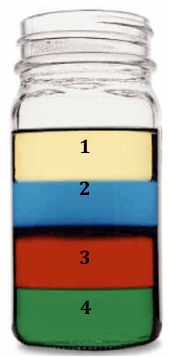
Put the liquids in order from most dense to least dense?
a)
4, 3, 2, 1
b)
1, 2, 3, 4
c)
3, 4, 2, 1, 
d)
4, 3, 1, 2
51.
An object with which of the following densities will float on water?
a)
0.7 g/cm3
b)
1.2 g/cm3
c)
3.5 g/cm3
d)
11.4 g/cm3
52.
Helium balloons rise on earth because
a)
helium is less dense than air
b)
helium is more dense than air
c)
helium is cooler than air
d)
helium is warmer than air
53.
A student knows the mass of an object. What other variable does the student need to know to calculate the object's density?
a)
Color
b)
Weight
c)
Volume
d)
Length
54.

Potential energy depends on the ________ and ________ of the object.

a)

Height (position)

b)

Mass

c)

Speed

d)

Friction

55.

Which point has the most potential energy?

a)

G

b)

F

c)

B

d)

A

56.

At which point of the roller coaster is potential energy the greatest?

a)

W

b)

X

c)

Y

d)

Z

57.
When a pendulum swings, at which point is kinetic energy highest?
a)
1
b)
2
c)
3
d)
4
58.
When a pendulum swings, at which point is potential energy at its greatest?
a)
1
b)
2
c)
3
d)
4
59.

The faster an object moves, the ________ kinetic energy it has.

a)

more

b)

less

60.

__________ is stored energy.

a)

Potential

b)

Kinetic

61.
Conduction can only occur between two objects when –
a)
one object is less dense than the other.
b)
both objects are in physical contact with each other.
c)
one of the objects is made of a metal.
d)
both objects are exactly the same temperature.
62.
In the situation illustrated, how will heat energy move? Heat energy will be transferred from –
a)
the water to the hot plate by convection.
b)
the water to the hot plate by conduction.
c)
the hot plate to the water by convection.
d)
the hot plate to the water by conduction.
63.
Radiation is a method of thermal energy transfer that moves -
a)
through empty space.
b)
when objects touch.
c)
only through solids.
d)
in the motion of fluids.
64.
An example of a situation in which an egg is receiving thermal energy through convection -
a)
The egg is kept warm by its mother in the nest.
b)
An egg cracked on a hot sidewalk starts to cook.
c)
The egg is hard boiled in a pot of water.
d)
A metal pan on the stove fries the egg.
65.
Which of the following describes a way in which heat energy will be transferred by conduction?
a)
Sample 1 to Sample 2
b)
Sample 3 to Sample 2
c)
Sample 3 to Sample 1
d)
Sample 2 to Sample 3
66.
What two kinds of heat transfer are represented?
a)
stove→pot=radiation pot→egg=conduction
b)
stove→pot=conduction pot→egg=radiation
c)
stove→pot=convection pot→egg=conduction
d)
stove→pot=conduction pot→egg=convection
67.
Which of following is a conductor?
a)
Wooden Stick
b)
Styrofoam Cooler
c)
Metal Pot
d)
Plastic Container
68.

What type of energy transformation occurs, when a hawk eats a mouse and then uses the energy from the mouse to fly?

a)

mechanical energy to chemical energy

b)

thermal energy to mechanical energy

c)

chemical energy to mechanical energy

d)

mechanical energy to thermal energy

69.

What is the energy transformation that occurs in an electric pencil sharpener?

a)

mechanical energy to electrical energy

b)

electrical energy to mechanical energy

c)

radiant energy to sound energy

d)

chemical energy to mechanical energy

70.

Which object shows an energy transformation from electrical to mechanical?

a)
b)
c)
d)
71.

What type of energy transformation occurs in an electric fan?

a)

electrical energy to mechanical energy

b)

radiant energy to mechanical energy

c)

chemical energy to radiant energy

d)

electrical energy to nuclear energy

72.

What type of energy transformation occurs in an electric hot that is turned on?

a)

thermal energy to electrical energy

b)

electrical energy to thermal energy

c)

thermal energy to mechanical energy

d)

mechanical energy to thermal energy

73.

When a car burns gasoline it creates hot air to move the pistons in the engine, which causes the car to move. What energy transformation occur from the fuel to the movement of a car?

a)

thermal energy to mechanical energy

b)

thermal energy to chemical energy to mechanical energy

c)

chemical energy to thermal energy to mechanical energy

d)

chemical energy to electrical energy

74.

When a car burns gasoline it creates hot air to move the pistons in the engine, which causes the car to move. What energy transformation occur from the fuel to the movement of a car?

a)

thermal energy to mechanical energy

b)

thermal energy to chemical energy to mechanical energy

c)

chemical energy to thermal energy to mechanical energy

d)

chemical energy to electrical energy

75.

Which of the following is a disadvantage of using solar energy?

a)

releases carbon dioxide into the atmosphere

b)

reduces the need for electricity from fossil fuels

c)

produces energy only when the sun is shining

d)

is an unclean source of energy

76.
Which energy conversion is taking place when you put gasoline in a car?
a)
thermal -> electrical
b)
mechanical -> electrical
c)
chemical -> mechanical
d)
mechanical -> electromagnetic
77.
what type of energy is stored in a battery?
a)
electrical
b)
chemical
c)
thermal
d)
mechanical
78.
Electrical Energy is transferred to _____ Energy.
a)
Thermal
b)
Solar
c)
Electrical
d)
None
79.

The roller coaster cart has the most kinetic energy at position-

a)

W

b)

X

c)

Y

d)

Z

80.

What combination of processes can transform a metamorphic rock to sediments?

a)

Erosion, crystallization, and melting.

b)

Heating, pressure, and lithification.

c)

Melting, crystallization, and compaction.

d)

Exposure, weathering, and erosion.

81.

Which of the following rock types form from placing other rocks under heat and pressure?

a)

Sedimentary rock

b)

Metamorphic rock

c)

Intrusive igneous rock

d)

Extrusive igneous rock

82.

If you examine a rock sample and observe fossils in it, what type of rock does the sample represent?

a)

Igneous

b)

Metamorphic

c)

Sedimentary

d)

Fossils are found in several of the types listed above.

83.

Which of the following is a sample of igneous rock?

a)

Sample A

b)

Sample B

c)

Sample C

d)

Sample D

84.

The location marked by the black rectangle is characterized by high temperature and pressure. What rock type would most likely be formed in this location?

a)

Igneous

b)

Metamorphic

c)

Sedimentary

d)

None of the above

85.
Sedimentary rocks are formed by
a)
Cooling of lava or magma
b)
Heat and pressure
c)
Compacting and cementing
86.
What is the breaking down of rocks?
a)
Weathering
b)
Clastic
c)
Vesicular
87.
Small pieces of rock are also called
a)
sediment
b)
coal
c)
organic matter
d)
erosion
88.

In the Starburst Lab, we made models of all types of rocks. Which type of rock is able to turn into a metamorphic rock?

a)

Only sedimentary

b)

Only igneous

c)

Both igneous and sedimentary

d)

Neither igneous or sedimentary

89.

Rocks and sediment change as they move through the rock cycle. Which change involves turning into melting?

a)

Lava to rock

b)

magma to lava

c)

rock to magma

d)

rock to sediment

90.

What must happen to a metamorphic rock before it becomes a sedimentary rock rock?

a)

It must be broken down into sediment

b)

It must be melted into magma

c)

Its minerals must dissolve in water

d)

It must be exposed to high temperature and pressure

91.
The cracks in Earth's crust are called ___________.
a)
tectonic plates
b)
faults
c)
magma
d)
lava
92.
What are the puzzle pieces of the Earth's surface called?
a)
Tectonic plates
b)
Puzzles
c)
Earthquakes
93.
What is the outermost layer of the Earth called?
a)
Core
b)
Mantle
c)
Crust
94.
The area around the Pacific Ocean where lots of earthquakes and volcanoes happen is called the ____________.
a)
Ring of Earth
b)
Ring of Fire
c)
Ring of Stone
d)
Ring of Diamond
95.
Lava that is still deep inside the earth is called ____________________________.
a)
lava
b)
magma
c)
volcano
d)
earthquake
96.

This famous fault in California has a lot of earthquakes!

a)

New Madrid

b)

Denali Fault

c)

Ramapo Seismic Zone

d)

San Andreas Fault

97.

What type of boundary is shown in the diagram?

a)

Divergent

b)

Convergent

c)

Transform

98.

What type of boundary is shown in the diagram?

a)

Divergent

b)

Convergent

c)

Slide/Transform

99.

What type of boundary is shown in the diagram?

a)

Divergent

b)

Convergent

c)

Slide/Transform

100.
This boundary is described by two plates moving away from eachother along the edges and separating. The resulting gap allows magma to rise and create new crust, forming new lithosphere. 
a)
Convergent Boundary 
b)
Divergent Boundary  
c)
Transform Boundary
101.
This boundary is described as two plates moving past eachother ALONG THE EDGES horizontally.  These boundaries will get stuck or lock against eachother causing earthquakes when they slip and release. 
a)
Convergent Boundary
b)
Divergent Boundary
c)
Transform Boundary
102.
This boundary is described as moving toward one another  When the plates are both continental plates the will crumple up and form a mountains. When they are continental and oceanic plates, subduction occurs  and earthquakes and volcanoes form. 
a)
Convergent Boundary
b)
Divergent Boundary
c)
Transform Boundary
103.
Mountains are created at this type of  boundary.
a)
Divergent 
b)
Convergent
c)
Transform 
104.
New crust is created at this type of  boundary.
a)
Divergent
b)
Convergent, Subduction Zone
c)
Transform 
105.
Mid Ocean Ridge Formation  is created at this type of  boundary.
a)
Divergent 
b)
Convergent
c)
Transform 
106.
This layer of the Earth is found between the core and the crust.
a)
mantle
b)
outer core
c)
inner core
d)
crust
107.
The layer that lies beneath the mantle and surrounds the inner core. 
a)
mantle
b)
outer core
c)
inner core
d)
crust
108.
Is a layer of week of soft mantle that is made of rock that flows slowly.  Tectonic plates move on top of this layer. 
a)
Inner Core
b)
Asthensophere
c)
Lithosphere
d)
Outer Core
109.
This is the outermost, rigid layer of the Earth, made up of two parts, is divided into pieces call tectonic plates.
a)
Inner Core
b)
Asthensophere
c)
Lithosphere
d)
Outer Core
110.
The solid, dense center of our planet that extends from the bottom of the outer core to the center of the Earth.. 
a)
mantle
b)
outer core
c)
inner core
d)
crust
111.
Identify the letter in the diagram.  Identify letter A
a)
Lithosphere
b)
Asthenosphere
c)
Mantle
d)
Outer Core
112.
Identify the letter in the diagram.  Identify letter E
a)
Lithosphere
b)
Asthenosphere
c)
Mantle
d)
Outer Core
113.
Identify the letter in the diagram.  Identify letter F
a)
Lithosphere
b)
Asthenosphere
c)
Mantle
d)
Outer Core
114.
Identify the letter in the diagram.  Identify letter C
a)
Lithosphere
b)
Asthenosphere
c)
Mantle
d)
Inner Core
115.
The driving force of the tectonic plates are convection currents, where can these be found?
a)
inner core
inner core
b)
crust
c)
mantle
d)
outer core
116.
What layer has a solid inner part and a liquid outer part?
a)
Crust
b)
Mantle
c)
Core
d)
none
117.
What layer is the thinnest?
a)
Crust 
b)
Mantle
c)
Core
d)
They are all the same size
118.
Which layer has the highest density?
a)
Crust
b)
Mantle
c)
Core
d)
All the same
119.
Which layer has a part that is thick  with a clay-like consistency that transfers heat through convection?
a)
Crust
b)
Mantle
c)
Core
d)
All of them
120.
What are the three main layers of the Earth?
a)
Center, Middle, Outer
b)
Center, Mantle, Crush
c)
Core, Mantle, Crust
d)
Core, Middle, Crush
121.
It is possible to drill through the crust.
a)
Sure, they have already done it.
b)
Yeah, they will get it done soon.
c)
No way, it would make the world explode
d)
Nah, we've only drilled a little bit, like 1/100th of the way through.
122.
What is the formula to calculate speed?
a)
S = t/d
b)
S = d/t
c)
S = d x t
d)
S = t x d
123.
What is speed?
a)
how far you go
b)
how much distance is covered over a period of time
c)
how fast you accelerate
d)
the change in the location of a object
124.
What is velocity?
a)
the quickness of an object
b)
the location of an object
c)
acceleration
d)
speed in a specific direction
125.
A runner races in the 100 meter dash.  It takes her 10 seconds to finish.  What is her average speed?
a)
10 m/s
b)
1000 m/s
c)
100 seconds
d)
10 seconds
126.
Total distance divided by total time is
a)
average speed
b)
constant speed
c)
instantaneous speed
d)
acceleration
127.
Alan travels 100 km in 5hrs. Find his average speed in km/h
a)
5km/hr
b)
10km/hr
c)
50km/hr
d)
20km/hr
128.
Find speed when distance is 142 km and time is 2 hours.
a)
71km/hr
b)
52km/hr
c)
17km/hr
d)
90km/hr
129.
What does this graph represent?
a)
Constant Speed
b)
Acceleration
c)
Not moving
130.
What is the speed of an object that travels 60 meters in 4 seconds?
a)
240 m/s
b)
15 m/s
c)
0.067 m/s
d)
15 mph
131.
Can be measured in meters per second (m/s)
a)
Distance
b)
Time
c)
Speed
d)
Acceleration