wayground logo

Free Printable Worksheets

Font size

S
M
L
XL
Worksheets

Chemistry Final Review

Total questions: 143

Worksheet time: 4hrs 9mins

Name
Class
Date
1.
Particles in an atom that are neutral and have no charge are 
a)
negatrons 
b)
electrons 
c)
neutrons 
d)
protons 
2.
The smallest particle of any particular type of matter is known by which of the following terms?
a)
Compound
b)
Atom
c)
Chemical
d)
Element
3.

All matter is made of what

a)

energy

b)

atoms

c)

electrons

d)

compounds

4.
If the number of protons equal the number of _____, the atom will have no charge
a)
protons
b)
neutrons
c)
electrons
d)
nucleus
5.
The subatomic particle with a negative charge is the
a)
electron
b)
proton
c)
neutron
d)
nucleus 
6.
What is the atomic number?
a)
the number of protons
b)
the number of protons and neutrons
c)
the number of neutrons
d)
the number of protons and electrons
7.
What is the mass number?
a)
the number of protons
b)
the number of protons and neutrons
c)
the number of neutrons
d)
the number of protons and electrons
8.
An atom with an unequal number of protons and electrons is said to have (a) ___.
a)
no charge
b)
balance
c)
charge
d)
unbalance
9.
Ions are: 
a)
atoms with a positive or negative charge
b)
atoms with no charge
c)
atoms with ONLY a positive charge
d)
atoms with ONLY a negative charge
10.
How many neutrons does the isotope of lithium have?
a)
8
b)
3
c)
4
d)
5
11.
How many protons does this isotope of titanium have?
a)
48
b)
22
c)
26
d)
70
12.
Which is the following is NOT a sign of a chemical change?
a)
Releasing a gas
b)
Releasing bubbles
c)
Changing state
d)
Rearranging atoms
13.
Signs that a chemical change has occurred include
a)
a change in color
b)
the release of bubbles
c)
the production of an odor
d)
all of the above
14.

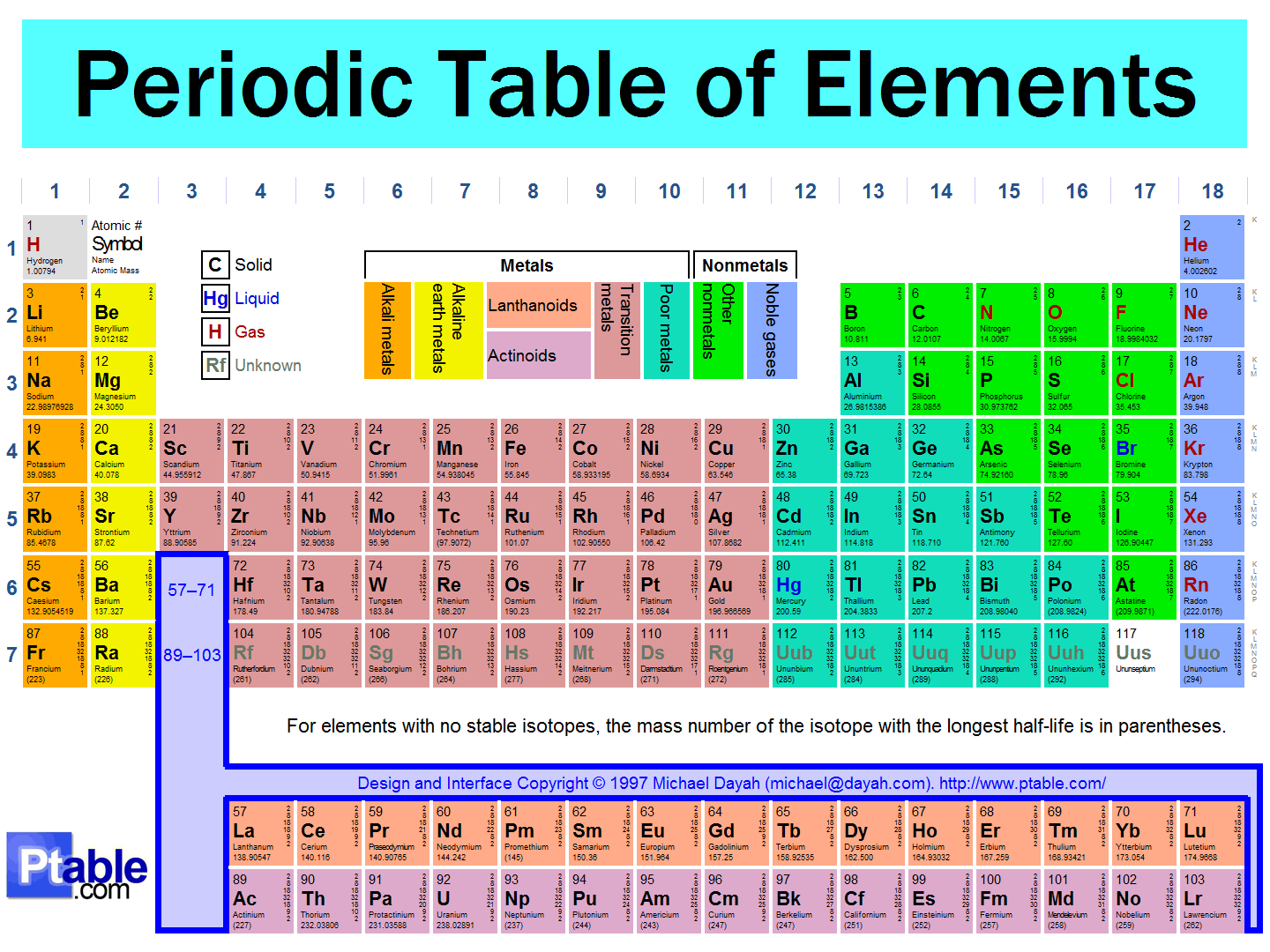
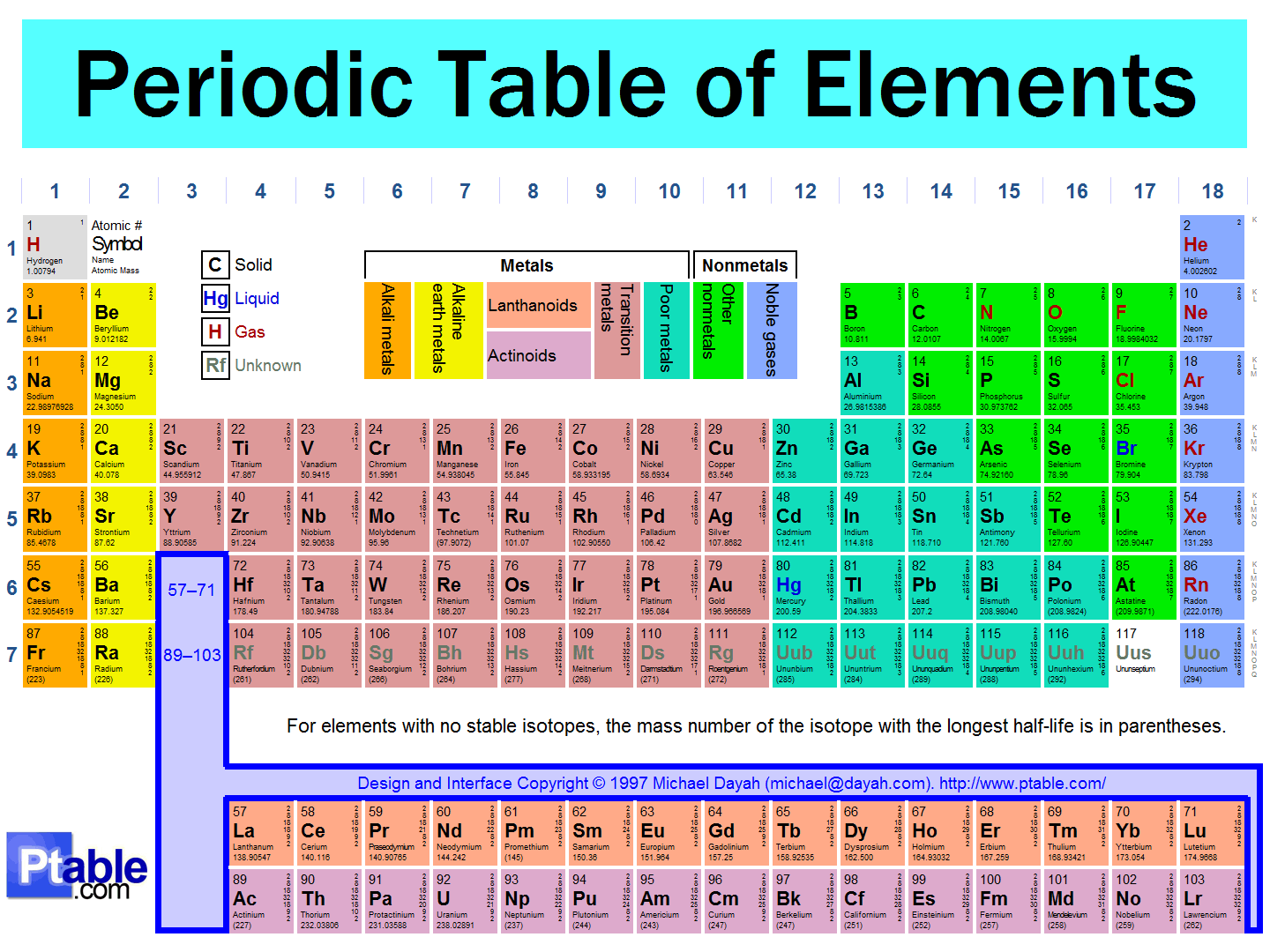
All the elements on the left side of the periodic table are called..

a)

Metals

b)

Metalloid

c)

Nonmetals

15.
A substance that is made up for one type of atom is called an:
a)
atom
b)
element
c)
compound
d)
mixture
16.
Silicon is a semiconductor and has properties of both metals and nonmetals. What type of element is Silicon? 
a)
Metal
b)
Nonmetal
c)
Metalloid
d)
Pretty
17.
Nonmetals are located in what section of this periodic table?
a)
Blue
b)
Yellow
c)
Pink
18.
H2
a)
Element
b)
Compound
19.
CaCo3
a)
Element
b)
Compound
20.
Where are electrons of an atom found?
a)
Nucleus
b)
Electron Cloud
c)
Some are in the nucleus and some in the electron cloud.
d)
They are moving everywhere.
21.
How many protons does Carbon have?
a)
3
b)
4
c)
5
d)
6
22.
Burning a piece of paper 
a)
Chemical Change 
b)
Physical Change 
23.
Melting Ice 
a)
Chemical Change 
b)
Physical Change 
24.
How many ATOMS are in the following compound:  C2H4O2
a)
3
b)
8
c)
1
d)
6
25.
Milk turning sour
a)
Chemical Change
b)
Physical Change 
26.
A mixture can be separated by ________ means. 
a)
physical
b)
chemical
27.
These are the two particles located inside the nucleus of an atom 
a)
Protons and Electrons 
b)
Protons and Neutrons 
c)
Electrons and Neutrons 
d)
Neutrons and Molecules 
28.
How many MOLECULES are in the following compound:  CaCO3
a)
1
b)
3
c)
5
d)
0
29.

To what family of elements do the elements helium, neon, and argon belong to?

a)

Halogens

b)

Actinides

c)

Noble gases

d)

Transition metals

30.

What are the name of the atoms of the same element that have a different number of neutrons ?

a)

Allotropes

b)

Radio actives

c)

Organics

d)

Isotopes

31.
The substances listed on the right side of a chemical equation are the
a)
Yields
b)
Reactants
c)
Products
d)
Precipitates
32.

An ionic bond is:

a)

a metal bonded to a nonmetal

b)

a nonmetal bonded to a nonmetal

c)

a metal bonded to a metal

33.
The substances listed on the left side of a chemical equation are the
a)
Products
b)
Coefficients
c)
Precipitates
d)
Reactants
34.
In chemical reactions, what does the principle of conservation of mass mean?
a)
Matter is not created or destroyed.
b)
The total mass of the reactants is greater than the total mass of the products.
c)
The total mass of the reactants is less than the total mass of the products.
d)
Matter is not changed.
35.
In the following equation, what are the products?
HCl + Zn → H2 + ZnCl2
a)
HCl + Zn
b)
H2 + ZnCl2
c)
Zn → H2
d)
the stuff on the outside
36.
Which number should go in the blank?
_ H2 + O2 -> 2 H2O
a)
1
b)
2
c)
3
d)
0
37.
Which number should go in the blank?
Mn + _ HNO3 → Mn(NO3)2 + H2
a)
1
b)
2
c)
3
d)
0
38.
H2 + O2 -> 2 H2O
Which kind of reaction is this?
a)
synthesis
b)
decomposition
c)
single displacement
d)
double displacement
39.
Mn + _ HNO3 → Mn(NO3)2 + H2
Which kind of reaction is this?
a)
synthesis
b)
decomposition
c)
single displacement
d)
double displacement
40.
FeS + HCl ---> FeCl2 + H2S
Which kind of reaction is this?
a)
synthesis
b)
decomposition
c)
single displacement
d)
double displacement
41.
H2CO3 → H2O + CO2
Which kind of reaction is this?
a)
synthesis
b)
decomposition
c)
single displacement
d)
double displacement
42.
Elements with similar properties
a)
Periods
b)
Groups
43.
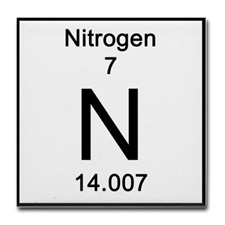
What is the number of protons that the element in this image contain?
a)
14
b)
7
c)
15
d)
18
44.
A "group" is a ____________ on the periodic table.
a)
column
b)
row
45.
A "period" is a ____________ on the periodic table.
a)
column
b)
row
46.
If there is no subscript, there is ______ atom(s) of that element.
a)
0
b)
2
c)
only 1
d)
1 million
47.
How many molecules of Carbon Dioxide?
6CO2
a)
12
b)
2
c)
6
d)
8
48.
What is the mass number of Chlorine-37 (Cl)?
a)
17
b)
37
c)
7
d)
35.45
49.
Rows ⋘---⋙ on the periodic table indicate the number of...
a)
groups
b)
energy levels
c)
valence electrons
d)
total electrons
50.
a)
Chlorine wants to lose 7 electrons
b)
Chlorine wants to gain 1 electron
c)
Chlorine is stable
51.
a)
This is an ionic bond with electrons shared
b)
This is an ionic bond with electrons transferred
c)
This is a covalent bond with electrons shared
d)
This is a covalent bond with electrons transferred
52.
a)
This molecule would be named PCl3
b)
This molecule would be named ClP3
c)
This molecule would be named PCl
d)
This molecule would be named PCl3
53.
What bonds to make an ionic bonds?
a)
metals and metals
b)
metals and nonmetals
c)
nonmetals and metalloids
d)
nonmetals and nonmetals
54.
This rule says that the amount of atoms in the reactants is equal to the amount of atoms in the products...
a)
Conservation of Energy
b)
E=MC2
c)
Conservation of Mass
d)
Rule of 8
55.
Which of the following is an example of a chemical reaction?
a)
Water evaporating from a pot on a hot stove
b)
Sand being removed from sea water by filtration
c)
A spoonful of sugar dissolving in a glass of water
d)
A white solid forming when two clear liquids are poured together
56.
carbonic acid
a)
H2CO3
b)
H2CrO4
c)
H2C2O4
d)
HCO3
57.
What is the name of the compound Ni(ClO3)2
a)
nickel (II) chlorate
b)
nickel (I) chlorite
c)
Nickel dichlorate
58.
What is the name of the compound P2O5
a)
Pentaphosphorus dioxide
b)
Phoshphide dioxide
c)
Diphosphorus pentoxide
59.
What is the name of the compound SO2
a)
Monosulfate oxide
b)
Sulfur Dioxide
c)
Monosulfur dioxide
60.
Which of these is covalent?
a)
NaCl
b)
Pb(NO3)2
c)
CO2
d)
AlCl3
61.
Bromine monoflouride
a)
Br1F1
b)
BrF
c)
Br2F
d)
BrF2
62.
Name this formula: 
KNO3
a)
Potassium Nitrogen Oxide
b)
Potassium Nitride
c)
Potassium Nitrate
d)
Potassium (I) Nitrite
63.
Phosphorous trichloride
a)
PCl3
b)
P3Cl
c)
P3Cl3
d)
PCL
64.
2 RbNO3 + BeF2 --> Be(NO3)2 + 2 RbF
a)
single displacement
b)
double displacment
c)
decomposition
d)
synthesis
65.
Identify this type of reaction,
Cl2 + 2KI -->  I2 + 2KCl
a)
Synthesis
b)
Single displacement
c)
Double displacement
d)
Decomposition
66.
What type of reaction involves the breaking down of a substance into simpler substances?
a)
Single Displacement Reaction
b)
Double Displacement Reaction
c)
Synthesis Reaction
d)
Decomposition Reaction
67.

What id the molar mass of UF6?

a)

101 g/mol

b)

238 g/mol

c)

257 g/mol

d)

352 g/mol

68.

What is the molar mass of Cl2?

a)

17 g/mol

b)

35.5 g/mo;

c)

71.0 g/mol

d)

89 g/mol

69.
What is the right ratio of chemicals for the BCE (Balanced Chemical Equation)?__Al + __O2--> __Al2O3
a)
4,1 --> 2
b)
4,3 --> 4
c)
3,4 --> 1
d)
4,3 --> 2
70.

Balance this equation, AlCl3 + NaOH → Al(OH)3 + NaCl

a)

3,1,3,1

b)

1,3,3,1

c)

1,1,1,3

d)

1,3,1,3

71.
How many valence electrons does Barium (Ba) have?
a)
1
b)
2
c)
5
d)
6
72.

Name the ionic compound, LiCl

a)

lithium chlorine

b)

lithium chloride

c)

lithium chlorate

d)

lithium monochloride

73.
A cation is a ____ ion.
a)
negative
b)
positive
c)
neutral
d)
ficticious
74.
A anion will be a ____ ion.
a)
negative
b)
positive
c)
neutral
d)
ficticious
75.
In the compound aluminum oxide, which is the cation?
a)
Al+3
b)
Al
c)
O-2
d)
O
76.

K ionizes to a charge of _________.

a)

+1

b)

+2

c)

-1

d)

-2

77.

Which is a diatomic element?

a)

iron

b)

carbon

c)

chlorine

d)

barium

78.

P ionizes to a charge of _______.

a)

+3

b)

-3

c)

+2

d)

-2

79.

What is the formula for phosphoric acid?

a)

H2PO3

b)

H3PO4

c)

HPO2

d)

HPO4

80.

Which formula correctly represents Na+ and O-2

a)

NaO2

b)

NaO

c)

Na2O

d)

NaO2

81.

C2H4 + 3O2 --> 2CO2 + 2H2O

a)

Synthesis

b)

Decomposition

c)

Single Replacement

d)

Double Replacement

e)

Combustion

82.

How is the current table organized

a)

Alphabetically

b)

Numerically

c)

Atomic Number

d)

Atomic Mass

83.

The following electron configuration, 1s22s22p4 is for which element

a)

Carbon

b)

Oxygen

c)

Beryllium

d)

Neon

84.

What two elements have similar properties to Sodium, Na

a)

Li and K

b)

Mg and Al

c)

Be and Mg

d)

Ne and Ar

85.
HCl + NaOH → 
a)
NaH + ClOH
b)
NaCl + H2
c)
NaCl + H2O
d)
NaCl + Cl2
86.
How many electrons should Oxygen have around its Lewis dot model?
a)
5
b)
6
c)
7
d)
8
87.
Which of the following is the correct Lewis structure for the compound PBr3?
a)
structure A
b)
structure B
c)
structure C
d)
structure D
88.
How did Mendeleev arrange the elements?
a)
alphabetical 
b)
density
c)
melting point
d)
atomic mass
89.
The horizontal row on the periodic table is called a
a)
group
b)
family
c)
period
d)
atomic number
90.
A vertical column is called...
a)
group
b)
tower
c)
period
d)
crew
91.
Elements which are shiny, conduct electricity and heat are called
a)
metal
b)
nonmetal
c)
metalloid
d)
nonexistent
92.
Which is a halogen?
a)
Helium
b)
Chlorine
c)
Oxygen
d)
Neptune
93.
Elements in a ..................have similar chemical properties.  
a)
period
b)
group
c)
row
94.
What is the small number that you CANNOT CHANGE in a chemical equation? 
a)
Subscript
b)
Coefficient
c)
Product
d)
Reactant 
95.
2H2   +   O2  →  2H2O
How many moles of water can be produced if 8 moles H2 are used?
a)
4 moles
b)
8 moles
c)
16 moles
d)
2 moles
96.
2NaClO3 (s)  2NaCl (s) + 3O2 (g)  
12.00 moles of NaClO3 will produce how many grams of O2?
a)
256 g of O2
b)
576 g of O2
c)
288 g O2
97.
Cl2 + 2KBr → Br2 + 2KCl
How many grams of potassium chloride (KCl) can be produced from 356 g of potassium bromide (KBr)?
a)
749 g
b)
223 g
c)
479 g
d)
814 g
98.
How many grams are in 7.8 moles of NaCl?
a)
476grams
b)
460 grams
c)
452 grams
d)
462 grams
99.
Mole ratios are obtained from the
a)
balanced chemical equation
b)
periodic table
c)
molar mass
100.
Determine the amount of moles in 1.50 x 10²³ atoms of fluorine.
a)
9.03 x 1046 moles
b)
0.249 moles
c)
4.73 moles
d)
0.0131 moles
101.
Determine the mass of 2.00 mols of nitrogen.
a)
0.143 g 
b)
28.0 g 
c)
1.20 x 1024 g
d)
3.32 x 10⁻²⁴g
102.
What is the formula for hydrochloric acid?
a)
HCl
b)
HClO
c)
H3ClO3
d)
HClO3
103.

What is the molar mass of Ge?

a)

72.59g

b)

72g

c)

73g

d)

73g

104.

The mass of a mole of MgF2?

a)

formula mass

b)

molar mass

c)

atomic mass

d)

molecular mass

105.
What is the volume occupied by 1 mole of any gas at STP? 
a)
44.8 L
b)
22.4 L
c)
16.8 L 
d)
20.4 L 
106.
What is the volume of 5 moles of oxygen gas at STP? 
a)
112 L 
b)
22.4 L
c)
78.8 L 
d)
114.24 L
107.
What is Avagadro's number? 
a)
6.02 X 10 24
b)
6.02 X 10 23
c)
6.02 X 10 22
d)
6.02 X 10 21
108.
What is the difference between a formula unit and a molecule?
a)
formula unit - ionic bond
molecule - covalent bond
b)
formula unit - big
molecule - small
c)
formula unit - covalent bond
molecule - ionic bond
d)
formula unit - small
molecule - big
109.
What volume of hydrogen will be produced at STP by the reaction 67.3 g of magnesium with excfess water according to the following reaction?
1Mg + 2H2O --> Mg(OH)2 + H2
a)
62L
b)
65L
c)
31L
d)
124L
110.
How do I move from grams to moles
a)
multiply by molar mass
b)
divide by molar mass
c)
multiply by Avo number
d)
divided by Avo number
111.
How do I change from moles to liters?
a)
divide by 22.4
b)
multiple by Avo number
c)
multiply by 22.4
d)
multiply by molar mass
112.

Periodic Law states that...

a)

the chemical properties can be grouped according to periodicity

b)

the physical and chemical properties of the elements are functions of their atomic numbers

113.

The most reactive non-metal is?

a)

chlorine

b)

fluorine

c)

boron

d)

oxygen

114.

The most reactive metal is

a)

Hydrogen

b)

Cesium

c)

Francium

d)

Gold

115.

Which is not part of Dalton's atomic theory?

a)

All elements are composed of atoms. Atoms are indivisible and indestructible particles

b)

Atoms of the same element are exactly alike

c)

Atoms of different elements are different

d)

Compounds are formed by the joining of atoms of two or more elements

e)

atoms have positive and negative charges

116.

The discovery of the charge of an electron using and oil drop experiment was done by?

a)

Millikan

b)

Thomson

c)

Bohr

d)

Planck

117.

Which elements have the same number of energy levels?

a)

H, Li, Na

b)

K, Ca, Br

c)

Cu, Ag, Au

d)

B, Si, Ge

118.
In the gold foil experiment, most of the positively charged alpha particles passed through the gold foil, but some were deflected or bounced back.  What did we conclude because of this?  
a)
Atoms are small indivisible spheres
b)
Atoms are mostly empty space with a small, dense, positive center
c)
Atoms have negatively charged particles which orbit the nucleus
d)
Light is a wave, not a particle
119.
Ernest Rutherford discovered that atoms were mostly _________________. 
a)
negatively charged
b)
positively charged
c)
electrons
d)
empty space. 
120.

This model added on to previous models by showing electrons existed at certain "energy levels". However it does not accurately show what those levels look like.

a)

The "Bohr Model" of the atom

b)

The "Rutherford Model" of the atom

c)

The "Plum Pudding Model" of the atom

d)

The "Quantum Mechanical Model" of the atom

121.
Who stated that all atoms of the same element are exactly alike?
a)
Democritus
b)
Dalton
c)
Thomson
d)
Borh
122.
What contribution did John Dalton make to atomic theory? 
a)
He discovered that every atom was positively charged. 
b)
He discovered that every element consisted of one type of atom.  
c)
He discovered that atoms had nuclei. 
d)
He discovered that atoms could be divided into smaller parts. 
123.
Rutherford's gold foil experiment provided evidence that...
a)
Negative and positive charges are spread evenly throughout the atom.
b)
Alpha particles have a positive charge.
c)
Gold is not a dense as previously thought.
d)
There is a dense positively charged nucleus at the center of an atom.
124.
What is the maximum number of electrons that an orbital can have?
a)
1 electron
b)
2 electrons
c)
3 electrons
d)
4 electrons
125.
Which element is pictured?
a)
neon
b)
fluorine
c)
magnesium
d)
argon
126.
This orbital diagram represents:  
a)
C
b)
B
c)
N
d)
O
127.
Hund’s rule states…
a)
Atomic orbitals have opposite spins and 2 electrons each
b)
Electrons occupy orbitals of highest energy first and energy level changes as you go up
c)
Electrons occupy orbitals of lowest energy first, starting with 1s
d)
Electrons occupy orbitals of equal energy, one electron enters EACH orbital ONE AT A TIME until orbitals of the entire energy level have one electron with the SAME SPIN.
128.
Electrons occupy orbitals of lowest energy first is part of what electron configuration rule?
a)
Hund’s Rule
b)
Aufbau Principle
c)
Pauli Exclusion Principle
129.
What atom matches this electron configuration?
1s22s22p63s23p64s23d10
a)
Zinc
b)
Copper
c)
Nickel
d)
Germanium
130.
What electron configuration matches an oxygen atom?
a)
1s22s22p63s2, 3p64s23d104p5
b)
1s22s22p4
c)
1s22s22p6
d)
1s22s22p63s23p64s23d1
131.
What is the electron configuration of Sulfur  using noble gas method
a)
[Ne]3s1
b)
[Ne]3s23p3
c)
[Ne]3s23p4
132.
How many atomic orbitals are there in the p sublevel?
a)
2
b)
3
c)
4
d)
5
133.
What is the shorthand electron configuration for Sulfur atom?
a)
[Ar] 3p4
b)
[He] 3s23p4
c)
[Ne] 3s23p4
d)
[Na] 3s23p3
134.
What is the noble gas configuration for phosphorus?
a)
[Ar] 3p5
b)
[He] 3s2 3p5
c)
[Ne] 3s2 3p3
d)
[Na] 3s2 3p5
135.
This is a correct dot diagram for fluorine (F)
a)
true
b)
false
136.
Which of the following is the correct Lewis dot structure for the molecule fluorine (F2)?
a)
A
b)
B
c)
C
d)
D
137.

Which is the correct molecular structure for carbon dioxide?

a)
b)
c)
d)
138.

Which geometric molecular shape is shown?

a)

bent

b)

trigonal pyramidal

c)

tetrahedral

d)

trigonal planar

139.

Which electron dot structure is correct for the element chlorine (Cl2)?

a)

A

b)

B

c)

D

d)

D

140.

Determine the molecular geometry of the given structure.

a)

Trigonal Pyramidal

b)

Trigonal Bipyramidal

c)

Trigonal Planar

d)

Tetrahedral

141.
Choose the correct shape for this molecule:
a)
linear
b)
Trigonal pyramidal
c)
Bent
d)
Tetrahedral
142.
Choose the correct shape for this molecule:
a)
Trigonal planar
b)
Trigonal pyramidal
c)
Bent
d)
Linear
143.
Choose the correct shape for this molecule:
a)
Bent
b)
Linear
c)
Tetrahedral
d)
Trigonal pyramidal