
 Worksheets
Cosmos
Total questions: 141
Worksheet time: 2hrs 0mins
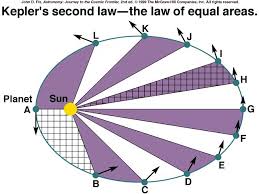

Earth's orbit follows an elliptical path.
Kepler's 1st law
Kepler's 2nd law
Kepler's 3rd law
When Earth orbits around the sun, it slows down when it is far from the sun. It speeds up its orbit when it is close to the Sun. This is because the sun's gravity is stronger when you are closer to it.
Kepler's 1st law
Kepler's 2nd law
Kepler's 3rd law
Nutation

The diagram below shows a moon revolving around a planet in an elliptical orbit. At which position is the moon traveling fastest?
location 1
location 2
location 3
location 4

The diagram below shows a moon revolving around a planet in an elliptical orbit. At which position is the moon traveling slowest?
location 1
location 2
location 3
location 4

According to the data in the chart, the farther a planet is from the sun
the longer it takes for it to complete one orbit.
the longer it takes for it to complete one day.
the less dense it is.
the smaller it is.
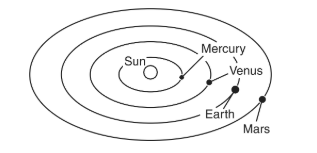
Which planet will take the least amount of time to revolve around the Sun?
Mercury
Venus
Earth
Mars

Which planet will take the most amount of time to revolve around the Sun?
Mercury
Venus
Earth
Mars
Which statement best describes Kepler’s 2nd Law of Planetary Motion?
Planets revolve around the sun over equal areas in equal time intervals.
Planetary orbits are in the shape of an ellipse.
A planet’s orbital period is proportionate to its distance from the sun.


The diagram below shows a moon revolving around a planet in an elliptical orbit. If the moon in the above picture is moving clockwise, at position 1 the moon is ______________.
speeding up
slowing down

The diagram below shows a moon revolving around a planet in an elliptical orbit. If the moon in the above picture is moving clockwise, at position 3 the moon is ______________.
speeding up
slowing down
Kepler's third law can be applied to any two bodies as long as they are orbiting around a single common body.
True
False
Kepler’s 3rd law states the square of the orbital period is proportional to the cube of the orbital radius. (T2=r3)
If a planet's orbital radius is doubled, what happens to the length of a year on that planet?
It will become twice as long
It will become about 8 times as long
It will become 2.8 times as long
It will remain the same
Which statement best describes Kepler’s 2nd Law of Planetary Motion?
A line that connects a planet to the Sun sweeps out equal areas in equal times.
All planets move in elliptical orbits with the Sun at one focus.
The square of the orbital period of any planet is directly proportional to the cube of the radius of its orbit.
Earth's orbital radius is 1.5 x 10¹¹ m and it orbits the Sun in 1 year. If Mercury's orbital radius is 5.79 x 10¹⁰ m, calculate the time taken for it to orbit the Sun.
0.240 years
0.386 years
0.621 years
Which of the following statement is best in accordance with Kepler's first law of planetary motion?
A. The orbits of planets form an ellipse, with the Sun at one focus.
B. Planets orbit in perfect circles, with the Sun slightly off-center.
C. All planets make one orbit of the Sun in exactly the same time period.
D. Planets farther from the Sun orbit proportionally faster.
How do Kepler’s laws of planetary motion compare to Newton’s laws of motion and Newton’s law of universal gravitation?
A. Kepler described Earth’s orbit around the Sun. Newton described the Moon’s orbit around Earth.
B. Kepler explained only the shape of Earth’s orbit. Newton explained only Earth’s speed in orbit.
C. Kepler explained the effect of gravity on Earth’s orbit around the Sun. Newton explained the
effect of the Moon’s gravity on the Sun.
D. Kepler described the shape and speed of Earth’s orbit around the Sun. Newton identified the
forces that cause Earth to orbit the Sun.

The diagram below shows four points along Earth's orbit as it revolves around the Sun. The shaded area in the sector bounded by Points 1 and 2 is the same as the shaded area in the sector bounded by Points 3 and 4.
Which statement accurately compares the conditions at these four points?
A. The magnitude of Earth's acceleration is the same at all four points.
B. The Sun's gravitational pull on Earth is the same at Point 1 as it is at Point 3.
C. Earth's speed is the same as it goes from Point 1 to Point 2 as when it goes from Point 3 to Point 4.
D. It takes Earth the same amount of time to go from Point 1 to Point 2 as it does to go from Point 3 to Point 4.

The table below lists the distances of Mercury, Earth, and Saturn from the Sun. Kepler’s third law of motion describes the relationship between the distances of the planets from the Sun and their orbital periods.
Based on the time it takes each planet to complete a ‘year’ around the Sun, rank these planets in order from shortest to longest.
A. Mercury, Earth, Saturn
B. Mercury, Saturn, Earth
C. Earth, Mercury, Saturn
D. Saturn, Earth, Mercury
Which statement is a relationship described by one of Kepler's laws?
A. For every action, there is an equal and opposite reaction.
B. The acceleration of the Moon depends directly on the net force applied to it by Earth.
C. Every object in a state of uniform motion tends to remain in that state of motion unless an external force is applied to it.
D. A line drawn between the Moon and the center of Earth will sweep out equal areas of the plane of the Moon's orbit in equal time periods.
Which statement is a direct implication of Kepler's Second Law of Planetary Motion?
A. A planet's acceleration is affected by its mass.
B. A planet's velocity depends on its position in its orbit.
C. A planet's total distance from the foci of its orbit is constant.
D. A planet's period can be predicted from the semimajor axis of its orbit.
Why do planets in our solar system keep stable, nearly circular orbits?
Centripetal force is equal to the gravitational attraction between the Sun and the planet.
Inertial force of the planet is equal to the centripetal force of the planet.
The planet's orbital speed must remain constant (never changes) as it moves around the Sun.
The planet's orbital speed has to speed up and slow down because the larger planets (Jupiter and Saturn) have a strong outward gravity pull force counter to the Sun's gravity pull force.

At which position is the planet's orbital speed getting faster?
Position #1
Position #2
Position #3
Position #4
At which position is the planet's orbital speed getting slower?
Position #1
Position #2
Position #3
Position #4
At which position is the gravitational attraction between the sun and the planet the weakest?
Position #1
Position #2
Position #3
Position #4
If a new planet were found orbiting the Sun at 200 times as far as the Earth is from the Sun, what would it's orbital period be?
34 years
200 years
300 years
2800 years
3 billion years
Kepler's first law says that the planets move around the Sun in an ellipse with the Sun at one focus. What is at the other focus?
Empty space
The Earth
The Moon
Your teacher
The planet being considered
From Kepler's third law, a hypothetical planet that is twice as far from the Sun as Earth should have a period of
0.5 Earth years
1 Earth year
2 Earth years
More than 2 Earth years
It depends on the planet's mass
Kepler's 3rd Law states:
All objects in the universe in stable orbits have the same ratio of T2/R3
True
False
Kepler's 3rd Law states:
All objects IN THE SAME ORBITAL SYSTEM in stable orbits have the same ratio of T2/R3
True
False
A way of measuring distances in space. Equivalent to the distance from Earth to the Sun.
Elipse
Eccentricity
Astronomical Unit
Period
Planets orbit the sun in a shape called an ellipse.
Kepler's 1st Law
Kepler's 2nd Law
Kepler's 3rd Law
Planets travel faster when they are closer to the sun.
Kepler's 1st Law
Kepler's 2nd Law
Kepler's 3rd Law
Kepler's 3rd law tell us that __ would be dependent on __.
orbital period ; distance
distance ; orbital period
What is the largest planet in our solar system?
Which planet is known as the "Red Planet"?
Which planet has the most moons?
What is the name of the planet famous for its rings?
Which planet is known as the "Blue Planet"?
Mars
Earth
Venus
Neptune
What is the hottest planet in our solar system?
Mercury
Venus
Earth
Mars
Which planet is closest to the Sun?
Venus
Mercury
Earth
Mars
Which planet has the fastest rotation?
Unit 3.4 Notes: What is a galaxy?
A group of old stars
A cluster of stars, gas, dust, stellar remnants and often planetary systems
A cloud of gas and dust
A specific portion of the universe
Unit 3.4 How many types of galaxies are there?
1
2
3
4
Unit 3.4 What type of galaxy has a black hole in its center?
Elliptical
Irregular
Spiral
Unit 3.4: What type of galaxy is often made of old stars?
Elliptical
Irregular
Spiral
Unit 3.4: What type of galaxy does not have a distinct shape?
Elliptical
Irregular
Spiral
Unit 3.4: What type of galaxy often appears red?
Elliptical
Irregular
Spiral
Unit 3.4: The center of the Milky Way Galaxy looks like a bright cloudy spot in the sky.
True
False
Unit 3.5: How many planets are in our solar system?
2
6
4
8
Unit 3.5: SELECT ALL THAT APPLY
What are the stages of the formation of our solar system?
Molecular Cloud
Protoplanetary Disk
Formation of the sun
Evolution of Planets
Unit 3.6: Below is the correct order for planets closest to the sun.
Earth, Mars, Venus, Mercury
True
False
Unit 3.6: The 4 planets closest to the sun are often called Inner Terrestrial Planets
True
False
Unit 3.6: The 4 planets farther from the sun are often called Outer Jovian Planets
True
False
Unit 3.6: What is between Mars and Jupiter?
Asteroid Belt
Kuiper Belt
Milky Way
Sun
Unit 3.6: What other set of rocky objects is beyond Neptune?
Asteroid Belt
Kuiper Belt
Ol
Milky Way
Sun
Unit 3.6: What rocky area can we find Pluto?
Asteroid Belt
Kuiper Belt
Sun
Milky Way
Unit 3.6: Which planet has the most Moons?
Earth
Jupiter
Mercury
Venus
Unit 3.6: Which planets have no Moons?
Earth
Jupiter
Saturn
Mercury
Venus
Unit 3.6: Which planet's defining feature is their rings?
Earth
Jupiter
Saturn
Uranus
Unit 3.6: Which planet rotates sideways?
Earth
Jupiter
Saturn
Uranus
Unit 3.6: Which 2 planets are considered ice giants?
Earth
Jupiter
Saturn
Uranus
Neptune
Name for the Roman goddess of beauty and love
Mercury
Venus
Mars
Phobos
Deimos
Name for the Greek demigod Fear
Mercury
Venus
Mars
Phobos
Deimos
Name for the Roman god of war
Mercury
Venus
Mars
Phobos
Deimos
Name for the Greek demigod Panic
Mercury
Venus
Mars
Phobos
Deimos
Name for the Roman messenger to the gods
Mercury
Venus
Mars
Phobos
Deimos
The following features are associated with which of the terrestrial planets?
Ishtar Terra, Aphrodite Terra
Mercury
Venus
Earth
Mars
The following features are associated with which of the terrestrial planets?
Tharsis Bulge, Valles Marineris
Mercury
Venus
Earth
Mars
The following features are associated with which of the terrestrial planets?
Caloris Basin, chaotic terrain
Mercury
Venus
Earth
Mars
The following features are associated with which of the terrestrial planets?
Grand Canyon, Mount Everest
Mercury
Venus
Earth
Mars
Which of the terrestrial planets closely resembles the Moon?
Mercury
Venus
Mars
Which of the terrestrial planets orbits three times on its axis for every two orbits around the Sun?
Mercury
Venus
Mars
Which of the terrestrial planets has a thick, permanent cloud layer containing sulfuric acid?
Mercury
Venus
Mars
Which of the terrestrial planets has 300,000 times more carbon dioxide than Earth, resulting in a runaway greenhouse effect?
Mercury
Venus
Mars
Which of the terrestrial planets spins clockwise due to being struck by a planetesimal in the early solar system?
Mercury
Venus
Mars
Which of the terrestrial planets has a day that is only 39 minutes longer than one Earth day?
Mercury
Venus
Mars
Which of the terrestrial planets has the two moons called Phobos and Deimos?
Mercury
Venus
Mars
Which of the terrestrial planets is home to large polar vortices and is the brightest object in the sky after the Sun and Moon?
Mercury
Venus
Mars
A planet needs to spin quickly on its axis and have internal convection for what?
an atmosphere
a magnetic field
liquid water
plate tectonics
What best describes Mercury's surface temperature?
Very hot during the day, very cold at night
Very cold during the day, very hot at night
Very hot all the time due to its closeness to the Sun
Very cold all the time due to no atmosphere
Why is the temperature so hot on Venus?
runaway greenhouse effect
proximity to the Sun
abundance of volcanic activity
gravitational stress
Both of these planets have no magnetic field due to slow rotation.
Mercury and Venus
Mercury and Mars
Venus and Earth
Mars and Venus
This planet has no magnetic field because of insufficient internal convection.
Mercury
Venus
Earth
Mars
Many unmanned spacecraft and rovers have been sent to Mars in the search of what compound and possible life?
water
carbon dioxide
methane
ammonia
This phenomenon is responsible for the deflection of air to the side caused by its motion across the surface of a rotating body
Coriolis Effect
Greenhouse Effect
Magnetic Field
Convection Currents
This phenomenon is responsible for the trapping of heat energy on a planet with an atmosphere
Coriolis Effect
Greenhouse Effect
Magnetic Field
Convection Currents
This phenomenon is responsible for deflecting dangerous particles from the Sun
Coriolis Effect
Greenhouse Effect
Magnetic Field
Convection Currents
This phenomenon is responsible for volcanic activity such as earthquakes and volcanoes, as well as many weather phenomena
Coriolis Effect
Greenhouse Effect
Magnetic Field
Convection Currents
Phobos and Deimos are
captured asteroids and moons of Mars
features on Mars' surface
active volcanoes on Venus
impact craters on Mercury
Terrestrial planets get their atmospheres by what method?
capturing small particles with gravity
volcanic gases being released
biological processes
chemical breakdown of rocks in the presence of sunlight
Large convection currents in Venus' atmosphere result in a large _____ at the poles.
polar vortex
permanent storm
magnetic field
volcano
The dense, thick atmosphere on Venus results in a surface pressure that is
similar to Earth's
roughly half of Earth's
75-100 times that of Earth
twice that of Earth's
Venus has about ____ times as much carbon dioxide as Earth.
300,000
30
100
50
The number of craters on a rocky body indicate what?
the planet is geologically inactive
the planet is geologically active
how close it is to an asteroid belt
how old the planet is
Mars and Earth have a similar axial tilt, resulting in similar
seasons
length of day
length of year
gravity
How does the mass of Jupiter compare with that of the other planets?
It is almost as massive as Saturn.
It is slightly larger and more massive than Saturn.
It is similar to that of the Earth and Venus.
It is about a tenth the mass of the Sun.
It is twice as massive as all other planets combined.
Essentially, the Great Red Spot is:
always located within 10 degrees of Jupiter's north pole.
a large cyclonic storm (hurricane).
traveling north and south across Jupiter's face.
Neptune's largest atmospheric feature.
composed primarily of iron oxide.
The first spacecraft to drop a weather probe into Jupiter's atmosphere was:
Voyager 2.
Global Surveyor.
Galileo.
Viking 1.
Cassini.
Which of the Galilean moons is the densest and most geologically active?
Titan
Europa
Ganymede
Io
Callisto
Which of the jovian moons is the largest and also the largest moon in the solar system, even bigger than Mercury?
Titan
Umbriel
Ganymede
Callisto
Triton
Saturn's storms are most analogous to:
carbon dioxide and ethane.
nitrogen and oxygen.
methane and ammonia.
hydrogen sulfide and ammonia.
hydrogen and helium.
The reason Saturn lost very little of its original atmosphere is due to its:
large mass.
many moons.
rapid rotation.
ring system.
strong magnetic field.
Our most detailed knowledge of Uranus and Neptune comes from:
ground-based radio telescopes.
manned missions.
spacecraft exploration.
the Hubble Space Telescope.
ground-based visual telescopes.
A day at the north pole of Uranus lasts:
about 21 years.
about 7 hours.
about 84 years.
about 8 hours.
about 42 years.
Neptune and Uranus have a bluish tint because:
their atmospheres contain methane, which absorbs red light.
at their distances, the Sun appears blue, the red absorbed by dust in the ecliptic.
their atmospheres contain hydrogen and helium.
ammonia ice reflects blue light better than any other color.
they are far away and distance makes objects appear bluish.
How long do we know the Great Red Spot storm on Jupiter has lasted?
50 years
100 years
two centuries
three centuries or more
The clouds on this planet reflect a lot of light making it one of the brightest objects we can see.
Jupiter
Saturn
Uranus
Neptune
Jupiter has a huge magnetosphere. What causes it?
Jupiter's core is liquid iron and nickel metals and has convection currents like the Earth's core.
Jupiter rotates really fast and the friction between the cloud layers causes charged particles that generate a magnetic field as they rotate.
Jupiter has a metallic hydrogen mantle just above the core that conducts electricity.
Jovian Planets
They are primarily composed of rock and metal.
They have thick atmospheres composed mainly of hydrogen and helium.
They are smaller than terrestrial planets.
They have no moons.
Jovian Planets
Jupiter, Saturn, Uranus, and Neptune
Mercury, Venus, Earth, and Mars
Pluto, Eris, Haumea, and Makemake
Ceres, Vesta, Pallas, and Hygiea

