
 Worksheets
Environmental Science quarter 1 test
Total questions: 139
Worksheet time: 2hrs 6mins
When water vapor is cooled and forms droplets of liquid water
Condensation
Evaporation
Transpiration
Runoff

________________ is movement of water past the soil going deep into the groundwater.
Evaporation
Transpiration
Percolation
Sublimation
____________________ is the process by which water on the ground surface enters the soil.
Infiltration
Percolation
Deposition
Condensation
__________________ is the process by which moisture is carried through plants from roots to small pores on the underside of leaves, where it changes to vapor and is released to the atmosphere. It is essentially evaporation of water from plant leaves.
Transpiration
Percolation
Infiltration
Plant Uptake
Water that flows across the land and enters rivers and streams. It eventually flows into lakes and the ocean.
Transpiration
Surface Runoff
Deposition
Precipitation
What is it called when water sticks to water?
Cohesion
Adhesion
Capillary Action
Xylem
What allows water to stick to particles of dust in the air, thereby condensing to form clouds?
Cohesion
Adhesion
Dipole moment
Phloem
How does water enter a plant?
through the stomata
through the roots
by active transport in root hair cells
by osmosis in root hair cells
This vascular tissue (tubes) is responsible for the transportation of water and minerals up from the roots to the stem then leaves
Stomata
Shoot
Phloem
Xylem
What ions cause hardness in water?
(all two)
Calcium
Sodium
Magnesium
Hydrogen
Select one way to reduce water use.
wash dishes under a running tap
install a rain barrel to downspouts
take baths instead of showers
Wastewater from people’s homes that can be recycled and put to good use. Treated groundwater can be used to irrigate both food and non-food producing plants.
Blackwater
Sewage
Greywater
Rainwater

A particular golf course is using large amounts of nitrogen fertilizer. What process could move this nitrogen into a local stream?
volatilization
nitrogen fixation
runoff and leaching
ammonification
What cycle are fossil fuels part of ?
carbon
oxygen
nitrogen
phosphorus
What is the largest reservoir for water?
the ocean
rocks and minerals
the atmosphere
glaciers
What is the largest reservoir for nitrogen?
the ocean
rocks and minerals
the atmosphere
bacteria
In an ecosystem, what happens to the atoms of certain chemical elements, such as carbon, oxygen, and nitrogen?
They move into and out of living systems.
They are only found in abiotic factors.
They move out of living systems and do not return.
They move into living systems and remain there.
Nitrogen fixation is the process in which certain bacteria convert nitrogen gas into
liquid nitrogen
nitrates
nitrites
ammonia
The water cycle is driven by
water
wind
the sun
Earth's rotation
When water is heated in the ocean by the sun and turns into water vapor
Condensation
Evaporation
Transpiration
After condensation, the droplets of water in the clouds fall to Earth in different forms...
precipitation
condensation
evaporation
When tiny droplets of water form in the air it is called
precipitation
evaporation
condensation
Plant roots directly obtain water from
Water vapor
Groundwater stored below the soil
Precipitation
Water runoff from rivers and streams
Human activity can increase CO2 levels in the atmosphere through
Photosynthesis
Burning of fossil fuels
Planting more trees
Removing nitrogen from fertilizer.

According to the diagram, geologic activity, such as volcanoes,
Increases the levels of CO2 in the atmosphere.
Decreases the levels of CO2 in the atmosphere.

Nitrogen in the atmosphere is unusable. What form is nitrogen in the atmosphere?
Nitrites
Ammonia
Nitrates
N2 gas

Denitrifying bacteria
Turn nitrogen gas into nitrates so that plants can synthesize amino acids.
Turn nitrates into nitrites so that nitrogen fixing bacteria can synthesize DNA.
Returns nitrogen into the atmosphere in the form of N2 gas.
Use phosphorus as fertilizer.

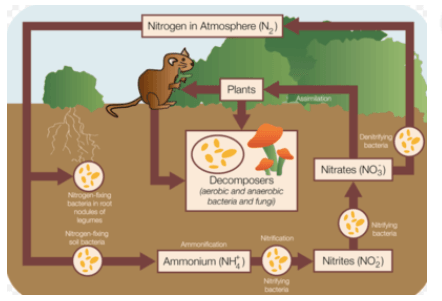
A correct path that nitrogen could take would be
air -> animals -> plants -> bacteria
animals -> air -> bacteria -> plants
bacteria -> air -> plants -> animals
air -> bacteria -> plants -> animals

Decomposition is part of all cycles except _______
the carbon cycle
the nitrogen cycle
the water cycle
the phosphorus cycle
The factor that causes the most changes to the cycles is ______
weather
humans
temperature
time
An Aquifer is
porous rock that allows water to flow through it
water that flows through and collects in rock pores
water that soaks into the ground
Infiltration is
porous rock that allows water to flow through it
water that flows through and collects in rock pores
water that soaks into the ground

A simple way to look at the transfer of food energy through an ecosystem in an ecosystem is
through a trophic level
through a Food Chain
through a Food Web

Herbivores eat
Everything
only plants.
only meat

Decomposer is responsible for
eating all the meat.
recycle nutrients in an ecosystem.
eat only plants.

Trophic Levels represent ...
level of students at VOHS.
levels of nourishment in a food chain.
level of largest plants

Models the complex network of feeding relationships
trophic levels
food webs
food chains

Plants are...
producers
herbivores
omnivores

Calories, kilocalories, and joules are a measure of
species
energy
plants
Ecosystem
The thin layer of land, air, and water that is home to all living organisms
Consists of all the living organisms and their interactions with
nonliving components.
All the members of the same species living in one place.
The flow of energy patterns involving the feeding relationships between producers and consumers in a community.
Biodiversity
The flow of energy patterns involving the feeding relationships
between producers and consumers in a community
The total number of animal and plant species in an ecosystem.
The living components of an ecosystem.
The nonliving, physical factors that affect the living components in an
ecosystem.
Biotic
The flow of energy patterns involving the feeding relationships
between producers and consumers in a community
The total number of animal and plant species in an ecosystem.
The living components of an ecosystem.
The nonliving, physical factors that affect the living components in an
ecosystem.
Producers
Organisms that can make their own food, usually green plants.
The total number of animal and plant species in an ecosystem.
The living components of an ecosystem.
The nonliving, physical factors that affect the living components in an ecosystem.
Community
Organisms that can make their own food, usually green plants.
The total number of animal and plant species in an ecosystem.
The living components of an ecosystem.
All the populations of different species living in the same area.

Select all the biotic factors from the list.
Water
Turtle
Log Turtles are Sitting On
Grasses
Sun

In this food web, the gray fox is a...
Primary Consumer
Secondary Consumer
Both a Primary Consumer and a Secondary Consumer
Producer

If only 10% of the energy in the pyramid is available as you move from one trophic level to the next, what happens to the other 90%?
Passed on to decomposers
Metabolized and "lost" as heat energy and waste
Assembled into tissues of producers permanently
False statement - 100% of the energy is available

The initial source of energy for all ecosystems is...
The Sun
Photosynthesis
Sugar
There is no one source

If the average Bluefin Tun weighs 20 pounds, how many pounds of secondary consumers are needed in the third trophic level to support it?
20 pounds
200 pounds
2,000 pounds
20,000 pounds

What are the PRODUCERS in this food web?
Wildflowers and Grass
Rabbit and Mouse
Snake and Hawk
Grass and Mouse

Which is a SECONDARY CONSUMER in this food web?
Snake
Mouse
Grass
Wildflowers
A habitat is ___________________.
the place or kind of place in which an animal or plant naturally lives.
is how plants produce their own food.
is an animal that only eats meat.
the place where only one animal lives.
An organism’s habitat provides _____________________.
food, water, shelter, and space.
food, water, and clothes.
only food.
video games, ninjas, and baked beans.
The flock of white seagulls that are fighting over a single food source (Nemo & Dory) depicts which ecological relatioship?
Intraspecies Competition
Mutualism
Parasitism
Commensalism
A pair of red, male kangaroos are seen fighting over a potential mate. The ecological relationship between the two male kangaroos shown is -
Commensalism
Mutualism
Predator-Prey
Competition

The animal in an ecological relationship that results in another animal being hunted, killed, and eaten…
autotroph
habitat
predator
herbivore
producer

An ecological symbiotic relationship between two organisms where one benefits and the other is harmed…
parasitism
herbivore
mutualism
carnivore
commensalism

This is the job or role of a specific organism within its habitat...
producer
prey
carnivore
niche
photosynthesis

Another word for a plant or other producer that makes its own food using energy from sunlight…
photosynthesis
autotroph
consumer
carnivore
herbivore
Technically speaking, ALL food chains should end with these types of organisms so that nutrients can be recycled back into the habitat…
parasites
predators
herbivores
symbiotes
decomposers

What do you call the total count of a specific organism living within their natural habitat?
ecosystem
community
population
symbiosis
niche

The arrows in a food chain or web represents what?
They point to the organism that is being eaten.
It shows how sunlight flows within an ecosystem.
They show the direction the energy is flowing between organisms.
They represent how water is transferred within a habitat.


In the food web above, what organism is a tertiary consumer?
Fox
Frog
Vole
Grass
What term describes the position of an organism on the food chain?
food web
energy levels
trophic levels
matter cycle


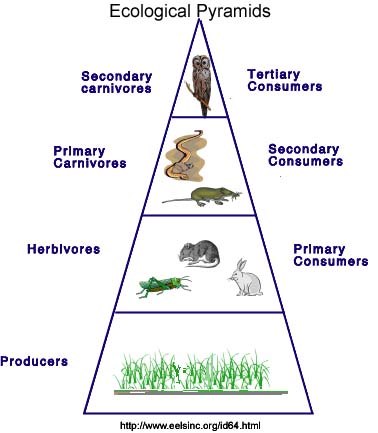

The number of organisms at the top of the energy pyramid are usually smaller because the hawk
needs more energy
has more predators
have more offspring
eat producers
In a food web the arrow always points to
the consumer
the prey
producer
autotroph
How much energy is available to be passed on to the next level in a food web?
100%
10%
50%
75%
If only 10% of the energy in the pyramid is available as you move from one trophic level to the next, what happens to the other 90%?
Passed on to decomposers
Metabolized and "lost" as heat energy and waste
Assembled into tissues of producers permanently
False statement - 100% of the energy is available
If the average Bluefin Tun weighs 20 pounds, how many pounds of secondary consumers are needed in the third trophic level to support it?
20 pounds
200 pounds
2,000 pounds
20,000 pounds
what is a tributary
large body of water entering a stream or river
part of a stream or river that adds to a larger body of water
polution added to large body of water


Look closely at the map of the watershed below. If water enters the watershed at the top of the mountain where the arrow is pointing, at which point will it stop draining?
Point A
Point B
Point C
Point D
All water below the surface of land is called__________.
water table
watershed
groundwater
runoff

__________ tells you how healthy the water is.
water quantity
water quality
good water
tasty water

Which important role do trees play in the health of the bay?
Create shade
They are pretty
Help stop erosion
Provide lumber

The health of an ecosystem is directly related to the...
Air Quality
Water Quality
Amount of animals in the area
Amount of food in the area
estuary
What is the process of moving sediments from location to another?
Deposition
Erosion
Weathering
Compaction
Which of these is an example of erosion?
Light shinning onto a mountain
Rain breaking down rock
Wind blowing away sediment
All of the above
Rain washing away soil from a hillside
Weathering
Erosion
Deposition
How do sandy beaches form?
Waves pounding pebbles int smaller and smaller peices
Wind eroding pebbles into smaller pieces
Water freezing and thawing the cracks of pebbles
Rain wearing away rocks into smaller and smaller pieces
How do plants in the soil affect how fast erosion happens?
It doesn't affect erosion.
It slows down erosion.
It speeds up erosion.

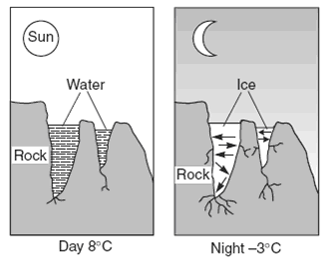
Which statement best explains why this process results in weathering?
Which of the following is NOT an element of erosion?
Water
Wind
Chemical
Electrical Current
Which of the following was formed through erosion?
Eiffel Tower
The Grand Canyon
Mt. Rushmore
The Pyramids of Giza
Wind blowing sand from one location to another
Weathering
Erosion
Deposition
Which of the following is a natural underground basin for storing ground water?
Aquifer
Artesian basin
Sedimentary basin
Well
2) Which of the following is a true statement?
Groundwater is water in a lake.
The contaminants in groundwater are very easy to clean up.
Drilling wells are how groundwater is extracted.
New Orleans is only two hundred feet above sea level.
Which of the following can occur when too much groundwater is pumped out of underground aquifers?
Drought
Flooding
Subsidence
Erosion
Which of the following tells what percent of the world's freshwater supply is made up of groundwater?
Thirty
Fifty
Sixty
Twenty
Which of the following is a true statement?
Groundwater contains more salt than surface water.
Groundwater contains many disease-causing organisms.
Surface water contains more minerals than groundwater.
The Great Artesian Basin is in Africa.
Which of the following is a true statement about surface water?
The temperature of surface water remains constant.
Surface water cannot evaporate.
Surface water is called 'hard' water.
Surface water is called 'soft' water.

The downward movement of water into the soil is called ?
osmosis
infiltration
transpiration
evaporation

