
 Worksheets
Unit 3: Ocean and Atmosphere
Total questions: 137
Worksheet time: 2hrs 20mins
Which severe weather hazard is most localized and short-lived but highly destructive along its narrow path?
Tornado
Hurricane
Drought
Monsoon
Which observation would best indicate the onset of drought conditions in a region?
Extended precipitation deficit over months
A single day without rain
A brief thunderstorm
A seasonal river flood
Which two specific hazard categories are shown with relatively lower counts compared to floods and extreme weather?
Drought and extreme temperature
Earthquake and tsunami
Volcanic eruption and landslide
Hurricane and tornado
Which event is the clearest example of atmosphere–hydrosphere interaction?
Volcanic ash affecting air temperature
Ocean evaporation fueling a hurricane
Earthquake generating tsunamis
Roots stabilizing soil
Which sphere includes living organisms that can modify local weather by releasing water vapor?
Geosphere
Biosphere
Hydrosphere
Cryosphere
Which change would most likely increase evapotranspiration rates in an ecosystem?
Decreased solar energy
Increased plant coverage and sunlight
Freezing temperatures
Reduced wind
According to the profile, which layer is immediately above the troposphere?
Mesosphere
Stratosphere
Thermosphere
Exosphere
Ionosphere

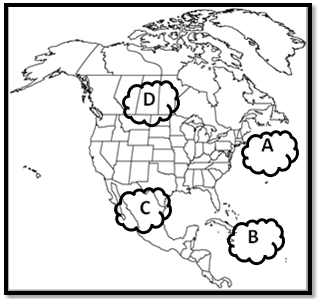
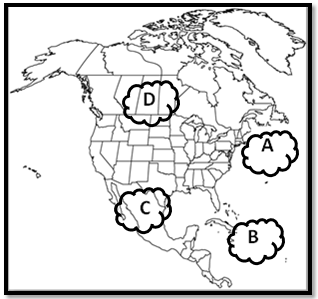
Based on the source regions shown, which air mass is most directly responsible for lake-effect snow downwind of the Great Lakes?
cT
mT
cP
mP
Which air mass would most likely bring steady drizzle and cool temperatures to the Pacific Northwest coast?
mP
cT
mT
cP
If maritime tropical air from the Gulf meets continental polar air from Canada, which frontal weather is most likely to develop?
Calm, clear skies with no clouds
Thunderstorms along a cold front
Dust storms with no clouds
Snow squalls only
Which statement best describes a source region for maritime tropical air?
Cold land surfaces at high latitudes
Warm oceans in low latitudes
High plateaus and deserts
Polar ice sheets
Which pair of air masses would create the strongest temperature contrast across a front in winter?
mT and cP
mP and cP
mT and cT
mP and mT

Which statement is most consistent with the Cleveland location relative to the shown air masses?
It is only affected by mT air year-round.
It can experience cP air moving over the Great Lakes, enhancing snowfall.
It lies within the source region for cT air.
It is rarely influenced by mP air from the Atlantic.
The phrase "impact climate" in the lesson title suggests examining which of the following?
Short-term weather events only
Long-term patterns in temperature and precipitation
The composition of igneous rocks
The phases of matter at room temperature
Which statement aligns with the albedo definition provided?
Albedo measures emitted infrared radiation
Albedo is the fraction of sunlight reflected by a surface
Albedo is the amount of sunlight absorbed by the atmosphere
Albedo is unrelated to surface color
Which pair correctly matches surface and relative albedo?
Dark soil — higher
Fresh snow — higher
Black asphalt — higher
Charcoal — higher
Which outcome is most consistent with increasing dark-colored surfaces in an area?
Higher albedo and more reflection
Lower albedo and more absorption
No change in albedo
Higher albedo but more absorption
A light-colored desert surface compared to a dark forest will generally:
Absorb more sunlight and have lower albedo
Reflect more sunlight and have higher albedo
Have the same albedo
Emit more sunlight
If the Coriolis Effect were absent, which outcome would be most likely for tropical disturbances?
They would fail to develop organized rotation
They would have higher sea surface temperatures
They would move only westward
They would intensify more quickly
In the United States weather usually moves from
west to east
east to west
Which type of weather is usually associated with a cP air mass?
moist and cool
dry and warm
moist and warm
dry and cool
An air mass that is humid and forms over water is called a _______________ air mass.
maritime
continental
Most weather comes from -
water
temperature
air masses
very large area
Of the four types of air masses, which would describe air that is cool and humid and forms over the North Pacific ocean?
Maritime Tropical
Maritime Polar
Continental Tropical
Continental Polar
Where does the air the affects North Carolina's weather come from?
If an air mass forms over land, chances are it will be
humid.
moist.
cloudy.
dry.
Warm phase; high air pressure; forms over the Pacific Ocean
maritime tropical air
la nina
gulf stream
el nino
3. What does the following describe?
Air masses moving and meeting.
Changes in weather
Changes in air temperature
Changes in cloud types
Changes in pressure


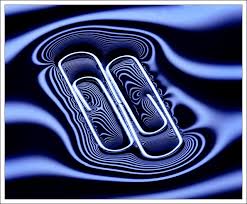


The ability of water molecules to stick to each other, creating surface tension is called:
Cohesion
Adhesion
Insulation
Ph
What property of water results in the accumulation of small amounts of water into larger amounts of water? The results in the rivers, lakes, streams, and even the oceans.
Cohesive Behavior
Expansion Upon Freezing
Ability to Moderate Temperature
Universal Solvent
What property of water allows for water to act as a temperature regulator for the world?
Cohesive Behavior
Expansion Upon Freezing
High Specific Heat
Universal Solvent

What property of water causes these Alka-Seltzer tablets to dissolve?
Universal Solvent
Expansion Upon Freezing
Cohesive Behavior
High Specific Heat
Why does water move from the roots to the leaves of plants?
Water is pushed by solutes
Water is pulled by gravity
Capillary action pulls the water molecules like a chain
Water's cohesion causes it to "pull" towards the leaves
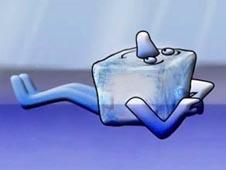
Why does ice stay at the top of oceans instead of sinking to the bottom?
Ice is colder than liquid water
Ice is less dense than liquid water
Ice is more dense than liquid water
Ice is warmer than liquid water
Water has an unusually high specific heat. What does this mean?
At its boiling point, water changes from liquid to vapor.
A large amount of heat is required to raise the temperature of water.
Ice floats in liquid water.
Salt water freezes at a lower temperature than pure water.
Floating ice can insulate bodies of water.
Both El Nino and La Nina have this in common
Influence birds that migrate over the ocean
Influence rainy / dry weather world wide
The weather at the polar regions
The directions that ships travel in the oceans
How often do El Nino events occur?
2-5 years
2-7 years
7-10 years

The image is of a(n):
El Nino event
La Nina event
Non-El Nino (normal conditions)
Without question, ENSO events:
Are preventable
Eliminate sources of rain
Are really scary
Impact everyone on the planet somehow

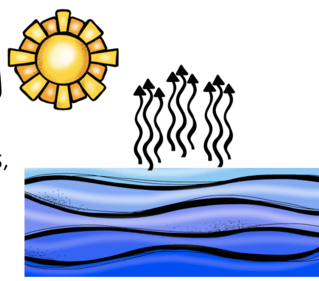
What results from livestock and other agricultural practices and by the decay of organic waste in municipal solid waste landfills?
Carbon Dioxide
Methane
Water Vapor
Fluorinated Gases
Nitrous Oxide
Which of the following natural events is NOT a source of carbon dioxide?
Wildfire
Decomposing plants and animals
Volcanic eruption
Earthquake

Which of the following is contributing to an INCREASE in carbon dioxide in the atmosphere?
deforestation
photosynthesis
oceans
all of the above
the loss of animal species
Which gas makes up the greatest percentage of Earth's atmosphere?
Argon
Nitrogen
Nitrous oxide
Carbon dioxide
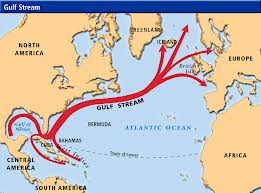




Which two factors make ocean water more dense?
Cold Temperatures
Warm Temperatures
Higher Salinity
Lower Salinity
As surface currents flow from the equator towards the poles what happens to them?
They become warmer.
They become lighter.
They become more dense.
They slow down.
Air above the land warms up faster than air over the water, and the cooler air from the water blows toward land. What type of wind is this?
Land Breeze
Global Wind
Sea Breeze
Surface Wind
What drives ocean surface currents?
Density Differences
Earth's Core
Global Winds
Gravity
What drives deep ocean currents?
Surface Winds
Unequal Heating
Global Winds
Differences in Density
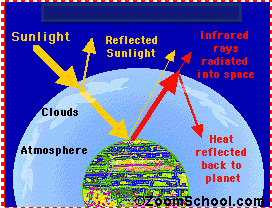
What do the Greenhouse gases do to heat in the atmosphere?
Absorb it
Reflect it
Trap it
Eliminate it
What type of heat transfer is given off by flames of a fire?
Convection
Conduction
Radiation
What is thermal energy?
The total amount of heat an object contains.
How hot or cold an object is.
The total energy of motion in the particles of a substance.
How much heat is transferred from one object to another.
Convection currents in the atmosphere are caused by what?
Warm air rising and warm air sinking
Cold air rising and cold air sinking
Warm air rising and cold air sinking
Cold air rising and warm air sinking
What direction does air move?
High Pressure to High Pressure
Low Pressure to Low Pressure
High Pressure to Low Pressure
Low Pressure to High Pressure
What form of energy is the sun's light?
Thermal
Electrical
Nuclear
Electromagnetic Radiation
What form of energy is the sun's light?
Thermal
Electrical
Nuclear
Electromagnetic Radiation
What direction does air move?
High Pressure to High Pressure
Low Pressure to Low Pressure
High Pressure to Low Pressure
Low Pressure to High Pressure
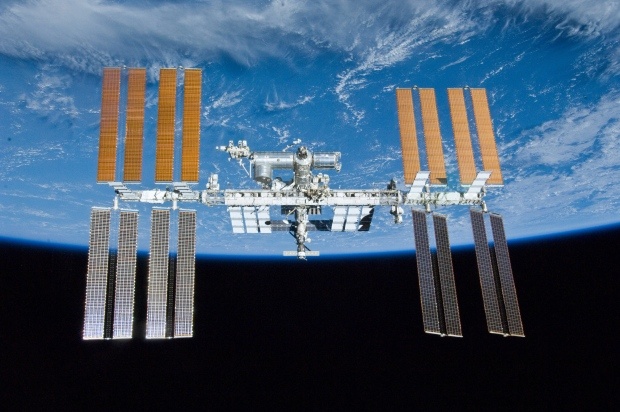
Oxygen is the most abundant gas in the atmosphere
true
false

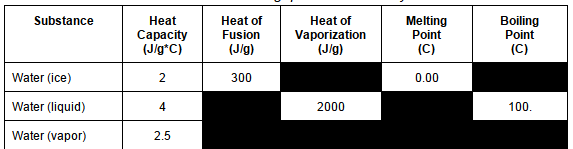

Which will heat up slower?
water
lead
granite
iron

Which will heat up faster?
copper
granite
iron
basalt


The curving of moving objects from a straight path due to the Earth's rotation is called
a continental deflection.
the Coriolis effect.
a pressurized deflection.
a rotational deflection.

When temperature decreases, the density of liquid water _________________.
increases
decreases
stays the same

As the depth of ocean water increases, the temperature
increases.
decreases.
fluctuates depending on the pressure.
stays the same.

The measure of the amount of dissolved salt in a given amount of water is called _____.
solubility
salinity
density
proximity

