wayground logo

Free Printable Worksheets

Font size

S
M
L
XL
Worksheets

Year 10 ESS

Total questions: 136

Worksheet time: 2hrs 49mins

Name
Class
Date
1.

_________________________ is the planet that takes the most time to orbit the sun.

a)

Saturn

b)

Earth

c)

Neptune

2.

Neptune is the __________________________ planet from the sun.

a)

farthest

b)

closest

c)

nearest

3.

The eighth planet is ______________________

a)

Neptune

b)

Earth

c)

Mars

4.

Uranus is the only planet the ____________ ________________ _____________ _________________________,

a)

spins on its side.

b)

sings in the morning

c)

Spins around 3 times,

d)

that Mrs. Hammerman is visiting.

5.

Uranus is the _______________________ planet.

a)

hottest

b)

coldest

c)

oldest

6.

The seventh planet is ________________________.

a)

Jupiter

b)

Mars

c)

Uranus

7.

Saturn is the ___________ planet in our Solar System.

a)

lightest

b)

heaviest

c)

largest

d)

oldest

8.

Saturn has _________________ rings around it.

a)

7

b)

6

c)

4

d)

12

9.

The sixth planet from the sun is _____________________.

a)

Uranus.

b)

Mars.

c)

Saturn.

10.

The fifth planet from the sun is _________________________.

a)

Ms. Haroula

b)

Mars

c)

Jupiter

11.

Mars is covered with ______________ _________________.

a)

red sand.

b)

orange rocks

c)

Purple dust.

12.

The fourth planet from the sun is __________________________.

a)

Earth

b)

Mars

c)

Saturn.

13.

Earth is the only planet in our Solar System that ______ _________.

a)

travels around the moon.

b)

travels around the sun.

c)

supports life.

14.

The third plant from the sun is _______________________________.

a)

Jupiter

b)

Earth

c)

Mars

15.

Venus is the __________________________ plant.

a)

brightest

b)

biggest

c)

smallest

16.

Venus is the ____________ planet in our Solar System.

a)

coldest

b)

hottest

c)

rainiest.

17.

Mercury is the closest planet to the _____________________.

a)

sun

b)

earth

c)

Mr. Alex

18.

The first planet from the sun is _______________________.

a)

Mars

b)

Earth

c)

Mercury

19.

The planets move ________________________________________.

a)

around the earth

b)

around the sun.

c)

around the planets.

20.

The sun is the _________________________________________.

a)

4th planet from Mars.

b)

the 2nd planet from the sun.

c)

center of our solar system.

21.

What pulls us towards Earth?

a)

Gravity

b)

Stars

c)

Air

d)

Land

22.
Tides are caused by ___________
a)
wind
b)
gravitational pull of moon
c)
waves gravitation toward land
d)
rain
23.

The Sun affects Earth in all of the following ways EXCEPT:

a)

it heats up Earth's surface

b)

it provides energy for plants

c)

it's energy is stored in fossil fuels such as coal

d)

it creates the tides on the Earth

24.
Which of the following is best shown in the picture?
a)
Earth's revolution
b)
A month on Earth
c)
A year on Earth
d)
Earth's rotation
25.
Which of the following do the blue arrows represent in the picture?
a)
A day on Earth
b)
Earth's rotation around the Sun
c)
Earth's revolution around the Sun
d)
A month on Earth
26.
Which of the following amounts of time has gone by when the Moon makes 1 revolution around the Earth?
a)
1 month on Earth
b)
1 year on Earth
c)
1 day on Earth
d)
1 week on Earth
27.
What type of orbit does the Earth have?  This was proven by astronomer Johannes Kepler.
a)
An elliptical orbit around the moon.
b)
An elliptical orbit around the Sun.
c)
A circular orbit around the moon.
d)
A circular orbit around the Sun.
28.
Earth revolves around ________, because it has the __________ in the solar system.
a)
the moon; most gravitational force
b)
the sun; least gravitational force
c)
Jupiter; most gravitational
d)
the sun; most gravitational force
29.
List the following items from smallest to largest.
a)
universe, solar system, galaxy
b)
galaxy, solar system, universe
c)
solar system, galaxy, universe
d)
solar system, universe, galaxy
30.
The planets below are drawn to scale.Which planet could be Planet X?
a)
Neptune
b)
Mercury
c)
Uranus
d)
Venus
31.
These planets from the solar system are drawn to scale. Which planet could be Planet Z?
a)
Mars
b)
Venus
c)
Neptune
d)
Mercury
32.
These planets from the solar system are drawn to scale.  Which planets are X and Y?
a)
X is Venus and Y is Mars.
b)
B. X is Mars and Y is Venus.
c)
X is Mercury and Y is Mars.
d)
X is Mars and Y is Mercury.
33.
The graph below shows the diameters of the planets. The diameter of a planet is the distance from one side to the other through the middle at the widest part. Which two planets are closest in size?
a)
Uranus and Neptune
b)
Venus and Mars
c)
Jupiter and Saturn
d)
Mercury and Earth
34.
Pluto is called a dwarf planet. It is smaller than the planets in the solar system. The size of each solar system planet is listed in the table below. Which planet is MOST likely closest to Pluto in size?  
 
a)
Mars
b)
Mercury
c)
Jupiter
d)
Neptune
35.
Which set of planets is in order, from largest to smallest?
a)
Jupiter, Mars, Mercury
b)
Jupiter, Venus, Earth
c)
Uranus, Saturn, Mars
d)
Uranus, Mars, Venus
36.
How do gas giants compare to the terrestrial planets?
a)
terrestrial planets are much larger
b)
terrestrial planets are much smaller
c)
gas giants are slightly larger
d)
gas giants are slightly smaller
37.
Of the billions of stars in our galaxy, why is the Sun the only star in the galaxy that supplies energy to Earth?
a)
The Sun is the closest star.
b)
The Sun is the hottest star.
c)
The Sun is the biggest star.
d)
The Sun is the oldest star.
38.
Compared to the Sun, all other stars look like points of light in the night sky because the stars _______.
a)
are much smaller than the Sun.
b)
are much farther away than the Sun.
c)
give off different colors than the Sun.
d)
give off much less light than the Sun.
39.
Why does the Sun appear to be the largest star when there are stars that are much larger than the Sun?
a)
Stars have the same temperature as the Sun.
b)
Stars usually appear in groups called clusters.
c)
The Sun is closer to Earth than other stars.
d)
The Sun is younger than most other stars.
40.
How many planets are in the solar system?
a)
10
b)
8
c)
9
d)
7
41.
Which planets have rings?
a)
Earth, Mercury, Jupiter, and Saturn
b)
Pluto, Venus, Neptune, and Mars
c)
Saturn, Uranus, Jupiter, and Neptune
d)
Mars, Earth, Uranus, and Venus
42.
Which planet has the most moons?
a)
Jupiter
b)
Earth
c)
Saturn
d)
Mars
43.
Which planet is home to the Great Red Spot?
a)
Jupiter
b)
Mars
c)
Saturn
d)
Venus
44.
A light year is the 
a)
distance that light travels in one year
b)
Speed at which light travels 
c)
Distance between the sun and the earth. 
d)
Distance at which light no longer exists. 
45.

What is an astronomical unit (A.U.)?

a)

the time it takes light to travel one year

b)

the distance between the Earth and the Moon

c)

the distance between the Earth and the Sun

d)

the distance between the Earth and the Neptune

46.
What do we use astronomical units to measure?
a)
distances in our solar system
b)
How far our solar system is from others in our galaxy.
c)
The distances between galaxies. 
d)
The distance from one side of the universe to the other. 
47.

Why do we use light years and astronomical units to measure distances in space?

a)

Scientists want to sound smart.

b)

Hubble discovered these units and wanted to use them.

c)

Space is too small to use km, it wouldn't make sense.

d)

Space is too big, vast, enormous to use traditional units, like kilometres.

48.

Which of the following scenarios would be appropriate to use light years?

a)

From the sun to Earth

b)

from Earth to Neptune

c)

from the Milky Way to its closest galaxy

d)

Asteroid Belt to the Kuiper Belt

49.

Which of the following scenarios would we use Light Years to determine, not Astronomical Units (AU)?

a)

distance from Mercury to Saturn

b)

distance from Sun to Neptune

c)

distance from Earth to Sun

d)

distance from Asteroid Belt to the Betelgeuse Star

50.

Which correctly states the distances from Earth, from closest to farthest?

a)

Sun, Moon, Pluto, Asteroid Belt, Milky Way Galaxy

b)

Moon, Sun, Asteroid Belt, Pluto, Milky Way Galaxy

c)

Sun, Moon, Pluto, Asteroid Belt, Milky Way Galaxy

d)

Moon, Sun, Pluto, Asteroid Belt, Milky Way Galaxy

51.

Which of the following is CLOSEST to planet Earth:

a)

Jupiter

b)

Andromeda Galaxy

c)

Earth's moon

d)

the Sun

52.
What is a galaxy?
a)
A large storm of comets. 
b)
A parallel universe that existed before the Big Bang. 
c)
A collection of stars, dust, and gas bound together by gravity 
d)
Unknown 
53.
A good way to practice parallax is with your
a)
Foot
b)
Thumb
54.
The apparent shift in the position of an object when viewed from different locations is called 
a)
Parallelogram 
b)
Parallax 
55.
A parsec is
a)
angle of a star's shift over the course of a year
b)
the smallest unit for time
56.
We can use brightness of stars to measure distance because
a)
the strength of light decrease by the square of the distance
b)
light is a constant and always is bright
57.

Stars that are very bright, large & burn at the highest temperature

a)

Blue Giant stars

b)

Red Giant

c)

Neutron stars

d)

Proto stars

58.

Stars appear to twinkle because

a)

of their temperature

b)

their light is passing through our atmosphere

c)

they constantly change direction

d)

to make a wish on

59.

The closer a star is

a)

the larger it appears

b)

the more hydrogen is in the star

60.

The main gases that burn within the sun are

a)

Oxygen and Nitrogen

b)

Hydrogen and Oxygen

c)

Neon and Sulfur

d)

Hydrogen and Helium

61.

Diameter of the sun is about 108 times bigger than Earth, about _________ Earth's would fit inside the sun.

a)

500

b)

1 thousand

c)

1 million

d)

1 billion

62.
Which of the following is NOT a characteristic used to classify stars?
a)
Color
b)
Temperature
c)
Size
d)
Shape
63.
Define star constellations.
a)
Imaginary patterns of stars
b)
Extremely hot stars
c)
Extremely cool stars.
d)
Solar Nebulas
64.
True or False - A star's color is directly related to its temperature.
a)
True
b)
False
65.

The brightness of a star as seen from earth is defined as:

a)

Apparent Magnitude

b)

Absolute Magnitude

c)

Magnitude

d)

Candid Magnitude

66.

The brightness the star would have if it were a standard distance from earth.

a)

Apparent Magnitude

b)

Absolute Magnitude

c)

Magnitude

d)

Candid Magnitude

67.
A light year is a measurement of:
a)
Time
b)
Distance
c)
Gravity
d)
None of the Above
68.
Explosion of a high-mass star.
a)
White Dwarf
b)
Planetary Nebula
c)
Supernova
d)
Neutron Star
69.
An object whose gravity is so strong that nothing can escape.
a)
Planetary Nebula
b)
Supernova
c)
Neutron Star
d)
Black Hole
70.
A huge group of single star systems, star clusters, dust, and gas bound together by gravity.
a)
Nebula
b)
Milky Way
c)
Galaxy
d)
High-Mass Star
71.
True or False - The hottest stars are blue.
a)
True
b)
False
72.
Which of the following is a name used for stars:
a)
Neutron
b)
Supergiant
c)
White dwarf
d)
All of the above
73.

Most scientists believe the Big Bang Theory explains which of the following questions?

a)

How our planets and moons formed

b)

How our universe began

c)

How the sun turns hydrogen into helium

d)

How fast light travels through space

74.

Which statement is true?

a)

The galaxies are moving toward us.

b)

The galaxies are moving away from us.

c)

The universe remains static or unchanged in motion.

d)

None of the above

75.

Cosmic Microwave Background Radiation is a form of _________.

a)

Matter

b)

Energy

c)

Visible Light

d)

Water

76.

Which elements are most

abundant in the visible

universe?

a)

Hydrogen and Carbon

b)

Carbon and Helium

c)

Hydrogen and Oxygen

d)

Hydrogen and Helium

77.

As galaxies move away from our galaxy

a shift on the electromagnetic spectrum

(EMS) is noticed. This phenomena is

called _____________.

a)

redshift

b)

blueshift

c)

unshift

d)

blackshift

78.

How does Cosmic Microwave Background Radiation support the Big Bang Theory?

a)

Microwaves are found everywhere in the universe.

b)

Microwaves occurred at the time of the Big Bang

c)

Microwaves are useful in our everyday lives

d)

Only A & B

79.

How does the abundance of hydrogen and helium support the Big Bang Theory.

a)

Hydrogen and helium are elements on the Periodic Table

b)

Hydrogen and helium are in the same ratio throughout the universe.

c)

Hydrogen and helium have many current uses today

80.
According to the Big Bang Theory, which graph best represents the relationship between time and the size of the universe from the beginning of the universe to the present?
a)
Size decreasing as time increases
b)
Size and time both increasing
c)
Size does not change as time increases
d)
Size increases, then decreases as time increases
81.
What is the CMBR
a)
The shape of the universe
b)
The first primordial elements
c)
Red shifted galaxies
d)
Leftover heat from the Big Bang 
82.
What shape do scientists think the universe is?
a)
Sphere
b)
Triangular
c)
Saddle Shaped
d)
Flat
83.
How did the discovery of Cosmic Microwave Background Radiation support the Big Bang Theory?
a)
It suggests that Hydrogen and Helium were the first elements to form.
b)
It confirms the age of the Earth to be around 5 billion years old.
c)
It supports the idea that the universe used to be hotter.
d)
It demonstrates that the universe continues to expand.
84.
Which statement best describes the age of our solar system and universe?
a)
Our solar system and the universe are estimated to be 5 billion years old.
b)
Our solar system and the universe are estimated to be 10 billion years old.
c)
Our solar system is at least twice as old as the universe.
d)
The universe is roughly 13.7 billion years old.
85.
Which of the following is NOT true about the Big Bang Theory?
a)
It is the scientific explanation of how life began on Earth and evolved over time.
b)
It is the scientific explanation for the origin of the universe.
c)
It states that the universe expanded from a single point and is still expanding today.
d)
It states that the universe used to be much hotter and smaller.
86.
What can we conclude from the observation that nearly all galaxies are moving away from us?
a)
Massive black holes are drawing galaxies away from Earth.
b)
The Sun and Earth are located at the center of the universe.
c)
Everything in the universe is moving the same direction.
d)
The once-smaller universe is expanding in all directions.
87.

The Big Bang Theory is the most widely accepted theory about the origin of the universe.

a)

true

b)

false

88.

Which description is considered most accurate regarding what actually happened during the Big Bang?

a)

Two galaxies collided causing an immense explosion as stars crashed into one another

b)

All of what would become the universe was concentrated in a single small point, or singularity, which rapidly expanded into what is now stars, planets, galaxies, matter, and energy.

c)

All matter emerged from a massive black hole at the center of the universe.

d)

Parts of the sun were ripped off by massive internal explosions and were thrown into space where they cooled to become other things, like plants, comets, and other galaxies.

89.

A galaxy showing blue shift is ___.

a)

very cold

b)

moving towards us

c)

dying

d)

about to supernova

90.

Observations of space indicate that most matter in the universe is ___.

a)

hydrogen, helium, and dark matter

b)

gold and plutonium

c)

oxygen and water vapor

d)

carbon

91.

What instrument has allowed us to look deep into space to observe things far away that give us hints to the past?

a)

The Hubble telescope

b)

The Eiffel Tower

c)

Binkley's barometer

d)

The Smith Space Balloon

92.
What is the ISS?
a)
International Student Services
b)
Inside Sun Secrets
c)
International Space Station
d)
Iraq Space Services
93.

What is the artifical satellite that orbits Earth

a)

Hubble Telescope

b)

Spirit

c)

Opportunity

d)

Challenger

94.

The Hubble telescope was put in space to:

a)

take images past the atmosphere

b)

it is closer to the sun

c)

too big for Earth

d)

its not really in space

95.
Gravity on the moon is _____ than that on the Earth.
a)
the same
b)
greater
c)
less
d)
non existent
96.

The more distant a galaxy, the faster it is

a)

moving towards us

b)

moving away from us

c)

growing

d)

spinning

97.
Edwin ____________ created a very important law after inventing a telescope that was used to see galaxies far, far away.
a)
Darwin
b)
Hubble
c)
Newton
d)
Murphy
98.

Why are the astronauts aboard the ISS required to exercise 2 hours per day?

a)

To avoid losing too much muscle and bone

b)

To keep them from going stir crazy

c)

To meet Department of Health regulations

99.
What are the big, flat shiny things on the ISS?
a)
solar panels
b)
wind sails
c)
heat reflectors
d)
antennas
100.
Which country has never had an astronaut aboard the ISS?
a)
Japan
b)
Russia
c)
North Korea
d)
Canada
101.
What is the average length of time astronauts spend on board the ISS?
a)
2 weeks
b)
6 months
c)
1 year
d)
2 years
102.
How long does it take the ISS to complete one orbit?
a)
Half an hour
b)
90 minutes
c)
12 hours
d)
2 days
103.
Which of the following is the best conclusion that can be made from this graph?
a)
atmospheric carbon dioxide levels have been decreasing since 1960
b)
Hawaii has a lot of carbon dioxide
c)
humans have been working hard to decrease carbon dioxide levels
d)
atmospheric carbon dioxide levels have increased steadily since 1960
104.

Which of the following have been changed or altered due to climate change ?

a)

droughts

b)

flooding

c)

melting of polar ice caps

d)

all of the above

105.

The main human activity that releases greenhouse gases is

a)

using public transportation and there by reduce the affects of greenhouse gases.

b)

burning fossil fuels

c)

texting on cellphones

d)

eating meat

106.

Which of the following is contributing to an INCREASE in carbon dioxide in the atmosphere?

a)

deforestation

b)

photosynthesis

c)

oceans

d)

all of the above

e)

the loss of animal species

107.
 What is the greenhouse effect?
a)
The warming of a planet due to trapped radiation.
b)
The cooling of Earth due to air pollution.
c)
The heating of a solid, such as a rock.
108.
What gas from the list below is a cause for global warming?
a)
Urethane
b)
Oxygen
c)
Carbon Dioxide
109.
What do scientists think the effect will be of having more greenhouse gases in our atmosphere?
a)
More warming of the atmosphere
b)
More cooling of the atmosphere
c)
More air in the atmosphere
d)
Less air in the atmosphere
110.
T/F: Water vapor is a greenhouse gas
a)
True
b)
False
111.
T/F: Some greenhouse gases are naturally present in the Earth's atmosphere
a)
True
b)
False
112.
Which of the following is an example of a greenhouse gas?
a)
Carbon Dioxide
b)
Nitrogen
c)
Oxygen
d)
Neon
113.
Increased carbon dioxide may cause global warming by trapping more ____________ in the atmosphere.
a)
water
b)
gases
c)
heat
d)
water vapor
114.
Which is a natural source of greenhouse gases?
a)
aerosols
b)
deforestation
c)
volcanic eruptions
d)
burning fossil fuels
115.
Which natural process removes carbon dioxide from the atmosphere?
a)
forest fires
b)
volcanic eruptions
c)
cellular respiration
d)
photosynthesis
116.
What is one way that carbon enters the atmosphere?
a)
Sunlight
b)
Vehicle emissions/Exhaust
c)
Ocean uptake
d)
Rain
117.

What converts nitrogen gas into a usable form for plants and animals?

a)

bacteria

b)

rain

c)

fungi

d)

car exhaust

118.

The process in which nitrogen circulates and is recycled is called

a)

The nitrogen cycle

b)

The carbon cycle

c)

The water cycle

d)

The phosphorus cycle

119.

Organisms that need nitrogen to survive.

a)

only plants

b)

only animals

c)

only bacteria

d)

all living things

120.

How is nitrogen "fixed" into a usable form for plants?

a)

Through action of bacteria only

b)

Through lightning only

c)

Through action of bacteria and lightning

d)

Through photosynthesis

121.

How do animals get the nitrogen they need?

a)

From the air they breathe

b)

From the water they drink

c)

From the food they eat

d)

From the sun

122.

Gas that makes up 78% of our atmosphere.

a)

Oxygen

b)

Nitrogen

c)

Hydrogen

d)

Carbon Dioxide

123.

What is the process of combining nitrogen gas with other elements to make nitrogen into usable compounds?

a)

nitrogen composition

b)

nitrogen fixation

c)

ammonia

d)

denitrification

124.

What is the formula for atmospheric nitrogen?

a)

N

b)

N2

c)

NH3

d)

NO3

125.

What process occurs when dead plant and animal matter decomposes and nitrogen is released back into the atmosphere?

a)

Assimilation

b)

Fixation

c)

Ammonification

d)

Denitrification

126.

Plants and animals cannot use nitrogen directly from the air.

a)

True

b)

False

127.

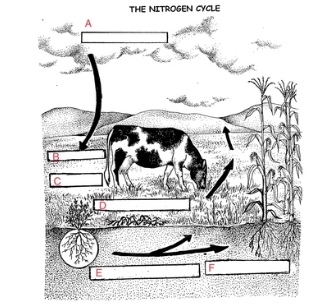
In the nitrogen cycle, what does label A in the diagram represent?

a)

Gas

b)

Clouds

c)

Carbon dioxide in the atmosphere

d)

Nitrogen in the atmosphere

128.

What is Global Warming?

a)

Increasing temperature in Earth's atmosphere

b)

Decreasing temperature in a city

c)

Increasing rain rates in Earth

d)

Decreasing temperature rates

129.

Global warming is caused by a phenomenon known as the greenhouse effect.

a)
b)
130.
Without the Greenhouse Effect the Earth would be too
a)
warm 
b)
cold
c)
dead
d)
funny
131.
Which of the following is NOT an effect of Global Warming?
a)
Polar ice caps will melt.
b)
Coastal regions will be covered with rising sea levels.
c)
Some areas will experience serious droughts
d)
The Earth's rotation will slow down and eventually stop
132.
What is the mixture of gases surrounding the Earth called?
a)
carbon
b)
concentration
c)
atmosphere
d)
emissions
133.
It was hot all week last week.  Is this a sign of climate change?
a)
Yes
b)
No
134.
Worldwide, temperatures have been increasing for more than 100 years.  Is this evidence of global warming?
a)
yes
b)
no
135.

Which of these is considered a non renewable energy source? (choose all that apply)

a)

solar power

b)

gasoline

c)

geothermal power

d)

coal

136.

Which of the following is a consequence of global warming? (Choose all that apply)

a)

Seas rising (flooding)

b)

Loss of habitat for animals.

c)

More severe storms and weather.

d)

Increased forest fires and drought.