
 Worksheets
POTU - S1 Semester Exam Review
Total questions: 139
Worksheet time: 4hrs 34mins

What do waves carry and transfer?
Nothing
Only Sound
Only sunlight
Energy

The highest part of the wave is called the _______________.
Amplitude
Wavelength
Trough
Crest

_________________________ is the distance between a point on one wave and the identical point of the next wave.
Amplitude
Frequency
Crest
Wavelength

Which wave has the greatest wavelength?
Red Wave
Orange Wave
Green Wave
Purple Wave
The bottom of a wave is
trough
crest
wavelength
crust

Which of the following has the shortest wavelength?
microwaves
UV rays
Infrared
the color blue

Which of the following has the most energy?
Red
Blue
Green
Violet

Which of the following has the longest wavelength?
Infrared
The color Indigo
gamma rays
TV

Which of the following has the least amount of energy?
UV rays
The color yellow
infrared
Gamma rays
Which wave has high enough energy to cause damage to skin and sometimes cancer?
Microwaves
Visible Light
Infrared Rays
Ultraviolet Rays
Which of the following electromagnetic waves is given off as heat and is used in toasters and grills?
Gamma Rays
Microwaves
Infrared Waves
X-Rays

What type of electromagnetic wave is represented by the illustration?
Gamma Rays
X-Rays
Visible Light
Radio Waves
What types of waves are used in communication signals such as cellular phones?
Radio Waves
X-Rays
Microwaves
Visible Light

This device is a
telescope
spectroscope
microscope
prism

The unknown emissions spectra belongs to the element
Hydrogen
Mercury
Neon
Sodium

The unknown emissions spectra belongs to the element
Hydrogen
Mercury
Neon
Helium
Which type of spectra produces, or emits, light of specific frequencies and has bright lines on a dark background?
Absorption spectra
Emission spectra
Continuous spectra
Which type of spectra measures the light that a gas absorbs and produces dark lines?
Absorption spectra
Emission spectra
Continuous spectra


In comparison to other stars in the sky, the Sun appears brighter because it is _____ than other stars.
Bigger
Smaller
Closer
Further
As the _________ of a star increases, luminosity (brightness) increases.
size
distance
age
composition

Which star is the least bright?
B
A
C
D

Which star appears the least bright from Earth?
B
A
C
D
The star 'Capella' has an apparent magnitude of 0.08 and an absolute magnitude of -0.48. Is it closer than or further than 32.6 light years away?
closer than
further than
exactly 32.6 light years away

Put the stars in order from COOLEST to HOTTEST.
Which object (based on apparent magnitude) is the brightest:
Full Moon (-12.6)
Venus (-4.4)
Sirius (-1.4)
Pluto (+15.1)
Two stars have the same apparent magnitude as seen from Earth’s surface. Star A is 33 ly away. Star B is 346 ly away. Which of the following claims is supported by the evidence?
Star B is larger than Star A
Star B is more luminous than Star A
The stars have the same absolute magnitude
Star A has a smaller absolute magnitude

Which of the following are the brightest?
red supergiants
yellow main sequence
red dwarfs
white dwarfs

Which of the following stars is the hottest?
Bellatrix
Deneb
Polaris
Barnard's Star
Which of the following stars is the brightest?
Bellatrix
Deneb
Polaris
Barnard's Star
Which of the following are generally the hottest?
Supergiants
Red Giants
Yellow Main Sequence Stars
White Drarfs
Where are the coolest stars on an HR Diagram found?
top
bottom
left
right


sort of cool, dim (not too much light), and red?


What is magnitude?
degree of compactness of a star.
degree of temperature of a star.
the age of a star.
degree of brightness of a star.

Which star is brighter than the sun?
Sirius B
Procyon B
Van Maanan's Star
Aldebaran

Which star is considered a main sequence star?
Vega
Betelgeuse
Pollux
Van Maanan's Star

Which star is considered a supergiant?
Sirius B
Sun
Betelgeuse
Van Maanan's Star
Which star shown below is brightest?
a magnitude -1 star
a magnitude 1 star
a magnitude 2 star
a magnitude 3 star

What small, hot, faint objects are found at B?
neutron stars
black holes
white dwarfs
brown dwarfs

What objects are found at C?
Blue giants
Red giants
White dwarfs
Main sequence stars
With greater distance, the parallax angle
increases
decreases
stays the same
doesn't change


This is an image of the first stage in the formation of a star, also known as a ....
Main Sequence
Planetary Nebula
Supernova
Nebula
The stage after the main sequence star:
red giant
nebula
white dwarf
black dwarf
When nebula is big and hot enough is collapses on itself and ...................... is made
white dwarf
supernova
protostar
planetary nebula
Black hole ends life of the biggest stars in the universe
true
false
Neutron stars are very small and extremely dense
true
false
Supernova happens after
super red giant
nebula
protostar
white dwarf

All stars begin their life as a
Main Sequence
Nebula
Protostar
Black Dwarf

A ________ is an object so dense with so much gravity that even light cannot escape.
neutron star
white dwarf
black hole
black dwarf
The super red giant ends its life as a massive explosion called
supernova
planetary nebula
constellation
black dwarf
Our sun is in this stage of its life
nebula
red giant
black hole
main sequence star
Our sun will end its life as a black hole
true
false
All stars begin their life as a white dwarf
true
false
Our sun will end its life as a black dwarf
true
false
How many stars are there in our solar system
1
1 billion
1 million
100
Only the biggest stars in the universe can become black holes at the end of their life.
true
false

The life cycles of stars are determined by their:
mass (size)
color
distance from Earth
how bright they are
Stars are made of mostly which two gases?
Hydrogen and Helium
Hydrogen and Oxygen
Hydrogen and Nitrogen
Hydrogen and Carbon
Stars give off heat and light in a process called ___________.
nuclear fusion
supernova
luminosity
spectroscopy
In the process of nuclear fusion, hydrogen atoms combine to form ___________ atoms.
helium
carbon
nitrogen
oxygen


The parallax of a star is observed because
all stars have the same apparent brightness.
parallax increases with distance.
stars do not move.
the observer moves.

The unknown force or energy which tends to accelerate the expansion of the universe is called ___
the faint force
dark energy
the shadow force
black energy

The Universe is expanding, and that expansion is ___
getting faster every day
getting slower every day
randomly changing
constant
According to the Big Bang, about how old is the universe?
Like, 3 or 4 weeks?
175 million years old
14 billion years old
37 trillion years old
What makes "dark matter" dark?
It cannot be directly observed
It listens to a lot of emo music and finds edgy memes on iFunny.
The light that comes off from dark matter is very dim
The light that comes off from dark matter is super old

What type of galaxy is this?
Irregular
E0
Sb
SBc
What kind of matter makes up you and me and all we can see?
Special Matter
Normal Matter
Dark Matter
Light Matter
Hubble used collective learning in order to determine that the Universe was expanding. Which of the following scientists provided Hubble with the evidence he needed to figure out if certain stars (Cepheid variable stars) were moving away from us?
Nicolas Copernicus
Ptolemy
Henrietta Leavitt
Isaac Newton
What is the main difference between E0 and E7 galaxies?
E0 galaxies have bars in the center; E7 galaxies do not.
E0 galaxies are elliptical in appearance, while E7 galaxies are round.
E7 galaxies are elliptical in appearance, while E0 galaxies are round.
E0 galaxies have tightly wrapped spiral arms; E7 galaxies have loosely wrapped spiral arms

What type of galaxy is this?
Spiral
Elliptical
Irregular
Barred Spiral

What is the creature's final displacement?
23 m
9 m
-9 m
-23 m
At what position did the creature change direction?
-7 m
9 m
2 m
16 m
If you draw a straight line on a map to see how far you are from where you started, you just found your ______.
Distance
Displacement
Position
Time

What is the creature's starting position?
6 m
-3 m
1 m
3 m
What distance did the creature travel?
7 m
3 m
-3 m
-7 m
Distance
Total length of the path travelled
How far an object is from its starting point
Location of an object relative to a defined zero point
Displacement
Total length of the path travelled
How far an object is from its starting point
Location of an object relative to a defined zero point
Position
Total length of the path travelled
How far an object is from its starting point
Location of an object relative to a defined zero point

What was the displacement of object C?
Pick the types of galaxies
square
elliptical
spiral
fixed shape
irregular
Choose the image that represents the spiral galaxy


from 3rd second to 5th second, the object is
moving at a constant speed
speeding up
not moving
slowing down

On a position vs. time graph, the steeper the slope _____
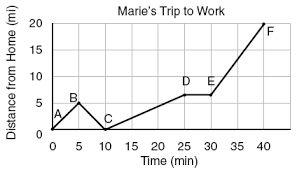
When was Marie driving the fastest?
C to D
D to E
E to F

Line A indicates that the object is
Speeding up in positive direction
Speeding up in negative direction
moving at constant speed in negative direction
moving at constant speed in positive direction
Which sentence is the evidence?

"Rhinos have horns"
Is this a claim, evidence or reasoning?
Claim
Evidence
Reasoning


To determine how fast an object is moving on a Position-time graph I should...
Look at the vertical axis at that time
Look at the steepness of the line (slope)
Look at if the slope is positive or negative
Look at the direction of the curvature, if any
Horizontal line on a Position Time graph indicate that the object is
Speeding up
Slowing down
at Rest
moving at a constant speed

What is the speed pf the object in section A?
0 m/s
30 m/s
0.5m/s
2 m/s
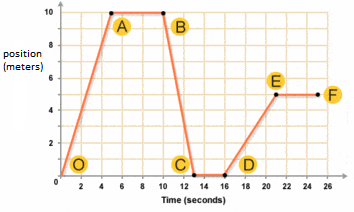
What is happening in this graph from point B to C?
The object is going down a hill.
The object is returning to its starting location.
The object is slowing down.
The object is staying still.

