wayground logo

Free Printable Worksheets

Font size

S
M
L
XL
Worksheets

PS 9 Semester One Exam Review January 2021

Total questions: 139

Worksheet time: 3hrs 9mins
Name
Class
Date
1.
What is speed?
a)
how far you go
b)
how much distance is covered over a period of time
c)
how fast you accelerate
d)
the change in the location of a object
2.
What is velocity?
a)
the quickness of an object
b)
the location of an object
c)
acceleration
d)
speed in a specific direction
3.
Can be measured in meters per second (m/s)
a)
Distance
b)
Time
c)
Speed
d)
Acceleration
4.
A distance vs. time graph shows an object's
a)
frame of reference
b)
speed
c)
acceleration
d)
favorite food
5.
Change in speed over a given period of time is
a)
velocity
b)
motion
c)
speed
d)
acceleration
6.
The speed at any single instant of time?
a)
speed
b)
average speed
c)
instantaneous speed
d)
velocity
7.
What is average speed?
a)
distance divided by time
b)
total distance divided by total time
c)
speed divided by time
d)
total speed divided by time
8.
Which of the following is a unit for acceleration?
a)
km/s
b)
m/s2
c)
mi/hr
d)
ft
9.
In a distance versus time graph where does the time go?
a)
y axis
b)
x axis
10.
Acceleration is....
a)
Speeding up only
b)
Speeding up and slowing down only?
c)
Slowing down only?
d)
Any change in speed (faster or slower) or a change in direction.
11.
An object is in _____ any time its position is changing.
a)
motion
b)
distance
c)
speed
d)
time
12.

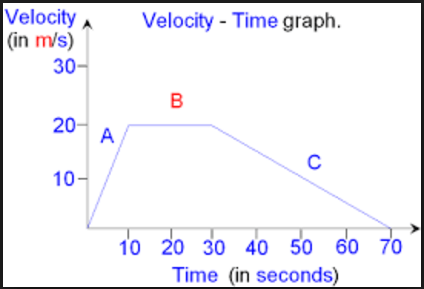
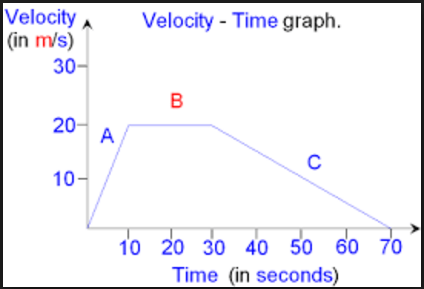
This is a velocity-time graph. What is the object doing in segment A?

a)

Speeding up

b)

Slowing down

c)

Constant Velocity

d)

Not moving

13.
This is a velocity-time graph.  What is the object doing in segment B?
a)
Positive acceleration
b)
Negative acceleration
c)
Constant Velocity
d)
Not moving
14.

This is a velocity-time graph. What is the object doing in segment C?

a)

Speeding up

b)

Slowing down

c)

Constant Velocity

d)

Not moving

15.

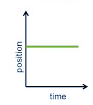
Describe the motion of the object in the graph

a)

Moving with constant speed

b)

Speeding up

c)

Not moving

16.
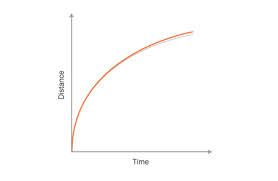
What is this graph showing?
a)
Constant Speed
b)
Acceleration (speeding up)
c)
Deceleration (slowing down)
d)
No motion
17.
Which graph shows the object standing still?
a)
A
b)
B
c)
C
d)
D
18.
Which graph represents zero acceleration (constant velocity)?
a)
A
b)
B
c)
C
d)
D
19.
Which graph represents the greatest acceleration?
a)
A
b)
B
c)
C
d)
D
20.

What is occurring on this graph?

a)

speeding up in the positive direction

b)

moving at a constant speed in the positive direction

c)

not moving

d)

moving at a constant speed in the negative direction

21.

What is occurring on this graph?

a)

Negative acceleration

b)

moving at a constant speed in the positive direction

c)

positive acceleration

d)

negative net force

22.

Velocity is speed with __________________________.

a)

a unicycle helmet

b)

direction

c)

fight

23.

What is motion?

a)

the stopping of an object to a frame of reference

b)

a change in position relative to a frame of reference

c)

the middle ground between light and shadow, between science and superstition, and it lies between the pit of man's fears and the summit of his knowledge

d)

a change in the time in which it takes to get an office referral

24.

Total distance divided by total time, for an object shows:

a)

acceleration

b)

the size of one's toupee

c)

absolute speed

d)

average speed

25.

In a car, a good frame of reference would be:

a)

The trees you are driving past in the car

b)

the tissue box sitting inside your car

c)

the old lady riding a unicycle beside your car in the same direction and at the same speed

26.

The clown walked 27 feet in 9 seconds. what was his velocity?

a)

18 feet/sec

b)

243 feet/sec

c)

36 feet/sec

d)

3 feet/sec

27.

A unicyclist pedals 40 hours at 5 miles per hour without making any stops. How far does she get?

a)

200 miles

b)

8 miles

c)

35 miles

d)

45 miles

28.

Fonzie flies through the air 24 meters on water skis wearing a leather jacket with swimming trunks over the shark. It takes him 2 seconds to make the jump. How fast was Fonzie flying through the air on water skis in a leather jacket and swimming trunks?

a)

8 m/sec

b)

12 m/sec

c)

22 m/sec

d)

26 m/sec

29.

An old lady rolls down a hill at 3 meters/second. The hill is 36 meters long. How many seconds does it take the old lady to reach the bottom of the hill?

a)

39 seconds

b)

12 seconds

c)

15 seconds

d)

33 seconds

30.
The equation to calculate momentum is
a)
p=mv
b)
p=1/2mv2
c)
p=mgh
d)
p=mg
31.
The momentum of an object depends upon the object's ___________&_____________.  
a)
size and shape
b)
mass and speed
c)
mass and veloctiy
d)
mass and energy
32.
Which object has the greatest momentum?
a)
Object A
b)
Object B
c)
Object C
d)
cannot be determined
33.

Find the momentum of a 3.0 kg mass when it is stopped.

a)

0 kg*m/s

b)

need to know the velocity

c)

3.0 kg*m/s

d)

9.8 kg * m/s

34.
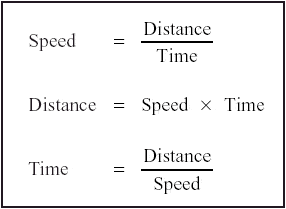
What is the formula to calculate speed?
a)
Speed = time/distance
b)
Speed = distance/time
c)
Speed = distance x time
d)
Speed = time x distance
35.
Which of the following is a unit for acceleration?
a)
km/s
b)
m/s2
c)
mi/hr
d)
ft
36.
When a car goes around a corner at 20 mph, why do we say it  accelerates?
a)
The car is accelerating because of the velocity is constant
b)
The car accelerates because it's going 20 mph
c)
Cars always accelerate when they are in motion
d)
The car is accelerating because it's changing direction
37.
Calculate the average speed (in meter/sec) if a cheetah runs 180 meters in 10 seconds.
a)
198 m/sec
b)
170 m/sec
c)
12 m/sec
d)
18 m/sec
38.
Acceleration only takes place when things speed up. 
a)
True
b)
False
39.
A roller coasters accelerates from an initial velocity of 6.0 m/s to a final velocity of 70 m/s over 4 seconds.  What's the acceleration?
a)
24 m/s2
b)
18 m/s2
c)
16 m/s2
d)
16 m/s
40.
A dog runs with an initial speed of 7.5 m/s on a waxed floor.  It slides to a stop in 15 seconds.  What is the acceleration?
a)
-7.5 m/s
b)
-7.5 m/s2
c)
-0.5 m/s2
d)
7.5 mi//hr
41.
A drag racer accelerated from 0 m/s to 200 m/s in 5 s.  What was the acceleration?
a)
0 m/s
b)
40 m/s2
c)
-40 m/s2
d)
40 m/s
42.
Acceleration can be classified as _______________
a)
Speeding up
b)
Slowing Down
c)
Changing directions
d)
All of the above
43.
A golf ball accelerates off a tee at 15m/s2, changing its velocity from 0m/s to 50 m/s down the fairway. How long did it take the golf ball to accelerate?
a)
750 seconds
b)
35 seconds
c)
0.3 seconds
d)
3.3 seconds
44.
"For every action, there is an equal and opposite reaction."
a)
Newton's 1st Law
b)
Newton's 2nd Law
c)
Newton's 3rd Law
d)
Newton's 4th Law
45.
Force = Mass x Acceleration
a)
Newton's 1st Law
b)
Newton's 2nd Law
c)
Newton's 3rd Law
d)
Newton's 4th Law
46.
The tendency of an object to resist changes in its motion is...
a)
inertia
b)
force
c)
acceleration
d)
velocity
47.
Any push or pull on an object.
a)
force
b)
velocity 
c)
inertia
d)
momentum
48.
The force that opposes motion between two surfaces in contact with each other.
a)
inertia
b)
friction
c)
momentum
d)
gravity
49.
The combination of all the forces acting on an object is the...
a)
net force
b)
action force
c)
reaction force
d)
balance force
50.

When two equal forces act in opposite directions on an object, they are called ______________________.

a)

frictional force

b)

balanced force

c)

centripetal force

d)

gravitational force

51.

When an unbalanced force acts on an object, the force ______________________.

a)

changes the motion of the object

b)

is cancelled by another force

c)

does not change the motion of an object

d)

is equal to the weight of the object

52.
An automobile you are riding in suddenly stops, but you continue to go forward.
a)
Newton's
1st
Law of Motion
b)
Newton's
2nd
Law of Motion
c)
Newton's
3rd
Law of Motion
53.
You push against a wall and the wall is pushing back on you.
a)
Newton's
1st
Law of Motion
b)
Newton's
2nd
Law of Motion
c)
Newton's
3rd
Law of Motion
54.

What is the acceleration of a 50 kg object pushed with a force of 500 newtons?

a)

100 m/s2

b)

25,000 m/s2

c)

10 m/s2

d)

25 m/s2

55.

A cannonball with a mass of 0.5 kg is flying at an acceleration of 10 m/sec/sec. What is its force?

a)

50 Newtons

b)

5 Newtons

c)

20 Newtons

d)

9.5 Newtons

56.
Which force produces a change in motion?
a)
unbalanced force
b)
balanced force
c)
gravitational force
d)
frictional force
57.
A crumpled piece of paper hits the ground before a flat sheet of paper because
a)
the acceleration of gravity is greater on the  crumpled paper.
b)
there is more air resistance against the flat paper.
c)
the crumpled paper is more massive
d)
the crumpled paper is less massive.
58.
The gravitational force of any object near Earth's surface is ____.
a)
unknown
b)
friction
c)
Newton's first law
d)
9.8 m/s2
59.
A magician pulls a tablecloth out from under dishes and glasses on a table without disturbing them.
a)
Newton's 1st Law
b)
Newton's 2nd Law
c)
Newton's 3rd Law
d)
None of them
60.

What is the magnitude and direction of the force in the free body diagram shown?

a)

70 N right

b)

70 N left

c)

50 N right

d)

50 N left

61.

What is the magnitude and direction of the force in the free body diagram shown?

a)

20 N, no change in motion

b)

20 N right

c)

20 N left

d)

0 N , no change in motion

62.

What is the magnitude and direction of the force in the free body diagram shown?

a)

35 N right

b)

17 N right

c)

11 N right

d)

5 N right

63.

What is the definition of work?

a)

A job that completes a task

b)

Energy transferred when a force makes an object move

c)

Earning money

d)

Using a computer

64.

If you push against an object and it doesn't move, are you doing work?

a)

No

b)

Yes

65.

In order for work to be done, what two things need to happen?

a)

Object needs to move in any direction

b)

Object needs to have acceleration and speed

c)

Object must move and must move in the direction of the force applied

d)

Object needs to feel force, it doesn't matter if it moves

66.

A ___________ is a device that changes the force or increases the motion from work.

a)

Work

b)

Job

c)

Machine

d)

Calculator

67.

A _________ does work with just one movement of the machine.

a)

Compound Machine

b)

Simple Machine

c)

Useful Machine

d)

Efficient Machine

68.

A __________ is a combination of two or more simple machines

a)

Simple Machine

b)

Compound Machine

c)

Efficient Machine

d)

Useful Machine

69.

Which is an example of a simple machine.

a)

Doorknob

b)

Pulley

c)

Bicycle

d)

Knife

70.

Machines can be made more efficient by ____________.

a)

Increasing input

b)

Decreasing energy

c)

Increasing friction

d)

Reducing friction

71.

What is the SI unit for work?

a)

Newtons

b)

Joules

c)

Grams

72.

What is energy?

a)

moving energy

b)

stored energy

c)

renewable energy

d)

The ability to do work.

73.

What is potential energy?

a)

moving energy

b)

stored energy

c)

renewable energy

d)

non renewable energy

74.

Two factors that determine work are

a)

force

b)

acceleration

c)

mass

d)

distance

e)

velocity

75.

units of force are

a)

newtons

b)

grams

c)

joules

d)

meters

76.

units for work are

a)

newtons

b)

joules

c)

meters

d)

seconds

77.

if you push a cart with a force of 60 N for 2 m... how much work have you done

a)

120 J

b)

30 J

c)

120 N

d)

30 N

78.
What is the formula for work?
a)
Force = work x distance
b)
Distance = force x work
c)
Work = force x distance
d)
Work = force x mass
79.
A kid applies a force of 70 N to a ball over 1.1 meters. How much work did he do on the ball? 
a)
77 J
b)
7.7 J 
c)
0.7 J 
d)
770 J 
80.

At which point of the roller coaster is potential energy the greatest?

a)

W

b)

X

c)

Y

d)

Z

81.

When you eat fruits and vegetables, chemical bonds are releasing stored energy, this is...

a)

a. thermal energy

b)

b. sound energy

c)

c. electrical energy

d)

d. chemical energy

82.
Any time an energy conversion takes place, some of the original energy is converted to which one of the following?
a)
a. sound energy
b)
b. potential energy
c)
c. light energy
d)
d. thermal energy
83.
Which of the following is a conversion from light energy to chemical energy?
a)
a. turning on a stove to heat dinner
b)
b. turning on a lamp
c)
c. growing an apple tree
d)
d. making toast in a toaster
84.
After an energy conversion, you end up with the same total amount of energy as the original amount of potential energy. Which of the following laws explains this rule?
a)
a. law of energy changes
b)
b. law of conservation of energy
c)
c. law of power and energy
d)
d. law of potential energy
85.
a.  Energy stored in the nucleus of an atom.
a)
A. Sound Energy
b)
B. Potential Energy
c)
C. Nuclear Energy
d)
D. Thermal energy
86.
The energy of moving electrons
a)
A. Energy
b)
B. Energy Conversion
c)
C. Chemical Energy
d)
D. Electrical Energy
87.
Energy from light waves.
a)
Radiant Energy 
b)
Chemical Energy 
c)
Nuclear Energy 
d)
Radiation 
88.
Walking on the warm sand sand with your bare feet.
a)
conduction
b)
convection
c)
radiation
89.
Which direction will the heat flow while this person holds a hot cup of tea?
a)
from the cup to her hand
b)
from her hand to the cup
c)
no heat is transferred
90.
Heat transfers from an area of ____temperature to an area of ___ temperature.
a)
high to low
b)
low to high
c)
high to high
91.
High temperature is connected to:
a)
Low kinetic energy.
b)
High kinetic energy.
c)
Zero net energy.
d)
Equal kinetic energies.
92.
Which material is the best conductor of heat?
a)
glass
b)
styrofoam
c)
metal
d)
wood
93.
What materials would be good insulators for a handle on a pan or pot that would be used on the stove?
a)
wood or plastic
b)
metal or rubber
c)
wood or rubber
d)
copper or steel
94.
Why does a metal lawn chair get hot in the sun when the grass sitting in the same sunlight remains cool to the touch?
a)
Heat travels easily through plants but not metals.
b)
Heat travels easily through both plants and metals.
c)
Heat travels easily through metal objects but not through plants.
95.
The particles of a gas move ____than the particles of the same substance in the liquid or solid state.
a)
faster
b)
slower
c)
same speed
96.
 How many joules of heat are needed to raise the temperature of 10.0 g of aluminum from 22°C to 55°C, if the specific heat of aluminum is 0.90 J/gx°C?    
a)
297 Joules
b)
0.003 Joules
c)
297 J/gx°C
d)
0.003 J/gx°C
97.
What  is the formula to calculate heat energy required to raise the temperature of any substance?
a)
Q=mc∆t
b)
Q=mc
c)
Q= ½mv
d)
m=QC
98.
The energy of moving particles
a)
heat
b)
thermal energy
c)
school
d)
temperature
99.
The flow of thermal energy from warmer objects to cooler objects 
a)
Ice Cold
b)
Heater
c)
Heat
d)
Convection 
100.
The amount of energy required to raise the temperature 1ºC for every kilogram is called____?
a)
Thermal Energy
b)
Specific Heat
c)
Temperature
d)
Kinetic Energy
101.
What is the symbol for Thermal Energy?
a)
Q
b)
t
c)
m
d)
C
102.
What unit do you use to measure Thermal Energy?
a)
J/Kg ºC
b)
Kg
c)
ºC
d)
J
103.
What is the equation to measure change in Thermal Energy?
a)
Q=mc∆t
b)
Q=mc
c)
Q= ∆mct
d)
m=QC
104.
Water has a specific heat of 4184 J/KgºC.  Wood has a specific heat of 1760 J/KgºC.  What material needs more energy to raise the temperature 1ºC
a)
Wood
b)
Water
c)
Both are the same
105.
Copper, Stainless Steel, Carbon Steel, and Zinc were all heated using the same thermal energy.  What material would be the coolest after being heated?
a)
Copper
b)
Carbon Steel
c)
Zinc
d)
Stainless Steel
106.
What does temperature measure?
a)
Heat
b)
ºC
c)
Kinetic Energy
d)
Thermal Energy
107.
What are the two major forces involved with nuclear energy? 
a)
Fission and Fusion
b)
Alpha and Beta particles
c)
Gamma and Fission
d)
Radioactivity and Alpha Decay
108.

Nuclear Power uses ____________ to create energy

a)

coal

b)

natural gas

c)

uranium

d)

cooling towers

109.

The process that creates the energy in a nuclear reaction is called ___________________.

a)

fusion

b)

fission

c)

combustion

d)

radiation

110.

Choose THREE benefits of using nuclear power

a)

no CO2 emitted to the atmosphere to cause global warming

b)

no fossil fuels are burned

c)

there is no waste with nuclear power

d)

it provides a large amount of electricity

e)

the waste stays radioactive for thousands of years

111.

Which nuclear accident was caused by human error ?

a)

Chernobyl

b)

Fukashima

c)

North Anna

d)

Three Mile Island

112.

What is a continuous series of nuclear fission reactions?

a)

Chain Reaction

b)

Nuclear Fission

c)

Nuclear Fusion

113.

What is a renewable energy source.

a)

Coal

b)

Solar Power

c)

Nuclear Power

d)

Natural Gas

114.

What is a non renewable energy source.

a)

Solar Power

b)

Wind

c)

Natural Gas

d)

Tidal

115.

What are the 3 MAIN types of fossil fuels?

a)

Coal - Oil - Nuclear

b)

Coal - Oil - Solar

c)

Oil - Coal - Gas

116.

Wind energy

a)

is less expensive than fossil fuels

b)

is difficult to utilize in areas with low wind availability

c)

is a renewable source of energy

d)

utilizes small or large areas of land not previously used

117.

The releasing of stored chemical energy in fuels by burning; burning gas in car, burning wood is called ____________________________.

a)

combustion

b)

fossil fuels

c)

resources

d)

greenhouse gases

118.

What is the energy produced by moving water?

a)

hydroelectric power

b)

streams

c)

hydrowater power

d)

rivers

119.

Select all the renewable energy sources.

a)

wind

b)

nuclear

c)

geothermal

d)

moving water

120.

The intense heat from Earth’s interior is called ____________________________________________ energy.

a)

thermal

b)

geothermal

c)

solar

d)

wind

121.
Waves move ___ through vibrations
a)
Energy
b)
Matter
c)
Mass
d)
Weight
122.
Longitudinal waves are ______.
a)
Parallel
b)
Perpendicular
c)
Crazy
123.
Transverse waves are ___.
a)
Parallel
b)
Perpendicular
c)
Weird
124.

The highest point on a wave is:

a)

the crest

b)

the trough

c)

the top

d)

the coast

125.
What kind of wave is pictured below?
a)
compressional wave
b)
transverse wave
c)
sound wave
d)
mechanical wave
126.

You can't hear sounds in outer space because there is no

a)

medium

b)

light

c)

energy

d)

heat

127.

All waves carry ________ as they travel from one place to another.

a)

matter

b)

space

c)

energy

d)

water

128.
Which part of the wave is shown at letter E?
a)
trough
b)
crest
c)
resting point
d)
amplitude
129.
Any material that a wave travels through is called a ____________________.
a)
vibration
b)
compression
c)
medium
d)
crest
130.
In longitudinal waves, the parts where the coils are spread apart are called what?
a)
rarefactions
b)
compressions
c)
mechanicals
d)
longitudes
131.
In what type of wave does the medium move perpendicular to the movement of the wave?
a)
Transverse
b)
Longitudinal
c)
Electromagnetic
d)
Radio
132.
In a longitudinal wave, the parts where the coils are close together are called what?
a)
longitudes
b)
rarefactions
c)
compressions
d)
contractions
133.
Which type of wave does sound travel in?
a)
Transverse
b)
Longitudinal
134.
Which answer best explains what causes a wave?
a)
Shaking
b)
Potential energy
c)
Light
d)
Vibrations
135.
What kind of wave is pictured?
a)
Transverse
b)
Longitudinal
c)
surface
d)
none of the above
136.

A wave that can travel through matter and empty space is a:

a)

electromagnetic wave

b)

longitudinal wavy

c)

transverse wave

137.

Which are properties of a mechanical wave?

a)

can be longitudinal or transverse

b)

can move through space

c)

must have matter to move

d)

carries energy

138.
Who is Ariel's villain?
a)
Jafar
b)
Medusa
c)
Jesse
d)
Ursula
139.
Who is the villain in Alice in Wonderland?
a)
Jafar
b)
Roger Rabbit
c)
Queen of Hearts
d)
Mickey Mouse