wayground logo

Free Printable Worksheets

Font size

S
M
L
XL
Worksheets

7th Grade Final Review 2024

Total questions: 135

Worksheet time: 2hrs 52mins

Name
Class
Date
1.
A testable explanation to a problem that has not yet been tested. 
a)
data
b)
theory
c)
hypothesis
d)
fact
2.
This is the group that we will compare our experimental group to. This group stays "normal."
a)
Control Group
b)
Experimental Group
c)
 Normal Group
d)
Weird Group
3.
Another word for prediction or educated guess is: ________________
a)
hypothesis
b)
conclusion
c)
experiment
d)
data
4.

Choose the best-written hypothesis that answers the question:

Question: Why is my room warmer during the day than at night?

a)

Sunlight is making my room warmer.

b)

Mr. Nuzzo has the heat turned on in the morning.

c)

If I close my blinds during the day, then my room will be cooler because sunlight cant get in.

d)

Sunlight actually cools down a room.

5.
This variable in an experiment is the one being changed by the scientist. 
a)
dependent variable
b)
independent variable
c)
data
d)
control group
6.
Dependent variable means
a)
the scientist controls what to test
b)
educated guess
c)
ask a question
d)
what is being measured
7.
If you increase the amount of spinach you eat, then you will increase the iron in your blood. 
What's the dependent variable?
a)
increase the amount of iron in your blood
b)
spinach you eat
8.
What is the force that causes objects to fall to Earth?
a)
Air resistance
b)
Gravity
c)
Water resistance
d)
Pressure
9.
What is the name of the units that we measure force in?
a)
Einsteins 
b)
Newtons
c)
Kg
d)
Metres
10.
Which is the correct definition of a 'force'?
a)
An influence, which cannot be measured, that causes something to move, stop moving or change direction.
b)
An influence, which can be measured, that causes something to move, stop moving or change direction.
c)
Something which has power.
d)
An influence, which can be measured, that causes something to move.
11.
What force does a parachute use to slow things down before hitting the ground?
a)
Friction
b)
Air resistance
c)
Water resistance
d)
Wind
12.
When two objects rub together, what force do they produce
a)
Gravity
b)
Air resistance
c)
Friction
d)
Water resistance
13.

Which type of force is the cat using on the pizza box?

a)

push

b)

pull

c)

gravity

d)

friction

14.

Which type of force is being used by the dog?

a)

push

b)

pull

c)

gravity

d)

friction

15.

Which surface would you expect the MOST friction?

a)
b)
c)
d)
16.

Wylie Coyote is not trying to skate, so what force is helping him move so gracefully?

a)

Gravity

b)

Magnetism

c)

Friction

d)

energy

17.

What force most likely caused a problem with sliding into the pool?

a)

Gravity

b)

Push

c)

Pull

d)

Friction

18.

using the same force on different objects with different masses, the object with less mass

a)

will accelerate quicker

b)

will accelerate slower

c)

will not move

d)

will accelerate at the same speed

19.

The more mass

a)

the more matter

b)

the less matter

c)

the mass will not be affected

20.
What type of force is shown in the picture?
a)
The Cat force
b)
Star Wars Force
c)
Unbalanced force
d)
Balanced  force
21.
An _______ force must act on an object for it to CHANGE it's motion
a)
balanced
b)
unbalanced
c)
gravitational
d)
electrical
22.

If the net force is equal to zero, the forces acting on the object are

a)

balanced

b)

unbalanced

23.
What is the net force?
a)
5000 N right
b)
4000 N right
c)
40 N left
d)
4000 N left
24.
What is the net force in this picture?
a)
50 Newtons to the right
b)
950 Newtons to the right
c)
950 Newtons to the left
d)
50 Newtons to the left
25.

If a student has two magnets, how might it be determined which magnet is stronger?

a)

Count how many paper clips each magnet can lift.

b)

Submerge each magnet in a bowl of water.

c)

Examine each magnet to determine the north pole.

d)

Measure the length and the mass of both magnets.

26.

You are pushing a wheelbarrow. What happens to the wheelbarrow's motion if more mass is added and you push with the same force?

a)

The motion will remain the same

b)

The motion will increase.

c)

The motion will decrease.

d)

The motion will change directions.

27.
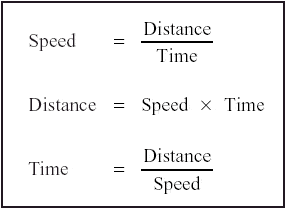
What is the formula to calculate speed?
a)
S = t/d
b)
S = d/t
c)
S = d x t
d)
S = t x d
28.

A runner races in the 100 meter dash. It takes her 10 seconds to finish. What is her average speed?

a)

10 m/s

b)

1000 m/s

c)

100 seconds

d)

10 seconds

29.
Which of the following is a unit of time?
a)
sec
b)
mi
c)
m/s
d)
km
30.

What is the speed of a bus that travels 250 km in 2 hours?

Formula ?

Answer ?

a)

S= D/T

125km/hr

b)

S= T/D

521km/meters

c)

S=D/T Km/hr

d)

All fo the above

31.
The unit for acceleration is 
a)
m/s2
b)
m/s
c)
m.s2
d)
s/m
32.
a car traveled from rest until it reached 100 m/s in 20 sec so the acceleration is ------m/s2
a)
100
b)
2000
c)
5
d)
50
33.
acceleration depends on --------
a)
velocity only
b)
velocity change and direction
c)
direction only
d)
time
34.
Can be measured in meters per second (m/s)
a)
Distance
b)
Time
c)
Speed
d)
Acceleration
35.
Calculate the average speed (in meter/sec) if a cheetah runs 180 meters in 10 seconds.
a)
198 m/sec
b)
170 m/sec
c)
12 m/sec
d)
18 m/sec
36.
The definition of momentum is
a)
Mass in Motion
b)
The size of an object
c)
The velocity of an object
d)
A comparison between two objects
37.
When the speed of an object is doubled, its momentum
a)
remains unchanged in accord with the conservation of momentum.
b)
doubles
c)
quadruples
d)
decreases
38.
Momentum is a ____________________ quantity
a)
science
b)
scalar
c)
vector
d)
energy
39.
Momentum is a ____________________ quantity
a)
science
b)
scalar
c)
vector
d)
energy
40.
What is the net force?
a)
40 N left
b)
0 N Balalnced
c)
400 N right
d)
40 N right
41.
Momentum is a ____________________ quantity
a)
science
b)
scalar
c)
vector
d)
energy
42.
A rock formed from fragments of other rocks is a(n)
a)
Metamorphic Rock
b)
Sedimentary Rock
c)
Extrusive Rock
d)
Igneous Rock
43.
If heat and pressure inside the Earth cause a rock to melt, the material that formed would be
a)
Metamorphic
b)
Magma
c)
Sedimentary
d)
Igneous
44.
The three groups of rocks are classified by
a)
How they form
b)
Color
c)
Grain size
d)
Chemical Composition
45.
Fossils are only found in
a)
Sedimentary rocks
b)
Foliated Metamorphic rocks
c)
Igneous Rocks
d)
Nonfoliated Metamorphic rocks
46.
This rock was formed by smaller pieces of rock that settled at the bottom of a lake millions of years ago. What type of rock is this?
a)
Sedimentary
b)
Igneous
c)
Metamorphic
47.

Rocks that form from colling magma inside Earth?

a)

Igneous intrusive

b)

Igneous extrusive

c)

Metamorphic foliated

d)

Metamorphic nonfoliated

48.

What does arrow number 1 represent?

a)

heat and pressure

b)

weathering and erosion

c)

melting

d)

cooling and hardens

49.
Which layer formed first?
a)
Rock Layer W
b)
Rock Layer X
c)
Rock Layer Y
d)
Rock Layer Z
50.
Fossils give us evidence about which of the following?
a)
plants and animals that lived long ago
b)
how weathering and erosion break down rocks
c)
the other planets in our solar system
d)
the transfer of energy from one form  to another
51.
Preserved parts or traces of animals and plants that lived in the past
a)
natural gas
b)
imprints
c)
photos
d)
fossils
52.

Which rock layer most likely contains fossils of the most recently evolved organisms?

a)

1

b)

2

c)

3

d)

4

53.
Finding fossils of coral reefs in the Nevada desert provides evidence that:
a)
Nevada used to be much colder than it is today
b)
an ocean once covered what is now Nevada
c)
there was a mistake because no coral reefs exist in deserts
d)
ancient corals used to live on land
54.
The diagram shows fossils in different rock layers. Which of these statements about the age of these fossils is most likely correct?
a)
Fossil A and C are the same age
b)
Fossil B is older than fossil C
c)
Fossils A is older than fossil B
d)
Fossil D is older than fossil C
55.
Which layer is oldest?
a)
A
b)
W
c)
G
d)
Z
56.
What is the correct order of the rock layers from oldest to youngest?
a)
F, E, C, B, A, D
b)
A, B, C, D, E, F
c)
F, E, D, C, B, A
d)
D, F, E, C, B, A
57.

According to the Law of Superposition list the ages of rocks from youngest to oldest.

a)

A,D,B,C

b)

C,B,D,A

c)

B,D,A,C

d)

The Law of Superposition is not seen in the image

58.

Which type of rock forms with intense heat and pressure over time?

a)

igneous

b)

sedimentary

c)

metamorphic

59.
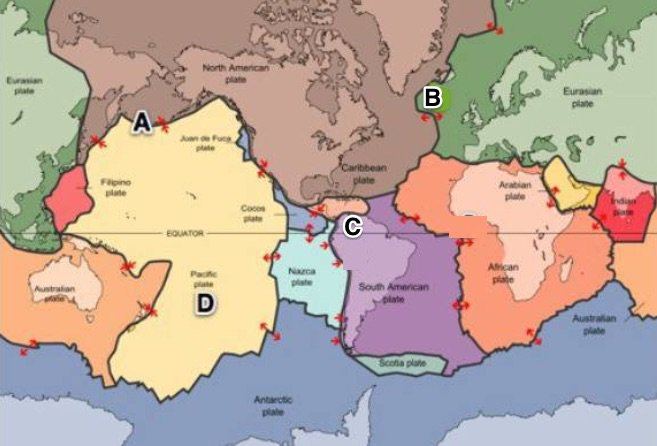
Created by a divergent boundary.
a)
Rocky Mountains
b)
Mariana Trench
c)
Mid Atlantic ridge
60.
Mountains form from ...
a)
plates sliding past one another
b)
collision of plates
c)
plates moving away from each other
61.
Which of the following is where one plate slides under another plate?
a)
submarine zone
b)
divergence zone
c)
subduction zone
d)
lower zone
62.
Associated with transform boundaries.
a)
Volcanoes
b)
mountains
c)
trenches
d)
earthquakes
63.
What happens to temperature as you go deeper in the Earth?
a)
decreases
b)
increases
c)
fluctuates
d)
remains the same
64.
Name the boundary
a)
convergent boundary
b)
divergent boundary
c)
transform boundary
d)
sergent boundary
65.
What is represented by the picture? 
a)
Sea-floor spreading
b)
Pangea
c)
How the continents are arranged today
d)
Volcanoes
66.
Name the boundary
a)
convergent boundary
b)
divergent boundary
c)
transform boundary
d)
sergent boundary
67.
A location where two tectonic plates collide is known as a _________ boundary.
a)
Convergent
b)
Divergent
c)
Transform
d)
Spreading
68.

___________ currents in the Earth's asthenosphere cause plate to shift at their boundaries. This movement also causes earthquakes and volcanic activity.

a)

conduction

b)

convection

c)

radiation

d)

ocean

69.

Where would sea floor spreading most likely occur?

a)

At convergent boundaries (oceanic vs. oceanic)

b)

At convergent boundaries (oceanic vs. continental)

c)

At divergent plate boundaries (oceanic vs. oceanic)

d)

At transform plate boundaries

70.
A break in Earth's crust along which rocks move is called a ________.
a)
plate
b)
rift
c)
fault
d)
breach
71.
_________ are vibrations that travel through Earth carrying the energy released during an earthquake.
a)
Seismic Waves
b)
Rumbles
c)
Plate Tectonics
d)
Convection Currents
72.
The process by which molten material adds new oceanic crust to the ocean floor is called ___________.
a)
Divergent boundary
b)
Sea-floor spreading
c)
Convergent boundary
d)
Renovating 
73.

back and forth motion

a)

S-wave

b)

P-wave

c)

elastic rebounding

d)

L-wave

74.

side to side motion

a)

L-wave

b)

S-wave

c)

P-wave

d)

focus

75.

where quake begins on surface

a)

epicenter

b)

joint

c)

fault

d)

focus

76.
This famous transform fault is located in the western United States creates significant earthquake activity for California
a)
New Madrid
b)
Denali Fault
c)
Ramapo Seismic Zone
d)
San Andreas
77.
Which travels fastest, always being the first detected by seismic stations?
a)
P waves
b)
S waves
78.
Many earthquakes happen along the borders of...
a)
Countries
b)
Tetonic Plates
c)
Climate Zones
d)
None of the above.
79.

Which of the following describes the height of a transverse wave?

a)

frequency

b)

trough

c)

crest

d)

amplitude

80.

As wavelength increases, frequency decreases, with frequency decreasing, energy increases.

a)

True

b)

False

c)

Insufficient data

81.

Xrays and Gamma Rays have the highest frequencies, therefore, highest energies.

a)

True

b)

False

82.

Which of the following occurs as a light wave bends when it passes from one medium into another?

a)

constructive interference

b)

refraction

c)

destructive interference

d)

reflection

83.

Newton’s prism experiments showed that white sunlight is made up of

a)

the full electromagnetic spectrum.

b)

only blue light.

c)

all the colors of the visible spectrum.

d)

only the longest wavelengths.

84.

High frequency in EM waves equals

a)

high energy and short wavelength

b)

high energy and long wavelength

c)

low energy and short wavelength

d)

low energy and long wavelength

85.
Which of the following provides stored energy to run the circuit?
a)
Battery
b)
Light Bulb
c)
Switch
d)
Wire
86.
Which kinds of materials make good conductors?
a)
Fabric
b)
Metal
c)
Plastic
d)
Wooden
87.

Which of the following is an insulator?

a)

aluminum foil

b)

copper penny

c)

piece of string

d)

wooden craft sticks

88.
A light bulb in a circuit transfers energy into 
a)
Motion
b)
heat and light
c)
sound and light
d)
light
89.

How can it be explained that someone's hair can stick to a balloon?

a)

There is static electricity.

b)

There is too much dust in the air.

c)

The person needs to wash his hair.

90.

Opposite charges _______________.

a)

attract

b)

repel

c)

nothing changes

91.

The flow of electric charge in a circuit is called _______.

a)

Heat

b)

Sound

c)

Electric Current

d)

Magnetic

92.

Identify the part of the circuit that is labeled 1.

a)

battery

b)

wire

c)

switch

d)

bulb

93.

Identify the part of a circuit that is labeled 3.

a)

battery

b)

wire

c)

switch

d)

bulb

94.

If the light is on, the circuit is _________________.

a)

closed

b)

open

95.

Mahra finds that all of the electric cords in her school are covered with plastic. Why is it important to cover the electric cords with plastic?

a)

Plastic is an insulator.

b)

Plastic is a conductor.

c)

Plastic is strong.

d)

Plastic will melt.

96.

A north pole and a south pole will attract each other.

a)

True

b)

False

97.

Which of the following objects cannot be moved by a magnet?

a)

A paper clip

b)

A nail

c)

A toothpick

d)

A staple

98.

Earth acts like a giant magnet because its center is made up MOSTLY of

a)

Granite

b)

Limestone

c)

Iron

d)

Nickel

99.
True or False: All metals stick to magnets.
a)
True
b)
False
100.

Where is the force of attraction the strongest on a magnet?

a)

At the poles.

b)

In the middle of the magnet.

c)

Above the magnet.

d)

Below the magnet.

101.
Which of the following is a sign that a chemical reaction has occurred?
a)
change in shape
b)
melting
c)
formation of a gas
d)
dissolving
102.
Is melting butter for popcorn a chemical or physical change?
a)
chemical
b)
physical
103.
Which of the following is NOT an example of a physical change?
a)
crumpled paper
b)
pencil sharpening
c)
shrunken clothing
d)
rust
104.
A change where one or more new substances are created.
a)
Physical Change 
b)
Chemical Change 
105.
Which of these is a result of a chemical change?
a)
A mixture
b)
A solution
c)
A new substance
d)
Melting or freezing
106.
A change in phase ...
a)
Chemical Change
b)
Physical Change
107.
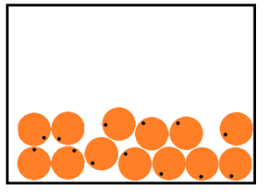
When molecules flow around each other, they are in this phase
a)
solid
b)
liquid
c)
gas
d)
plasma
108.
What takes place when a liquid changes to a gas?
a)
condensation
b)
melting
c)
evaporation
d)
freezing
109.
What is a group of atoms joined together called?
a)
an atom
b)
molecule
c)
matter
d)
compound
110.
What are the reactants of cellular respiration?
a)
glucose & carbon dioxide
b)
glucose & oxygen
c)
water & oxygen
d)
water & carbon dioxide
111.
The purpose of cellular respiration is to 
a)
make water
b)
make ATP
c)
make glucose
d)
make  oxygen
112.
In which way are photosynthesis and cellular respiration different?
a)
Cellular respiration stores ATP, while photosynthesis releases ATP.
b)
Cellular respiration produces oxygen, while photosynthesis uses oxygen.
c)
Photosynthesis releases energy, while cellular respiration stores energy.
d)
Photosynthesis uses carbon dioxide, while cellular respiration produces carbon dioxide.
113.
What is the correct equation for cellular respiration?
a)
6O2 + C6H12O6 -> 6CO2 + 6H2O + Energy
b)
6O2 + C6H12O6 + Energy -> 6CO2 + 6H2O
c)
6CO2 + 6H2O -> 6O2 + C6H12O6 + Energy
d)
6CO2 + 6H2O + Energy -> 6O2 + C6H12O6
114.
An organism that needs to eat other organisms to obtain energy is known as a:
a)
Autotroph
b)
Producer
c)
Consumer
d)
Mutualist
115.
What does a food web represent?
a)
All connections of energy flow throughout all organisms in a habitat.
b)
The specific ways that mutualism is carried out.
c)
A single pathway or energy flow between organisms. 
d)
How carnivores get their food. 
116.
relationship in which two species live closely together
a)
resource
b)
mutualism
c)
succession
d)
symbiosis
117.
The rabbit in this food web would be considered a:
a)
Decomposer
b)
Producer
c)
Secondary Consumer
d)
Primary Consumer
118.
The amount of energy that usually transfers from one trophic level to the next...
a)
10%
b)
20%
c)
80%
d)
50%
119.
The nonliving aspects of an ecosystem.
a)
Abiotic factors
b)
Biotic factors
120.
A collection of organisms that make up a community as well as all of the nonliving aspects of the environment.
a)
Population
b)
Community
c)
Habitat
d)
Ecosystem
121.
 plants that convert energy from the sun
a)
decomposer
b)
primary consumer
c)
secondary consumer
d)
producer
122.
What are the Abiotic factors in this image? 
a)
water, sunlight, dirt, air
b)
birds and plants
c)
birds, water, dirt
d)
plants, water
123.

Barnacles are animals that cannot move. In order to get food, they attach to whales and catch any floating plankton in the water. The whale is neither helped nor harmed in the interaction. What type of symbiosis is this?

a)

Mutualism

b)

Commensalism

c)

Parasitism

d)

Neutralism

124.

In the wild, some alligators gets their teeth cleaned by birds. The birds gets their food from the alligators' teeth.

What type of symbiosis is this?

a)

Mutualism

b)

Commensalism

c)

Parasitism

d)

Neutralism

125.

In an ecosystem, there are populations of moose, rabbits, grass, and pine trees. Suddenly, a fire blazes through the area, which kills all of the populations. As the months go on, new species of grass begin to take root. This attracts animals, and eventually the ecosystem is restored.


What type of ecological succession happened?

a)

Primary succession

b)

Secondary succession

c)

Tertiary succession

d)

None of the above

126.
Members of a species in a defined area
a)
Ecosystem
b)
community
c)
biodiversity
d)
population
127.
A collection of organisms that belong to different populations but all live in the same area and interact with one another.
a)
Population
b)
Ecosystem
c)
Community
d)
Ecosphere
128.

What would happen within a few months after the formation of a volcanic island?

a)

pioneer species would grow

b)

no pioneer species would grow

c)

trees and large plants would grow

d)

rich, organic soil would be present

129.
What does every food chain start with? (Even if it's not drawn or written there!)
a)
producers
b)
sun
c)
consumer
d)
decomposers
130.
What does every food chain start with? (Even if it's not drawn or written there!)
a)
producers
b)
sun
c)
consumer
d)
decomposers
131.
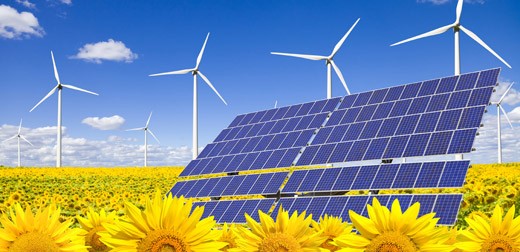
__________ is an energy resource that WILL NOT run out in the next several hundred years.
a)
Renewable Energy Resource
b)
Nonrenewable Energy Resource
132.

Coal is a renewable resource.

a)

True

b)

False

133.

Energy that comes from the sun

a)

Wind

b)

Solar

c)

Renewable energy

d)

Efficient

134.

What are renewable resources?

a)

A limited amount and cannot be replaced in a human life time.

b)

Plastic bags

c)

Coal, oil, and natural gas

d)

Can be replaced in our lifetime through natural processes

135.

Wind is a renewable resource.

a)

True

b)

False