wayground logo

Free Printable Worksheets

Font size

S
M
L
XL
Worksheets

Final exam

Total questions: 141

Worksheet time: 2hrs 56mins

Name
Class
Date
1.
all living and nonliving things in nature
a)
biodiversity
b)
built environment
c)
natural environment
d)
sustainable society
2.
preserves natural resources forfuture generations
a)
biodiversity
b)
built environment
c)
sustainable society
3.
the parts of the world thathumans have made
a)
natural environment
b)
built environment
c)
sustainable society
4.
the variety of life on Earth
a)
biodiversity
b)
natural environment
c)
built environment
5.
the place where an organism lives
a)
natural environment
b)
habitat
c)
built environment
6.
The ______ was the time period when humans began to farm and raise animals.
a)
hunter-gathering period
b)
Industrial Revolution
c)
Agricultural Revolution
7.
Which of the following is not a major requirement for the survival of all living things?
a)
clothes
b)
oxygen
c)
nutrients
d)
energy
8.
The ______ was the time when humans started using machines to produce goods.
a)
scientific period
b)
Agricultural Revolution
c)
Industrial Revolution
9.
_____ is the fair treatment of all people concerning environmental problems.
a)
A sustainable society
b)
Environmental justice
c)
Applied science
10.
A theory may eventually become a ______.
a)
hypothesis
b)
principle
c)
question
11.
Environmental science is a(n) ______________________ because it usesknowledge to solve practical problems.
a)
Earth 
b)
Applied 
c)
Physical 
12.
Overpopulation, overconsumption, pollution, and loss of biodiversity are examples of ______________________.
a)
environmental challenges 
b)
pollution 
c)
envirnomental factors 
13.
Using more resources than the environment can support is known as______________________.
a)
exessive use 
b)
over consumption 
c)
wasteful 
14.
A basic law or truth that has been tested over time is a(n)______________________.
a)
priciple 
b)
theroy 
c)
belief 
15.
Moral principles that guide people’s actions are called ______________________.
a)
compass 
b)
ethics
c)
instincts 
16.
In the scientific method, what is used to test a hypothesis?
a)
control group 
b)
experiemnt 
c)
exam 
17.
What is the process of making sense of the results of an experiment?
a)
publication 
b)
analysis 
c)
communication 
18.
What is being tested in an experiment?
a)
ideas 
b)
hypothesis 
c)
rules 
19.
What is a well-tested hypothesis that explains many scientific observations?
a)
law
b)
principle 
c)
theory 
20.
A(n) ______ is the environment where an organism lives.
a)
diversity 
b)
ecosystem 
c)
EPA 
d)
Earth 
21.
Air pollution is _________________________
a)
the addition of any substance that has harmful or toxic effects to air
b)
the addition of any good substance that benefits air
c)
a chemical reaction
22.
The pattern of air during thermal inversion is
a)
warm- cold- warm
b)
cold- warm- cold
c)
there is no pattern, it is only cold
23.
The Clean Air Act is federal law that regulates levels of air pollution produced from
a)
Transportation and factories
b)
Private homes only
c)
Power plants only
d)
Transportation, factories, power plants, and private homes
24.
How does air pollution move during thermal inversion?
a)
Thermal inversion makes pollution very still
b)
Pollution travels very fast in cold air
c)
There is no pollution during thermal inversion
25.
Two historical events during which smog killed many citizen and made thousands sick...
a)
Donora Fluoride Fog and London Smog
b)
London Smog and Exxon Valdez
c)
China Smog and Fluoride Fog
26.
A common air pollutant that is very dangerous because you cannot see it or smell it
a)
Sulfur Monoxide
b)
Carbon Monoxide
c)
Carbon Dioxide
d)
Nitrogen Oxide
27.
Smog is formed when nitrogen oxide mixes with...
a)
Water
b)
Sunlight
c)
Coal
d)
Other gases
28.
Dust and ash are examples of
a)
Gases
b)
PPM
c)
Particulates
29.
When the air quality is bad, what type of alert do we receive?
a)
Ozone Action Day
b)
Ozone Alert
c)
Air Quality Alert
30.
Which one of these does not belong
a)
Electrostatic precipitator
b)
Mop
c)
Scrubber
d)
Air Filter
31.
Acid Rain has multiple negative effects on the environment, but what does it do that effects our clean air?
a)
Creates erosion
b)
Melts Statues
c)
Kills plants
d)
Harm animals
32.
What type of pollution is the result of a chemical reaction?
a)
Primary pollutant
b)
Secondary Pollutant
c)
Smog
d)
Water pollution
33.
What part of the United States gets the most acid rain?
a)
Northeast
b)
West Coast
c)
Georgia
d)
Miami
34.

Which of the following is an example of a renewable resource?

a)

fossil fuels

b)

oil

c)

biomass

d)

plastic

35.

Which of the following is an example of a Non-renewable resource?

a)

Geothermal

b)

Coal

c)

Hydro

d)

Solar

36.

When there is higher biodiversity

a)

more organisms are likely to die because they can't adapt to environmental changes

b)

there is less diversity

c)

there is more diversity and higher sustainability of life

d)

there is more diversity and lower sustainability of life

37.

How do biodiversity and sustainability work together?

a)

The lower the biodiversity the greater the sustainability

b)

The higher the biodiversity, the less sustainable the ecosystem

c)

The higher the biodiversity, the greater the sustainability

d)

Biodiversity has nothing to do with sustainability

38.

High biodiversity is

a)

having a lot of the same organism

b)

having a few of the same organism

c)

having a lot of variety of different organisms

d)

only having one of each organism

39.

Which of the following can lead to a decrease in biodiversity?

a)

Human activities

b)

Recycling

c)

Irriagtion

40.

Which of the following is not a cause of pollution?

a)

Excess fertilizer use

b)

Over fishing

c)

Burning of fossil fuels

d)

Waste disposal

41.

A species form that supports an entire ecosystem.

a)

Endangered Species

b)

Invasive Species

c)

Keystone Species

d)

Threatened Species

42.

Artificial eutrophication is when a body of water or water system becomes excessively rich with nutrients. What is NOT an example of an effect of eutrophication?

a)

Increase algae growth

b)

Decrease in oxygen levels

c)

Fish dying

d)

Improvement of water quality

43.

What percentage of the Earth's freshwater is usable by humans?

a)

97%

b)

50%

c)

30%

d)

1%

44.

Which organism is in a trophic level that would get most of its energy directly from the sun?

a)

Plant

b)

Bug

c)

Snake

d)

Bird

45.

True or False: As you go up in trophic levels the concentration of mercury in an organism will decrease.

a)

True

b)

False

46.

Which gas makes up 78% of our atmosphere?

a)

oxygen

b)

Carbon dioxide

c)

nitrogen

d)

argon

47.

Which layer of the atmosphere does all weather occur?

a)

exosphere

b)

troposphere

c)

mesosphere

d)

thermosphere

48.

Which layer of the atmosphere helps us by burning up incoming meteors?

a)

exosphere

b)

troposphere

c)

mesosphere

d)

thermosphere

49.

Which layer of the atmosphere contains the ozone layer?

a)

troposphere

b)

thermosphere

c)

methosphere

d)

stratosphere

50.

A compound made of three oxygen atoms is called

a)

acid rain

b)

smog

c)

ozone

d)

carbon dioxide

51.

Which layer of the atmosphere, as identified by the chart, is MOST likely the troposphere?

a)

A

b)

B

c)

C

d)

D

52.

Based on the chart, which layers of the atmosphere have a temperature that decreases as the altitude increases? Check all that apply.

a)

troposphere

b)

stratosphere

c)

mesosphere

d)

thermosphere

53.

Which layer of the atmosphere do we live in?

a)

tropsophere

b)

stratosphere

c)

mesosphere

d)

thermosphere

54.
As you go higher in the troposphere, the temperature _______________.
a)
decreases
b)
increases
c)
stays the same
d)
gets very hot
55.
What is the function of the ozone layer?
a)
to allow UV rays to get to Earth
b)
to block UV rays from getting to Earth
c)
To keep oxygen in
d)
to allow meteors to get to Earth
56.
Where I find clouds.
a)
thermosphere
b)
stratosphere
c)
troposphere
d)
ionosphere
57.
Which layer is the outermost layer?
a)
troposphere
b)
thermosphere
c)
exosphere
d)
mesosphere
58.

How did scientists determine where the layers of the atmosphere are divided?

a)

a change in elements

b)

a change in compounds

c)

a change in temperature

d)

a change in ozone

59.

Which of the following can change climate in the atmosphere

a)

CFC's

b)

Volcanic Eruptions

c)

Sulfur

d)

Meteorite Impacts

60.

The troposphere is heated from below, which drives weather patterns caused by

a)

Convocation Cells

b)

Convection Currents

c)

Jet Streams

d)

Conduction

61.
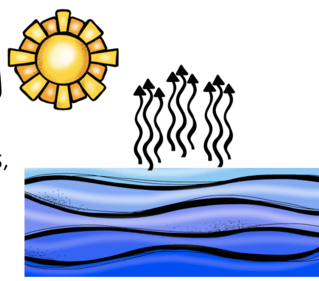
What part of the water cycle does this picture show?
a)
condensation
b)
precipitation
c)
evaporation
d)
transpiration
62.
What is it called when plants give off water vapor as a waste product?
a)
condensation
b)
evaporation
c)
sublimation
d)
transpiration
63.
Evaporation happens when the sun ___________ water and turns it into vapor.
a)
cools
b)
heats up
c)
freezes
d)
lights up
64.
What is the water cycle?
a)
the 3 forms of water
b)
the movement of water on, above, or below the surface of the Earth
c)
when water melts
d)
when clouds form
65.
Where is most water found on Earth?
a)
glaciers
b)
lakes
c)
rivers
d)
oceans
66.

What converts nitrogen gas into a usable form for plants and animals?

a)

bacteria

b)

rain

c)

fungi

d)

car exhaust

67.

The process in which nitrogen circulates and is recycled is called

a)

The nitrogen cycle

b)

The carbon cycle

c)

The water cycle

d)

The phosphorus cycle

68.
Based on this diagram, which of the following can you infer is the chemical formula for gaseous nitrogen?
a)
N
b)
N2
c)
N3
d)
N4
69.
_____ is the conversion of organic nitrogen into ammonia
a)
Nitrogen Fixation
b)
Ammonification
c)
Denitrification
d)
Assimilation 
70.

True or False: Bacteria fix nitrogen from the atmosphere into a form plants can use

a)

True

b)

False

71.
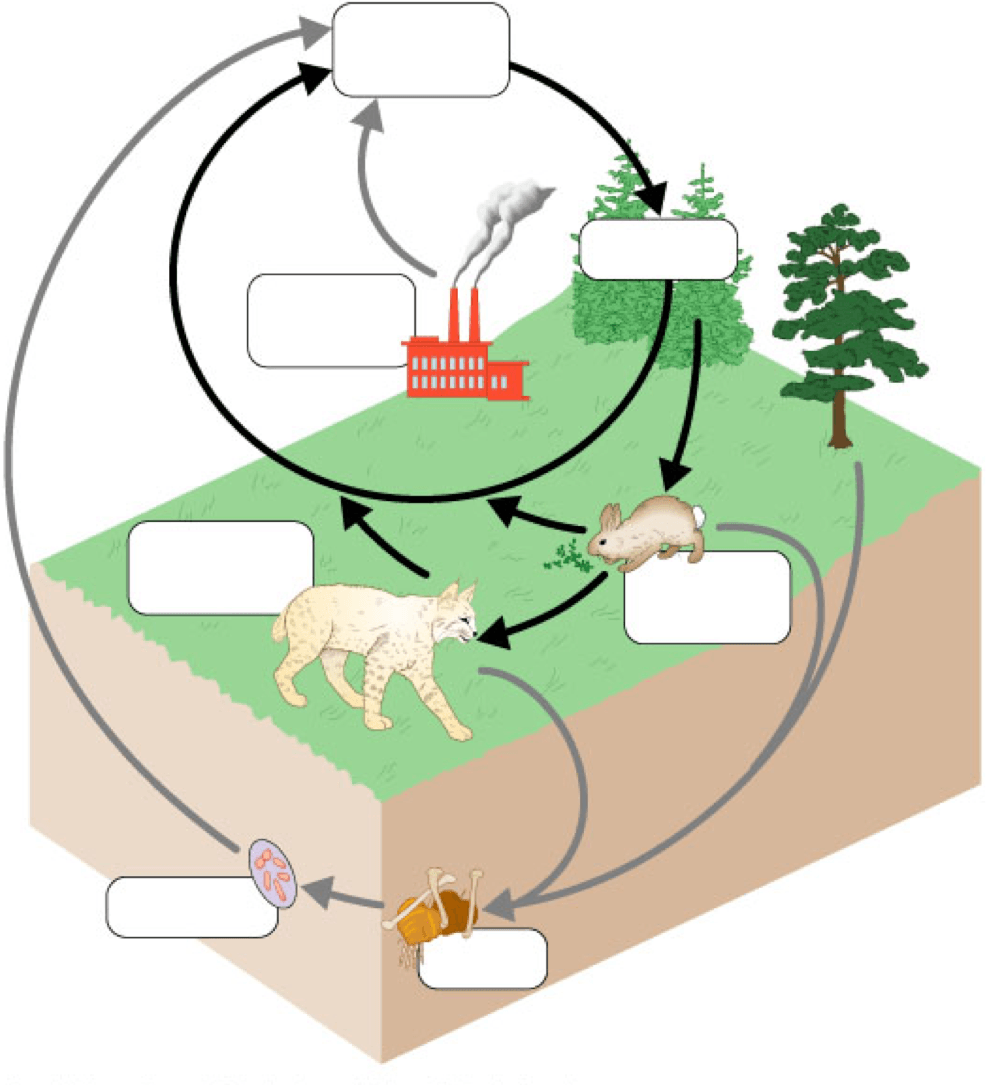
In the carbon cycle, producers take in the gas __
a)
carbon dioxide
b)
oxygen
c)
nitrogen
d)
carbon monoxide
72.
In what process is Carbon transformed into chemical energy?
a)
Photosynthesis
b)
Respiration
c)
Primary Production
d)
Secondary Production
73.

The circulation of the element Carbon among Earth's atmosphere, land, oceans, and organisms is called _____________.

a)

the Carbon Cycle

b)

the Oxygen Cycle

c)

the Carbon dioxide Cycle

d)

the Water Cycle

74.

Plants use ____________________ to make their own food.

a)

Carbon Dioxide

b)

Oxygen

c)

Materials

d)

Gravity

75.

Which of the following is true about the greenhouse effect? you can choose more than one

a)

It is a natural process

b)

It is caused by gasses trap heat from infrared radiation

c)

It makes life on Earth possible

d)

It is the cause of global warming

76.
What part of the water cycle does this picture show?
a)
condensation
b)
precipitation
c)
evaporation
d)
transpiration
77.
What is it called when plants give off water vapor as a waste product?
a)
condensation
b)
evaporation
c)
sublimation
d)
transpiration
78.
Evaporation happens when the sun ___________ water and turns it into vapor.
a)
cools
b)
heats up
c)
freezes
d)
lights up
79.
What is the water cycle?
a)
the 3 forms of water
b)
the movement of water on, above, or below the surface of the Earth
c)
when water melts
d)
when clouds form
80.
Where is most water found on Earth?
a)
glaciers
b)
lakes
c)
rivers
d)
oceans
81.

What converts nitrogen gas into a usable form for plants and animals?

a)

bacteria

b)

rain

c)

fungi

d)

car exhaust

82.

The process in which nitrogen circulates and is recycled is called

a)

The nitrogen cycle

b)

The carbon cycle

c)

The water cycle

d)

The phosphorus cycle

83.
Based on this diagram, which of the following can you infer is the chemical formula for gaseous nitrogen?
a)
N
b)
N2
c)
N3
d)
N4
84.
_____ is the conversion of organic nitrogen into ammonia
a)
Nitrogen Fixation
b)
Ammonification
c)
Denitrification
d)
Assimilation 
85.

True or False: Bacteria fix nitrogen from the atmosphere into a form plants can use

a)

True

b)

False

86.
In the carbon cycle, producers take in the gas __
a)
carbon dioxide
b)
oxygen
c)
nitrogen
d)
carbon monoxide
87.
In what process is Carbon transformed into chemical energy?
a)
Photosynthesis
b)
Respiration
c)
Primary Production
d)
Secondary Production
88.

The circulation of the element Carbon among Earth's atmosphere, land, oceans, and organisms is called _____________.

a)

the Carbon Cycle

b)

the Oxygen Cycle

c)

the Carbon dioxide Cycle

d)

the Water Cycle

89.

Plants use ____________________ to make their own food.

a)

Carbon Dioxide

b)

Oxygen

c)

Materials

d)

Gravity

90.

Which of the following is true about the greenhouse effect? you can choose more than one

a)

It is a natural process

b)

It is caused by gasses trap heat from infrared radiation

c)

It makes life on Earth possible

d)

It is the cause of global warming

91.

What is a food chain?

a)

The flow of energy from one thing to another

b)

The way animals eat each other

c)

The way the sun makes everything

d)

How the plants grow

92.
What is a producer? 
a)
Organism that creates their own food.
b)
Organism that eat other organisms for energy
c)
Organism that eat other dead organisms
93.
What is a consumer? 
a)
Organism that creates their own food.
b)
Organism that eat other organisms for energy
c)
Organism that eat other dead organisms
94.
An animal that eats other animals is a....
a)
carnivore
b)
omnivore
c)
herbivore
d)
decomposer
95.
What animal is on the top of the food chain? 
*Remember Humans are on the top of all food chains because we do not get hunted. 
a)
Grass
b)
Grasshopper
c)
Mouse
d)
Owl
96.
What do Herbivores eat? 
a)
Plants ONLY 
b)
Animals ONLY
c)
Plants AND Animals
97.

What do plants need to make their own food?

a)

Sun, Water, and Animals

b)

Sun, Coke, and Soil

c)

Sun, Water, and Soil

d)

Nothing at all

98.

An example of a predator:

a)

shark

b)

mouse

c)

rabbit

99.

An example of prey:

a)

lion

b)

mouse

c)

shark

100.
Where does the energy start in this food chain?
a)
Plant
b)
Sun
c)
Deer
d)
Wolf
101.

What is a decomposer?

a)
b)
c)
d)
102.
What are animals called in a food chain?
a)
Producers
b)
Consumers
c)
Decomposers
d)
Plants
103.
What are plants called in a food chain?
a)
Producers
b)
Consumers
c)
Decomposers
d)
Scavengers
104.
What is the role of a producer?
a)
Use sunlight to make food
b)
Gain energy from eating other organisms
c)
Keep other species from overpopulating
d)
Breaking down dead stuff 
105.
Which of these organisms would receive energy from the snake?
a)
Plant
b)
Rabbit
c)
Mouse
d)
Hawk
106.
Which type of consumer eats meat and plants?
a)
Herbivores
b)
Carnivores
c)
Omnivores
d)
Plants
107.
True/False
Food webs show you everything an animal eats. Food chains show you one thing.
a)
True
b)
False
108.
Which of these is true about this food web?
a)
The Owl gets its energy from the producer.
b)
The Lion gets its energy only from a wild cat.
c)
The Kite gets its energy from the goat.
d)
The Mouse is most likely to die, several ways.
109.

Is wind a biotic or abiotic factor?

a)

biotic

b)

abiotic

110.

Is soil a biotic or abiotic factor?

a)

biotic

b)

abiotic

111.

Are rocks biotic or abiotic factors?

a)

biotic

b)

abiotic

112.

Is water a biotic or abiotic factor?

a)

biotic

b)

abiotic

113.

Is temperature a biotic or abiotic factor?

a)

biotic

b)

abiotic

114.

Is pH a biotic or abiotic factor?

a)

biotic

b)

abiotic

115.

Is precipitation a biotic or abiotic factor?

a)

biotic

b)

abiotic

116.

Is symbiosis a biotic or abiotic factor?

a)

biotic

b)

abiotic

117.

Is competition within a species a biotic or abiotic factor?

a)

biotic

b)

abiotic

118.

Is predation a biotic or abiotic factor?

a)

biotic

b)

abiotic

119.

Is disease a biotic or abiotic factor?

a)

biotic

b)

abiotic

120.

Are producers biotic or abiotic factors?

a)

biotic

b)

abiotic

121.

Are consumers biotic or abiotic factors?

a)

biotic

b)

abiotic

122.

Are decomposers biotic or abiotic factors?

a)

biotic

b)

abiotic

123.

Is sunlight a biotic or abiotic factor?

a)

biotic

b)

abiotic

124.

Abiotic factors are ___________.

a)

non-living parts of an ecosystem

b)

living parts of an ecosystem

c)

things that once were alive, but now are dead

d)

not important parts of ecosystems.

125.

Biotic factors are ___________.

a)

non-living parts of an ecosystem

b)

living parts of an ecosystem

c)

things that once were alive, but now are dead

d)

not important parts of ecosystems.

126.

An ecosystem is made up of __________.

a)

living things only

b)

non-living things only

c)

both living and non-living things

127.

T/F: Abiotic factors are an unimportant part of ecosystems.

a)

true

b)

false

128.

What does the word root 'bio-' mean?

a)

living

b)

dead

c)

science

d)

study

129.

What does ecological footprint measure?

a)

How quantity of natural resources humans need compared to the earth's capacity to provide those resources

b)

The size of cities across the world

c)

The amount of fossil fuels that are burned for energy

d)

The shoe size of the average human

130.

How is ecological footprint measured?

a)

In terms hectares of land required by each person in a selected area for food, water, transport, housing and waste management

b)

In terms of number of years it would take before resources ran out

c)

In terms of the average life expectancy of a nation

d)

In terms of shoe size, e.g. women's 9

131.
Which is NOT a way to decrease your ecological footprint?
a)
Eating less meat and processed foods
b)
Walking or biking to school
c)
Turning off electricity and water when you're not using it. 
d)
Driving a large car around for fun.
132.

Which one of the following are Greenhouse Gases

a)

Carbon dioxide

b)

Oxygen

c)

Hydrogen

d)

Helium

133.

Which is NOT a way to decrease your ecological footprint?

a)

Eating less meat and processed foods

b)

Walking or biking to school

c)

Turning off electricity and water when you're not using it.

d)

Using cars for short journeys

134.

What is urban sprawl?

a)

The sprawl of people from rural areas to urban areas.

b)

The main city centre in an urban area.

c)

The spreading of rural areas into surrounding rural areas to accommodate the need for extra land space due to a rise in ecological footpint.

d)

The spreading of urban areas into surrounding rural areas to accommodate an expanding population.

135.

What kinds of resources make up your ecological footprint?

a)

waste production

b)

water and energy use

c)

food and shelter

d)

clothing and transportation

e)

All of the above

136.

Purchasing fewer clothes could reduce your carbon footprint by:

a)

saving you money which would make you more financially secure

b)

leading to less land being cleared to grow fibre crops such as cotton

c)

reducing the fuel required to transport clothes from overseas

d)

setting a good example for your friends so that you can show them how good a person you are

137.
Which of the following can be described as the amount of consumption and waste production of an entire country?
a)
Agricultrual Footprint
b)
Transportation Footprint
c)
Urban Footprint
d)
National Footprint
138.
Which of the following can be described as the effect of food production on the environment?
a)
Agricultural Footprint
b)
Transportation Footprint
c)
Urban Footprint
d)
National Footprint
139.

Which of the following is a concern of deforestation? Check all that apply.

a)

It can have negative effects on soil quality.

b)

It can raise carbon dioxide levels by reducing the number of trees that can remove it from the atmosphere.

c)

It can compromise the availability of fresh water.

d)

It can lower Carbon dioxide levels.

140.

According to this image, in which continent does the ecological footprint exceed capacity by the largest amount?

a)

Europe

b)

North America

c)

South America

d)

Australia

141.

Why Should I pass you?

4 lines