wayground logo

Free Printable Worksheets

Font size

S
M
L
XL
Worksheets

Biology Summary Quiz

Total questions: 145

Worksheet time: 3hrs 47mins

Name
Class
Date
1.

The surface area of a cell is

a)

the total amount of space taken up by a cell

b)

the area of a cell

c)

the outer surface of the cell, the cell membrane

d)

a comparison between the surface area and the volume of the cell

2.

As a cell grows larger the SA:V of that cell

a)

increases

b)

decreases

c)

does not change

d)

changes proportionately

3.

The _______________ grows faster than the _________________ when a cell grows

a)

surface area , volume

b)

cytoplasm , membrane

c)

membrane , cytoplasm

d)

volume , surface area

4.

Multicellular organisms overcome the problem of SA:V by

a)

shrinking as they get older

b)

growing really large

c)

dividing into many cells

d)

having many small cells that all have a different role, but work together to allow function

5.

Diffusion is

a)

movement of molecules across a plasma membrane from a high concentration to a low concentration along a concentration gradient

b)

movement of larger molecules dragged through channels within the membrane from a high concentration to a low concentration along a concentration gradient

c)

movement of molecules through channels within the membrane from a low concentration to a high concentration against the concentration gradient

d)

movement of water molecules across a plasma membrane from a high concentration to a low concentration along a concentration gradient

6.

Why are cells microscopic in size?

a)

they need to be able to hide

b)

they need to maximise their SA:V to ensure they are efficiently supplied with nutrients so they can survive

c)

they want to minimise their surface area

d)

they need to minimise their SA:V to ensure they are efficiently supplied with nutrients so they can survive

7.

Surface area-to-volume ratios affect the ability of a biological system to

a)

obtain necessary resources and eliminate waste product

b)

exchange chemicals and energy with the environment

c)

acquire or dissipate thermal energy

d)

A and B

e)

all of the above

8.

Which of the following structures is ALWAYS found in both eukaryotic and prokaryotic cells?

a)

nucleus

b)

mitochondria

c)

ribosomes

d)

cell wall

9.

PROKARYOTIC cells do NOT have

a)

membrane bound organelles

b)

cell membrane

c)

DNA

d)

ribosomes

10.

Endosymbiotic Theory is the idea that ______ cells could have evolved from_____cells

a)

prokaryotic, eukaryotic

b)

eukaryotic, animal

c)

prokaryotic, plant

d)

eukaryotic, prokaryotic

11.

Which statement represents and accurate comparison between prokaryotic and eukaryotic cells?

a)

Prokaryotic cells are larger than eukaryotic cells.

b)

Prokaryotic cells have membrane bound organelles, eukaryotic cells do not.

c)

Prokaryotic cells are members of protista and fungi kingdoms, eukaryotic cells are members of archaea and bacteria kingdoms.

d)

Prokaryotic cells contain spiral DNA and no nucleus, eukaryotic cells contain a nucleus and linear DNA.

12.

Which is the most significant difference between a prokaryotic and a eukaryotic organism?

a)

A prokaryotic cell is complex, while a eukaryotic cell is simple.

b)

A prokaryotic cell is multicellular, while all eukaryotic cells is unicellular.

c)

A prokaryotic cell requires oxygen, while an eukaryotic cell requires carbon dioxide.

d)

A prokaryotic cell has a nucleoid, while an eukaryotic cell contains a nucleus.

13.

What is the shape of this bacteria?

a)

cocci

b)

spirillum

c)

bacillus

d)

hexagon

14.

What is the whip-like 'tail' that bacteria use for movement?

a)

Cell wall

b)

Ribosome

c)

Flagella

d)

Cytoplasm

15.

Which is not one of the parts of the Cell Theory?

a)

All organisms are made of one or more cells

b)

The cell is the basic unit of all organisms

c)

Cells cannot divide and create new cells

d)

All cells come from existing cells

16.

What characteristic do all algae share?

a)

They are autotrophs.

b)

They live in colonies.

c)

They are unicellular.

17.
What is the single most important characteristic that separates protists from bacteria and viruses?
a)
They are prokaryotic.
b)
They are eukaryotic.
c)
They eat in multiple different ways.
18.

A process by which bacteria reproduce asexually

a)

binary fission

b)

cellular respiration

c)

pasteurization

d)

decomposers

19.

The process of breaking down food to release energy

a)

Photosynthesis

b)

ribosomes

c)

Binary fission

d)

Cellular Respiration

20.
Plasmids are found in bacteria. Scientists use plasmids to 
a)
Insert eukaryotic  genes into bacteria
b)
insert eukaryotic genes into humans
c)
insert clones into the parent organism
21.
T6- Which technology below would probably be the most important to a person who had diabetes and had to take insulin every day? 
a)
using recombinant DNA to produce human hormones from bacteria
b)
 testing parents for genetic disorders before they have children
c)
engineering fruits and vegetables that resist insects and other pests
d)
C. developing ways to identify criminals through DNA fingerprinting
22.
T6- How do scientists cut DNA into smaller strands?
a)
restriction enzymes
b)
scissors
c)
ligase
d)
agarose
23.
_________ DNA is created by using the ______ from a bacteria and splicing a section of DNA into it.
a)
recombinant, plasmid
b)
Cloning, ribosome
c)
transcription, translation
d)
cumulus, mitochondria
24.
Fermentation involves
a)
aerobic respiration
b)
anaerobic respiration 
25.
What is a disadvantage of fermentation as a process? 
a)
It produces too much ATP
b)
It only produces 2 ATP
c)
It occurs in the absence of oxygen
d)
It is only for quick bursts of energy
26.
Lactic acid fermentation occurs in your muscles after a workout because your cells are struggling to get
a)
Glucose
b)
Sunlight
c)
Oxygen
d)
Water
27.
How are lactic acid and alcoholic fermentation similar?
a)
They have the same products
b)
They have the same reactants
c)
They both require oxygen
d)
They occur in the same organisms
28.
Which of the following situations is MOST HARMFUL to an ecosystem's food web or food chain?
a)
introduction of a similar producer
b)
loss of one of the top consumers
c)
increase in the population of producers
d)
disease killing the producers
29.
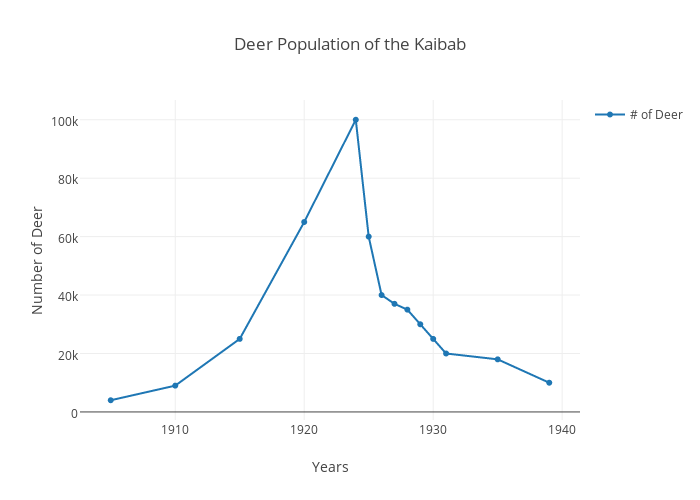
The graph above shows the variation in the deer population in the Kaibab Plateau from 1905 to 1939. Between 1907 and 1923, the natural predators of deer were eliminated from the area by hunters. What was the most likely reason for the decline in the deer population after 1924?
a)
The deer stopped competing for resources because they had no predators.
b)
The increased number of deer led to increased competition for resources.
c)
A large number of deer left the region in search of new predators.
d)
The removal of predators caused fewer resources to be available to the deer.
30.
In a particular habitat, owls eat mice and mice eat grass. If the owl population suddenly grows, then most likely
a)
the number of mice will decrease and the amount of grass will not change.
b)
the number of mice will increase and the amount of grass will increase.
c)
the number of mice will increase and the amount of grass will not change.
d)
the number of mice will decrease and the amount of grass will increase.
31.
Which habitat exhibits the greatest biodiversity?
a)
A habitat with 15 different species with about 300 individuals each
b)
A habitat with 10 different species with about 75 individuals each
c)
A habitat with 4 different species with about 150 individuals each
d)
A habitat with only one species with about 2000 individual
32.
What is the MOST likely consequence if a fungal disease killed the grass in this WOODLAND ECOSYSTEM?
a)
Only the rabbits would be affected, because they are the ones who eat the grass.
b)
The blueberry bush would begin to grow wild, because it would have more space to grow.
c)
Nothing would happen; the animals would eat something else.
d)
The ecosystem would most likely be disrupted, because the grass is one of its primary producers
33.
Cattle egrets forage (feed) in fields among cattle. The egret gets easy access to flying insects stirred up by the cattle, and the cattle don't care if they are there or not.
a)
mutualism
b)
commensalism
c)
competition
d)
parasitism
34.

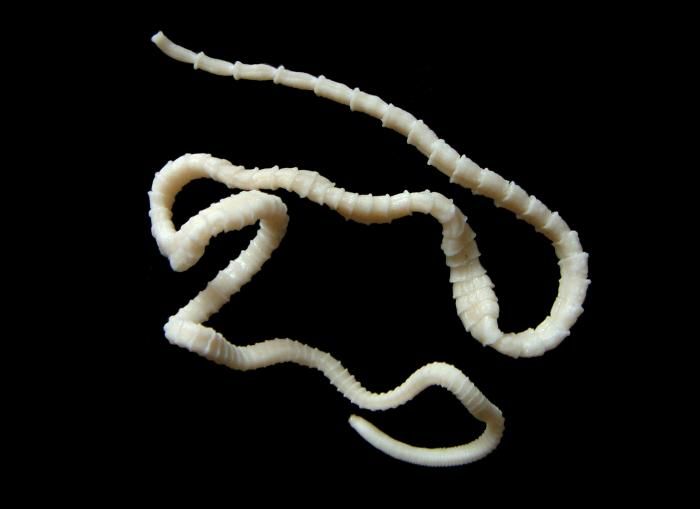
A tapeworm lives in the intestine of a cat absorbing nutrients through its skin. A tapeworm and a cat have this type of relationship.

a)

mutualism

b)

parasitism

c)

commensalism

d)

competition

35.
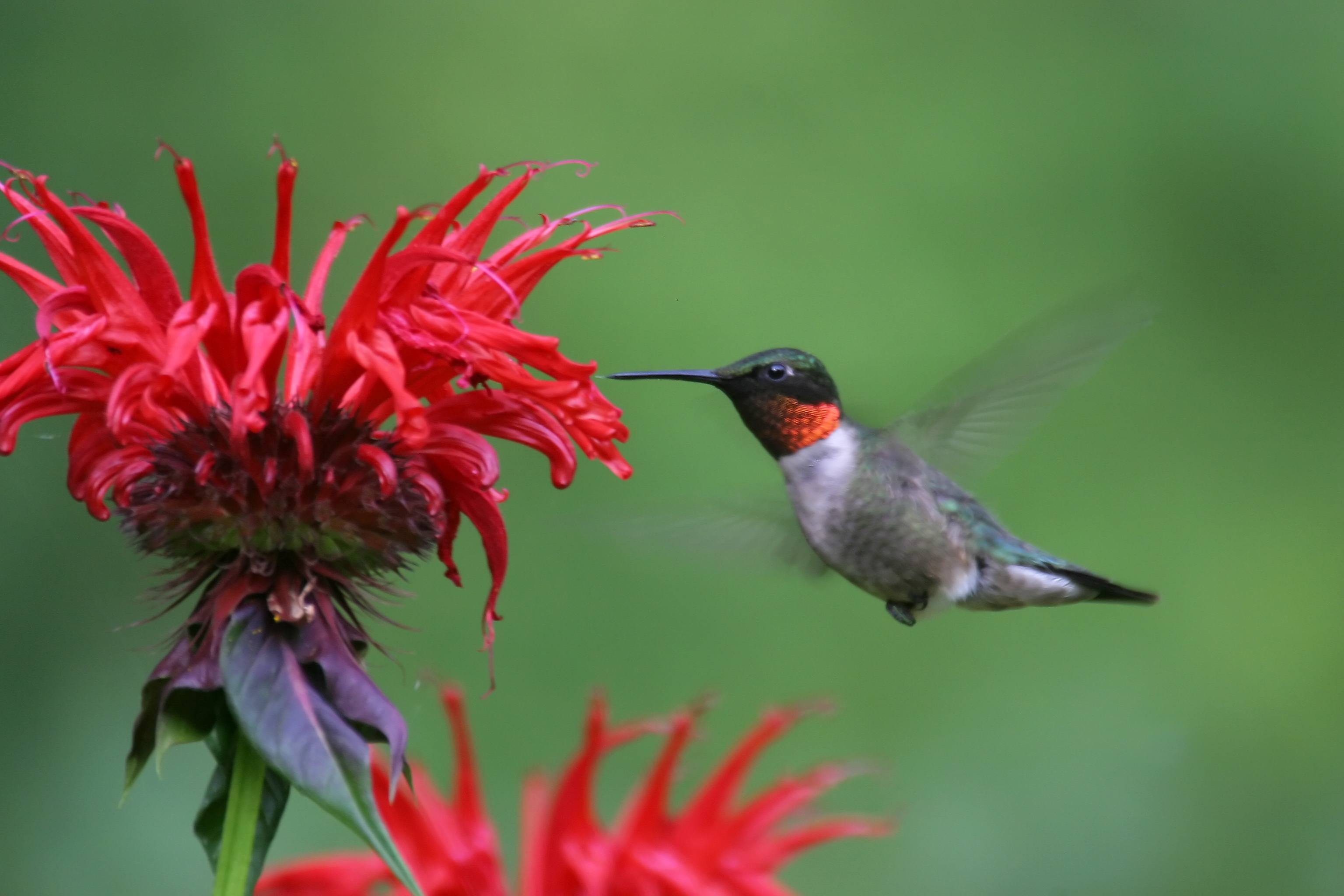
What type of symbiosis?  Hummingbirds feed on nectar from flowers.  The flowers are pollinated by hummingbirds as they move from flower to flower.
a)
commensalism
b)
mutualism
c)
parasitism
d)
predation
36.
The efficiency of energy transfer from a lower trophic level to the next highest level is roughly
a)
1%
b)
10%
c)
100%
d)
1000%
37.
In the energy pyramid here, how much of the energy in each level gets lost as heat or used by the organism for survival?
a)
80%
b)
90%
c)
10%
d)
20%
38.
The arrows in a food chain or web represents what?
a)
They point to the organism that is being eaten.
b)
It shows how sunlight flows within an ecosystem.
c)
They show what direction the energy is flowing between organisms. 
d)
They represent how water is transferred within a habitat.
39.

According to the food web, what are the predator-prey relationships in the ecosystem? Select all correct answers.

a)

Hawk & Rabbit

b)

Hawk & Snake

c)

Snake & Rabbit

d)

Rabbit & Grass

40.

Why is "A" less biodiverse than "B"?

a)

Image "A" is more biodiverse.

b)

Image "A" has many corn plants and this makes it have high "rich" biodiversity.

c)

Image "A" has a lot more plants than image "B"

d)

Even though "A" has a lot of corn plants they are all the same species and makes this a low "poor" biodiverse area.

41.

Species that are clearly critical to the functioning of an ecosystem are known as

a)

biodiversity

b)

keystone species

c)

main species

d)

native species

42.

Describes differences in DNA among individuals of a population or species.

a)

Subspecies

b)

Genetic Isolation

c)

Species Diversity

d)

Genetic Diversity

43.

Groups of different populations that live in a given area and interact are called a(n)...

a)

Community

b)

Colony

c)

Population

d)

Ecosystem

44.

Which statement best describes the relationship between species A and B?

a)

Species A is the prey of Species B

b)

Species A is a parasite of Species B

c)

Species A is a consumer and B is a producer

d)

Species A and B has a mutualistic relationship

45.

What is required for a trait to be an adaptation

a)

it must look cool

b)

it must help to survive and reproduce

c)

it must create more offspring

d)

it must create competition

46.

A sea worm will emerge out of its tube during high tide to find food. What type of adaptation is this?

a)

physical

b)

social

c)

behavioral

d)

physiological

47.

A clapper rail (bird) has a long bill to probe for food in the mud. What type of adaptation is the long bill?

a)

physical

b)

social

c)

behavioral

d)

physiological

48.

An angler fish produces light to attract prey. Producing light is what type of adaptation

a)

physical

b)

social

c)

behavioral

d)

physiological

49.

Ribbed Mussels have a shell to prevent from dehydration. What type of adaptation is the shell?

a)

physical

b)

social

c)

behavioral

d)

physiological

50.

what is an adaptation?

a)

a change in behavior or physical aspect of an organism in order to be better suited to survive in a particular environment.

b)

a change that an organism quickly develps to survive

c)

a unique characteristic that makes an organsism more dominant

d)

a shift in an organisms behavior

51.

Adapatation are caused by

a)

natural selection

b)

harsh environmets

c)

unique organisms

d)

evolution

52.

Adapatations lead to...

a)

Unique organisms

b)

Evolution

c)

Mutations

d)

Stronger Organsisms

53.

what would an animal in the desert most likely do to stay cool?

a)

lay underneath the sun

b)

Drink a lot of water

c)

eat succulentsthat are high in water content

d)

stay in a burrow during the hottest times of day

54.
a)

Physiological

b)

Structural

c)

Behavioral

55.
a)

Physiological

b)

Structural

c)

Behavioral

56.
a)

Physiological

b)

Structural

c)

Behavioral

57.
Identify the phase:
a)
Metaphase I
b)
Metaphase II
c)
Anaphase I
d)
Anaphase II
58.
The fertilized egg is termed a/an _____.
a)
gamete
b)
allele
c)
homolog
d)
zygote
59.

Is the following cell diploid or haploid?

a)

Diploid

b)

Haploid

60.
In sexual reproduction, chromosome reduction is necessary to ___.
a)
ensure that all offspring have the correct diploid number of chromosomes
b)
ensure that all offspring have the correct haploid number of chromosomes
c)
ensure that all daughter cells are identical
61.

1n indicates that the cell is ____.

a)

Diploid

b)

Haploid

62.
What is the name of the step found above?
a)
Interphase
b)
Prophase I
c)
Metaphase I
d)
Anaphase I
63.
What type of cells does meiosis produce? 
a)
2 Genetically identical cells
b)
2 Genetically different cells
c)
4 genetically identical cells
d)
4 genetically different cells
64.
What happens to a cells DNA amount at the end of TelophaseI/cytokinesis I?
a)
DNA/ genetic material stays the same amount
b)
DNA/genetic material is reduced in half
c)
DNA/genetic material is doubled
d)
There is NO DNA/genetic material
65.
A human being has a somatic cell that has 46 chromosomes.  What is the haploid number found in a gamete?
a)
23
b)
46
c)
69
d)
92
66.

The diagram below represents a change that occurred in a pair of chromosomes during the formation of an egg cell. The alteration that occurred will most likely be passed on to every cell that develops from the egg cell. Why would this type of alteration result in offspring with combinations of traits that differ from those found in either parent?

a)

It converts sex cells into body cells.

b)

It results in the formation of diploid gametes.

c)

. It results in new combinations of genes on each chromosome.

d)

It changes the chromosome number of the body cells that develop from the egg cell.

67.
The diagram below represents a cell process. Which statement regarding this process is correct?
a)
Cell contains the same genetic information that cells and contain.
b)
Cell has DNA that is only 50% identical to cell B.
c)
Cell has DNA that is only 75% identical to cell B.
d)
Cells A, B, and contain completely different genetic information.
68.
The diagram below represents a microscopic structure observed during cell division. Which parts of the structure are indicated by arrows A and B, respectively?
a)
centriole and tetrad
b)
homologous chromosome and spindle fiber
c)
homologous chromosome and spindle fiber
d)
chromatid and centromere
69.
Some variation must be present in a population in order for natural selection to take place. These variations arise from mutations in the DNA and
a)
sorting of chromosomes during sexual reproduction
b)
combining of chromosomes during organ development
c)
changing of chromosomes during cloning
d)
removal of chromosomes during selective breeding
70.

What is the first checkpoint of the cell cycle?

a)

Mitosis checkpoint

b)

G1 checkpoint

c)

G2 checkpoint

71.

Name the 3 checkpoints of the cell cycle

a)

Anaphase checkpoint, mitosis/metaphase checkpoint, and telophase checkpoint

b)

Interphase checkpoint, S phase checkpoint, and M phase checkpoint

c)

G1 checkpoint, G2 checkpoint, and S phase checkpoint

d)

G1 checkpoint, G2 checkpoint, and mitosis/metaphase checkpoint

72.
What causes genetic variation in meiosis?
a)
chromosomes lining up
b)
crossing over of chromosomes
c)
separation of chromosomes
d)
chromosomes pulling apart
73.
What kind of cells are made in MEIOSIS?
a)
Haploid cells
b)
Diploid Cells
c)
Skin Cells
d)
Liver Cells
74.
If the Diploid number of Carrots is 18, the haploid number is
a)
18
b)
9
c)
27
d)
36
75.
The process of crossing over occurs in what phase of meiosis?
a)
anaphase 1
b)
prophase 1
c)
prophase 2
d)
telophase 1
76.
The chromosomes that pair up during meiosis, are called __________ chromosomes.  
a)
homozygous 
b)
asexual
c)
homologous
d)
genes
77.
Which cellular process is shown?
a)
meiosis
b)
endocytosis
c)
mitosis
d)
phagocytosis
78.

What is this phase of Mitosis?

a)

Prophase

b)

Metaphase

c)

Anaphase

d)

Telophase

79.

What is this phase of Mitosis?

a)

Prophase

b)

Metaphase

c)

Anaphase

d)

Telophase

80.

Which is used to repair or grow cell?

a)

mitosis

b)

meiosis

c)

replication

d)

transcription

81.
Each identical side of a chromosome is the 
a)
centromere
b)
chromatin
c)
centriole
d)
chromatid
82.
When DNA is in its less coiled, "relaxed," state, between cell divisions, it is called
a)
autosomes
b)
chromatid
c)
chromatin
d)
centromere
83.
The structure that holds two chromosomes together until they separate for cell division is the
a)
chromatid
b)
chromatin
c)
centromere
d)
cytoplasm
84.
Endocytosis is defined as
a)
the movement of large molecules from the inside of the cell to the outisde of the cell using channel proteins. 
b)
the movement of large molecules from the inside of the cell to the outisde of the cell membrane vesciles. 
c)
 the movement of large molecules from the outside of the cell to the inside of the cell using membrane vesciles.
d)
the movement of large molecules from the outside of the cell to the inside of the cell using channel proteins. 
85.
Exocytosis is the movement of
a)
any type of substance from outside the cell to the inside of the cell. 
b)
very large substances from outside the cell to the inside of the cell. 
c)
any type of substance from inside the cell to the outside.
d)
very large substances from inside the cell to the outside.
86.
Active transport _______ and is the movement of a substance from _____ to _____ concentration
a)
requires energy, high to low
b)
requires no energy, low to high
c)
 requires no energy, high to low
d)
 requires energy, low to high
87.
If something goes "along" its concentration gradient it goes from
a)
an area of low concentration to an area of high concentration
b)
an area of high concentration to an area of low concetration
88.
In this image, the cell is using which type of molecular transport?
a)
Osmosis
b)
Diffusion 
c)
Endocytosis
d)
Exocytosis 
89.
A type of active transport that releases particles that were enclosed from a cell when the membrane of the vesicle fuses with that of the cell membrane
a)
Exocytosis
b)
Osmosis
c)
Mitosis
d)
Endoyctosis
90.
A type of active transport that brings particles into a cell when the cell membrane encloses a particle to make a vesicle
a)
Diffusion
b)
Passive Transport
c)
Active Transport
d)
Endocytosis
91.
What gas is released by plants during photosynthesis?
a)
sulfur
b)
carbon dioxide
c)
oxygen
d)
hydrogen
92.
What are the reactants (what's needed) for photosynthesis?
a)
glucose and oxygen
b)
light, water, and carbon dioxide
93.
Which of the following is the correct equation for PHOTOSYNTHESIS?
a)
carbon dioxide + water --> oxygen + glucose
b)
carbon dioxide + glucose + water --> oxygen 
c)
oxygen + water --> carbon dioxide + glucose
d)
glucose+ oxygen ---> water + carbon dioxide 
94.
Which organelle does photosynthesis take place in?
a)
Mitochondrion
b)
Chlorplast
c)
Cytoplasm
d)
Nucleus
95.
This image shows the process of _____.
a)
Respiration
b)
Photosystem I
c)
Dark Reactions
d)
Photosynthesis
96.
What are the reactants of cellular respiration?
a)
glucose & carbon dioxide
b)
glucose & oxygen
c)
water & oxygen
d)
water & carbon dioxide
97.
In which way are photosynthesis and cellular respiration different?
a)
Cellular respiration stores ATP, while photosynthesis releases ATP.
b)
Cellular respiration produces oxygen, while photosynthesis uses oxygen.
c)
Photosynthesis releases energy, while cellular respiration stores energy.
d)
Photosynthesis uses carbon dioxide, while cellular respiration produces carbon dioxide.
98.
What is the correct equation for cellular respiration?
a)
6O2 + C6H12O6 -> 6CO2 + 6H2O + Energy
b)
6O2 + C6H12O6 + Energy -> 6CO2 + 6H2O
c)
6CO2 + 6H2O -> 6O2 + C6H12O6 + Energy
d)
6CO2 + 6H2O + Energy -> 6O2 + C6H12O6
99.
Bacteria exchange genetic information during 
a)
asexual reproduction
b)
binary fission
c)
conjugation
d)
photosynthesis
100.

Bacteria uses binary fission to reproduce.........

a)

True

b)

False

101.
Most of the cell membrane is made of...
a)
Lipids
b)
Carbohydrates
c)
Proteins
d)
Nucleic acids
102.
What forms the channels and pumps in the phospholipid bilayer?
a)
carbohydrates
b)
proteins
c)
hydrophilic heads 
d)
lipids
103.
Which of the following is responsible for getting large or charged (polar) molecules across the cell membrane?
a)
E
b)
B
c)
C
d)
D
104.
Part of the plasma membrane responsible for cell recognition... 
a)
C
b)
E
c)
B
d)
D
105.
The function of the plasma membrane is....
a)
to regulate what enters and leaves the cell.
b)
fight bacteria and viruses that enter the cell.
c)
provide rigid support and protection to the cell.
d)
make sure each cell can move
106.

The monkey would be a

a)

decomposer

b)

producer

c)

primary consumer

d)

secondary consumer

107.

Abiotic factors are nonliving things in an ecosystem. Select the list that only contains abiotic factors.

a)

variety of food sources, annual precipitation, and number of decomposers

b)

the density of predators, water depth, types of parasites

c)

precipitation amount, number of prey species, plant types

d)

water temperature, amount of sunlight, soil type

108.
Which of the following are examples of Postzygotic Reproductive Isolation? 
a)
Behavioral
b)
Low Hybrid Viability
c)
Hybrid Sterility
d)
Both B & C are correct
109.
There are 5 different kinds of Prezygotic Reproductive Isolation. Find the examples in the following list:
a)
Hybrid Sterility
b)
Mechanical
c)
Gametic
d)
Both b & c
110.
Do prezygotic isolating mechanisms occur:
a)
before the zygote
b)
after the zygote
c)
at the same time as the zygote
d)
none of these
111.
What does the term "Hybrid" mean in the context of reproductive isolating mechanisms? 
a)
All offspring
b)
Only male offspring
c)
Offspring with parents from different species
d)
Offspring with parents from the same species
112.

A type of isolation in which two populations become separated by a physical barrier such as a canyon, river, lake, preventing the two populations from interbreeding.

a)

Geographic isolation

b)

Behavioral isolation

c)

Temporal isolation

113.

The females of two species of fruit fly, Drosophila melanogaster and Drosophila simulans release slightly different mating hormones called pheromones, which are used to attract male mates.

a)

Geographic isolation

b)

Behavioral isolation

c)

Temporal isolation

114.

In the Great Lakes region of North America, gray wolves and coyotes are similar species but do not mate because their breeding periods occur at different times of the year.

a)

Geographic isolation

b)

Behavioral isolation

c)

Temporal isolation

115.
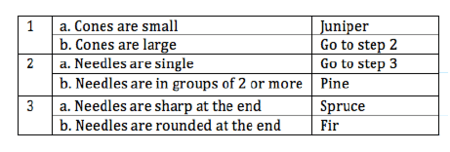
A dichotomous key for trees is provided. Hikers found a tree that has large brown cones and single sharp needles. What species of tree have the hikers found?
a)
Juniper
b)
Pine
c)
Spruce
d)
Fir
116.
The 8 levels of classification, most broad to most specific.
a)
Domain, Genus, Family, Order, Class, Phylum, Kingdom, Species
b)
Domain, Species, Kingdom, Genus, Phylum, Family, Class, Order
c)
Domain, Kingdom, Phylum, Class, Order, Family, Genus, Species
d)
Order, Kingdom, Species, Domain, Phylum, Family, Class, Genus
117.
Term given to describe the 2 name naming system is:
a)
dichotmous key
b)
binomial nomenclature
c)
2 scientific names
d)
binomial key
118.
Using this dichotomous key, identity the name of the circled fish.
a)
band-tail puffer
b)
spotted goat fish
c)
peacock flounder
d)
trumpet fish
119.
The first part of a scientific name is an organism's _______________ and the second part is its ________________.
a)
species, genus
b)
phylum, order
c)
class, spices
d)
genus, species
120.
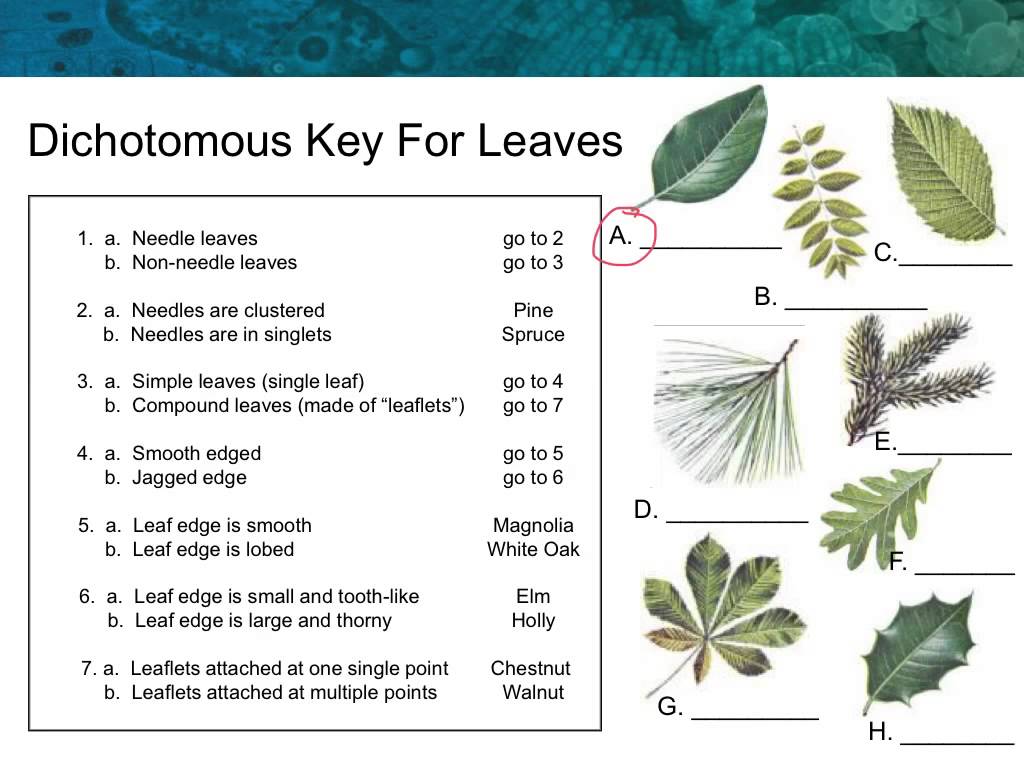
What is a dichotomous key used for in science?
a)
To organize biomes
b)
Classify organisms
c)
Identify bacteria only
d)
None of these
121.
A table of arachnid and insect characteristics is shown. Which characteristic could be used to distinguish between
arachnids and insects?
a)
Jointed legs
b)
Body segments
c)
Presence of eyes
d)
Presence of antennae
122.

What is an increase of biodiversity over time, after a natural or man made disturbance?

a)

ecological recession

b)

climax recession

c)

ecological succession

d)

climax succession

123.

Which is faster: Primary or Secondary Succession?

a)

Primary Succession

b)

Secondary Succession

c)

Both Take The Same Amount of Time

124.

Primary succession occurs in an area that has:

a)

soil

b)

no soil

c)

some soil

d)

none of these

125.

___ are the first organisms to colonize an area and begin the process of ecological succession.

a)

foundational organisms

b)

introductory organisms

c)

primary organisms

d)

pioneer species

126.

What is an example of an area that is likely to undergo primary succession?

a)

Glaciers melt and leave exposed rock

b)

Plants die from drought and decompose

c)

Land is bulldozed and soil remains

127.

What is the main difference between primary and secondary ecological succession?

a)

Primary begins WITHOUT soil; Secondary begins WITH soil

b)

Primary is the first state and secondary is the second stage

c)

Primary builds plant community; secondary builds animal community

d)

Primary begins WITH soil; Secondary begins WITHOUT soil

128.
After a forest fire, an ecosystem would start regrowth through -
a)
primary succession
b)
secondary succession
c)
climax community
d)
limiting factors
129.

Which of the following best describes primary succession?

a)

Volcano wipes out ecosystem that gradually grows back from ash covered soil

b)

Volcano creates a new island of rock that must break down to form an ecosystem

c)

Forest fire burns down forest that must bounce back over time

d)

Tornado destroys a crop that must slowly grow back over time.

130.
This mechanism of evolution occurs when individuals migrate between populations.
a)
Extinction
b)
Gene flow
c)
Genetic drift
d)
Natural Selection
131.
A virus killed most of the seals in the North Sea (e.g. dropped the population from 8000 to 800).  In an effort to help preserve the species, scientists caught 20 of the remaining seals and used them to start a new population in the northwest Pacific Ocean.  Which of the following statements would accurately describe the new   population?  
a)
The new seal population is genetically less diverse than the original population 
b)
The new seal population is genetically more diverse than the original population
c)
There is equal genetic variety compared  to the original population 
d)
None of the answers
132.
Which of the following is an example of the bottle neck effect?
a)
Bald Eagles are hunted until near extinction, population recovers.
b)
Small group of iguanas floats to an island, starts a new population.
c)
Red fox pups are more likely to survive in a snowy environment if they are born white.
d)
Farmer chooses seeds from largest apples to plant next year.  This results in larger apples from year to year.
133.

All of the genetic information found in a population.

a)

population

b)

genetic drift

c)

evolution

d)

gene pool

134.
Gene Flow tends to ___________ genetic variation (diversity)
a)
Increase
b)
Decrease
c)
Stabilize
d)
Exaggerate 
135.
According to the bead lab, Genetic drift (bottleneck or founder) tends to ___________ genetic variation (diversity)
a)
Increase
b)
Decrease
c)
Stabilize
d)
Exaggerate 
136.
Which of the following is an example of the bottleneck effect?
a)
Cheetah populations reach their lowest levels with reduced diversity and as they rebound are so genetically similar they appear to be inbred.
b)
Affected individuals with blue skin can trace their ancestry back to one of the first settlers in the region.
c)
The environment of a fox population changes and over time foxes who are white survive and pass on their genes to their offspring.
d)
Humans choose two dogs they like the characteristics of and breed them together.
137.

Which Element of SHE is this:

Science is a global enterprise that relies on clear communication, international conventions, and review and verification of results.

a)

Communication

b)

Development

c)

Influence

d)

Application

138.

Which element of SHE is this:

Development of complex scientific models and/or theories often requires a wide range of evidence from many sources and across disciplines.

a)

Collaboration

b)

Development

c)

Influence

d)

Limitation

139.

Which element of SHE is this:

International collaboration is often required in scientific investigation.

a)

Collaboration

b)

Influence

c)

Application

d)

Limitation

140.

Which Element of SHE is this:

Science informs public debate and is in turn influenced by public debate; at times, there may be complex, unanticipated variables or insufficient data that may limit possible conclusions.

a)

Communication

b)

Collaboration

c)

Development

d)

Limitation

141.

Which Element of SHE is this:

New technologies improve the efficiency of scientific procedures and data collection and analysis. This can reveal new evidence that may modify or replace models, theories, and processes.

a)

Communication

b)

Development

c)

Influence

d)

Limitation

142.

Which Element of SHE is this:

The use of scientific knowledge may have beneficial or unexpected consequences; this requires monitoring, assessment, and evaluation of risk and provides opportunities for innovation.

a)

Communication

b)

Development

c)

Influence

d)

Application and Limitation

143.

Which Element of SHE is this:

Advances in scientific understanding in one field can influence and be influenced by other areas of science, technology, engineering, and mathematics.

a)

Communication

b)

Collaboration

c)

Influence

d)

Application

144.

Which Element of SHE is this:

Scientific knowledge, understanding, and inquiry can enable scientists to develop solutions, make discoveries, design action for sustainability, evaluate economic, social, cultural, and environmental impacts, offer valid explanations, and make reliable predictions.

a)

Communication

b)

Development

c)

Influence

d)

Application

145.

Which Element of SHE is this:

The acceptance and use of scientific knowledge can be influenced by social, economic, cultural, and ethical considerations.

a)

Communication

b)

Development

c)

Influence

d)

Limitation