
 Worksheets
Alchemy combined
Total questions: 140
Worksheet time: 1hrs 13mins
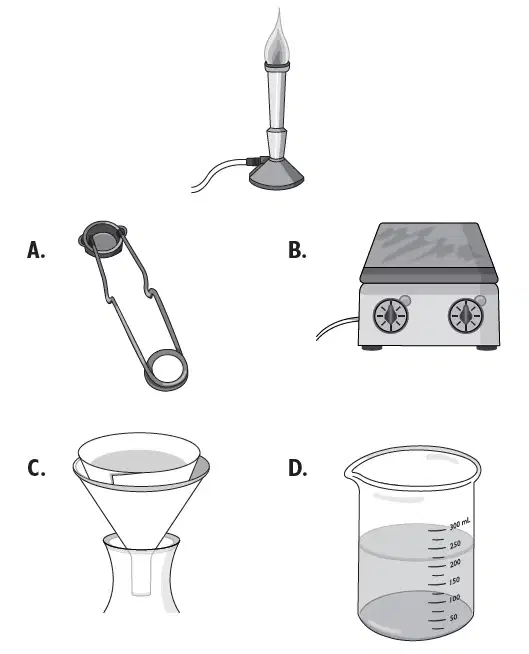
What additional equipment makes it possible to use the piece of lab equipment (Bunsen burner) shown?
A
B
C
D
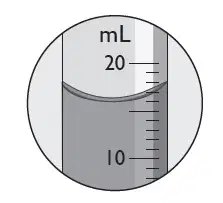
What is the correct reading for the volume of water in the graduated cylinder?
16 mL
16.5 mL
17 mL
17.5 mL
18 mL
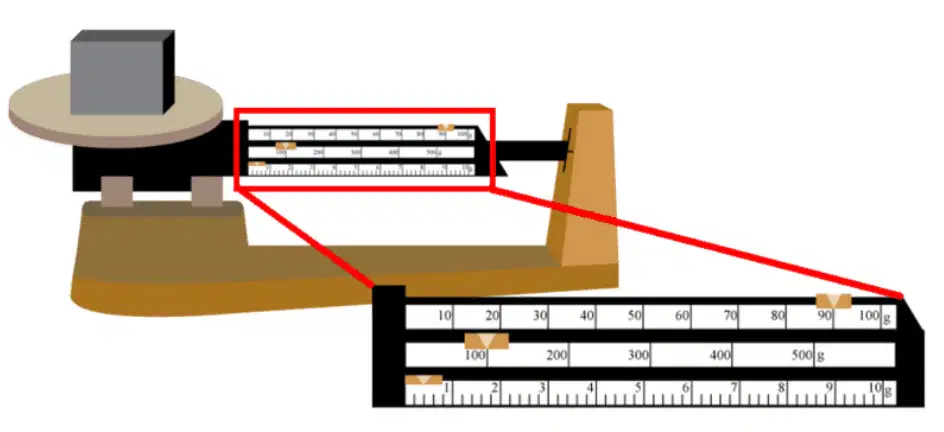
Assume that an object has been placed in the pan of a triple beam balance. The scales of the balance are shown. What is the mass of the object?
90 g
190 g
190.4 g
194 g
Which statement is NOT an appropriate lab safety rule?
Wear protective glasses or safety goggles for all laboratory work.
Check chemical labels twice to make sure you have the correct substance.
Report any laboratory accident, no matter how small, to your teacher immediately.
Make sure to put used chemicals back in their original bottles.
Which piece of lab equipment would you use to measure the volume of a liquid most accurately?

volumetric flask

graduated cylinder

test tube

beaker
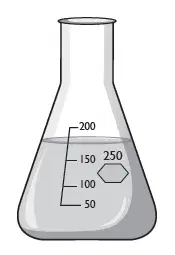
What is the name of the piece of lab equipment in the illustration?
flask
beaker
graduated cylinder
test tube
Which of the following is considered matter?
air
an idea
a dream
heat
energy
Which is NOT part of the definition of matter?
it has mass.
It has volume.
It takes up space.
It can be seen.
Which of the following are NOT matter? (Check all that apply.)
sound
hydrogen
wind
gasoline
a river
Which of the following are physical changes? Check all that apply.
glass breaking
nail rusting
paper burning
sugar dissolving
eggs cooking

A block and a cylinder are put on either side of an equal-arm balance. The block goes down and the cylinder goes up. What can this observation alone tell us about the two objects?
The block has larger volume and mass.
The block has larger mass and density.
The block has larger volume, mass and density.
The block has larger mass only.
The block has larger volume only.
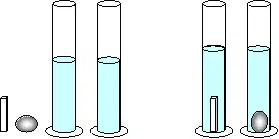
A block and an egg are placed into identical graduated cylinders as shown in the pictures. The water level rises by the same amount in each cylinder. Based on this measurement alone which property (or properties) can be concluded to be the same for the block and the egg?
mass only
volume only
density only
mass and volume
volume and density
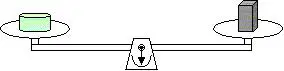
The two objects shown below are put on either side of an equal-arm balance. The balance remains level. Based on this observation alone which property (or properties) of the two objects must be the same?
mass only
volume only
volume and mass
mass and density
mass, volume, and density
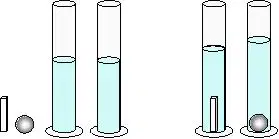
A block and a ball are placed into graduated cylinders as shown in the pictures. The water level rises higher in the cylinder in which the ball is placed. Based on this measurement alone which quantity or quantities are larger for the ball?
mass only
volume only
density only
mass and volume
mass, volume, and density

The diagram shows two irregularly shaped swimming pools. Which of the methods listed below could be used to find which pool has the greater surface area?
Measure and then multiply the (Length) x (Width) of each pool.
Float basketballs on each pool. The pool that holds more floating basketballs has larger area.
Completely fill each pool with bowling balls. The pool that holds more bowling balls has a larger area.
Measure the amount of water needed to fill each pool. More water means more surface area.
Measure the distance around each pool. The pool with the bigger distance around it has the larger area.
What is an operational definition for the mass of an object?
The amount of matter that makes up a body.
The number of milliliters of water that an object displaces.
How heavy something is.
The amount of space that something takes up.
The number of standard units that balance an object.

The diagrams show 15 mL of water in one graduated cylinder and a rock sample in another. How can you use one or both graduated cylinders to determine the volume of the rock sample?
Additional equipment is necessary to determine the volume of the rock sample.
Pour the 15 mL of water into the second graduated cylinder and read the water level.
Pour the 15 mL of water into the second graduated cylinder and subtract 15 mL from the resulting water level.
Read the mark at eye level on the second graduated cylinder that is at the same height as the very top of the rock sample.

Sally needs to determine the volume of 4 objects; a cube, a block, a cylinder and a sphere. For which of these objects can she use the formula: volume = (length) x (width) x (height)?
only the cube
only the block
the cube and the block
the cube, the block, and the cylinder
all four objects
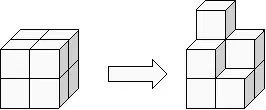
A large cube is built up from several smaller cubes. Each of the small cubes is the same size. The small cube in the upper right front corner is moved to the top of the structure as shown. Which of the following statements is most accurate about the properties of the large cube when the corner block is moved?
The mass and volume increase.
The volume and surface area increase.
The mass and surface area increase.
The volume increases.
The surface area increases.
A magician says: "I can recover lost coins from the sea. Give me a coin. I will toss it into the sea and then recover it." Before giving the coin to the magician, you place it on your balance. You obtain a mass measurement of 43.16 g. The coin seems to be tossed into the sea and then to reappear in a flourish of the magician's hand. You wipe off the coin, then place it on your balance and obtain a mass measurement of 43.17 g. We will assume you have measured correctly both times. Could the magician have returned the same coin?
If the uncertainty of the balance is equal to or greater than 0.01 g, the coins could possibly be the same.
It’s just not possible to retrieve a coin tossed into the ocean.
The masses are different, so the coins must be different.
We would need to know the density of the coins to determine if they are made out of the same material.
What is the density of a block with a mass of 100.0g and a volume of 50.0 cm3?
0.5 g/cm3
2 g/cm3
50 g/cm3
100 g/cm3
150 g/cm3

Two blocks, A and B, are on an equal-arm balance. The balance remains horizontal. Which block has the greater density?
block A
block B
both have the same density
you would need to know each substance

Noah and Sophie were discussing the density of two pieces of pure gold. One is a small gold nugget and the other is a large sheet of gold foil. Noah says: "I think that the foil has a greater density because it has a large surface area." Sophie disagrees: "I think the nugget has the greater density because it is more compact." With whom do you agree?
Noah
Sophie
Neither because the densities are the same.
Neither because objects that are thicker have greater densities.
Neither because you need to know mass and volume.
Mary Anne noticed a metal object lying by the railroad tracks. She believes the object may have originally been a copper penny that was run over by a train. What information about the metal object would be most useful in determining if her hypothesis is correct?
its weight
its mass
ts volume
its density
What is the density of a liquid if the volume is 25 mL and the mass is 20 g?
0.8 g/mL
1.25 g/mL
45 g/mL
500 g/mL
The density of gold is 19.3 g/cm3 and lead is 11.4 g/cm3. What is true about the density of a lead block that is coated with gold?
Its density is 11.4 g/ cm3.
Its density is 19.3 g/ cm3.
Its density is between 11.4 g/cm3 and 19.3 g/cm3.
There is not enough information to determine the density of the block.
You find an object that is made of a pure metal. What could you do to identify which metal the object is made of?
Measure its length and compare it to the length of other metals.
Determine its shape and compare it to the shape of other metals.
Measure its mass and compare it to the mass of other metals.
Measure its volume and compare it to the volume of other metals.
Determine its density and compare it to the density of other metals.
Which of these statements is true about two blocks of gold that are different shapes but have the same mass?
They have the same volume and the same density.
They have different volumes and different densities.
They have different volumes, but the same density.
They have the same volume, but different densities.

An archeology student found a coin at a dig. She determined that the mass of the coin is 4.33 g and its volume is 0.48 cm3. What is the coin most likely made of?
aluminum
copper
silver
zinc
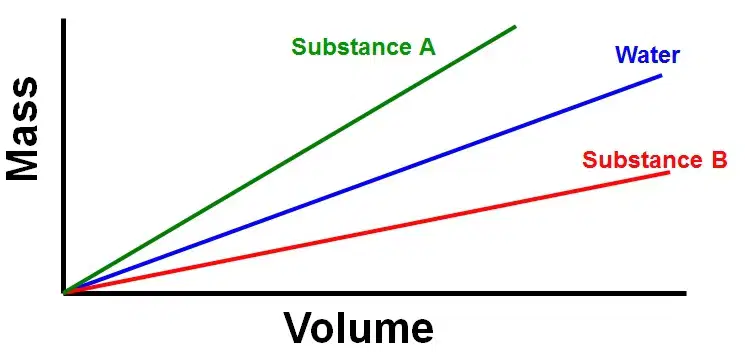
Two objects, one made only of substance A and the other made only of substance B, are dropped into a bucket of water. What will happen?
Both objects will float.
Both objects will sink.
The object made of substance A will sink.
The object made of substance B will sink.
There is not enough information to tell.
Which of the following is an element?
CaI
HF
Rh
H2O
Is copper sulfate (aq) an element or a compound?
It is an element because copper and sulfur are elements.
It is an element because copper sulfate is one chemical.
It is a compound because it is a blue liquid.
It is a compound because it is made of more than one element.
CaCl2 is an example of:
a metal
a phase
an element
a compound
Potassium iodide, KI(aq), is added to lead nitrate, Pb(NO3)2(aq), resulting in KNO3(aq) and a yellow solid. Identify the yellow solid from the list below.
PbI2(s)
PbI2(aq)
Pb(NO3)2(s)
KI(s)
What is a chemical symbol?
A combination of letters and numbers indicating a compound.
One or two letters indicating an element.
One or two letters indicating a compound.
A combination of letters and numbers indicating an element.
What is a chemical formula?
A combination of letters and numbers indicating a compound.
One or two letters indicating an element.
One or two letters indicating a compound.
A combination of letters and numbers indicating an element.
Which of the following statements about elements is false?
An element is a unique form of matter.
Elements can be broken apart into different substances.
An element serves as building material for more complex matter.
Elements can be combined to form different substances.
How many elements are represented by the chemical formula NaNO3?
2
3
4
5
What kind of substance is sulfur (S)?
an element
a compound
a mixture
an metallic gas
What kind of substance is sulfuric acid (H2SO4)?
an element
a compound
a mixture
a metallic gas
How many elements are in NaHCO3?
3
4
6
12
If a copper compound is in solution, how would we designate that after the compound formula?
(s)
(l)
(g)
(aq)
Which of the following is false about atoms, elements and compounds?
Different kinds of atoms can combine to make one kind of element.
Compounds are made of more than one kind of element.
Elements and compounds are both made of atoms.
An element is always made of only one kind of atom.
Which statement is NOT a description of a chemical reaction?
A liquid is heated on a Bunsen burner and its temperature rises.
A solid is dropped into a beaker of liquid and an explosion occurs.
Two liquids are mixed in a beaker and a solid forms at the bottom of the beaker.
A solid is dropped into a beaker of liquid and a gas is released.
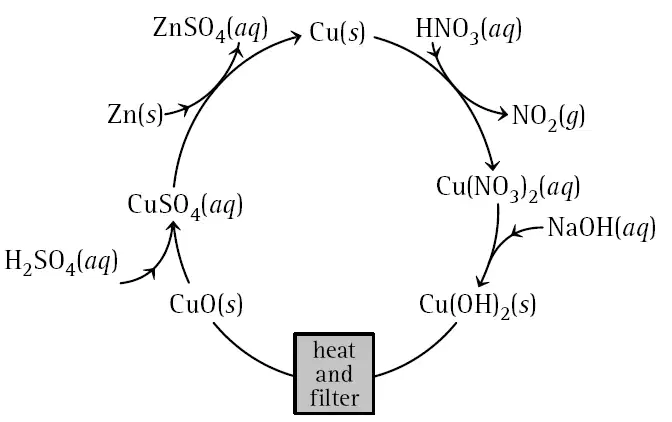
The copper cycle is a demonstration of what principle of chemistry?
Most elements are metallic solids.
Metals are excellent conductors.
Elements exist as gases, liquids, or solids.
Mass is conserved in chemical reactions.
Which of the following is evidence of a chemical change?
change in shape
change in size
change in odor
change in state or phase
Which of the following statements about chemical changes is false?
Chemical changes can be reversed by physical changes.
Chemical changes form new substances that have different properties.
Chemical changes can be detected.
Compounds can be broken down through chemical changes.
Which of the following statements about physical changes is false?
Dissolving is a physical change.
Changes of state (e.g., melting, boiling, etc.) are physical changes.
Physical changes are often easily reversible.
Physical changes can produce new substances.
In the following chemical equation, which are the reactants? Check all that apply.
Fe(s) + CuSO4(aq) --> FeSO4(aq) + Cu(s)
Fe(s)
CuSO4(aq)
FeSO4(aq)
Cu(s)
In the following chemical equation, which are the products? Check all that apply.
Fe(s) + CuSO4(aq) --> FeSO4(aq) + Cu(s)
Fe(s)
CuSO4(aq)
FeSO4(aq)
Cu(s)
How many atoms are represented by the chemical formula NaNO3?
2
3
4
5
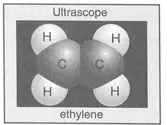
Refer to the image of an ethylene molecule. What is the chemical formula for this molecule?
C2H4
H2C4
4HC2
2CH4

In the diagrams (A-D), lighter color = nitrogen (N) and darker color = oxygen (O). Which diagram shows nitrogen dioxide (NO2)?
A
B
C
D
The chemical formula for the compound copper oxide is Cu2O. What is most likely to be true about the properties of copper oxide in relation to the properties of copper and oxygen?
Copper oxide has properties very similar to those of oxygen.
All three substances have similar properties.
All three substances have different properties.
Copper oxide has properties very similar to those of copper.
Which combination of elements would you expect to have the most similar properties?
hydrogen, H, and helium, He
nitrogen, N, and oxygen, O
carbon, C, and silicon, Si
copper, Cu, and zinc, Zn
Which of these elements would you expect to have the greatest reactivity?
boron, B
carbon, C
cesium, Cs
neon, Ne
At room temperature, most of the elements in the periodic table are:
metals
nonmetals
liquids
gases
Is indium a metal, a nonmetal, or a metalloid?
metal
nonmetal
metalloid
depends on the temperature
there is no way to tell
In what phase or state of matter would you find radon at room temperature?
solid
liquid
gas
plasma
Group 1A elements are called:
alkaline Earth metals
alkali metals
noble gases
halogens
transition metals
Group 2A elements are called:
alkali metals
alkaline Earth metals
halogens
noble gases
transition metals
The least reactive group of elements on the periodic table is the:
alkali metals
alkaline Earth metals
halogens
noble gases
transition metals
Group 7A elements are called:
alkali metals
alkaline Earth metals
halogens
noble gases
transition metals
Group 8A elements are called:
alkali metals
alkaline Earth metals
halogens
noble gases
transition metals
In which set of elements would all members be expected to have very similar chemical properties?
N, O, F
Na, Mg, K
Ne, Na, Mg
S, Se, Si
O, S, Se
Which of the following is NOT a property of metals?
ductile
mostly solid at room temperature
easily broken into pieces
shiny
conducts electricity
Which of the following is a metal?
sodium (#11)
neon (#10)
hydrogen (#1)
sulfur (#16)
Where would a nonmetal most likely be found on the periodic table?
a zone in between metals and metalloids
the top left corner
the top right corner
the middle
Which of these describes bromine's location on the periodic table?
Group 3, Period 7A
Group 4, Period 7A
Group 7A, Period 3
Group 7A, Period 4
What is the correct ordering of groups from left to right on the periodic table?
alkali metals, noble gases, alkaline earth metals, halogens
alkaline earth metals, alkali metals, halogens, noble gases
alkali metals, alkaline earth metals, halogens, noble gases
noble gases, alkali metals, alkaline earth metals, halogens
Which of the following are attracted to a negative charge?
proton
neutron
electron
nucleus
atom
Ernest Rutherford shot alpha particles at a thin sheet of foil. Most of the particles went through the sheet, while a small number bounced back. What did this experiment allow him to conclude about the nature of atoms?
Most of an atom must be empty space.
Electrons orbit at different distances from the nucleus, as in a solar system.
Alpha particles must be very large.
An alpha particle is composed of two protons and two neutrons.
The atom is like plum pudding.
What evidence supports a model of the atom that cannot be divided into smaller pieces?
A 1.0 cm3 sample of pure gold will always have a mass of 19.3 g.
Some alpha particles bounce back when shot toward gold foil.
Atoms form ions.
Chemical processes cannot change one element into another.
What evidence caused Rutherford to change the “plum pudding” model into the nuclear model?
It is possible to remove a negatively charged particle from an atom using electrical forces.
The farther from the center of an atom the negatively charged particles are, the easier they are to remove.
If a tiny particle is shot into the middle of an atom, it hits something dense in the center and bounces back in the direction from which it came. If a tiny particle is shot into the edges of the atom, it goes through. Most tiny particles shot at an atom will go through.
Neutral particles can be found at the center of an atom. They account for roughly half the mass of the atom.
What evidence caused Bohr to change Rutherford’s nuclear model into a solar system model?
It is possible to remove a negatively charged particle from an atom using electrical forces.
If a tiny particle is shot into the middle of an atom, it hits something dense in the center and bounces back in the direction from which it came. If a tiny particle is shot into the edges of the atom, it goes through. Most tiny particles shot at an atom will go through.
The farther from the center of an atom the negatively charged particles are, the easier they are to remove.
Neutral particles can be found at the center of an atom. They account for roughly half the mass of the atom.
Which of the following correctly describes the structure of an atom?
A nucleus of protons and neutrons, surrounded by electrons.
A nucleus of neutrons, surrounded by protons and electrons.
A nucleus of matter, surrounded by protons, neutrons and electrons.
A nucleus of protons, surrounded by neutrons and electrons.
What part of the atom has a positive charge?
proton
neutron
electron
outer shells
What part of the atom has no charge?
proton
neutron
electron
outer shells
What experimental evidence supports a model of the atom that consists of electrons distributed in a “pudding” of positive charge?
Atoms form compounds.
Alpha particles are sometimes deflected by gold foil.
Neutrons have similar masses to protons.
Electrons can be removed from materials.
The number of protons in a sodium atom is:
11
12
23
34
What can the atomic number tell you about a neutral atom? (Check all that apply.)
number of protons
number of neutrons
number of electrons
mass number
atomic weight
How do you find the mass of an individual atom?
The number of neutrons minus the number of protons.
The number of protons plus the number of electrons.
The number of neutrons minus the number of electrons.
The number of protons plus the number of neutrons.
How do you find the number of neutrons?
The mass number minus the number of protons.
The number of protons plus the number of electrons.
The number of protons minus the number of electrons.
The number of protons minus the average atomic mass.
The number of protons plus the average atomic mass.
If you have a sample of atoms and each atom has twelve protons in its nucleus, which element is it? Name the element (one word, spelled correctly).
(a)
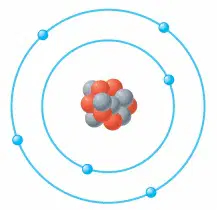
What element does the atomic model represent? Name the element (one word, spelled correctly).
(a)
The number of protons in a sodium atom is:
11
12
22
23
34
A neutral atom of chromium (Cr) has 24 protons and 28 neutrons. How many electrons will it have?
4
12
24
28
52
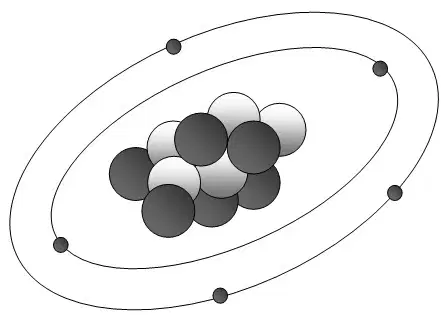
What is the atomic number of this atom?
5
6
11
16
What is the total number of neutrons in an atom of an element with an atomic number of 18 and a mass number of 40?
18
22
40
58
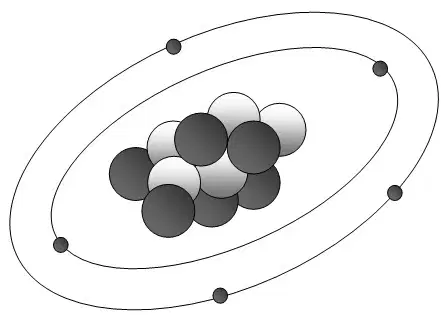
What are the atomic number and atomic mass of this atom?
number 5,
mass 10
number 5,
mass 11
number 6,
mass 11
number 6,
mass 17
Lithium has an atomic number of 3 and an average atomic mass of 6.941 amu. Which isotope would you find in the greatest abundance for lithium?
lithium-7
lithium-4
lithium-6.95
lithium-6.9
lithium-6

In the isotope symbols shown below, what does the number on the left above the “C” represent?
number of protons
number of neutrons
atomic number
mass number

What is different about the three different isotopes shown?
number of nuclei
number of protons
number of neutrons
number of electrons

Calcium has an atomic number of 20. What is the correct isotope symbol for calcium-44?
A
B
C
D
Isotopes of the element uranium have different:
numbers of protons.
numbers of electrons.
atomic numbers.
atomic masses.
The number of neutrons most likely to be found in a boron atom (#5) is:
3
5
6
11
A deuterium atom has one neutron and a mass of ____ amu.
1
2
3
4
Which of the following is NOT an isotope of hydrogen?
protium
deuterium
tritium
hyperbium
Isotopes of an element have different:
atomic numbers
numbers of protons
numbers of neutrons
numbers of electrons
How many neutrons are in the isotope tritium?
0
1
2
3
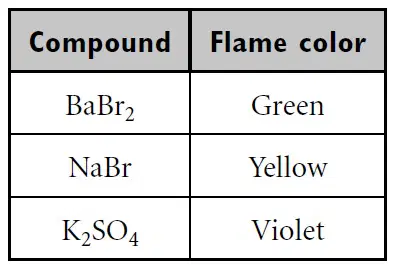
Use the table to determine the color of the flame produced by a sample of potassium bromide (KBr).
green
violet-green
violet
yellow
violet-yellow
A flame test with lithium chloride, LiCl, produces a red color. A flame test with sodium sulfate, Na2SO4, produces a yellow-orange color. What color would you expect in a flame test with lithium sulfate, LiSO4?
yellow
yellow-orange
orange
pink
red
Lithium carbonate (Li2CO3) will produce a red color in fireworks or a flame. Which part of lithium carbonate is responsible for the red color?
both parts
carbonate (CO3)
lithium (Li)
it is not possible to tell
If two chemical samples both produce an orange flame upon testing, which statement is most likely true?
The samples contain different compounds.
The samples both contain calcium atoms.
The samples both contain chlorine atoms.
The two samples must contain identical compounds.
What evidence supports the claim that chloride, Cl−, does not cause the flame to have a color?
Lithium chloride, LiCl, and sodium chloride, NaCl, have different colors.
Ammonium chloride, NH4Cl, does not cause the flame to have a color.
Sodium chloride, NaCl, and sodium nitrate, NaNO3, both produce flames with a yellow-orange color.
All of these statements.
Which of these compounds will give similar flame colors when heated?
1) NaCl 2) CaCl2 3) SrCl2 4) Sr(NO3)2 5) Cu(NO3)2
1, 2, and 3
2 and 3
3 and 4
4 and 5
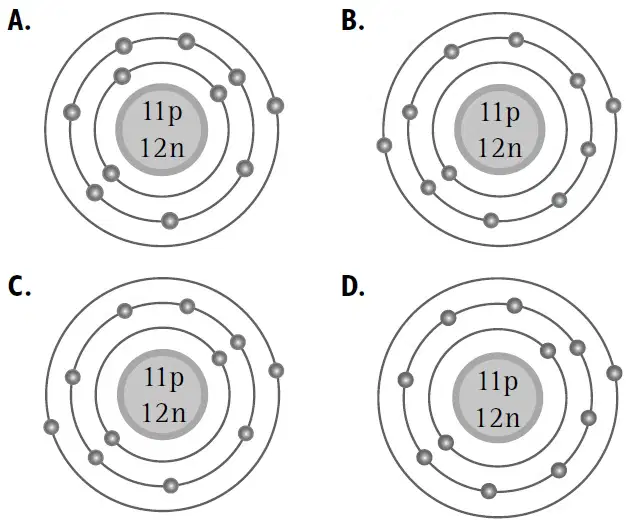
Which is the correct shell model for the element sodium (atomic number 11)?
A
B
C
D
An atom that has seven valence electrons is in which group?
halogens
noble gases
alkali metals
alkaline earth metals
Magnesium is an alkaline earth metal. How many valence electrons does it have?
1
2
3
4
The number of valence electrons in a calcium atom (#20) is:
2
4
20
40
What element has two electron shells and 3 valence electrons?
Li
Be
B
Mg
If an element is located in Group 4A of the periodic table, what can you conclude about atoms of this element?
It has properties similar to beryllium.
It has four valence electrons.
It has four core electrons.
It has four electron shells.
To create an ion from a neutral atom, which of these values is changed?
number of nuclei
number of protons
number of neutrons
number of electrons
When a magnesium atom forms an ion with a noble gas configuration, what will its charge be?
3+
2+
1+
1-
2-

Which of these are the correct labels for the two shell diagrams shown?
a fluorine atom and a fluoride ion with a charge of 1-
a fluorine atom and a fluoride ion with a charge of 1+
a fluorine atom and a neon atom
a neon ion with a charge of 1+ and a neon atom
An ion is created when what part of the atom is gained or lost?
protons
neutrons
electrons
alpha particles
How many valence electrons do most Noble Gases have?
2
4
8
18
When a lithium atom forms an ion, its charge will become:
1+
1-
2+
2-
In most ionic compounds, how many electrons does each ion have in its valence shell?
2 or 8
8
8, 16, or 24
a number equal to its atomic number
a number equal to its atomic mass
The rule of zero charge states that:
atoms gain neutrons when forming ionic compounds.
an ionic compound contains two or more elements that have no charge.
an atom that gains an electron must also gain a proton to remain electrically neutral.
the charges on metal cations and nonmetal anions in an ionic compound add up to zero.
Why do different atoms bond together to make compounds?
Because atoms need an equal number of protons and electrons.
So the atoms can get rid of extra energy in their electrons.
Because the atoms are more stable with full outer shells of electrons.
So the atoms can gain electrons.
Which statement best illustrates the “rule” for forming ionic compounds?
The total number of electrons and protons must be a multiple of 8.
The total number of electrons must be a multiple of 8.
The total number of ions must be a multiple of 8.
The total number of valence electrons must be a multiple of 8.
Bromine gains one electron to form which ion?
Br+1
Br-1
Br+2
Br-2
Mg and O combine to form the ionic compound magnesium oxide. What is the correct formula for magnesium oxide?
MgO2
Mg2O
MgO
Mg2O2
What is the correct formula for the compound magnesium chloride?
MgCl2
Mg2Cl3
Mg2Cl
MgCl
Which of these compounds will NOT form?
ArCl2
Na2S
AlCl3
NaCl
Which of these compounds does NOT occur?
LiCl
MgCl2
AlCl3
CaCl
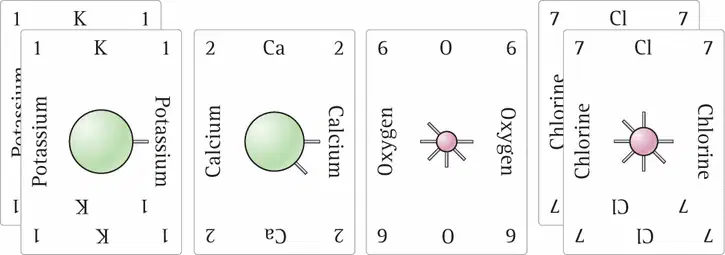
Which compound can be made with these cards?
K2O
K2Ca
K2Cl2
Cl2O
KO
An ionic compound is formed when:
a neutral compound gains an electron.
a cation bonds to an anion.
a hydroxide ion bonds to a nitrate ion.
an atom gains an electron.

Two groups of the periodic table are highlighted in the image. What is the metal to nonmetal ratio of ionic compounds formed from these groups?
1:1
1:2
2:1
2:7
An ionic compound is formed when:
an atom gains an electron.
a neutral compound gains an electron.
a cation bonds to an anion.
a hydroxide ion bonds to a nitrate ion.
Which of these dissolves readily in water?
Al(s)
Cu(s)
CaCl2(s)
SiO2(s)
Which of these is the best description of a metal?
soluble in water, conductive
soluble in water, nonconductive
insoluble in water, conductive
insoluble in water, nonconductive
Which of these does not readily conduct electricity?
sugar dissolved in water
a piece of aluminum foil
salt dissolved in water
a copper wire
One carbon atom bonds with four hydrogen atoms to form methane (CH4). The bonds are formed when hydrogen atoms share electrons with carbon atoms. These bonds are:
covalent bonds
ionic bonds
electronic bonds
hydrogen bonds
Based on its physical properties, what type of bonding is found in methanol, CH4O(l)?
metallic
ionic
network covalent
molecular covalent
Which type of substance will conduct electricity the best after dissolving in water?
metallic
ionic
molecular covalent
network covalent
Which type of bonding is found in zinc, Zn(s)?
metallic
ionic
molecular covalent
network covalent
Sugar is an example of a compound that is held together by molecular covalent bonding. Therefore, sugar is:
hard but brittle, fracturing along planes.
durable, rigid, and difficult to break.
bendable and malleable.
relatively easy to separate into smaller pieces.
Which of these is the best description of a network covalent compound?
soluble in water, conductive
soluble in water, nonconductive
insoluble in water, conductive
insoluble in water, nonconductive

