
 Worksheets
AP Environmental Science Review Quizizz
Total questions: 129
Worksheet time: 1hrs 14mins
The study of environmental science primarily considers
interactions among human systems and those found in Earth
the effect of human systems
abiotic factors that influence the state of our environment
factors that affect global climate change
An ecosystem is a location on Earth that includes
only biotic components
only abiotic components
interacting biotic and abiotic components
positive and negative feedback loops
Living in a sustainable way refers to
recycling all paper, plastic, and metals
using resources in a way that does not deprive future generations
using Earth's resources efficiently
eating locally whenever possible
Place the ecology levels of organization in proper order (smallest to largest)
organism > population > community > ecosystem > biosphere
community > organism > ecosystem > biosphere > population
organism > community > biosphere > population > ecosystem
population > biosphere > ecosystem > community > organism
A tapeworm lives in the small intestines where it feeds and grows, robbing the human of essential nutrients. This is a _____ type of relationship.
Commensalism
Parasitism
Symbiotic
Mutualism
The cattle egret follows herds of cattle and eat the insects that the cattle stir up as they move through the grassland. The cattle appear to be unaffected by the egrets. This is a _____ type of relationship.
Commensalism
Parasitism
Symbiotic
Mutualism
A positive feedback loop occurs
when a system responds to a change by returning to its original state
when feedback into a system decreases a rate of response
when a system is in a steady state
when feedback into a system increases a rate of response
Which is a biotic factor?
producers
pH
energy
humidity
What law best relates to energy loss within an ecosystem?
First law of thermodynamics
Second law of thermodynamics
Third law of thermodynamics
Law of conservation of matter
Which best describes the concept of net primary production?
total amount of energy available from the Sun
total amount of cellular respiration conducted within an ecosystem
energy captured minus energy lost
total amount of energy available from the producer

In which biome would you expect to find an area with an average temperature of 10oC and 200 cm of precipitation annually?
Temperate seasonal forest
Temperate rainforest
Woodland/shrubland
Tropical seasonal forest
In which biome would you expect to find an area with an average temperature of 4oC and 50 cm of precipitation annually?
Tundra
Boreal forest
Temperate grassland/cold desert
Woodland/shrubland
What factors are used to classify a biome?
average temperature
average precipitation
distinctive plants adapted to area
all of these are correct
Terrestrial biomes are defined by ____ and ____ variables.
temperature; precipitation
temperature; animals
precipitation; plants
animals; plants
What is a herbivore?
receives energy from the sun
only eats meat
only eats plants
eats both plants and meat
A keystone species is best defined as
an organism that eats all others
an organism that runs the fastest
an organism that keeps the food web stable
an organism that has the most advantages
Which of the following are examples of wetlands?
swamps
marshes
bogs
all of these are correct
Which biome has warm temperatures, high precipitation, and little seasonal variation due to its location near the equator?
Boreal forest
Tropical rainforest
Woodland/shrubland
Subtropical desert
The direction of an arrow in a food chain represents
the flow of energy from organism B to A
the movement of organisms
the directionality of the sun
the flow of energy from organism A to B
All of the following is true about a niche generalist EXCEPT
thrives in multiple environments
feeds on specific food only
lives in various habitats
feeds on various food
What is an omnivore?
receives energy from the sun
only eats meat
only eats plants
eats both plants and meat
Which of the following biogeochemical cycles does not have an atmospheric phase?
Hydrolic Cycle
Nitrogen Cycle
Sulfur Cycle
Carbon Cycle
Phosphorous Cycle
The length and complexity of a food web in the Arctic would be ____ when compared to one in the tropical rainforest.
Short and less complex
short and more complex
long and less complex
long and more complex
Producers rely on _____ to release chemical energy and consumers rely on ____ to release chemical energy.
Cellular Respiration; photosynthesis
Cellular Respiration; cellular respiration
photosynthesis; cellular respiration
photosynthesis; photosynthesis
In the Nitrogen cycle, what is one Natural way that Nitrogen gets into our soil?
Fertilizers
Human Waste through septic tanks
Decomposing animals
Industrial waste
There are less nutrient rich soils in the Rain Forest due to the dense tree canopy and water runoff.
True
False
Which biome has the lowest average Temperature, and the lowest Precipitation?
Tundra
Savanna
Rainforest
Taiga
Which is the only biogeochemical cycle that doesn't occur in our atmosphere?
Nitrogen
Phosphorus
Hydrogen
Carbon
Which of the following is an example of a biotic factor?
Temperature
Light
Atmosphere
Population
Water
Intraspecific Competition is between the same species. true or false?
True
False
Diurnal and Nocturnal creatures share their resources through the use of which of the following processes?
Competition
Resource Partitioning
Different trophic levels
Coevolution
In a food pyramid, which organism can be found on the bottom?
Primary Consumers
producers
Secondary Consumers
Herbivores
Human activities such as the ____ release large amounts of Carbon into our atmosphere.
Burning of fossil fuels
burning of wood
use of synthetic fertilizers
use of detergents
Which of the following biogeochemical cycles does not have an atmospheric phase?
Hydrolic Cycle
Nitrogen Cycle
Sulfur Cycle
Carbon Cycle
Phosphorous Cycle


I. Replanting a logged forest
II. Developing substitutes for nonrenewable resources I
II. Banning the use of all fossil fuels


__________ primary productivity is the total amount of energy that producers convert to chemical energy in organic molecules per unit of time.
Net
Total
Gross
Secondary

__________ primary productivity = the organic materials that remain after photosynthetic organisms in the ecosystem have used some of these compounds for their cellular energy needs (cellular respiration).
Gross
Total
Net
Secondary
In which process are nitrate ions and nitrite ions converted into nitrous oxide gas and nitrogen gas?
Nitrification
Denitrification
Assimilation
Ammonification
Nitrogen fixation
A biome is defined by its characteristic vegetation and overall productivity. What two factors determine these characteristics?
Temperature
Longitude
Precipitation
Animal life
Proximity to humans
Which trophic level has the MOST biomass?
Producers
Primary Consumers
Secondary Consumers
Tertiary Consumers
Of the following organisms, which occupies the highest (tertiary) trophic level?
Hawk
Snake
Mouse
Grass
How much energy is LOST between trophic levels?
10%
90%
100%
50%
75%

What level of productivity is in this image?
Euphotic
Oligotrophic
Mesotrophic

Assimilation
A
B
C
D
Nitrification
A
B
C
D
Why can't producers assimilate nitrogen directly from the atmosphere?
Nitrogen must be 'fixed' into an organic form (usually by bacteria)
Nitrogen CAN be assimilated, it's just easier for plants to pull nitrogen from the soil/fertilizer
Nitrogen is not needed by plants
Very little nitrogen is stored in the atmopshere
A forest has a GPP of 4.9 kg C/m2/yr & the respiration rate is 3.1 kg C/m2/yr. What is the NPP?
1.8 kg C/m2/yr
8.0 kg C/m2/yr
2.8 kg C/m2/yr
7.0 kg C/m2/yr
Two species that have a high degree of niche overlap will ___
compete intensely
immediately speciate
interbreed
coexist peacefully
How is the majority of energy within an ecosystem lost?
Heat loss (second law of thermodynamics)
Cellular respiration (first law of thermodynamics)
Energy used to capture prey (first law of thermodynamics)
Energy used to grow biomass (second law of thermodynamics)

Boreal forest
Temperate Grassland
Temperate Seasonal Forest
Subtropical Desert
Tundra
Fragmenting one large park or preserve into many small parks with human habitation in between them is most likely to lead to which of the following?
Reduction in species diversity
Stabilization of microclimates
Decrease in the proportion of edge habitat
Increase in population size of carnivores
The factor that likely poses the greatest threat of extinction of species worldwide is
black market trade in endangered species
aggressive collecting of specimens by museums and zoos
increasing loss of habitat
weakening of environmental legislation
Which of the following best shows the process of evolution?
A population of mosquitoes develops resistance to a pesticide
A bear goes into hibernation
A lizard’s color becomes brown as it sits on a log
A population of foxes increases as more prey becomes available
Characteristics that tend to increase the risk of a species becoming endangered include which of the following?
Having a very limited distribution
Being a specialist at the end of a long food chain
Having a small population size
All of these are correct
In general, which of the following is the best long-term method of preventing extinctions?
Protecting the habitats of endangered species
Paying people not to kill endangered species
Removing predators from areas that contain endangered species
Providing food to endangered species in the wild
If mean global temperature keeps on increasing as predicted by contemporary scientists, which of the following is most likely?
There will be fewer insect pests and disease-carrying organisms
Specialist species living in fragile ecosystems will risk extinction
There will be an increase in the reproductive rate of mammals
The geographical range of many plants will move toward the equator
Gradual transition over time from one type of biological community to another.
Symbiosis
Law of tolerance
Ecological succession
Energy pyramid
The theory of island biogeography suggests that species richness is affected by which of the following factors?
Island distance from mainland
How the island is formed
Island size
All of these are correct
Which of the following statements about ecological succession is correct?
Secondary succession is followed by primary succession.
Primary succession occurs over a shorter time span than secondary succession.
Succession is influenced by competition for limiting resources such as available soil, moisture, and nutrients.
In forest succession, less shade-tolerant trees replace more shade-tolerant trees.
After a severe drought, the productivity in an ecosystem took many years to return to pre-drought conditions. This observation indicates that the ecosystem has
low resilience.
high resilience.
high resistance.
low resistance.
According to the first law of thermodynamics
energy can never leave or enter the system.
energy can never change form.
energy is not created or destroyed.
none of these are correct
Which of the following are needed for photosynthesis?
Water, solar energy, and carbon dioxide
Water, solar energy, and glucose
Oxygen and glucose
Oxygen, water, and solar energy
After a forest fire, a badly damaged ecosystem recovered rapidly. This ecosystem has
high resistance.
low resistance.
high resilience.
low resilience.
Which best describes the concept of gross primary production?
Total amount of energy available to primary consumers
Total amount of cellular respiration conducted within an ecosystem
Total amount of energy available within an ecosystem
Total amount of solar energy that producers capture via photosynthesis
Which is another name for a producer?
Heterotroph
Autotroph
Decomposer
Scavenger
The number of individuals per unit area determines the population's __________.
density
mortality
age distribution
survivorship
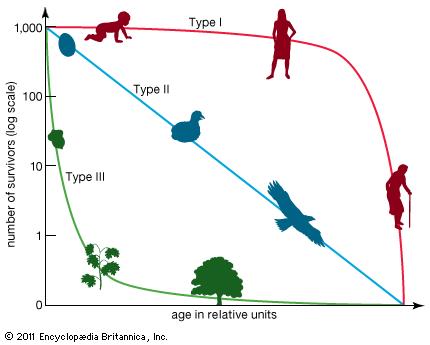
The mortality rate of organisms following a type I survivorship curve is __________.
fairly constant throughout life
higher in post-reproductive years
lower after the organisms become established
unrelated to age

What type of reproductive pattern would this organism have?
K-strategist
R-strategist
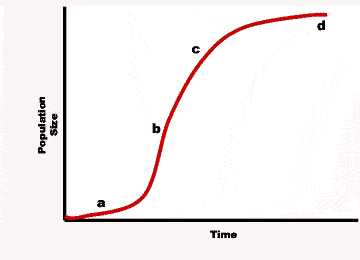
What point on the graph represents carrying capacity?
a
b
c
d
What point on the graph represents carrying capacity?
a
b
c
d

What type of spatial dispersion do dandelions in your yard typically exhibit? (Remember seeds are wind dispersed.)
Clumped
Random
Uniform
What point on the graph represents exponential growth?
a
b
c
d

Type of symbiosis: Hummingbirds feed on nectar from flowers. The flowers are pollinated by hummingbirds as they move from flower to flower.
commensalism
mutualism
parasitism
predation


The human population is approaching
100 million
1 billion
5 billion
8 billion

If a population grows larger than its environmental carrying capacity, then
death rate may rise.
death rate may fall significantly.
birth rate may rise significantly.
immigration rate may increase.


60. Which population is larger?
Population A is larger than population B.
Population B is larger than population A.
Currently, the populations are roughly the same size, but population B will soon be larger.
Currently, the populations are roughly the same size, but population A will soon be larger.

61. Population A is most likely
growing rapidly.
growing slowly.
stable.
going to decline in the next 20 years.

80. In phase 3 of a demographic transition, _________________ increases while _____________ decreases.
family income; education funding
the crude death rate; the crude birth rate
the crude birth rate; the crude death rate
affluence; the crude birth rate

According to the soil texture chart, what is the percentage of sand, silt, and clay at the point indicated?
50, 40, 10
70, 30, 0
30, 20, 50
80, 10, 10
The E horizon is
the least weathered zone.
the zone through which iron and aluminum pass from overlying horizons.
the zone which receives dissolved organic acids that pass from overlying horizons.
present in all soils.
Topsoil is the
A horizon.
O horizon.
B horizon.
C horizon.

Identify the zone labeled 5 in the figure.
A horizon
O horizon
B horizon
C horizon

In the figure, what is the percentage of sand, silt, and clay at point A?
40 percent sand, 20 percent silt, 40 percent clay
40 percent sand, 30 percent silt, 10 percent clay
30 percent sand, 40 percent silt, 30 percent clay
40 percent sand, 40 percent silt, 20 percent clay

