wayground logo

Free Printable Worksheets

NEW

Font size

S
M
L
XL
Worksheets

Optics Theory

Total questions: 58

Worksheet time: 39mins

Name
Class
Date
1.

Light bounces when it is

a)

reflected

b)

absorbed

c)

refracted

2.
Light bends when it is 
a)
refracted
b)
reflected
c)
absorbed
3.
mirror
a)
absorbs
b)
reflects 
c)
refracts
4.
Smooth surfaces _______ a lot of light.
a)
reflect
b)
bend
c)
absorb
d)
twist
5.
Which explains why the fork looks different under water?
a)
light can't pass through the glass
b)
the wavelength of light lengthens
c)
the amount of light increases when going through water
d)
light is refracted at an angle
6.
Opaque means...
a)
No light passes through it
b)
All light passes through it
c)
Some light passes through it
7.
Blurs light as it passes through
a)
Transparent
b)
Translucent
c)
Opaque
d)
Refraction
8.
Allows most light through
a)
eflection
b)
Refraction
c)
Translucent
d)
Transparent
9.

which is a transparent object

a)

glass

b)

copper

c)

iron

d)

steel

10.

Which travels faster?

a)

sound

b)

light

c)

water

11.
Curve in
a)
Converse
b)
Convex
c)
Convection
d)
Concave
12.
Curve Out
a)
Converse
b)
Concave
c)
Convex
d)
Convection
13.
The bending of waves as they pass from one substance into another.
a)
Reaction
b)
Reflection
c)
Refraction
d)
Repost
14.
The distance between one peak and the next in a wave
a)
Transpartent
b)
Scattering
c)
Wavelength
d)
Waste Pro
15.
A substance through which light travels.
a)
Wavelength
b)
Opaque
c)
Frequency
d)
Medium
16.
The taking in of light by a material....
a)
absorption
b)
reflection
c)
refraction
d)
dark colors
17.
Light is a kind of.....
a)
reflection
b)
energy
c)
heat
d)
matter
18.
Which of these describes how light travels through an empty space?
a)
It travels straight but may change direction to avoid objects.
b)
It changes direction often even if there are no objects. 
c)
It comes to a stop after it travels a certain distance. 
d)
It travels in a straight line without stopping. 
19.
What surface best reflects light?
a)
dull
b)
shiny
c)
clear
d)
black
20.
The two kinds of reflection are 
a)
transparent and translucent
b)
opaque and translucent
c)
regular and diffuse
21.
______ is a copy of the object formed by reflected or refracted rays of light
a)
reflection
b)
refraction
c)
object
d)
image
22.
A plane mirror produces a/an 
a)
a small, real image
b)
a large, real image
c)
 a small, virtual image
d)
a same sized, virtual image
23.
_______ mirrors can form either a virtual or a real image
a)
concave mirrors
b)
convex mirrors
c)
plane mirrors
24.
This diagram best represents 
a)
reflection
b)
refraction
c)
absorption
d)
diffusion
25.
What is the ray of light that strikes the surface.
a)
Incident ray
b)
reflected ray
c)
normal ray
d)
normal
26.
........... – the angle between the normal and the reflected ray.
a)
Angle of incidence
b)
Angle of reflection
c)
Angle of coincidence
d)
Angle of direction
27.
Law of reflection state that - The angle of incidence is .................. to the angle of reflection.
a)
equal
b)
double
c)
half
28.
What is B?
a)
Angle of incidence
b)
Angle of reflection
c)
Incident ray
d)
Reflected ray
29.
What is C?
a)
Angle of incidence
b)
Angle of reflection
c)
Incident ray
d)
Reflected ray
30.
What is E?
a)
Angle of incidence
b)
Angle of reflection
c)
Normal
d)
Reflect ray
31.
What does the word "converging" mean?
a)
to separate
b)
to come together
c)
parallel 
d)
perpendicular
32.
A converging lens is also known as a ____ lens.
a)
convex
b)
concave
c)
double
d)
refracted
33.
_____ is a lens that is thicker in the middle and makes an object appear bigger.
a)
prism
b)
convex lens
c)
concave lens
d)
mirror
34.
a mirror with a surface that curves inward like the inside of a bowl
a)
concave mirror
b)
convex mirror
c)
plane mirror
d)
flat mirror
35.

An image that forms where light seems to come from a point but light rays don't actually meet is a(n):

a)
virtual image
b)
real image
c)

inverted image

36.
Convex Mirrors produce...
a)
only virtual images
b)
virtual or real images
c)
only real images
d)
inverted images
37.
convex mirrors are
a)
plane mirrors
b)
converging mirrors
c)
diverging mirrors
d)
smaller than concave mirrors
38.

A dentist uses a small dental mirror to help magnify teeth in your mouth. What type of mirror is this?

a)

a convex mirror

b)

a concave mirror

c)

a convex lens

d)

a concave lens

39.
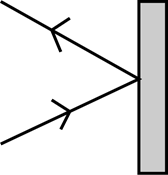
The illustration shows a light ray striking an object.
In the illustration, the light ray striking the object is-
a)
absorbed
b)
stopped
c)
reflected
d)
refracted
40.
The line that passes through the center of a curved mirror is called
a)
focal point
b)
center of curvature 
c)
principle axis
d)
light ray
41.

Images in a plane mirror are

a)

real

b)

larger

c)

same size

d)

smaller

42.

The image formed by this diverging mirror is

a)

upright, smaller, real

b)

inverted, larger, virtual

c)

upright, smaller, virtual

d)

inverted, smaller, real

43.

The image formed by this converging mirror is

a)

upright, same size, virtual

b)

inverted, same size, real

c)

inverted, larger, virtual

d)

upright, smaller, real

44.

The image formed by this converging mirror is

a)

upright, same size, virtual.

b)

inverted, same size, real.

c)

upright, larger, virtual.

d)

inverted, smaller, real.

e)

no image is formed.

45.
A material that reflects or absorbs all of the light that strikes it is called which of the following? 
a)
Transparent
b)
Translucent
c)
Diffuse
d)
Opaque
46.

The lowest part of the wave is? (H on the diagram)

a)

crest

b)

trough

c)

reflection

d)

wavelength

47.

The highest point on a wave, F on the diagram.

a)

trough

b)

amplitude

c)

crest

d)

wavelength

48.

The distance between 2 crests or troughs. J on the diagram.

a)

wavelength

b)

amplitude

c)

frequency

d)

wave speed

49.
When an object is placed on the focal point in front of a convex lens, the image produced is ___.
a)
real, reduced, and inverted
b)
real, enlarged, and inverted
c)
real, true, and inverted
d)
There is no image
50.
What does the word "diverging" mean?
a)
to spread apart
b)
to come together
c)
parallel
d)
perpendicular
51.
a real image...
a)
is produced by virtual rays and can be projected on a screen
b)
is produced by real rays and cannot be projected on a screen
c)
is produced by virtual images and cannot be projected on a screen
d)
is produced by real rays and can be projected on a screen
52.
What type of image is formed when rays of light actually intersect?
a)
real
b)
virtual
c)
projected
d)
curved
53.

The primary colours are

a)

Red, blue, green

b)

Blue, indigo, violet

c)

Red, magenta, green

d)

Magenta, cyan, yellow

54.
Why does this the t-shirt appear red and the shorts appear blue?
a)
The t-shirt reflects red light, the shorts reflect green light, other colours are absorbed.
b)
The t-shirt reflects blue light, the shorts reflect red light, other colours are absorbed.
c)
The t-shirt reflects red light, the shorts absorb yellow light, all other colours are reflected
d)
The t-shirt reflects red light, the shorts reflect blue light, other colours are absorbed.
55.
Red objects appear 'red' because:
a)
red objects are made from red materials
b)
red objects absorb red light
c)
red objects absorb all other colour except red light
d)
red objects don't reflect any light
56.

Which colour of light has the most energy?

a)

Blue

b)

Green

c)

Red

d)

Yellow

57.
Which color reflects all light?
a)
White
b)
Black
c)
Orange 
d)
Green
58.
Which color absorbs all light?
a)
White
b)
Black
c)
Orange
d)
Green