
 Worksheets
Unit 1 Astronomy Review
Total questions: 55
Worksheet time: 47mins
Most scientists believe the Big Bang Theory explains which of the following questions?
How our planets and moons formed
How our universe began
How the sun turns hydrogen into helium
How fast light travels through space
Most distant galaxies show a red shift. This is considered evidence that the universe is ___.
getting cooler
expanding
condensing into a small point
swirling around
A galaxy showing blue shift is ___.
very cold
moving towards us
dying
about to supernova
Observations of space indicate that most matter in the universe is ___.
hydrogen, helium, and dark matter
gold and plutonium
oxygen and water vapor
carbon
Which description is considered most accurate regarding what actually happened during the Big Bang?
Two galaxies collided causing an immense explosion as stars crashed into one another
All of what would become the universe was concentrated in a single small point, or singularity, which rapidly expanded into what is now stars, planets, galaxies, matter, and energy.
All matter emerged from a massive black hole at the center of the universe.
Parts of the sun were ripped off by massive internal explosions and were thrown into space where they cooled to become other things, like plants, comets, and other galaxies.
Scientists infer that the Big Bang occurred approximately
4.6 billion years ago
7 billion years ago
9 billion years ago
13.7 billion years ago


The diagram represents the light spectra given off by the same element as observed under two different conditions. Spectrum A was observed when that element was heated in a laboratory. Spectrum B shows the same element as seen in the light from a distant star. The light spectrum observed from this distant star shows a
red shift, which indicates that the star is moving away from Earth
red shift, which indicates that the star is moving toward Earth
blue shift, which indicates that the star is moving away from Earth
blue shift, which indicates that the star is moving toward Earth
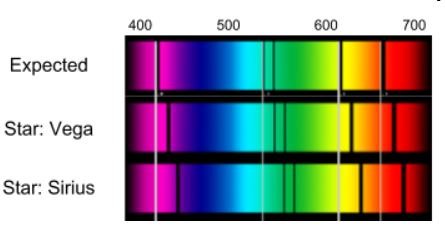
What is true about these stars?
Both of these stars are moving away from us.
Both of these stars are moving towards us.
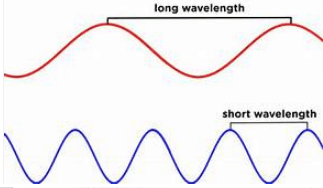
What happens to the wavelengths of energy if they are moving AWAY from a source?
The waves stretch out and get longer.
The waves compress and get shorter.

Which of the following has the longest wavelength?
microwaves
UV rays
Infrared
Gamma rays
What is at the middle of a Heliocentric system?
Mars
Moon
Sun
Earth
Which evidence best supports the theory that the universe began with a massive explosion?
cosmic background radiation in space
parallelism of Earth's axis
radioactive dating of Earth's bedrock
life cycle of stars
Which sequence correctly lists the relative sizes from smallest to largest?
our solar system, universe, Milky Way Galaxy
our solar system, Milky Way Galaxy, universe
Milky Way Galaxy, our solar system, universe
Milky Way Galaxy, universe, our solar system
Planets that are closest to the Sun are identified as
low-density Jovian
low-density terrestrial
high-density Jovian
high-density terrestrial
The best evidence of Earth's rotation is provided by
the
Foucault pendulum and global warming
Foucault pendulum and Coriolis effect
Moon phases and global warming
Moon phases and Coriolis effect
Which diagram best represents the regions of Earth in sunlight on June 21 and December 21? [NP indicates the North Pole and the shading represents Earth's night side. Diagrams are not drawn to scale.]


Seasonal changes on Earth are primarily caused by the
parallelism of the Sun's axis as the Sun revolves around Earth
changes in distance between Earth and the Sun
elliptical shape of Earth's orbit around the Sun
tilt of Earth's axis as Earth revolves around
the Sun


Imagine you drew a dot on the paper. At which angle would the dot receive the most intense amount of light?
90 degrees (shown as A in the image)
60 degrees (shown as B in the image)
30 degrees (shown as C in the image)
What effect does the tilt of the earth have?
It causes the earth to be farther away from the sun at different times of the year
It changes the angle that the sun strikes the earth in different land areas
When the earth is tilted away from the sun we have day
When the earth is tilted away from the sun we have night

The diagram below represents the sun's path at equinox. According to the position of the Sun below, what is a possible time of the location?
9 am
12 noon
6 pm
3 pm

Which sun's path best represents the summer solstice?
A
B
C
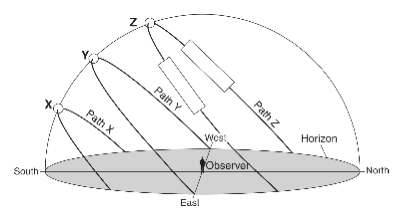
When the sun gets higher in the sky, shadows get ______.
longer
gone
shorter
darker
Shadows are longest during _______.
morning and evening
noon
night

What is the shadow direction when the Sun is at location C
East
Northwest
Northeast
West

In which general direction is the Sun in NY
North
South
West
East

A major belt of asteroids is located between Mars and Jupiter. What is the approximate average distance between the Sun and this major asteroid belt? (Need ESRT p.15)
110 million kilometers
220 million kilometers
390 million kilometers
850 million kilometers

Which planet has an orbital eccentricity most like the orbital eccentricity of the Moon?
Saturn
Mars
Mercury
Neptune
Which process combines lighter elements into heavier elements and produces energy within the Sun and other stars?
fusion
insolation
conduction
radioactive decay
Earth, the Sun, and billions of stars are contained within
(1) a single constellation
(2) the Milky Way galaxy
(3) the solar system
(4) a giant cloud of gas

This planet is 227.9 million kilometers from the Sun. (NEED ESRT P.15)
Mercury
Earth
Mars
Pluto
Pluto's not a planet!

This planet has the longest period of revolution. (NEED ESRT P.15)
Mercury
Mars
Saturn
Neptune

This planet could float in water. (NEED ESRT P.15) (Reminder - the density of water is 1 g/cm3)
Earth
Jupiter
Saturn
Venus

This is the largest planet by size and mass.
Earth
Mars
Jupiter
Saturn

This planet has the most circular orbit. (NEED ESRT P.15)
Mercury
Venus
Earth
Mars

How long ago was our sun and planets formed?
10 million years ago
5 million years ago
4.6 billion years ago
13.7 billion years ago
A nebula is
a cloud of gas and dust
an asteroid
a protosun
a planet

An ancient model of the solar system that puts earth at the center and says that everything orbits around the earth is called ...
Solar System Model
Heliocentric Model
Geothermal Model
Geocentric Model

The name of the galaxy we live in is called __________.
Milky Way Galaxy
Snickers Galaxy
Twix Galaxy
Andromeda Galaxy
Winds and ocean currents bend from their expected path.
Foucault Pendulum
Coriolis Effect
Heliocentric
Geocentric

A Foucault pendulum appears to change its directions of swing because Earth
is tilted on its axis
is spinning on its axis
has a curved surface
has a density of 5.5 g/cm3

