wayground logo

Free Printable Worksheets

Font size

S
M
L
XL
Worksheets

Biology SOL Review

Total questions: 100

Worksheet time: 2hrs 58mins

Name
Class
Date
1.
Suppose two organisms, each heterozygous for eye color, reproduced and had offspring. How likely are the two organisms to have heterozygous offspring?
a)
25%
b)
50%
c)
75%
d)
100%
2.
This type of process requires oxygen
a)
aerobic
b)
anaerobic
c)
cell transport
d)
None of the above
3.
This phase of mitosis occurs after metaphase and before telophase.
a)
Cytokenesis
b)
Metaphase
c)
Anaphase
d)
Interphase
4.
Gametes are formed and the chromosome number is reduced in this type of cell division
a)
Mitosis
b)
Meiosis
c)
Cytokenesis
d)
Translation
5.
Which of the following cell organelles are related to movement?
a)
Ribosomes and lysosomes
b)
Flagella and Cilia
c)
Nucleus and cell membrane
d)
Golgi and ER
6.
The DNA code is transferred to mRNA in the ____ through a process called ____.
a)
Ribosome, Translation
b)
Nucleus, Transcription
c)
Nucleus, Translation
d)
Cytoplasm, Active Transport
7.
What repackages proteins into forms the cell can use, expel, or keep stored?
a)
RER
b)
Lysosomes
c)
Golgi Bodies
d)
Ribosomes
8.
Which molecule is paired with its correct role in protein synthesis?
a)
Nucleus-forms peptide bonds
b)
Ribosomes-carry DNA instructions
c)
m-RNA joins amino acids
d)
t-RNA-Transfers the correct amino acid
9.
An ecosystem has a stable population of white-tailed deer. What is the most likely outcome if a new species of deer that competed for the same resources were introduced?
a)
The white tailed deer population would increase
b)
The producer population would decrease
c)
The deer will not be affected
d)
The predator population would decrease
10.
During the process of protein synthesis, a section of DNA molecule is copied into which other molecule?
a)
DNA
b)
r-RNA
c)
m-RNA
d)
t-RNA
11.
According to the graph the enzyme Amylase will
a)
Slow down the digestion rate
b)
Speed up the digestion rate
c)
Denature the starch
d)
Take in excessive heat
12.
According to this graph the carrying capacity of these deer is?
a)
20
b)
40
c)
70
d)
80
13.
When a group of foxes moves to a new environment, a change in which of the following is least likely to be a selective pressure on the foxes?
a)
Temperature
b)
Food Resources
c)
Decomposers
d)
Precators
14.
Red flower color is dominant to white flower color in rose plants.  What is the expected result of a cross between two heterozygous rose plants?
a)
100% Red
b)
75% red, 25% white
c)
50% red, 50% white
d)
25% red, 75% white
15.
To classify an organism a scientist finds in the field, which of these will the scientist first compare to other known organisms?
a)
dietary habits
b)
ecological niche
c)
physical structure
d)
reproductive method
16.
What did Rosalind Franklin contribute to the understanding of DNA molecules?
a)
An image indicating the shape of a DNA molecule
b)
An analysis of the chemical makeup of a DNA molecule
c)
A though that DNA carries genetic information
d)
A theory about how DNA conveys genetic information
17.
Darwin's explanation for evolution was dependent on which scientific concept?
a)
The ability of organisms to learn
b)
The significance of social behaviors to survival
c)
The existence of variations in a population
d)
The relationship between size and survival
18.
A student is investigating the effect of plants on indoor air quality and states, "If plants are added to an indoor environment, the air quality will improve."  This statement is an example of 
a)
a theory
b)
a procedure
c)
an observation
d)
a hypothesis
19.
Although controversial at first, the germ theory of disease proposed that microorganisms were the cause of many diseases.  Which of these was a result of the general acceptance that microorganisms cause disease?
a)
The development and use of anibiotics
b)
The belief in spontaneous generation
c)
The link between viruses and RNA
d)
The proof of a supernatural cause for illness.
20.
The weakness of hydrogen bonds between the bases of DNA allows-
a)
rearrangement of the sequence of bases to take place
b)
base pairs to separate during transcription and replication
c)
new bases to be incorporated into the DNA molecule
d)
conversion of bases to amino acids in the event of cell starvation
21.
Which of these would most likely result in a change to the current classification of an organism?
a)
Discovering organisms with similar physical traits in the fossil record
b)
Finding a related organism that was previously considered extinct
c)
linking the organism to different ancestors through DNA sequencing
d)
Observing organisms that occupy the same ecological niche
22.
Five species of frogs that live in separate habits within 5 non-overlapping ranges along the Mississippi River share a common ancestor.  Which process is most likely responsible for the formation of these five distinct species?
a)
Physiological isolation
b)
Geographic isolation
c)
Behavioral isolation
d)
Reproductive isolation
23.
Which process divides a cell's nucleus and nuclear materials?
a)
cell cycle
b)
cytokinesis
c)
interphase
d)
mitosis
24.
In a cell undergoing meiosis, during which stage do the sister chromatids separate from each other?
a)
anaphase I
b)
anaphase II
c)
telophase I
d)
telophase II
25.
Which is not a characteristic of homologous chromosomes?
a)
Homologous chromosomes have the same length
b)
homologous chromosomes have the same centromere position
c)
Homologous chromosomes have the exact same type of allele at the same location
d)
Homologous chromosomes pair up during meiosis I
26.
The fungi absorb water and minerals and pass them on to the plant and receive carbohydrates from the plant. This is an example of — 
a)
mutualism
b)
competition
c)
predation
d)
parasitism
27.
A symbiotic relationship in which one organism benefits while one organism is harmed is known as:   a.  antagonism b.  commensalism c.  parasitism d.  mutualism
a)
antagonism
b)
commensalism 
c)
parasitism
d)
mutualism
28.
Organisms in a typical backyard are likely to include bacteria, grass, shrubs, trees, insects, spiders, birds, and small mammals. All these organisms make up — 
a)
population
b)
troop
c)
community
d)
ecosystem
29.
Which of the following organisms has the greatest risk of losing a population due to the death of only a few individuals? 
a)
Bacteria
b)
Flies
c)
Elephants
d)
Rats
30.
Which of these could not be a virus? 
a)
F
b)
G
c)
H
d)
J
31.
People who have been exposed to excessive radiation often experience mutations. If these mutations only occur in somatic (body) cells, these people may  
a)
experience an increased risk of cancer 
b)
experience difficulties replicating RNA
c)
pass on these mutations to their offspring
d)
develop entirely new DNA sequences in all cells 
32.
An important difference between viruses and living cells is that viruses —
a)
cannot reproduce without host cells
b)
cannot mutate but cells can
c)
contain more nuclei than cells
d)
need an energy source but cells do not 
33.
Which characteristic do viruses possess in common with living cells? 
a)
They contain nucleic acids such as DNA or RNA.
b)
They contain a nucleus and organelles.
c)
They make their own food.
d)
They are inactive outside the body of living cells. 
34.
Which phase of mitosis would be seen next?
a)
A
b)
B
c)
C
d)
D
35.
The process of DNA replication is necessary before a cell — 
a)
codes for RNA molecules 
b)
modifies lysosome enzymes 
c)
 divides into two cells
d)
makes a protein 
36.
The nonpoisonous eastern scarlet snake has colored bands that closely resemble the poisonous coral snake. This adaptation provides the eastern scarlet snake with —  
a)
 increased breeding opportunities
b)
 increased feeding opportunities
c)
method of avoiding predation 
d)
 the ability to attract prey
37.
Which is the best evidence that this bird is nocturnal? 
a)
The shape of its beak
b)
The size of its eyes 
c)
 The length of its talons 
d)
The thickness of its feathers
38.
Unlike mitosis, meiosis in male mammals results in the formation of
a)
one haploid gamete
b)
three diploid gametes
c)
four diploid gametes
d)
four haploid gametes
39.
A human zygote should have _____ chromosomes inside.
a)
46
b)
23
c)
92
d)
64
40.
When an area of a chromatid is exchanged with the matching area on a chromatid of its homologous chromosome, _________________ occurs
a)
crossing over
b)
mutagenesis
c)
hybridization
d)
fertilization
41.
The fourth child in the F2 generation has Down syndrome. Which of the following statements represents a reasonable explanation for the appearance of this syndrome the third generation when it is not expressed in the P1 or F1 generations?
a)
Down syndrome is a recessive trait and was passed down through the generations but not expressed.
b)
Down syndrome is caused by a dominant allele that becomes active under a limited set of environmental conditions.
c)
Down syndrome is the result of an alteration of the chromosome number and was not passed from P1 to F1 to F2.
d)
Down syndrome is a sex linked trait expressed in the fourth F2 child because this male possesses a single X chromosome.
42.
In certain rats, black fur is dominant over white fur. If two rats, both heterozygous for fur color are mated, their offspring would be expected to have 
a)
four different genotypes and two different colors
b)
two different genotypes and three different colors
c)
three different genotypes and two different colors
d)
three different genotypes and three different colors
43.
Which of the following genotypes is homozygous recessive?
a)
RR
b)
Rr
c)
rr
d)
None of the Above
44.
T15. The hypothesis that evolution of a species occurs in periods of rapid change separated by periods of little or no change is called
a)
divergence
b)
gradualism
c)
punctuated equilibrium
d)
isolation
45.
The model that predicts evolution occurs at a slow, steady rate is called...
a)
gradualism
b)
punctuated equilibrium
c)
adaptive radiation
d)
convergent evolution 
46.
Which word is defined as a reduced form of a functional structure in 1 organism that shows up as fully functional in another?
a)
homologous structures
b)
vestigial structures
c)
analogous structure
d)
DNA
47.
What is a diagram that shows characteristic relationships among organisms called?
a)
Cladogram
b)
Karyotype chart
c)
Punnet square
d)
Biogeography
48.
This type of process requires oxygen
a)
aerobic
b)
anaerobic
c)
cell transport
d)
None of the above
49.
This phase of mitosis occurs after metaphase and before telophase.
a)
Cytokenesis
b)
Metaphase
c)
Anaphase
d)
Interphase
50.
In a "controlled" experiment, how many variables should you change at a time?
a)
4
b)
3
c)
6
d)
1
51.
True or False: A hypothesis must be stated in a way that is testable.
a)
True
b)
False
52.
Procedure
a)
Educated guess that can be tested
b)
Step by step plan of the experiment
c)
The purpose of the experiment; what is to be answered
d)
Variable that is to change on purpose
53.
Observation
a)
Act of recognizing a fact using your senses
b)
Information organized for analysis
c)
Conclusion or reason proposed to explain an observation
54.
The variable that you change in the experiment. Also called the manipulated variable.
a)
Controlled
b)
Dependent
c)
Independent
d)
Responding
55.
Dependent Variable
a)
Variable that is to change on purpose
b)
Variable that is the result of what happened and is considered the data
c)
Variable that nothing was done to
56.
An organism that produces its own food supply from inorganic compounds is called a(an)
a)
heterotroph
b)
consumer
c)
detritivore
d)
autotroph
57.
What is the original source of almost all energy in most ecosystems?
a)
carbohydrates
b)
sunlight
c)
water
d)
carbon
58.
What is the term for each step in the transfer of energy and matter within a biological community?
a)
energy path
b)
food web
c)
trophic level
d)
food pyramid
59.
What does a food web represent?
a)
All connections of energy flow throughout all organisms in a habitat.
b)
The specific ways that mutualism is carried out.
c)
A single pathway or energy flow between organisms. 
d)
How carnivores get their food. 
60.
The amount of energy that usually transfers from one trophic level to the next...
a)
10%
b)
20%
c)
80%
d)
50%
61.
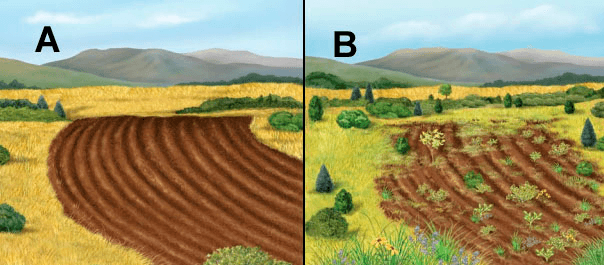
What type of succession is shown going from figure A to figure B?
a)
primary succession
b)
ecological succession
c)
secondary succession
d)
intermediate
62.
What is the order of succession shown in this figure?
a)
A, B, C, D
b)
B, A, D, C
c)
C, D, A, B
d)
D, A, B, C
63.
What property of water makes it the 'universal solvent'?
a)
it is a polar molecule
b)
it is an ionic compound
c)
it contains hydrogen bonds
d)
it steals electrons from other atoms
64.
Carbohydrates are made of... 
a)
C H O
b)
C H O N
c)
C H O N P
d)
C H O N S
65.
Which group of organic molecules serve as long-term energy storage and waterproof coverings?
a)
proteins
b)
carbohydrates
c)
lipids
d)
nucleic acids
66.
Proteins are composed of what smaller subunits?
a)
amino acids
b)
nucleic acids
c)
fatty acids
d)
nucleotides
67.
Also known as simple sugars, these are the carbohydrate monomers.
a)
lipids
b)
nucleotide
c)
monosaccharide
d)
monomer
68.
What happens to an enzyme when it is exposed to high temperature and pH?
a)
the enzyme stays the same
b)
the enzyme is denatured
c)
the enzyme creates sulfur-sulfur bonds
d)
creates amino acids
69.
Enzymes belong to which group of organic compounds
a)
carbohydrates
b)
lipids
c)
proteins
d)
nucleic acids
70.
What does an enzyme act on directly?
a)
amino acids
b)
catalysts
c)
substrates
d)
proteins
71.
Attractions between water molecules are called
a)
Covalent bonds
b)
Ionic bonds
c)
Polar bonds
d)
Hydrogen bonds
72.
A Compound that is being dissolved is called a
a)
Solution
b)
Solute
c)
Solvent
d)
Suspension
73.
Which is the monomer (building block) for nucleic acids?
a)
amino acid
b)
fatty acid & glycerol
c)
nucleotide
d)
monosaccharide
74.
Which is not a use or function of protein?
a)
forms enzymes and hormones
b)
forms transport channel in cell membrane
c)
forms structural proteins in the body
d)
quick energy
75.
A(n) ______ ____  is the part of the enzyme the molecule fits into.
a)
product
b)
active site
c)
enzyme
d)
substrate
76.
Shingles is a disease that appears in the elderly. Someone may be infected with shingles but only show symptoms dozens of years after infection. What type of virus causes shingles?
a)
A lytic cycle virus
b)
A lysogenic cycle virus
c)
A bacteriophage
d)
A bacteria
77.
I am a eukaryote, photosynthetic, and autotrophic. What kingdom do I belong to?
a)
Archaebacteria
b)
Plantae
c)
Protista
d)
Eubacteria
78.
I'm unicellular, autotrophic. What kingdom do I belong to?
a)
Animalia
b)
Archaebacteria
c)
Protista
d)
Plantae
79.
Green pigment that helps to absorb sunlight
a)
Xanthophyll
b)
Carotene
c)
Chlorophyll
d)
Lycopene
80.
Which of the following is an example of a nonvascular plant?
a)
Grass
b)
Fern
c)
Apple Tree
d)
Moss
81.
The plant cell wall is made up of
a)
chitin
b)
peptidoglycan
c)
cellulose
d)
glycogen
82.
Homo
a)
Different
b)
Same
83.
Hetero
a)
same
b)
different
84.
Uracil
a)
DNa
b)
RNA
85.
Genotype
a)
Genes-letters
b)
physical
86.

What type of biological molecule makes up the majority of the cell membrane?

a)

phospholipids

b)

amino acid chains

c)

ribonucleic acids

d)

disaccharides

87.

"Allows certain materials to pass through while blocking others" best defines -

a)

equilibrium

b)

fluid mosaic

c)

selectively permeable

d)

enzyme function

88.

What structures assist in moving large molecules, polar molecules, and molecules moving against the concentration gradient through the cell membrane?

a)

transport proteins

b)

phospholipids

c)

enzymes

d)

receptor proteins

89.

This image shows water passing through a cell membrane from high to low concentration in a process called -

a)

active transport

b)

osmosis

c)

dissolving

d)

respiration

90.

This image shows molecules passing through a transport protein from low to high concentration, which requires energy, in a process called -

a)

active transport

b)

osmosis

c)

dissolving

d)

respiration

91.
What would the INDEPENDENT variable be in an experiment testing which types of paper airplane goes furthest?
a)
the paper used
b)
the type of paper airplane
c)
the distance of each plane's flight
d)
how hard the plane is thrown
92.
In a water molecule, which atom(s) has/have a partial negative charge?
a)
Oxygen
b)
Hydrogen
c)
None of the atoms
d)
All of the atoms
93.
Enyzmes are a very important type of protein used to
a)
Build bones in skeleton
b)
Send hormonal signals throughout body
c)
Speed up chemical reactions
d)
Photosynthesize glucose in plants
94.

a nucleotide consists of what 3 parts

a)

rna,dna,phosphate

b)

5 carbon sugar,phosphate,nitrogenous base

c)

6 carbon sugar, phosphate, nitrogenous base

d)

carbon, sugar, oxygen

95.

This exponential growth curve shows a population under the following conditions -

a)

unlimited resources

b)

multiple predator types

c)

lack of mutations

d)

low carrying capacity

96.

Frogs, lily pads, mosquitoes, mushrooms, and algae are some __________ of a pond environment.

a)

primary successors

b)

secondary successors

c)

abiotic factors

d)

biotic factors

97.

The image shows the taxonomic classification of a brown stink bug. What is its scientific name?

a)

Animalia Hemiptera

b)

Halyomorpha halys

c)

Pentatomidae Halyomorpha

d)

Insecta Arthropoda

98.
An experiment is performed on plants to see how different liquids affect plant growth. Each plant in the experiment is given a different liquid; water, apple juice, or milk. Each plant has the same amount of soil, sunlight, and listens to the same music. In this investigation, the independent variable is ...
a)
The type of plant
b)
The amount of sunlight
c)
The type of music
d)
The type of liquid
99.
If you increase the amount of spinach you eat, then you will increase the iron in your blood. 
What's the dependent variable?
a)
increase the amount of iron in your blood
b)
spinach you eat
100.
This part of the experiment serves as a basis of comparison; the one variable being tested has been omitted. 
a)
experimental group
b)
control group
c)
data
d)
variables