wayground logo

Free Printable Worksheets

Font size

S
M
L
XL
Worksheets

DC BIO Unit 2 Review

Total questions: 127

Worksheet time: 2hrs 43mins

Name
Class
Date
1.
Prokaryotes have contains membrane-bound organelles. True or False?
a)
True
b)
False
2.
Which type of cell?
a)
Prokaryote
b)
Eukaryote
3.
Eukaryotes include animal cells and plant cells? True or False?
a)
True
b)
False
4.
______ make protein for the cell.  
a)
Nuclei
b)
Ribosomes
c)
Endoplasmic reticulum
d)
Vacuoles 
5.
Which type of cell is bigger?
a)
Prokaryotic
b)
Eukaryotic 
6.

Which is true of prokaryotic and eukaryotic cells?

a)

Prokaryotic cells are larger than eukaryotic cells.

b)

Eukaryotic cells do not have nuclei, and prokaryotic cells do have nuclei.

c)

Prokaryotic cells lack membrane-bound organelles, and eukaryotic cells contain membrane-bound organelles.

d)

Eukaryotic cells are simpler than prokaryotic cells.

7.
Prokaryotic and eukaryotic cells have many differences, but they also share some common features.  Which of the following may be found in either type of cell?
a)
Golgi bodies
b)
ribosomes
c)
mitochondria
d)
nucleus
8.
Which of the following would be found in both eukaryotic AND prokaryotic cells?
a)
chloroplast
b)
cytoplasm
c)
nucleus
d)
endoplasmic reticulum
9.
How are prokaryotes and eukaryotes similar?
a)
They both contain membrane-bound organelles.
b)
They both have cell membranes.
c)
The both have nuclei.
d)
They both have chloroplasts.
10.
How is this organism best classified?
a)
unicellular & eukaryotic
b)
multicellular & eukaryotic
c)
unicellular & prokaryotic
d)
multicellular & prokaryotic
11.
Which of the following in NOT a characteristic of eukaryotic cells?
a)
DNA is separated from the cytoplasm by a nuclear membrane
b)
Large
c)
Complex 
d)
Lack membrane-bound organelles
12.
How can surface area (SA) be increased? 
a)
Grow larger
b)
Divide into smaller pieces
13.
For cells to stay alive they require what type of SA:V?
a)
Large SA, Large V
b)
Small SA, Large V
c)
Large SA, Small V
d)
Small SA, Small V
14.
High Surface area to volume ratio allows cells to do what quickly?
a)
Move materials around inside the cell
b)
Move materials in and out of the cell 
c)
Communicate to other cells
d)
Divide
15.
This image shows how materials move into various sized cells in a given amount of time.... why does one square cell have more pink coloring than the others? 
a)
The surface area was too larger to get through
b)
The volume of the other cells was too large for the dye to get through
c)
There was not enough surface area for the dye to get through
d)
The volume was too low for the dye to stay in the square
16.
Microvilli are tiny projections that extend off the cell to increase the Surface Area.  What purpose might that serve? 
a)
Increased absorption
b)
Better communication among cells
c)
Maintain homeostasis 
d)
Decreased oxygen use
17.

Controls what enters and exits the cell.

a)

Cell Membrane

b)

Cell Wall

c)

Nucleus

d)

Mitochondria

18.

Provides ATP energy through the process of Cell Respiration

a)

Chloroplast

b)

Mitochondria

c)

Ribosomes

d)

Centrioles

19.

Contains enzymes for breaking down food and other material

a)

Golgi Body/Apparatus

b)

Vacuole

c)

Lysosomes

d)

Ribosomes

20.

Transports Proteins

a)

Smooth Endoplasmic Reticulum

b)

Rough Endoplasmic Reticulum

c)

Cytoplasm

d)

Golgi Body/Apparatus

21.

Command center that produces ribosomes.

a)

Nucleus

b)

Nucleolus

c)

Rough ER

d)

Smooth ER

22.

Storage area for water food and enzymes. 1 large in plants and many small in animals.

a)

Ribosomes

b)

Centrioles

c)

Lysosome

d)

Vacuoles

23.

Sorts, Packages, and Distributes materials throughout the cell.

a)

Golgi Body

b)

Rough ER

c)

Smooth ER

d)

Cytoplasm

24.

Traps light energy from the sun to make glucose in plants

a)

Mitochondria

b)

Chloroplast

c)

Cytoplasm

d)

Centrioles

25.

Produces Proteins

a)

Ribosomes

b)

Nucleolus

c)

Rough ER

d)

Mitochondria

26.
The compounds in biological membranes that form a barrier to the movement of hydrophilic materials across the membrane are 
a)
integral membrane proteins
b)
carbohydrates
c)
lipids
d)
peripheral membrane proteins
27.
In biological membranes, the phospholipids are arranged in a _______, with the_______.
a)
bilayer; fatty acids pointing toward each other
b)
bilayer; fatty acids facing outward
c)
single layer; fatty acids facing the interior of the cell
d)
single layer; phosphorus-containing region facing the interior of the cell
28.
A characteristic of plasma membranes that helps them fuse during vesicle formation and phagocytosis is the
a)
ratio of one protein molecule for every 25 phospholipid molecules
b)
capacity of lipids to associate and maintain a bilayer organization
c)
constant length of the fatty acid chain and the degree of saturation
d)
ability of phospholipid molecules to flip over and trade places with other phospholipid molecules
29.
A protein that forms an ion channel through a membrane is most likely 
a)
a peripheral membrane protein
b)
a phospholipid
c)
an enzyme.
d)
a transmembrane protein
30.
The hydrophilic regions of a membrane protein are most likely
a)
present only in muscle cells
b)
associated with the fatty acid region of the lipids
c)
either on the surface or inserted into the interior of the membrane
d)
exposed on the surface of the membrane
31.
When a mouse cell and a human cell are fused, the membrane proteins of the two cells become uniformly distributed over the surface of the hybrid cell. This occurs because
a)
many proteins can move around within the bilayer.
b)
all proteins are anchored within the membrane.
c)
all proteins in the plasma membrane are peripheral.
d)
different membranes contain different proteins.
32.
If a hospital patient is mistakenly given an IV of pure water instead of a saline solution that is isotonic to blood, the patient’s red blood cells will
a)
shrink and collapse
b)
release water to the plasma along its concentration gradient
c)
absorb water from the plasma and eventually burst
d)
transport equal amounts of water across the cell membrane in both directions
33.
Which of the following is not one of the functional roles of membrane proteins?
a)
Allowing movement of molecules that otherwise would be excluded by the lipid components of the membrane
b)
Transferring signals from outside the cell to inside the cell
c)
Facilitating the transport of macromolecules across the membrane
d)
Stabilizing the lipid bilayer
34.
If aquaporins are injected into the membranes of epithelial cells that line blood vessels,
a)
the flow of Na+ through aquaporins will increase
b)
the intracellular concentration of K+ will increase
c)
the membranes will become more permeable to water
d)
the electrical properties of the cells will be altered
35.
Which of the following is the driving force for simple diffusion?
a)
Concentration gradient
b)
ATP hydrolysis
c)
ADP hydrolysis
d)
Phosphorylation
36.
When cells are placed in a __________ solution they begin to swell.
a)
Hypertonic
b)
Isotonic
c)
Hypotonic
d)
Equalized
37.
A HYPOTONIC solution has a ______ concentration of solute than the cell and the cell will _____ when placed into a hypotonic solution.
a)
lower; swell
b)
lower; shrink
c)
higher; swell
d)
higher; shrink
38.
A HYPERTONIC solution has a _____ concentration of solute than the interior of the cell and a cell will ______ when placed into this solution.
a)
lower; shrink
b)
lower; swell
c)
higher; shrink
d)
higher; swell
39.
 If a cell containing 5% salt is placed into a glass of water with 20% salt, the water is _______ compared to the cell.
a)
hypertonic-
b)
hypotonic
c)
isotonic
40.
Special proteins help move particles, but NO energy is needed. This is..
a)
facilitated diffusion
b)
exocytosis
c)
active transport
d)
equilibrium
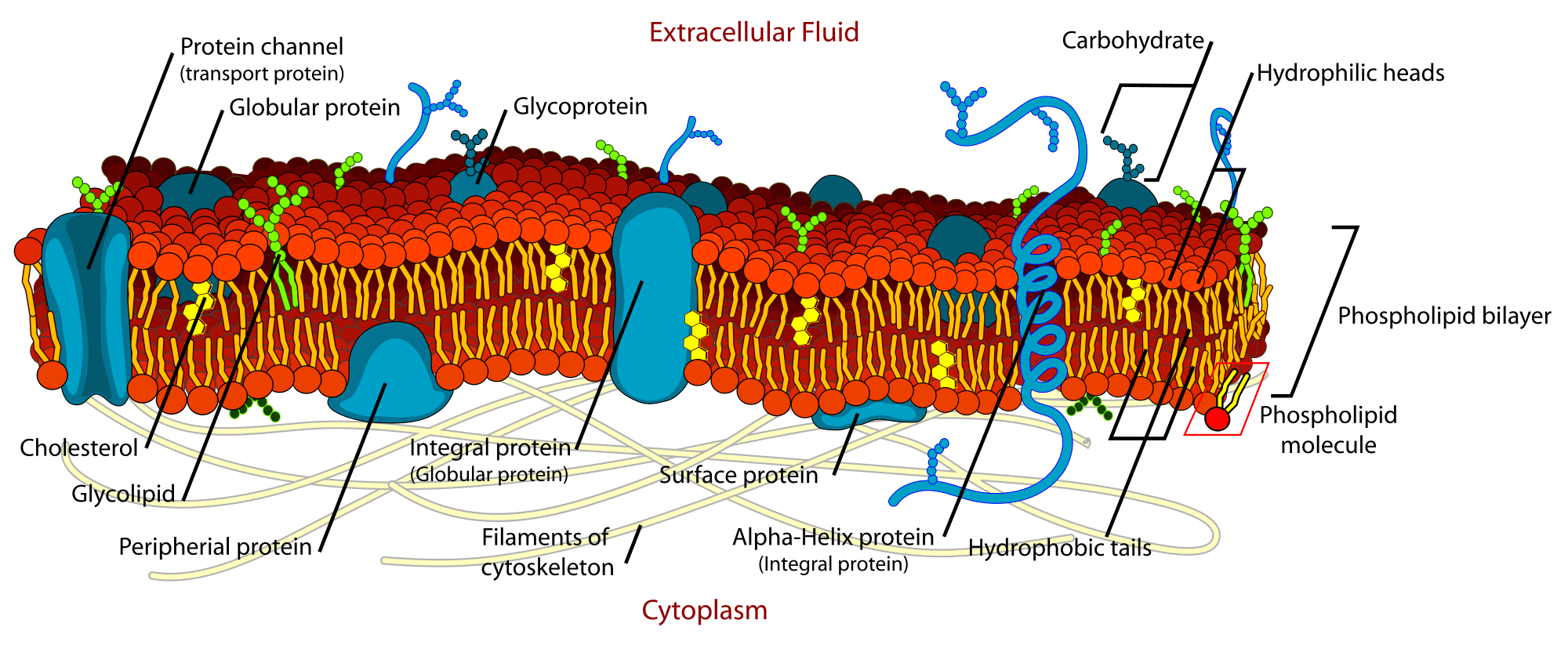
41.
Which of the following is responsible for getting large or charged (polar) molecules across the cell membrane?
a)
E
b)
B
c)
C
d)
D
42.
Hydrophilic portion of cell membrane?
a)
A
b)
C
c)
D
d)
43.
Hydrophobic region of the cell membrane?
a)
E
b)
B
c)
C
d)
44.

Hydrophobic means...

a)

water-loving

b)

water-fearing

c)

nonpolar

d)

lipid soluble

45.
What is this image?
a)
cell membrane
b)
proteins
c)
carbohydrates
d)
lipids
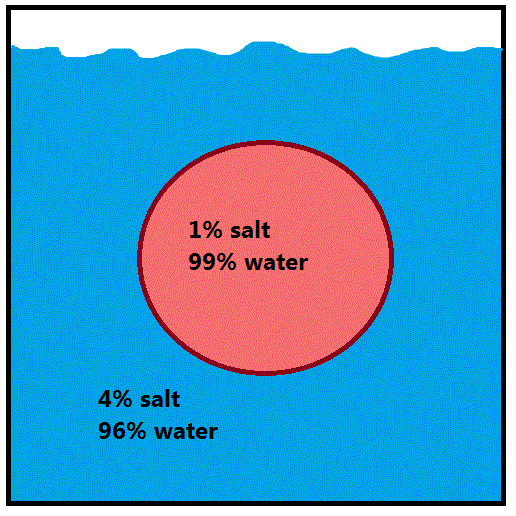
46.
Where will the water go?
a)
Into the cell
b)
Out of the cell
c)
Equally in & out - it's isotonic
d)
There is no water
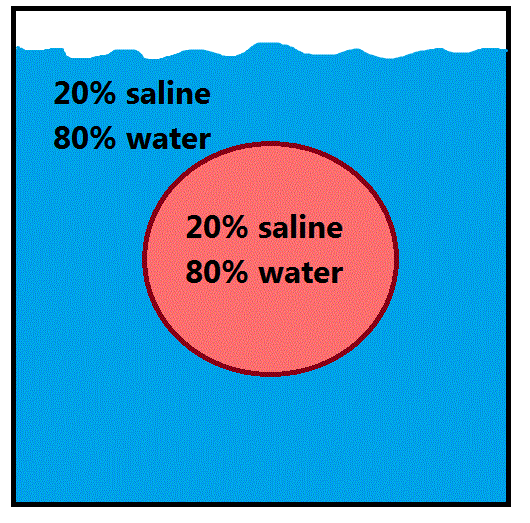
47.
A blood cell is placed into the jar, as seen. Where will the water go?
a)
Into the cell
b)
Out of the cell
c)
Equally in & out - it's isotonic
d)
The water is a lie
48.
A person with swollen gums rinses his mouth with warm salt water, and the swelling decreases. Which of the following has occurred?
a)
The swollen gums have absorbed the saltwater solution.
b)
The saltwater solution lowers the temperature of the water in the gums.
c)
The salt in the solution has moved against the concentration gradient.
d)
The water in the gums has moved out due to the high concentration of salt in the solution. 
49.
Look at the cross section of a cell membrane of a eukaryotic cell. H+ ions are being pumped from a low concentration to a high concentration. How do you describe this type of transport across the cell membrane?
a)
active transport
b)
passive transport
c)
facilitated diffusion
d)
co-transport
50.

A cross section of part of a Golgi complex is shown. Part of the membrane of the Golgi complex pinches off and moves away. Which of the following is a function of this process?

a)

to release energy from ATP

b)

to deliver proteins to other locations in the cell

c)

to collect amino acids for use in protein synthesis

d)

to sent messages about cell requirements to the nucleus

51.
Which of the following statements correctly matches a cell part with its function
a)
The cell membrane packages lipids for export
b)
The mitochondria perform photosynthesis
c)
The lysosome digests molecules
d)
The nucleus produces energy
52.

Keratin is a protein found in hair. Where in a cell is keratin made?

a)

nucleus

b)

vacuole

c)

ribosomes

d)

mitochondria

53.
After a protein is constructed at the ribosome, it can be transported to the Golgi complex for modification. What cellular structure is used in this transport?
a)
Lysosome
b)
Mitochondrion
c)
Nuclear pore
d)
Endoplasmic reticulum
54.
Synthesizes lipids, stores calcium, detoxifies drugs and poisons
a)
Rough ER
b)
Smooth ER
c)
Golgi Apparatus
d)
Peroxisomes
55.
Synthesizes proteins and packages them in vesicles; vesicles commonly go to the Golgi Apparatus
a)
Rough ER
b)
Smooth ER
c)
Nucleolus
d)
Nucleus
56.
Fuse with the plasma membrane
a)
Golgi Apparatus
b)
Lysosomes
c)
Secretory Vesicles
d)
Transport Vesicles
57.
Which of the following is NOT a function of the endomembrane system?
a)
Compartmentalization (creates different areas in the cell which do different things)
b)
Detoxification
c)
Protein modification and transportation of proteins
d)
Creation of ATP (energy)
58.
What is the function of the vacuole?
a)
Storage of water and nutrients
b)
Receives, modifies, and ships out proteins
c)
Transports ribosomes
d)
Transports proteins in a small bubble like package
59.
Which of the following molecules is NOT a byproduct of cellular respiration? 
a)
CO2
b)
Heat
c)
H2O
d)
ATP
60.
If the delta G of a reaction is negative, which response shows the best conclusion for that reaction? 
a)
The reaction will release more energy than was needed to form the reaction.
b)
Energy from the reaction can be used to do work. 
c)
Energy is absorbed by the reaction which then can be used to power other reactions. 
d)
Energy is absorbed within the reaction and distributed unevenly throughout the molecule. 
61.
If ADP is phosphorylated then what is this indicating in the reaction? 
a)
ADP is forming into ATP
b)
ADP is becoming AMP
c)
ADP is being used to power other reactions
d)
ADP is being created by the reaction
62.
Which molecule is not an important molecule regarding Cellular Respiration? 
a)
H2O
b)
NADH
c)
O2
d)
CO2
63.
Which process does not occur in aerobic conditions? 
a)
Fermentation
b)
Pyruvate Oxidation
c)
Citric Acid Cycle or Krebs cycle 
d)
Oxidative Phosphorylation 
64.
What is the main job of the electron carriers in cellular respiration? 
a)
Transport electrons and hydrogen atoms to the electron transport chain 
b)
Capture energy throughout the process of cellular respiration
c)
Provide the reactants for the process of cellular respiration
d)
Pump positive hydrogen ions and shuttle electrons across the electron transport chain and contribute to chemiosmosis
65.
How is cellular respiration related to photosynthesis?
a)
Both require oxygen to start
b)
respiration is the opposite of photosynthesis
c)
Both start with glycolysis
d)
Both end with 38 ATP for cells
66.
Which of the following statements are false?
a)
Glycolysis can occur with or without oxygen
b)
Glycolysis is the first step in both anaerobic and aerobic respiration
c)
Glycolysis occurs in the mitochondria
d)
Glycolysis produces 2 ATP, 2 Pyruvates, and 2 NADH
67.
What are the products (things that are made) in cellular respiration
a)
ATP
b)
Carbon dioxide (CO2)
c)
Water
d)
All of the above
68.
Glucose is broken down into pyruvate in a process known as 
a)
glycolysis
b)
electron transport
c)
the Krebs cycle
d)
phosphorylation
69.
This term refers to the production of ATP without oxygen being present.
a)
anaerobic
b)
prokaryotic
c)
biogenic
d)
organic
70.
What is the correct equation for cellular respiration?
a)
6O2 + C6H12O6 -> 6CO2 + 6H2O + Energy
b)
6O2 + C6H12O6 + Energy -> 6CO2 + 6H2O
c)
6CO2 + 6H2O -> 6O2 + C6H12O6 + Energy
d)
6CO2 + 6H2O + Energy -> 6O2 + C6H12O6
71.
What is cellular respiration?
a)
the breakdown of glucose  to release ATP
b)
the breakdown of glucose to release NADH
c)
the breakdown of glucose to release FADH
d)
the breakdown of glucose to release carbon
72.
What is the main job of the electron carriers in cellular respiration? 
a)
Transport electrons and hydrogen atoms to the electron transport chain 
b)
Capture energy throughout the process of cellular respiration
c)
Provide the reactants for the process of cellular respiration
d)
Pump positive hydrogen ions and shuttle electrons across the electron transport chain and contribute to chemiosmosis
73.
How many ATP are gained through glycolysis?
a)
0
b)
2
c)
4
d)
30-38
74.
Which molecule enters Kreb's Cycle?
a)
Pyruvate
b)
Glucose
c)
Acetyl CoA
d)
reducing powers
75.
What enzyme in the ETC is responsible for generating the ATP molecules?
a)
ATPase
b)
ATP synthase
c)
Hexokinase
d)
none of the above
76.
Where does ETC occur?
a)
Mitochondrial matrix
b)
Outer mitochondrial membrane
c)
Inner mitochondrial membrane
d)
Cytosol
77.
site of the krebs cycle
a)
1
b)
2
c)
3
d)
4
78.
At the end of the Kreb's cycle, where is most of the energy from the original glucose stored?
a)
in CO2
b)
in ATP
c)
in NADH
d)
in pyruvate
79.
During chemiosmosis
a)
H+ ions serve as the final electron acceptor
b)
a concentration gradient is generated when H+ ions are passively transported from the matrix to the intermembrane space of the mitochondrion
c)
energy is released as H+ ions move freely across the mitochondrial membrane
d)
ATP is synthesized when H+ ions move through a channel in ATP synthase
80.
What are the stages of cellular respiration in order?
a)
glycolysis, oxidative phosphorylation, the citric acid cycle
b)
oxidative phosphorylation, glycolysis, the citric acid cycle
c)
glycolysis, the citric acid cycle, oxidative phosphorylation
d)
the citric acid cycle, oxidative phosphorylation, glycolysis
81.
Use the diagram to answer the question. Between which parts of the molecule must the bonds be broken to form an ADP molecule?
a)
A and B
b)
A and C
c)
B and C
d)
C and D
82.
Which of the following are products of the light reactions of photosynthesis that are utilized in the Calvin cycle?
a)
CO2 and glucose
b)
H2O and O2
c)
electrons and H+
d)
ATP and NADPH
83.
Where does the Calvin cycle take place?
a)
stroma of the chloroplast
b)
thylakoid membrane
c)
outer membrane of the chloroplast
d)
interior of the thylakoid membrane
84.
When oxygen is released as a result of photosynthesis, it is a direct by-product of
a)
reducing NADP+
b)
splitting water molecules
c)
chemiosmosis
d)
electron transfer in photosystem II and I
85.
Which of the following events occurs in the light reactions of photosynthesis?
a)
NADP+ is produced
b)
ATP is consumed to yield ADP
c)
carbon dioxide is fixed in organic molecules
d)
light is absorbed and funneled to reaction-center chlorophyll a
86.
In a plant cell, where are ATP synthase complexes located?
a)
thylakoid membranes only
b)
inner mitochondrial membranes only
c)
thylakoid membrane and inner mitochondrial membranes
d)
thylakoid membrane and plasma membranes
87.
In photosynthetic cells, synthesis of ATP by chemiosmosis occurs during
a)
photosynthesis only
b)
cellular respiration only
c)
both photosynthesis and cellular respiration
d)
photophosphorylation only
88.
What is the primary function of the Calvin cycle?
a)
regenerate ATP for use in the light reactions of photosynthesis
b)
produce carbon dioxide for use in the light reactions of photosynthesis
c)
produce oxygen by oxidizing water
d)
produce simple sugars from carbon dioxide
89.
Where do the enzymatic reactions of the Calvin cycle take place?
a)
stroma of the chloroplast
b)
thylakoid membranes
c)
matrix of the mitochondria
d)
thylakoid space
90.
Which of the following statements best represents the relationships between the light reactions and the Calvin cycle?
a)
The light reactions provide ATP and NADPH to the Calvin cycle, and the Calvin cycle returns ADP, ℗i, and NADP+ to the light reactions.
b)
The light reactions provide ATP and NADPH to the carbon fixation step of the Calvin cycle, and the Calvin cycle provides water and electrons to the light reactions.
c)
The light reactions supply the Calvin cycle with CO2 to produce sugars, and the Calvin cycle supplies the light reactions with sugars to produce ATP.
d)
The light reactions provide the Calvin cycle with oxygen for carbon fixation, and the Calvin cycle provides the light reactions with sugars to produce ATP.
91.

When are ATP and NADPH produced?

a)

light-dependent reactions

b)

Calvin Cycle

c)

Krebs Cycle

d)

light- independent reactions

92.

How many turns of the Calvin cycle are required to produce one molecule of glucose?

a)

3

b)

6

c)

2

d)

1

93.

During photosynthesis sugars are assembled during

a)

photosystem II

b)

photosystem I

c)

Calvin cycle

d)

Krebs cycle

94.

CO2 is used in the Calvin cycle to make molecules of

a)

NADPH

b)

glycogen

c)

G3P

d)

Rubisco

95.
What does carbon combine with to form glucose? 
a)
NADPH
b)
ATP
c)
RuBP
d)
G3P
96.
How many G3P molecules make one molecule of glucose? 
a)
1
b)
2
c)
3
d)
4
97.
What does NADPH do? 
a)
carries electrons to the Calvin cycle
b)
carries electrons to the ETC
98.
The two main stages of photosynthesis are the
a)
light reactions and respiration
b)
dark reactions and the Calvin cycle 
c)
light reactions and the Calvin cycle
d)
dark reactions and fermentation
99.
What happens to the remaining G3P molecules in the last step of the dark reactions?
a)
They are used to make glucose.
b)
They are reshuffled to make CO2 by adding ATP.
c)
They exit the cycle.
d)
They are reshuffled to make RuBP by adding ATP. 
100.
What is the product of the Calvin Cycle?
a)
Rubisco
b)
Glyceraldehyde 3-Phosphate (G3P)
c)
Oxygen
d)
Starch
101.

What happens to an enzyme when it denatures?

a)

The activation energy of the reaction is doubled.

b)

The activation energy of the reaction is lowered.

c)

It's optimal conditions for temperature of the enzyme are doubled.

d)

The shape of the enzyme molecule is changed.

102.

Most enzymes are composed of .....

a)

Lipids

b)

Carbohydrates

c)

Proteins

d)

Nucleic Acids

103.
Where do substrates bind on an enzyme?
a)
voltage-gated channels
b)
surface receptor
c)
calcium channels
d)
active site
104.
What is the purpose  of an enzyme?
a)
give permission for the reaction
b)
raise activation energy
c)
speed up reactions
d)
control how many reactions occur
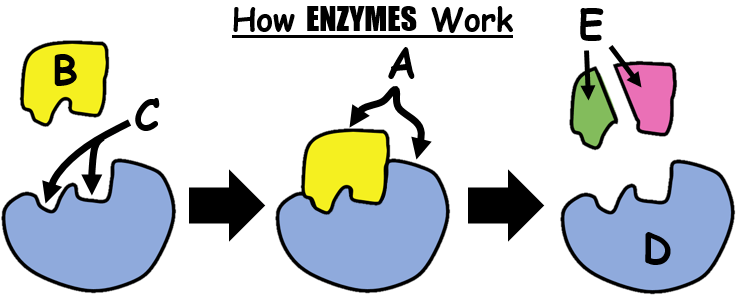
105.
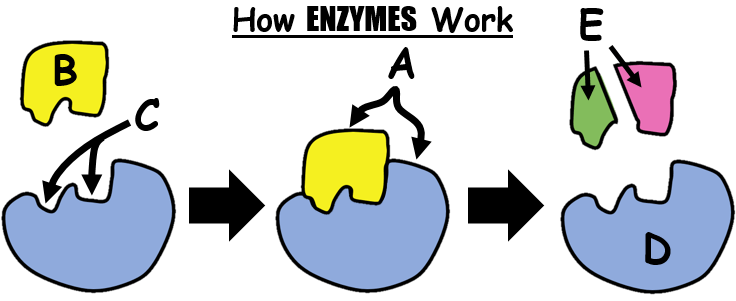
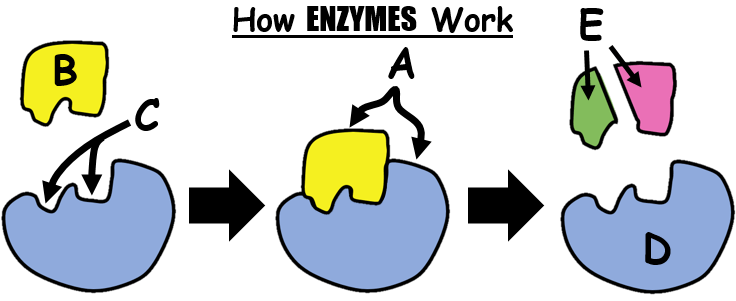
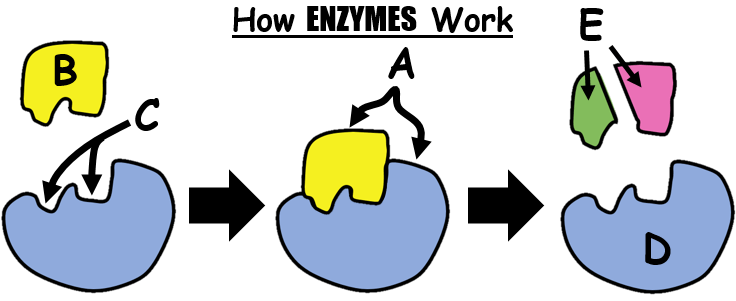
Letter D...
a)
active site
b)
enzyme
c)
substrate
d)
products
106.
Letter B...
a)
active site
b)
enzyme
c)
substrate
d)
products
107.
Letter C...
a)
active site
b)
enzymes
c)
substrate
d)
products
108.
Letter E...
a)
active site
b)
enzyme
c)
substrate
d)
products
109.
Any substance that is acted upon by an enzyme is called a(n)?
a)
Coenzyme
b)
Substrate
c)
Vitamin
d)
Polypeptide
110.
What type of macromolecule are enzymes?
a)
Protein
b)
Carbohydrate
c)
Lipid
d)
Nucleic Acid
111.
Which of the following correctly describes how enzymes work?  
a)
they lower the energy of the reactants to increase the rxn rate
b)
they supply energy to the reaction to increase the rxn rate
c)
they lower the energy of the products to increase the rxn rate
d)
they lower the activation energy of the reaction to increase the rxn rate
112.
Enzymes are made up of these repeating monomers.
a)
monosaccharides
b)
amino acids
c)
nucleotides
d)
phospholipids
113.
The energy needed to start a reaction
a)
activation energy
b)
adhesion energy
c)
chemical energy
d)
cohesion energy
114.
Which of these is NOT true?
a)
Enzymes can denature (change shape) when the temperature gets too high.
b)
Enzymes can only be used once in a chemical reaction. 
c)
Extreme pH can denature enzymes.
d)
Enzymes speed up chemical reactions. 
115.

Which of the following is directly responsible for the shape of an enzyme/protein?

a)

The amino acid sequence of the protein and the properties of the amino acids that make up the protein.

b)

The temperature of the surrounding environment.

c)

The pH of the surrounding environment.

d)

The amount of substrate present.

116.
Blocking Active site of an enzyme
a)
competitive inhibition
b)
allosteric inhibition
117.

Which statement is true concerning the structure of proteins?

a)

The primary structure is the sequence of amino acids.

b)

Alpha helix and beta sheet are examples of secondary structure.

c)

Side chains (R-groups) of amino acids can be polar or nonpolar

d)

All statements are true.

118.

In the graph, the energy level needs to increase before it goes back down. The increase is called the:

a)

enzyme energy

b)

substrate

c)

activation energy

d)

active site

119.
When a molecule can occupy the same active site as the substrate, a situation called __________________ can result
a)
Competitive lnhibition
b)
Allosteric Regulation
c)
Non-Competitive Inhibition
d)
Feedback Inhibition
120.
A receptor site that a molecule can bind to that changes the shape of the active site is called a(n):
a)
Allosteric Site
b)
Active Site
c)
DiSulphide Bridge
d)
MHC Receptor
121.
A molecule binds to an enzyme and decreases the ability of the active site to bind to the substrate. This is called:
a)
Allosteric Activation
b)
Allosteric Inhibition
c)
Competitive Activation
d)
Competitive Inhibition
122.

In non-competitive inhibition, a molecule will ______.

a)

bind in the enzyme's active site

b)

bind in a separate site on the enzyme besides the active site

c)

will not bind to the enzyme

123.
When water is added to split a molecule, the reaction is known as a(n) __ reaction.
a)
dehydration synthesis
b)
condensation
c)
hydrolysis
d)
super magical 
124.

Net release of energy

a)

endergonic

b)

exergonic

125.

Net intake of energy

a)

endergonic

b)

exergonic

126.

Which statement is true according to the image?

a)

A: endergonic; B: exergonic

b)

A: exothermic; B: endothermic

c)

A: exergonic; B: endergonic

d)

A: endothermic; B: exothermic

127.

The reaction shown is:

a)

endergonic because energy is released

b)

exergonic because energy is released

c)

endergonic because energy is captured

d)

exergonic because energy is captured