
 Worksheets
Molecular biology review
Total questions: 130
Worksheet time: 43mins
Water is considered (a) because it has a slightly electropositive end and slightly electronegative end.
The ability for water molecules to form bonds with itself is called (a) .
The ability for water to form bonds with other polar molecules is called (a) .
When salt dissolves in water, the positive sodium ions are surrounded by the (a) region of water molecules.
Cholesterol is considered
hydrophilic
hydrophobic
soluble in water
insoluble in lipid
High temperatures can damage tissues and denature proteins causing _____________ to stop working.
fatty acids
nucleic acids
enzymes
carbohydrates

Solute
A substance that does not dissolve.
A substance that is a solid, even in water.
A substance that solutes for a job well done :)
A substance that is dissolved in a solution.

Solvent
A solid substance that does not dissolve
A liquid substance capable of dissolving other substances
A gas that condenses
A solid substance that dissolves.

hydrophilic
Repelled by water
Attracted to water
on top of water
anti water
A loon is able to float on water due to
Viscosity
Buoyancy
Specific heat capacity
Thermal conductivity


In a solution of water and salt, salt is considered the (a)
HYPO means (a)


Osmosis is the movement of (a) across a membrane.
ISO means...
Low
A lot
Equal
Mammal
You are in a lifeboat drifting in the ocean for 3 days and all the water is finished... You are thirsty and see an ocean full of water. Should you drink the sea water?
No. It's hypertonic to your cells
No. It's hypotonic to your cells
No. It's isotonic to your cells
No. It's paratonic to your cells
Yes. Go for it. Stay alive as long as you can

Osmosis is the passage of (a) molecules from a region of their higher concentration to a region of their lower concentration through a (b) permeable membrane
Which one is the definition of Diffusion ?
movement of particles through the cell membrane from a region of lower concentration to a region of higher concentration using energy in the form of ATP.
passage of water molecules from a region of their higher concentration to a region of their lower concentration through a partially permeable membrane
net movement of molecule from a region of higher concentration to region of lower concentration. Molecule down a concentration gradient
net movement of molecule from a region of lower concentration to region of higher concentration. Molecule down a concentration gradient
Which one is the definition of Osmosis ?
movement of particles through the cell membrane from a region of lower concentration to a region of higher concentration using energy in the form of ATP.
passage of water molecules from a region of their higher concentration to a region of their lower concentration through a partially permeable membrane
net movement of molecule from a region of higher concentration to region of lower concentration. Molecule down a concentration gradient
net movement of molecule from a region of lower concentration to region of higher concentration. Molecule down a concentration gradient

What will be happen?
water molecule move from solution 1 to solution 2 by osmosis
water molecule move from solution 2 to solution 1 by osmosis
water molecule move from solution 1 to solution 2 by active transport
Sugar molecule move from solution 1 to solution 2 by osmosis

Osmosis
diffusion of water molecules through a semi-permeable mebrane from an area of low concentration to an area of high concentration
the diffusion of particles from an area of high concentration to an area of low concentration
diffusion of water molecules through a semi-permeable membrane from an area of high concentration to an area of low concentration
the diffusion of particles from an area of low concentration to an area of high concentration


The bonds that join monosaccharides are called:
Glycosidic Bonds
Cellulose, starch and glycogen are examples of:
monosaccharides
disaccharides
lipids
polysaccharides

What is the following molecule?
alpha glcuose
beta glucose
amino acid
disaccharide
Sucrose
Glucose + fructose
Lactose
Glucose + galactose
Maltose
Glucose + glucose
Which polysaccharide is used by plants to make their cell wall?
starch
glycogen
cellulose
chitin

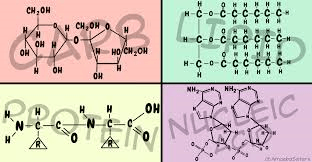
Carbon, Hydrogen, Nitrogen

Which biomolecule makes up cell membranes?
Protein
Carbohydrate
Lipid
Nucleic acid

Identify the biomolecule:
Lipid
Protein
Nucleic Acid
beta-D-glucose
alpha-D-glucose
Which triglyceride is solid at room temperature?
unsaturated
saturated
amino acids
nucleotide

What type of Biomolecule is shown?
Protein
Carbohydrate
Lipid
Nucleic Acid
How many single covalent bonds does carbon form?
1
2
3
4

What is the formula for glucose?
a
b
c
d
What is a disaccharide?
A single sugar molecule
A carbohydrate consisting of two sugar molecules
A complex carbohydrate found in grains
A type of lipid
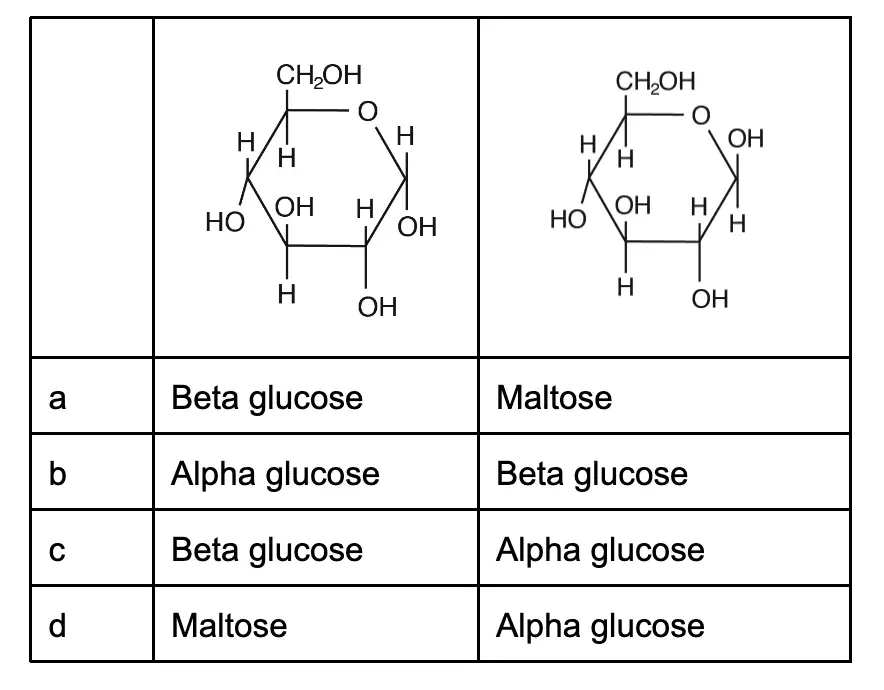
Identify the molecules:
a
b
c
d
How is maltose formed?
Hydrolysis reaction between two glucose molecules
Condensation reaction between a glucose and an amino acid
Addition reaction between two glucose molecules
Condensation reaction between two glucose molecules
What does hydrolysis mean?
A process of combining two substances through a chemical reaction
The breakdown of a molecule into its components using water
The process of converting a liquid into a gas
A method for producing electricity from water
What does a condensation reaction involve?
Combining two molecules to form a larger one with the release of water
Breaking down a complex molecule into its constituent parts using heat
The transition of a gas into a liquid
Mixing two substances to create a solid precipitate
What are the two types of starch found in plants?
Amylase and amylopectin
Amino acid and amylose
Amylose and amylopeptide
Amylose and amylopectin
What is glycogen made of?
Alpha glucose with 1-4 glycosidic bonds only
Alpha glucose with 1-4 and 1-6 glycosidic bonds
Alpha glucose with 1-6 glycosidic bonds only
Beta glucose with 1-4 and 1-6 glycosidic bonds
What is cellulose made of?
Beta glucose with 1-4 glycosidic bonds
Alpha glucose with 1-4 glycosidic bonds
Alpha glucose with 1-6 glycosidic bonds
Beta glucose with 1-4 and 1-6 glycosidic bonds
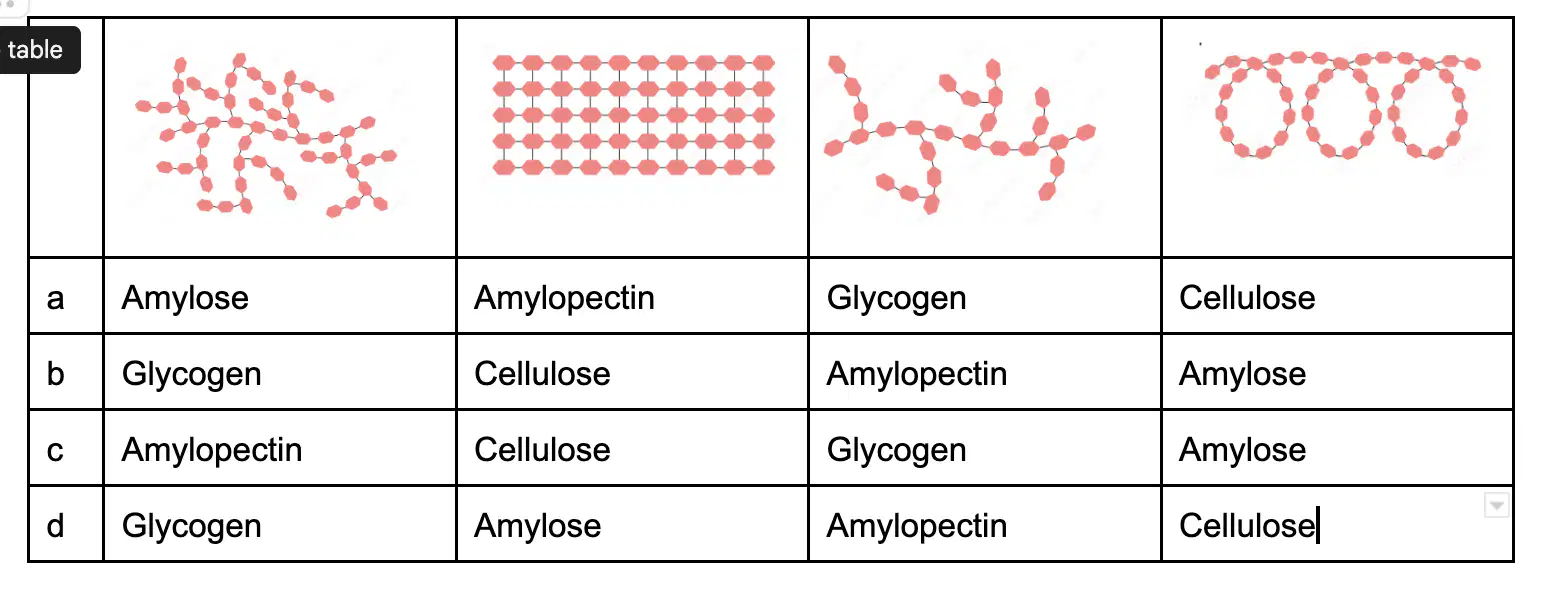
Identify the molecules:
a
b
c
d

Match the carbohydrate with the use:
a
b
c
d
starches with a linear structure are ....
amylose
polylose
amylopectin
gelatin
cellulose is also know as ______ in the diet
fiber
glucose
sugar
granules

These biomolecules are, in order of appearance...
cis and trans saturated fatty acids
cis and trans unsaturated fatty acids
trans and cis saturated fatty acids
trans and cis unsaturated fatty acids
A polymer of alpha-D-glucose found in plants has mostly 1,4 linkages and some 1,6 linkages. Which molecule fits this description?
glycogen
cellulose
amylose
amylopectin

What characteristic shows that this steroid molecule is a lipid?
it is made of carbon rings
it has a very low proportion of oxygen to carbon
it contains OH groups as do fatty acids
it is made only of nitrogen, oxygen, and hydrogen

The diagram shows the structure of palmitic acid. What type of fatty acid is palmitic acid?
it is monosaturated
it is polyunsaturated
it is saturated
it is a trans-fatty acid
What is a role of cholesterol in animal cells?
it increases body fat
it controls membrane fluidity
it lines the inner wall of capillaries
it is a constituent of bile
Which molecule diagram corresponds to the name?


In which compounds would a double bond link carbon to oxygen (C=O)?
I. amino acid
II. fatty acid
III. glycerol
I and II only
II and III only
I and III only
I, II, and III
That is the maximum number of fatty acids that can be condensed with glycerol?
one
two
three
four
Which of the following molecules is ribose?


Which process is an example of catabolism?
A. Translation of mRNA
B. Replication of DNA
C. Hydrolysis of protein
D. Synthesis of a disaccharide

Which molecule is depicted in the diagram?
A. A saturated fatty acid
B. An unsaturated fatty acid
C. A trans fat
D. A vegetable oil

The image shows the structural formula of a molecule.
What is this molecule?
A. Amino acid
B. Ribose
C. Deoxyribose
D. Lactose
Which molecule can be hydrolyzed?
A. Glycerol
B. Maltose
C. Fructose
D. Galactose
Which carbon compound produced by living organisms is inorganic?
A. DNA
B. Cellulose
C. Glucose
D. Carbon dioxide

A
B
C
D

A
B
C
D

A
B
C
D

What molecule is sugar?
A
B
C
D
A catalyst is a chemical that
blocks a chemical reaction from occurring
slows down a chemical reaction
speeds up the rate of a chemical reaction
has no effect on a chemical reaction

Object C in this image is know as the
enzyme
substrate
enzyme-substrate complex
product

This molecule represents a/an
monosaccharide
fatty acid
amino acid
nitrogen base
Which two factors can affect enzyme activity?
Light intensity
pH
Moisture
Temperature


What is the name of the bond that joins two amino acids together?
Ester bond
Glycosidic bond
Peptide bond
Nucleic bond
Which protein structure describes the sequence of amino acids?
Primary
Secondary
Tertiary
Quaternary
Alpha helix and beta sheet are examples of what type of protein structure?
Primary
Secondary
Tertiary
Quaternary
Which protein structure describes a protein's three-dimensional shape?
Primary
Secondary
Tertiary
Quaternary
Which protein structure is only found in proteins with more than one polypeptide chain?
Primary
Secondary
Tertiary
Quaternary
Which of the following can cause protein denaturation?
High heat
Cold temperatures
Strong acids
Strong bases
High pressure


Each amino acid is different from the other due to....
The R group
The amino group
The carboxyl group
The central carbon

Which colored box highlights the amino group?
Blue (left)
Turquoise (top)
Orange
Red
Purple

Which colored box is different for every amino acid?
Blue (left)
Turquoise (top)
Orange
Red
Purple

Which colored box highlights the carboxyl group?
Blue (left)
Turquoise (top)
Orange
Red
Purple
Alpha helix and beta sheet are examples of what type of protein structure?
Primary
Secondary
Tertiary
Quaternary
Which of the following structures involves the R groups interacting in a single polypeptide?
Primary
Secondary
Tertiary
Quaternary
A competitive inhibitor
binds to the allosteric site, blocking the substrate
binds to the active site, blocking the substrate
has a different shape than the enzyme
lowers the activation energy of a reaction
An inhibitor is a molecule that binds to the enzyme
and speeds up the enzymes function
is always reversible
slows down or stops the enzymes function
is always irreversible

What colour line represents non-competitive inhibition?
Green
Orange
Blue

Which colour line represents competitive inhibition?
Green line
Orange line
Blue line
Which of the following describes the active site?
the part of an enzyme that binds only to the product molecules
the sequence of amino acids responsible for the catalytic activity of enzymes
the sequence of amino acids responsible for the structure of an enzyme
the specific area responsible for the activity of all proteins
What determines the specificity of an enzyme for its substrate?
the temperature at which is it operating
the optimum pH of the enzymes
the concentration of the substrate
the structure of the enzyme molecule
Which levels of protein structure can determine the specificity of an enzyme?
primary
secondary
tertiary
primary
secondary
tertiary
quaternary
tertiary
quaternary
primary
secondary
quaternary
According to the induced fit model of enzyme function,
which of the following statements is correct?
active sites on enzymes are specific to a single substrate
the shape of the active site can be changed by the binding of an allosteric inhibitor
the binding of the substrate changes the shape of the active site slightly
competitive inhibitors can change the shape of enzymes
Which of the following statements are correct for the induced fit hypothesis?
1 - folding of an enzyme molecule causes the formation of the active site
2 - the shape of the active site changes to enable the substrate to bind
3 - temporary bonds hold the substrate in the active site
4 - more ES complexes are formed at the optimum temperature
1 and 2
1 and 3
2, 3 and 4
2 and 4

The graph shows the activation energy of an enzyme catalysed reaction and the same reaction without a catalyst.
Which arrow shows the activation energy of the uncatalysed reaction?
A
B
C
D

The diagram shows the energy changes in a chemical reaction. What would happen to the changes in energy if this reaction was controlled by an enzyme?
I would increase
II would decrease
I and IV would decrease
II and III would decrease
Which reaction is an example of catabolism?
Photolysis of water
Denaturation of a protein by a change in pH
Production of maltose from amylose by amylase
Condensation of glucose to form starch
Which type of chemical reaction is an example of anabolism?
Combustion
Condensation
Hydrolysis
Photolysis
Which type of chemical reaction is an example of anabolism?
Combustion
Condensation
Hydrolysis
Photolysis
In which processes are macromolecules broken down into monomers?
Anabolism and catabolism
Catabolism and hydrolysis
Hydrolysis and reduction
Reduction and anabolism

