wayground logo

Free Printable Worksheets

Font size

S
M
L
XL
Worksheets

AQA8464 Varia, evol and class, gen eng

Total questions: 128

Worksheet time: 2hrs 52mins

Name
Class
Date
1.
Evolution is .....
a)
the process by which species change over time
b)
responsible for similarities we see across all species
c)
responsible for the great variety of things on Earth
d)
all of the above
2.
Which is not a type of adaptation?
a)
structural
b)
predatory
c)
physiological
d)
behavioral
3.
As a species evolve, they develop ________ and ________ others
a)
old traits, save
b)
new traits, save
c)
old traits, lose
d)
new traits, lose
4.
Traits that help an organism survive are called....
a)
evolution
b)
natural selection
c)
adaptations
d)
habitats
5.
Which of the following is an example of a physical trait , or structural adaptation?
a)
a long neck of a giraffe
b)
building a nest
c)
regulation of body functions
d)
production of a toxic substance
6.
Which is an example of a physiological adaptation?
a)
building a nest
b)
regulation of body temperature
c)
long neck of a giraffe
d)
needles of a pine tree
7.
An organism that survives longer is more likely to produce_______offspring
a)
less
b)
the same amount
c)
more
d)
no
8.
Most adaptations that help an organism survive are passed on from parent to child as ___traits?
a)
adaptable
b)
physical
c)
more
d)
inherited
9.
The ability to recognize a predator is an example of a ______adaptation?
a)
behavioral
b)
structural
c)
physiological
10.
Which is an example of an organism protecting themselves from another organism __?
a)
white color in the snow
b)
hibernation during winter
c)
thick fur in the winter time
11.
Differences that exist naturally among members of a population or species___?
a)
mutation
b)
adaptation
c)
variations
d)
evolution
12.
Sources of variations include _______ and ______?
a)
sexual reproduction, mutations
b)
asexual reproduction, mutations
c)
biological evolution, genetics
d)
biological evolution, genetics
13.
Species with ______variation are ______likely to survive.
a)
more, less
b)
less,less
c)
less,more
d)
more,more
14.
What is the name of the medicines given to people who have bacterial infections?
a)
benedryl
b)
morphine
c)
antibiotics
d)
probiotics
15.
Change in a gene or chromosome
a)
evolution
b)
variation
c)
mutation
d)
adaptation
16.
Which most likely led to major changes in biological evolution?
a)
separation of landmasses
b)
short periods of drought
c)
long periods of drough
17.

Scientists classify organisms based on their _____.

a)

Population

b)

Characteristics

c)

Age

d)

Likes and Dislikes

18.

What do scientists use to refer to organisms because common names can create confusion?

a)

Scientific Names

b)

Latin Kingdoms

c)

Nicknames

d)

First Name

19.

The scientific name of a cherry blossom tree is Prunus yedoensis. What is its genus?

a)

Plantae

b)

Prunus

c)

Yedoensis

d)

Felis

20.

What is the correct order of Classification?

a)

Phylum, Kingdom, Class, Order, Family, Genus, Species

b)

Kingdom, Phylum, Order, Class, Family, Genus, Species

c)

Kingdom, Phylum, Class, Order, Family, Genus, Species

d)

Kingdom, Phylum, Class, Family, Genus, Species

21.

The scientific name for an organism comes from its _____.

a)

class and phylum

b)

family and species

c)

kingdom and phylum

d)

genus and species

22.

What is a tool that is used to identify organisms and that consists of paired statements?

a)

Cladogram

b)

Dichotomous Key

c)

Map

d)

Fossil Record

23.

On this Cladogram, which animals have fur?

a)

Mouse, Chimp

b)

Pigeon, Mouse, Chimp

c)

Lizard, Pigeon, Mouse, Chimp

d)

Chimp

24.

Which Level of Classification is missing from the YELLOW section?

a)

Kingdom

b)

Phylum

c)

Order

d)

Family

25.

What Level of Classification is missing from the RED section?

a)

Kingdom

b)

Order

c)

Genus

d)

Species

26.

What Level of Classification is missing from the PURPLE section?

a)

Class

b)

Order

c)

Family

d)

Genus

27.

What Level of Classification is missing from the ORANGE section?

a)

Genus

b)

Family

c)

Kingdom

d)

Species

28.

Using the cladogram below, which animals DON'T have lungs?

a)

Hagfish and Perch

b)

Salamander and Lizard

c)

Mouse and Chimp

d)

Pigeon

29.
Which of the following is the correct way to write the scientific name of the Northern cardinal?
a)
cardinalis cardinalis
b)
Cardinalis cardinalis
c)
cardinalis Cardinalis
d)
Cardinalis Cardinalis
30.
Natural selection could not occur without...
a)
genetic variation in species
b)
stable environments
c)
competition for unlimited resources
d)
gradual warming of the Earth
31.
Which is not classified as a living thing?
a)
bacteria 
b)
giant kelp
c)
slime mold
d)
virus
32.
Use the cladogram to determine which of the following organisms is most closely related to the dog?
a)
cat
b)
frog
c)
fish
d)
fly
33.
The species of finches that Darwin observed differed in the shape of their beaks.  According to Darwin, all of these species probably differed due to...
a)
natural selection
b)
had migrated from Africa
c)
had descended from similar birds in Africa
d)
ate the same diet
34.
An inherited characteristic that increases an organism's ability to survive and reproduce in its specific environment is called a(n)...
a)
homologous structure
b)
vestigial organ
c)
adaptation
d)
speciation
35.
When farmers select the largest hogs, the fastest horses, or the cows that produce the most milk for breeding it is called...
a)
natural selection
b)
artificial selection
c)
survival of the fittest
d)
homologous variation
36.
The study of the evolutionary relationships among organisms is called...
a)
taxonomy 
b)
domainology
c)
phylogeny
d)
binomial nomenclature
37.
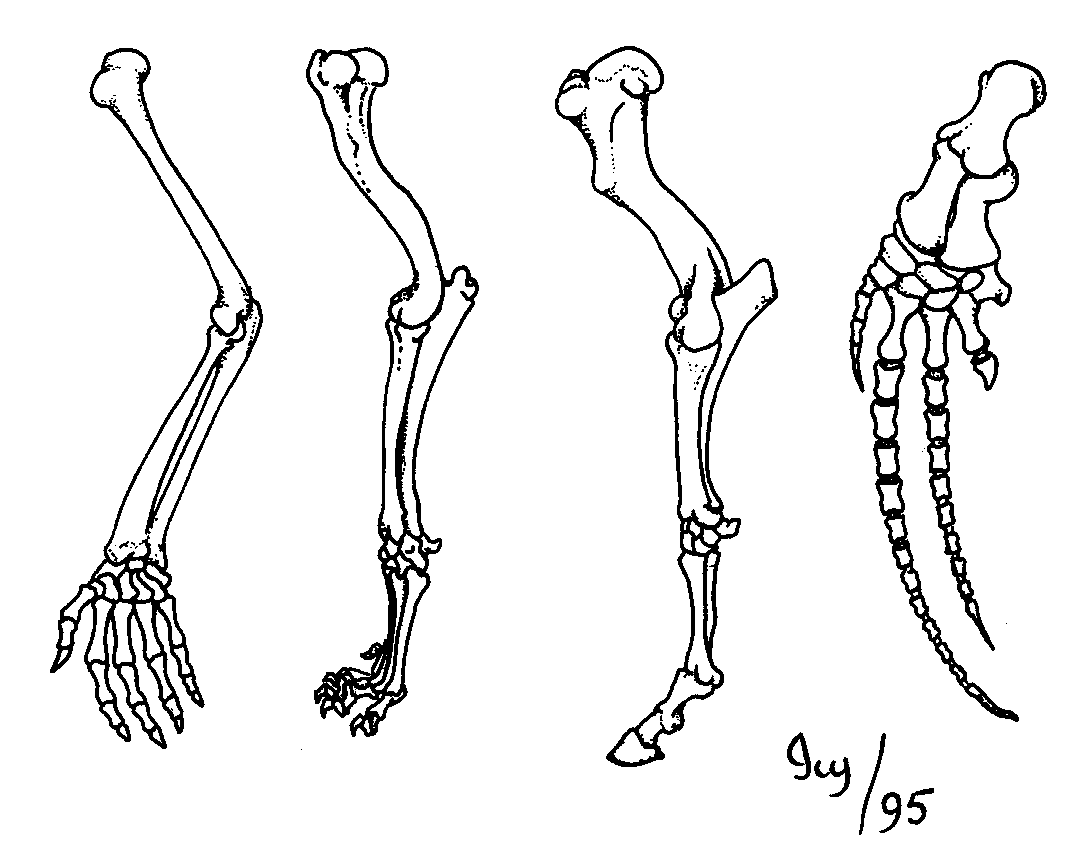
Refer to the illustration.  The similarity of these structures is one from of evidence that the organisms...
a)
share a common ancestor
b)
all grow at different rates
c)
evolved instantaneously
d)
live for a long time
38.
Which of the following would lead to genetic variation?
a)
crossing over
b)
independent assortment
c)
mutations
d)
all answers are correct
39.
Natural selection is the process by which...
a)
the age of selected fossils is calculated
b)
organisms with traits well suited to their environment survive and reproduce more successfully than organisms less suited to the same environment
c)
acquired traits are passed on from one generation to the next
d)
all answers are correct
40.
Evidence that evolution occurs includes all of the following except...
a)
no change has occurred in any species
b)
similarities in proteins and DNA sequences between organisms
c)
the fossil record
d)
homologous structures among different organisms
41.
A human appendix, whale hipbones, and skink's legs are examples of...
a)
homologous structures
b)
embryonic mates
c)
vestigial organs
d)
analogous structures
42.
When Darwin published his first book about evolution, he included all of the following ideas except...
a)
the idea that species change slowly over time
b)
the idea that some organisms reproduce at a greater rate than others
c)
the idea that species are permanent and unchanging
d)
the idea that some species become better suited to their environment than others
43.
How do fossils demonstrate evidence of evolution?
a)
They show that ancient species share similarities with species now on Earth
b)
They show evidence of species that are not extinct
c)
They are the primary source of evidence of natural selection
d)
Fossils reveal that many species have remained unchanged for millions of years
44.
Scientists see anatomical and molecular similarities among organisms that suggest that life on Earth began about 4 billion years ago as what type of organism?
a)
multicellular organisms
b)
eukaryotic organisms
c)
simple, one-celled organisms
d)
heterotrophic organisms
45.
Darwin believed in the idea that evolution happened slowly over a long period of time called
a)
punctuated equillibrium
b)
gradualism
c)
symbiosis
d)
mass extinction
46.
 In a population of clover flowers, there are both white and purple varieties.  The cows that graze the field where the clover grows prefer the purple variety.  Over time, the white clover flowers become much more numerous and the purple ones more scarce.  This is an example of which process that can cause evolutionary change?
a)
genetic equilibrium
b)
genetic mutation
c)
natural selection
d)
overproduction
47.
Which of the following list the taxa from broadest to most specific?
a)
domain, kingdom, class, order, phylum, family, genus, species
b)
species, genus, family, order, class, phylum, kingdom, domain
c)
domain, kingdom, phylum, class, order, family, genus, species
d)
 phylum, kingdom, class, family, order, genus, domain, species
48.
Structures that have different mature forms, but develop from the same embryonic structure are called ______________ structures.
a)
Darwinian
b)
Larmarckian
c)
homologous
d)
fossils
49.

Moist skin covered in scales

a)

Vertebrate

b)

Birds

c)

Fish

d)

Reptiles

50.

Dry skin with scales

a)

mammals

b)

Fish

c)

Birds

d)

Reptiles

51.

P = Genus

Q = Phylum

R = Class

S = Kingdom

T = Family

U = Species

V = Order


which of the following sequence shows the hierarchy of classification

a)

Q, S, U, V, T, P, R

b)

S, Q, R, V, T, P, U

c)

V, T, P, S, U, Q, R

d)

U, T, Q, P, V, S, R

52.

The lion, Panthera leo; the leopard, Panthera pardus; and the tiger, Panthera tigris; all share what classification?

a)

species

b)

genus

c)

class

d)

family

53.

According to the Linnaean Classification of organisms - if two organisms are in the same class then they must also be in the same:

a)

kingdom

b)

genus

c)

family

d)

phylum

54.

Compare the trilobite fossil to the 4 images of living organisms. Based on physical evidence, which animal is most like the ancient trilobite?

a)

scallop

b)

pillbug

c)

locust

d)

roundworm

55.

Looking at the two images of fossils above, one is older than the other. Which one is the older of the two

a)

the one on the left because it is more complex

b)

the one on the left because it is more primative

c)

the one on the right because it is more primative

d)

the one on the right because it is more complex

56.

Scientists believe that earlier generations of the giraffe had shorter legs and necks than those of today. Why?

a)

They were omnivores who ate both meat and plants

b)

Their food source was closer to the ground

c)

They would be faster to get away from predators

d)

There were no trees back then

57.

Darwin studied the finches of the Galapagos Islands. He noticed the difference in their beak shapes and sizes. What did he attribute those differences to?

a)

different ancestors

b)

crossbreeding with other birds

c)

defense from predators

d)

food sources available

58.

Blue beetles and green beetles live in a tropical forest. Green beetles are able to camouflage into the environment while blue beetles cannot. Based on the theory of natural selection, what will probably happen to the blue beetles?

a)

Their population will increase

b)

Their population will decrease

c)

They will breed with green beetles

d)

They will move to a new ecosystem

59.

Arctic foxes and snowshoe rabbits have specific adaptations that evolved over time to help them survive. Both turn white in the winter and have fur on the pads of their feet. These are adaptations to:

a)

food source

b)

environment

c)

competition

d)

mating

60.

Both the Atlantic gray whale and the stellar sea cow became extinct in the 1800's. More recently, the Caribbean monk seal was added to the extinct species list. What is the most likely cause of their extinction?

a)

global warming

b)

deforestation

c)

over-hunting by humans

d)

drop in sea level

61.

Layers of rock give evidence of

a)

Lamarckian inheritance.

b)

population growth.

c)

the great age of Earth.

d)

artificial selection.

62.

The largest division that a group of organisms can belong to is a

a)

Domain

b)

Species

c)

Phylum

d)

Kingdom

63.
Which layer is the oldest?
a)
1
b)
2
c)
3
d)
4
64.
The term for the formation of new and distinct species over the course of evolution is...
a)
speciation
b)
biological species concept
c)
reproductive barrier
d)
natural selection
65.
What is a species? 
a)
A group of organisms that can mate with each other and produce fertile offspring. 
b)
A group of organisms that can mate and produce offspring even if those offspring are infertile.
c)
A group of organisms that genetically are very different from each other. 
d)
Indivual organisms that live in the same environment. 
66.

Explain why there are no fossils of many early forms of life

a)

Early forms of life where too soft to form fossils

b)

Early forms of life were very, very small so finding fossilised remains is very difficult.

c)

Most dead organisms do not form fossils they decay

d)

All of the above

67.
The climate of a certain area is cold, and snow is found on the ground most of the year. Equal numbers of two populations of rabbits are introduced into this climate by a group of scientists. One of the populations is brown and the other is white. Predict what will happen over several generations.
a)
There will be equal numbers of brown and white rabbits
b)
There will be more brown rabbits that white rabbits
c)
There will be more white rabbits than brown rabbits
d)
There is no way to predict what will happen to the rabbit population
68.
How would you describe this evolution?
a)
Homologous structure
b)
Analogous structure
c)
Structural adaption
d)
Functional adaption
69.
Structures with the same parts have different functions; suggests that organisms share a common ancestry
a)
vestigial structures
b)
homologous structures
c)
adaptive radiation
d)
fossil
70.

What are the rules to scientific naming?

a)

Genus first and capitalized

b)

Species second and lower cased

c)

in italics or underlined

d)

genus + species

71.

Who's system of taxonomy do we use?

a)

Linnaeus

b)

Darwin

c)

Lamarck

d)

Hooke

72.

Which type of evolution means to different species becoming more and more similar?

a)

convergent evolution

b)

divergent evolution

c)

parallel evolution

73.
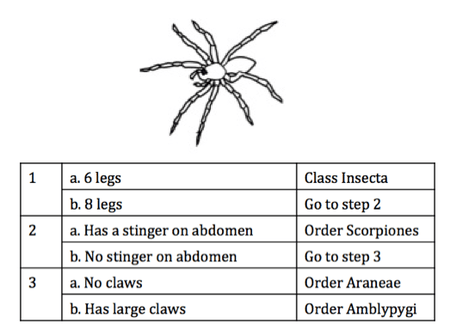
An illustration and a dichotomous key are given. What is the correct classification for this organism?
a)
Class Insecta
b)
Order Amblygygi
c)
Order Araneae
d)
Order Scorpiones
74.
A dichotomous key for trees is provided. Hikers found a tree that has large brown cones and single sharp needles. What species of tree have the hikers found?
a)
Juniper
b)
Pine
c)
Spruce
d)
Fir
75.
Coloring or another physical characteristic that help an organism blend in with its environment
a)
mimicry
b)
camouflage
c)
hibernation
d)
migration
76.

According to natural selection, light colored tree trunks would favor

a)

light colored moths

b)

dark colored moths

c)

red colored moths

d)

red and light colored moths

77.
What is the advantage of having different shaped beaks?
a)
To look different from other species.
b)
To be able to eat the food readily available in the environment.
c)
To protect itself against predators.
d)
To protect itself against prey.
78.

Which trait do only humans have, according to the cladogram?

a)

jaws

b)

mammary glands & hair

c)

terrestrial during all life stages

d)

bipedal & opposable thumbs

79.
According to this cladogram, birds are LEAST related to -
a)
Amphibians
b)
Sharks
c)
Ray Finned Fish
d)
Crocodiles
80.
What trait separates sharks from ray-finned fish?
a)
Vertebrae
b)
Bony skeleton
c)
Four limbs
d)
None
81.
Which species’ DNA is most similar to the DNA of the toothed whale? 
a)
Hippopotamus 
b)
Baleen Whale
c)
Grazing Mammals
d)
Camels
82.

A chart comparing the base sequences of homologous segments of DNA from various primates is provided. The information in the chart can be used to conclude that which pair of organisms have the most recent common ancestor?

a)

Chimpanzees and baboons

b)

Chimpanzees and lemurs

c)

Gorillas and chimpanzees

d)

Gorillas and baboons

83.

According to most scientists, what is the ultimate cause of most mass extinctions?

a)

overhunting

b)

evolution of new species to replace old ones

c)

major change in environment

d)

asteroid impact

84.
Which of these describes a species that has become extinct?
a)
fewer members of the species are dying than being born
b)
more members of the species are dying than being born
c)
very few members of a species are alive
d)
all members of a species have died
85.
Which of the following species is extinct?
a)
woolly mammoth
b)
giant panda
c)
bald eagle
d)
green sea turtle
86.
Which of the following is NOT a reason a species may become extinct?
a)
competition
b)
reproducing
c)
habitat loss
d)
overhunting
87.

Why do scientists think that NOT ALL dinosaurs died in the Cretaceous extinction?

a)

They have photographic evidence

b)

Because birds are still living today

c)

A zoo in California has a living dinosaur

d)

Birds are descendants of dinosaurs

e)

Only non-birds went extinct.

88.

Species that are in danger of becoming extinct are called __________.

a)

endangered

b)

not lucky

c)

extinct

d)

in a jam

89.
What is a mass extinction?
a)
When all the species in a particular area on earth suddenly go extinct
b)
When multiple species from all over the earth suddenly go extinct 
c)
When one species goes extinct due to habitat changes
d)
When all life on earth is wiped out 
90.

Choose all that apply. Fossils are great clues to life in the past. However, they have limitations. Some of those limitations are:

a)

We have fossils for only 1% of species believed to have lived.

b)

They are fragile and break easy loosing any evidence we have.

c)

They do not show us internal structures.

d)

They are too deep in the Earth to find.

91.

These teeth suggest this animal was a __________.

a)

herbivore

b)

omnivore

c)

carnivore

d)

foodivore

92.

How did this deeply buried fossil become exposed at the Earth's surface?

a)

it crawled through the rock

b)

erosion uncovered it

c)

dynamite blasted the rock away

d)

rock never formed here

93.

What did this animal most likely eat?

a)

plants

b)

fruit

c)

insects

d)

meat

94.

What do you call a scientist that studies fossils?

a)

Ecologist

b)

Paleontologist

c)

Zoologist

d)

Fossilologist

95.

According to most scientists, what is the ultimate cause of most mass extinctions?

a)

overhunting

b)

evolution of new species to replace old ones

c)

major change in environment due to extreme natural events

d)

asteroid impact

96.
Humans are causing extiction in which ways?
a)
By over hunting animals for food or products.
b)
By destroying the natural habitat of species.
c)
By polluting the environments of the world.
d)
All of the above.
97.
 Which is LEAST LIKELY to push a species toward extinction?  
         
a)
a.   Cutting down entire forest 
b)
b.  Putting animals in a zoo 
c)
 c.   Polluting mountain streams 
d)
d.   Introducing new species to an ecosystem with no known natural predator    
98.

What % of the species that have every lived are alive today?

a)

1%

b)

10%

c)

50%

d)

75%

99.
What happens when species produce too many offspring?
a)
Species share the limited resources 
b)
Species eat less so that all can survive
c)
Only those that are least fit can survive
d)
Only those that are best fit can survive
100.
Which of the following is an example of artificial selection?
a)
The loss of the dodo bird
b)
The finches of Galapagos
c)
The armadillo
d)
The breeding of dogs
101.
Which of the following must happen for a new species to evolve?
a)
Isolation
b)
Adaptation
c)
Differentiation 
d)
All of the possible multiple choice answers
102.
When a population becomes divided by an event such as a new river forming, ____________ has occurred.
a)
Differentiation 
b)
Isolation
c)
Adaptation
d)
Separation
103.
Variations in a population are caused by:
a)
Natural Selection
b)
Selective Breeding
c)
Artificial Selection
d)
Random Mutations
104.
Extinction occurs when __________ happens. 
a)
Loss of habitat
b)
Isolation
c)
Differentiation
d)
Adaptation 
105.
The variations within a population will most likely be passed on to future generations if they are: 
a)
Due to a mutation and result in beneficial variations
b)
Due to a mutation and result in harmful variations
c)
Not due to a mutation and result in harmful variations
d)
Not due to a mutation and result in beneficial variations
106.
____________ development of new species when a population is reproductively isolation in some form.
a)
Competitive 
b)
Speciation
c)
Isolation
d)
mutation
107.
Putting the gene for bioluminescence into a fish is an example of...
a)
Genetic Engineering
b)
Selective Breeding
c)
Artificial Selection
d)
Gene Mutation
108.
DNA can be spliced, in order to insert it in a different organism, using
a)
prescription enzymes
b)
digestive enzymes
c)
restriction enzymes
d)
transcription enzymes
109.
When human DNA is inserted in bacterial DNA to create insulin it is called
a)
viral DNA
b)
bacterial DNA
c)
recombinant DNA
d)
transcribed DNA
110.
Genetic engineering has been used to produce
a)
medicines.
b)
food animals.
c)
improved crops.
d)
all of these.
111.
A molecule containing DNA from two different organisms is called
a)
a plasmid.
b)
a polyploid.
c)
a hybrid organism.
d)
recombinant DNA.
112.
Any change or mistake in DNA replication can cause a ________  
a)
cancer cell 
b)
virus
c)
disease
d)
mutation
113.
Genes found on DNA contain the instructions for making  
a)
pyrimidines 
b)
pyrimidines
c)
proteins
d)
purines
114.
simple ring of DNA from prokaryotes
a)
plasmid
b)
restriction enzymes
c)
recombinant DNA
d)
gene
115.
molecular scissors that "cut' DNA
a)
plasmid
b)
restriction enzymes
c)
recombinant DNA
d)
gene
116.
In which step would the enzyme ligase be used?
a)
A
b)
B
c)
C
d)
D
117.
Which of these is the gene we will put into the bacterial plasmid?
a)
A
b)
B
c)
C
d)
D
118.
What would have caused the plasmid (B) to open?
a)
restriction enzyme
b)
ligase
c)
gene therapy
d)
sticky ends
119.
In step D, recombinant DNA is being placed back into _____ to be cloned by asexual reproduction.
a)
a bacteria
b)
a human
c)
a virus
d)
a sheep
120.
Deciding whether or not it is right to do certain things in biology  (e.g selective breeding) is called...
a)
cloning
b)
politics
c)
ethics
d)
gene therapy
121.
What is recombinant DNA?
a)
Adding DNA from one organism into the DNA of another
b)
DNA which has been changed over generations by natural selection
c)
DNA that causes genetic disorders
d)
DNA that has been sequenced
122.
The process of making changes in the DNA code of a living organism is called
a)
selective breeding 
b)
genetic engineering
c)
inbreeding
d)
hybridization
123.
Restriction enzymes....
a)
Cut  human DNA at a specific site
b)
Can be used to remove a gene of interest from a big lenght  of DNA
c)
Can be used to cut plasmid DNA
d)
Do all of these things
124.
Restriction Enzymes come from . . . 
a)
viruses
b)
bacteria
c)
goats
d)
spiders
125.
What shape are plasmids?
a)
linear
b)
circular
c)
double helix
d)
square
126.
In order to insert a human gene into plasmid, both must 
a)
code for the same gene product.
b)
be cut by the same restriction enzyme.
c)
originate from the same type of cell.
d)
have identical sequences.
127.
Which of these is a step in the genetic engineering process?
a)
Selection of the desired characteristic
b)
Isolation of the gene responsible for the characteristic
c)
Insertion of the gene into another organism
d)
All are correct
128.
How do we make enough insulin for people with diabetes?
a)
We kill a dog and remove insulin from the dog's pancreas.
b)
We genetically modify a bacteria and the bacteria make insulin for us.
c)
We get some insulin from the pancreas of a family friend
d)
None of them