wayground logo

Free Printable Worksheets

Font size

S
M
L
XL
Worksheets

practice final for chem

Total questions: 107

Worksheet time: 2hrs 29mins

Name
Class
Date
1.

The positive particles of an atom are

a)

electrons

b)

positrons

c)

neutrons

d)

protons

2.

Where are an atom's neutrons and protons located?

a)

nucleus

b)

electron cloud

c)

core

d)

center

3.

An atom with atomic number 6 would have how many protons?

a)

6

b)

12

c)

3

d)

Not enough information

4.
Particles in an atom that are neutral and have no charge are 
a)
negatrons 
b)
electrons 
c)
neutrons 
d)
protons 
5.
What is the atomic number for an element with three protons?
a)
2
b)
1
c)
3
d)
6
6.

In this image, what does 1.00794 stand for?

a)

Hydrogen

b)

atomic number

c)

atomic mass

d)

atomic explosion

7.

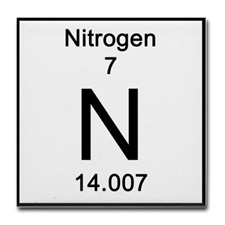
What is the number of protons that the element in this image contains?

a)

14

b)

7

c)

15

d)

18

8.
What is the atomic mass of "F"
a)
9
b)
18
c)
17
d)
19
9.
Where are electrons of an atom found?
a)
Nucleus
b)
Electron Cloud
c)
Some are in the nucleus and some in the electron cloud.
d)
They are moving everywhere.
10.

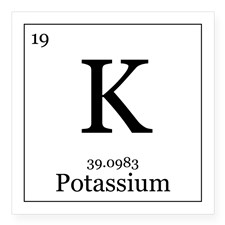
How many neutrons are in the atom "K"?

a)

7

b)

2

c)

39

d)

20

11.

Which state of matter does this picture best represent?

a)

Solid

b)

Liquid

c)

Gas

12.

Which state of matter does this picture best represent?

a)

Solid

b)

Liquid

c)

Gas

13.
What happens to the particles when you “cool off” a substance?
a)
speed up
b)
sink
c)
slow down
d)
run over each other
14.

What happens to a substance when you decrease its temperature?

a)

expands

b)

breaks down

c)

dissolves

d)

contracts

15.

When heating up a substance, the particles begin to ________________________ and _______________________.

a)

expand; slow down

b)

spread apart; move faster

c)

contract; speed up

d)

come closer together; move slower

16.
A(n) _____________ is a device for measuring temperature.
a)
thermometer
b)
barometer
c)
anemometer
d)
psychrometer 
17.

What is the relationship between degrees Celsius and Kelvin?

a)

Kelvin + 273.15 = Degrees Celsius

b)

Degrees Celsius + 273.15 = Kelvin

c)

Degrees Celsius multiplied by 273.15 = Kelvin

d)

Kelvin divided by 273.15 = Degrees Celsius

18.
In what units is temperature measured?
a)
degrees Celsius
b)
Kelvin
c)
both Kelvin and degrees Celsius
d)
neither 
19.

An atom's overall charge on the periodic table is

a)

positive

b)

depends on its mood

c)

neutral

d)

negative

20.
The smallest particle of any particular type of matter is known by which of the following terms?
a)
Compound
b)
Atom
c)
Chemical
d)
Element
21.

If the number of protons in an atom equals the number of _______, the atom will have no charge.

a)

protons

b)

neutrons

c)

electrons

d)

nucleus

22.

Two atoms of the same element but with different mass numbers are ________.

a)

relatives

b)

isotopes

c)

variables

d)

unstable

23.
How many neutrons does the isotope of lithium have?
a)
8
b)
3
c)
4
d)
5
24.
What is the atomic symbol for sodium?
a)
Na
b)
So
c)
NaCl
d)
S
25.
Which particles make up the nucleus of an atom?
a)
protons and neutrons
b)
electrons and protons
c)
electrons, protons, and neutrons
d)
electrons and neutrons
26.

What is 323 Kelvin in degrees Celcius?

a)

-50 oC

b)

50 oC

c)

100 oC

d)

25 oC

27.

Beakers are used

a)

to measure volume with high accuracy and precision

b)

to hold small amounts of dry chemicals

c)

to recover dissolved solids

d)

to measure approximate volumes and observe reactions

28.

Identify the equipment shown here:

a)

beaker

b)

Erlenmeyer flask

c)

Florence flask

d)

volumetric flask

29.

What does this picture likely represent?

a)

solid

b)

liquid

c)

gas

d)

plasma

30.

Isotopes of an element have the same number of ______, but a different number of ______.

a)

protons; electrons

b)

neutrons; protons

c)

protons; neutrons

d)

electrons; protons

31.

In a lab report, what do you call your prediction of what will happen in your experiment?

a)

Data Analysis

b)

Hypothesis

c)

Purpose

d)

Evaluation

32.
1000 grams = _____ kilograms
a)
0.0001
b)
1,000,000
c)
10
d)
1
33.
42 L = ___mL
a)
4,200
b)
.0042
c)
4.20
d)
42,000
34.
Blue Color
a)
Physical Property
b)
Chemical Property
35.
Density
a)
Physical Property
b)
Chemical Property
36.
Flammability (burns)
a)
Physical Property
b)
Chemical Property
37.
Reacts with acid
a)
Physical Property
b)
Chemical Property
38.
Reacts with water
a)
Physical Property
b)
Chemical Property
39.

Sugar dissolves in water

a)

Physical Change

b)

Chemical Change

40.

Length

a)

Intensive Property

b)

Extensive Property

41.

Density

a)

Intensive Property

b)

Extensive Property

42.

Melting point

a)

Intensive Property

b)

Extensive Property

43.

Volume

a)

Intensive Property

b)

Extensive Property

44.

Freezing point

a)

Intensive Property

b)

Extensive Property

45.

Which set of properties, intensive or extensive, are based on the size of a sample?

a)

intensive

b)

extensive

46.

What kind of physical property is this? Color

a)

intensive

b)

extensive

47.

What kind of physical property is this? Hardness

a)

intensive

b)

extensive

48.

What kind of physical property is this? Volume

a)

intensive

b)

extensive

49.

What kind of physical property is this? Mass

a)

intensive

b)

extensive

50.

What kind of physical property is this? Melting Point

a)

intensive

b)

extensive

51.
Frank has an eraser. It has a mass of 4g, and a volume of 2cm3. What is its density?
a)
8 g/cm3
b)
2 g/cm3
c)
1/2 g/cm3
d)
24 g/cm3
52.
Frank has a paper clip. It has a mass of 9g and a volume of 3cm3. What is its density?
a)
3 g/cm3
b)
1/3 g/cm3
c)
27 g/cm3
d)
39 g/cm3
53.
Mercury is a metal that is liquid at room temperature and has a density of 13.5 g/cm3.  Which of these metals would sink below the mercury if dropped into a container of mercury?
a)
gold (density=19.3 g/cm3)
b)
lead (density=11.4 g/cm3)
c)
iron (density=7.9g/cm3)
d)
aluminum (density=2.7g/cm3)
54.
What is the volume of 150 grams of lead if it has a density of 11.3 g/cm3?
a)
13.3 g
b)
13.3 cm3
c)
.075 g
d)
1695 cm3
55.

Freshly brewed black coffee

a)

Heterogeneous

b)

Homogeneous

56.

Lucky Charms

a)

Heterogeneous

b)

Homogeneous

57.

Air

a)

Heterogeneous

b)

Homogeneous

58.

Milk

a)

Heterogeneous

b)

Homogeneous

59.
Are made from a combination of 2 or more elements...
a)
Molecules
b)
Pure Substances
c)
Compounds
d)
Elements
60.
A combination that can be separated by physical processes is a .....
a)
Pure Substance
b)
Glucose
c)
Element
d)
Mixture
61.
A mixture that is NOT evenly distributed is called ....
a)
Compounded
b)
Homogenous
c)
Heterogenous
d)
Salty
62.
Mixture, such as mixed nuts or dry soup mix, in which different materials are unevenly distributed and are easily identified.
a)
suspension
b)
homogeneous mixture
c)
heterogeneous mixture
d)
colloid
63.
Substance with atoms that are all alike.
a)
element
b)
compound
c)
homogeneous mixture
d)
heterogeneous mixture
64.
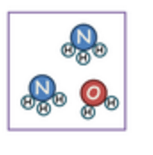
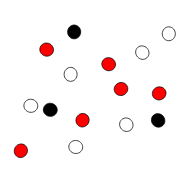
This picture represents: 
a)
Element
b)
Compound
c)
Mixture of Elements
d)
Mixture of Compounds
65.
This picture represents: 
a)
Element
b)
Compound
c)
Mixture of Elements
d)
Mixture of Compounds
66.
This picture represents: 
a)
Element
b)
Compound
c)
Mixture of Elements
d)
Mixture of Compounds
67.
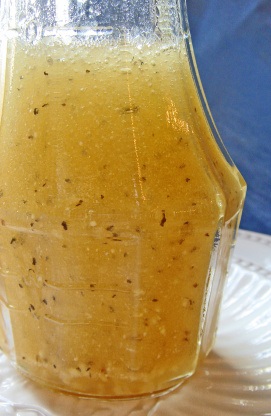
Italian Salad Dressing is a . . .
a)
heterogeneous mixture
b)
homogeneous mixture
c)
Pure Substance
d)
Compound
68.
A mixture that is so evenly mixed you can't see the parts.  Such as Kool-Aid
a)
Homogeneous Mixture
b)
Heterogeneous Mixture
c)
Pure Substance
69.
Which one of these pictures represents a pure substance? 
a)
1 and 2
b)
1 and 3
c)
2 and 3
d)
1, 2 and 3
70.
Element or compound that can't be broken down into simpler components and maintains the properties of the original substance.
a)
compound
b)
substance
c)
element
d)
law of conservation of mass
71.
It is a measure of how close measurements come to each other when they are made in the same way
a)
Accuracy
b)
Precision
c)
Error
d)
Extrapolation
72.
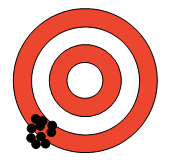
This bullseye demonstrates...
a)
High Accuracy & High Precision
b)
High Accuracy & Low Precision
c)
Low Accuracy & High Precision
d)
Low Accuracy & Low Precision
73.
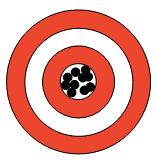
?
a)
High Accuracy & High Precision
b)
High Accuracy & Low Precision
c)
Low Accuracy & High Precision
d)
Low Accuracy & Low Precision
74.
Describe the accuracy and precision of the image
a)
Accurate and Precise
b)
Accurate and not precise
c)
Not Accurate and Precise
d)
not accurate and not precise
75.
This image is an example of...
a)
precision ONLY
b)
accuracy ONLY
c)
BOTH precision and accuracy
d)
NEITHER precision and accuracy 
76.
Which is the electron configuration for an oxygen atom?
a)
1s22s22p63s23p64s2
b)
1s22s22p4
c)
1s22s22p6
d)
1s22s22p63s23p6
77.
What atom matches this electron configuration?
1s2s2p3s2
a)
Neon
b)
Magnesium
c)
Aluminum
d)
Potassium
78.
How many valence electrons are represented here?
a)
7
b)
5
c)
2
d)
8
79.
What is the maximum number of electrons that an orbital can have?
a)
1 electron
b)
2 electrons
c)
3 electrons
d)
4 electrons
80.
What is this element? 
1s22s22p63s23p6
4s23d104p6
a)
Argon
b)
Krypton
c)
Selenium
d)
Bromide
81.
What atom matches this electron configuration?
[Xe] 6s2 4f14 5d9
a)
Mercury
b)
Gold
c)
Platinum
d)
Thallium
82.
How many valence electrons does Chlorine have?
a)
5
b)
2
c)
7
d)
5
83.
How many electrons can the first energy level hold?
a)
1
b)
2
c)
8
d)
0
84.
Which element is pictured?
a)
neon
b)
fluorine
c)
magnesium
d)
argon
85.
Identify the element in Period 5 that has 1 valence electron?
a)
Rb
b)
Nb
c)
Ag
d)
Sb
86.
Electron arrangement that uses arrows
a)
Electron configuration
b)
Shorthand configuration
c)
Lewis dot structure
d)
Orbital diagram
87.
What does Pauli exclusion principle state ?
a)
states that each electron occupies the lowest energy orbital available
b)
states that a maximum of two electrons can occupy a single atomic orbital, but if only if the electros have opposite spins
c)
states that single electrons electrons with the same spin must occupy each-energy orbital before additional electrons with opposite spins can occupy the same orbitals
88.
What does Hund's rule states ?
a)
states that single electrons electrons with the same spin must occupy each-energy orbital before additional electrons with opposite spins can occupy the same orbitals
b)
states that each electron occupies the lowest energy orbital available
c)
states that a maximum of two electrons can occupy a single atomic orbital, but if only if the electros have opposite spins
89.
Electrons occupy orbitals of lowest energy first is part of what electron configuration rule?
a)
Hund’s Rule
b)
Aufbau Principle
c)
Pauli Exclusion Principle
90.
24.1% of all the isotopes of a an element have a mass of 75.23 amu, 48.7% have a mass of 74.61 amu, and 27.2% have a mass of 75.20 amu.
What is the average mass of this element?
a)
74.92 amu
b)
24.97 amu
c)
75.01 amu
d)
74.51 amu
91.
24.1% of all the isotopes of a an element have a mass of 75.23 amu, 48.7% have a mass of 74.61 amu, and 27.2% have a mass of 75.20 amu.
How many protons does this element have?

a)
32
b)
33
c)
34
d)
no way to know
92.
Calcium has three different isotopes. One has a mass of 35.00 amu; another has a mass of 41.00 amu; and another has a mass of 40.00 amu. Which isotope is the most abundant of the three?
a)
40.00 amu
b)
41.00 amu
c)
35.00 amu
d)
impossible to tell
93.
An element with 4.35% have a mass of 49.9461 amu, 83.79% have amass of 51.9405 amu, 9.50% have a mass of 52.9407 amu, and 2.36% have a mass of 53.9389amu.
a)
51.99 amu
b)
52.19 amu
c)
53.45 amu
d)
17.33 amu
94.
Calculate the average atomic mass of silver.
a)
106.38649amu
b)
111.91896amu
c)
107.8677amu
d)
121
95.

The frequency of violet light is 7.5x10¹⁴ Hz. What is its wavelength?

a)

4.0x10⁻⁷ m

b)

4.0x10⁷ m

c)

2.25x10²³m

d)

2.25x10²³ Hz

96.
Violet light has a wavelength of
4.10 x 10⁻¹²  m. What is the frequency?
a)
1.23 x 10^ -3 Hz
b)
7.31 x 10^ 19 Hz
c)
1.37 x 10^12 Hz
d)
3.0 x 10^ 8 Hz
97.
True or false: as you move along the spectrum, radio to gamma waves, the wavelengths decrease in size (get smaller)
a)
true
b)
false
98.
A wave with a large wavelength will have a ______ frequency and _____ energy
a)
high, low
b)
high, high
c)
low, high
d)
low, low
99.
Select the correct order of waves on the EMS from the longest wavelength to the shortest wavelength
a)
Radio, Micro, Infra, Visible, Ultra, X-ray, Gamma
b)
Gamma, X-ray, Ultra, Vis, Infra, Micro, Radio
c)
Vis, Micro, Infra, Ultra, X-ray, Gamma, Radio
d)
Micro, Radio, Vis, Infra, Ultra, X-ray, Gamma
100.
Which has the LONGEST wavelength and, therefore, the lowest frequency/energy
a)
Gamma Rays
b)
Radio Waves
c)
Visible Light
d)
Infrared rays
101.
Valence electrons are the...
a)
Innermost electrons
b)
Middle electrons
c)
Outermost electrons
d)
Any electrons
102.

USE THE PERIODIC TABLE

How many valence electrons does carbon have?

a)

4

b)

12

c)

6

d)

14

103.

USE THE PERIODIC TABLE

Find the element that has 5 Valence Electrons and 4 energy levels.

a)

Arsenic - As

b)

Selenium - Se

c)

Calcium - Ca

d)

Vanadium - V

104.

Is this the correct Lewis Dot Structure for Boron?

a)

Yes

b)

No, missing electrons

c)

No, too many electrons

d)

No, dots are in wrong place.

105.

Hydrogen needs _____ electrons in its valence shell to be stable.

a)

4

b)

6

c)

8

d)

2

106.

What is the goal of the Lewis Dot Structure?

a)

To determine the electron position.

b)

To show the element's valence electrons & bonding capabilities.

c)

To find the atomic mass of an element.

d)

To search for the number of electrons in an individual atom.

107.

How many valence electrons should Magnesium have in its Lewis dot model?

a)

1

b)

2

c)

3

d)

4