
 Worksheets
Chemistry II Unit 7 Review
Total questions: 111
Worksheet time: 6hrs 5mins
What is the definition of solubility?
What is a solute?
A type of musical instrument
A substance that is dissolved in a solution
What is a solvent?
A substance that reacts with a solute
A substance that it dissolves in usually water
If something is soluble in another substance it (a) .
If something is NOT soluble in a substance it does NOT (a) .

25 grams of NaCl are dissolved in 100 mL of water at 60 oC. How many more grams need to be dissolved for the solution to be saturated?
13 grams
25 grams
6 grams
38 grams
How many grams of K2Cr2O7, are soluble in 100 g of water at 90 ºC?
85 grams
70 grams
40 grams
15 grams
How many grams of K2Cr2O7, are soluble in 50 g of water at 90ºC?
70 grams
35 grams
140 grams
105 grams


How many grams of KClO3, are soluble in 200g of water at 30ºC?
5 grams
100 grams
10 grams
20 grams

How much KNO3 solute is present in a saturated solution at 40 oC in 100 g of H2O?
75
55
63
85

How much Ce2(SO4)3 solute is saturated at 40 oC in 100 g of H2O?
240 g
220 g
230 g
250 g
3 g

What type of a solution is 60g NaNO3 at 40ºC in 100g H2O?
Saturated
Unsaturated
Supersaturated

What type of a solution is 100g KNO3 at 40ºC in 100g H2O?
Saturated
Unsaturated
Supersaturated
CuCl2 + NaOH → Cu(OH)2 + NaCl
Which product is insoluble?
CuCl2(aq) + NaOH(aq) → Cu(OH)2(s) + NaCl(aq)
Which of the following reactions does NOT have a net ionic equation?
C9H20 + O2 --> CO2 + H2O
AgNO3 + CaCl2 --> AgCl + Ca(NO3)2
NH4I + PbOH --> NH4OH + PbI2
Fe(NO3)2 + KOH --> KNO3 + FeOH
Which of the following shows the correct net ionic equation for the reaction of Ba(MnO4)2(aq) + (NH4)2SO4?
Ba2+ + SO42- --> BaSO4
2NH4+ + 2MnO4- --> 2NH4MnO4
Ba + MnO4- --> Ba(MnO4)2
2MnO4- + SO42- --> BaSO4
What is the precipitate in the net ionic equation of CuClO4 + ZnI2
CuI
Zn(ClO4)2
ZnClO4
CuI2
The concentration of OH– in a saturated solution of Mg(OH)2 is 3.6 x 10⁻⁴ M. The Ksp of Mg(OH)2 is
1.3 x 10⁻⁷
4.7 x 10⁻¹¹
3.6 x 10⁻⁴
2.3 x 10⁻¹¹
The correct mathematical expression for finding the molar solubility (X) of Sn(OH)2 is:
2(X)3 = Ksp
108(X)5 = Ksp
4(X)3 = Ksp
8(X)3 = Ksp
Barium carbonate has a measured solubility of 4.0 x 10⁻⁵ at 25°C. Determine the Ksp.
5.3 x 10⁻¹⁰
6.1 x 10⁻⁵
9.1 x 10⁻⁷
1.6 x 10⁻⁹
Sodium chloride is added slowly to a solution that is 0.010 M in Cu+, Ag+, and Au+. The Ksp values for the chloride salts are 1.9 x 10⁻⁷, 1,6 x 10⁻¹⁰, and 2.0 x 10⁻¹³, respectively. Which compound will precipitate first?
CuCl(s)
AgCl(s)
AuCl(s)
All will precipitate at the same time.
Calculate the solubility of Ca3(PO4)2(s) (Ksp = 1.3 x 10⁻³²) in a 1.0 x 10⁻² M Ca(NO3)2 solution.
5.7 x 10⁻¹⁴ mol/L
6.2 x 10⁻⁷ mol/L
1.6 x 10⁻¹⁴ mol/L
3.16 x 10⁻¹² mol/L
The [IO3–] in a saturated solution of Ce(IO3)3 is 5.55 x 10⁻³ M. Calculate the Ksp for Ce(IO3)3.
3.16 x 10⁻¹⁰
1.03 x 10⁻⁵
2.56 x 10⁻⁸
3.51 x 10⁻¹¹
What is the Ksp for silver phosphate (Ag3PO4) at 25°C? The solubility of silver phosphate at 25°C is 1.6 x 10⁻⁵ mol/L.
7.7 x 10⁻¹⁰
1.8 x 10⁻¹⁸
8.6 x 10⁻¹³
3.3 x 10⁻¹³
In a solution prepared by adding excess PbI2(s) [Ksp = 1.4 x 10⁻⁸] to water, the [I–] at equilibrium is:
1.5 x 10⁻³ mol/L
2.4 x 10⁻³ mol/L
1.2 x 10⁻³ mol/L
3.0 x 10⁻³ mol/L

In a redox reaction, the species that is reduced will ___ electrons, becoming more _____ charged.
lose; negatively
lose; positively
gain; positively
gain; negatively
A precipitation reaction must...
Have a solid ionic product from aqueous reactants
Have only gaseous products from gaseous reactants
Have only aqueous products from aqueous reactants
Which of the following represents the net ionic equation for the precipitation reaction between sodium carbonate and magnesium sulfate?
Na2CO3 + MgSO4 --> MgCO3 + Na2SO4
2Na+ + CO3-2 + Mg+2 + SO4-2 --> Mg+2 + CO3-2 + 2Na+ + SO4-2
2Na+ + SO4-2 --> Na2SO4
CO3-2 + Mg+2 --> MgCO3
What is the oxidation number of N in NO21-?
0
-1
2
3
The ______ the acid, the ______ its conjugate base.
stronger, weaker
stronger, stronger
Spectator ions _____________________________.
undergo chemical change during a chemical reaction.
do not undergo chemical change during a chemical reaction.
wear spectacles during a chemical reaction.
Identify the species reduced in the following reaction.
Fe(s) + 2 Ag+(aq) → Fe2+(aq) + 2 Ag(s)
Fe
Ag
none of these
None of the above






H
S
O
2Ca(s) + O2(g) --> 2CaO(s), calcium is __________
which element, if any, is oxidized?
4Fe + 3O2 --> 2Fe2O3
2CaO--> 2Ca + O2

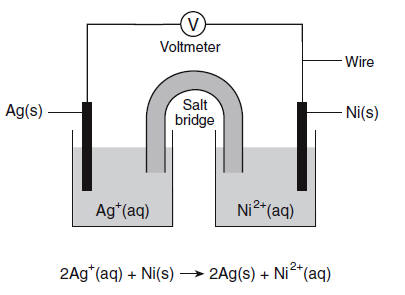
Which of the following statements applies to the change in mass of the electrodes involved in this electrochemical cell?
Electrode A is the anode and it gains mass
since metal ions are being converted to metal
atoms which often adhere to the electrode.
Electrode B is the anode and it gains mass
since metal ions are being converted to metal
atoms which often adhere to the electrode.
Electrode A is the cathode and it gains mass since metal ions are being converted to metal atoms which often adhere to the electrode.
Electrode B is the cathode and it gains mass since metal ions are
being converted to metal atoms which often adhere to the electrode.
Which statement best describes how a salt bridge maintains electrical neutrality in the half-cells of an electrochemical cell?
It prevents the migration of electrons.
It prevents the reaction from occurring spontaneously.
It permits the migration of ions.
It allows for the reaction from occurring spontaneously.

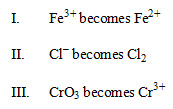
What is oxidation number of Cr in Cr2O72-?
-2
+2
+6
+12

When water is electrolyzed, gas collected at cathode, is
sulphur
oxygen
hydrogen
sulphur dioxide

Galvanic cells convert
mechanical energy in to electrical energy
potential energy in to electrical energy
electrical energy in to chemical energy
chemical energy in to electrical energy

In the following reaction
Sn+2 + 2Fe+3 → Sn+4 + 2Fe+2
the oxidizing agent is....
Sn+4
Sn+2
Fe+3
Fe+2

In the following reaction
Sn+2 + 2Fe+3 --> Sn+4 + 2Fe+2,
the reducing agent is...
Fe+3
Sn+2
Sn+4
Fe+2

An oxidizing agent will
increase in mass
lose electrons
be reduced
increase in oxidation number
What occurs to the mass of copper electrode in the following reaction?
Zn/Zn2+ // Cu2+/Cu
increases
decreases
remains the same
Electrons always flow from
cathode to anode
anode to cathode
In a Galvanic Cell, the anode is...
positive
negative
In a Galvanic Cell, the cathode is...
positive
negative
Oxidation occurs at the...
anode
cathode
Reduction occurs at the...
anode
cathode
In a redox reaction, the oxidising agent... (choose two options)
is oxidised
is reduced
increases its oxidation number
decreases its oxidation number
In a redox reaction, the reducing agent... (choose two options)
is oxidised
is reduced
increases its oxidation number
decreases its oxidation number
In a Galvanic cell, the cations in the salt bridge...
flow the same way as the electrons flow in the wire
flow the opposite way to the electron flow in the wire
stay in the salt bridge
In a Galvanic Cell, the salt bridge...
completes the circuit so that electrons can flow through the wire
maintains charge balance
is soaked in an unreactive electrolyte such as KNO3
all of the above

What is the name of the negative electrode in an electrolytic cell ?
cathode
anode
What is the name of the positive electrode in an electrolytic cell?
cathode
anode
According to Brønsted-Lowry acid base theory, an acid ___.
is a proton donor
is a proton acceptor
produces H+ when added to water
turns phenolphthalein pink
According to Arrhenius acid-base theory, an acid ___.
is an H+ acceptor
is a H+ donor
is a substance that produces H+ in water
turns litmus paper blue

Which reactant in the following equation is acting as a Brønsted-Lowry acid?
ammonium
ammonia
hydroxide
water
CO32-(aq) + H2O(l) → HCO3-(aq) + OH-(aq)
Using the above reaction, which species is the conjugate base?
CO32-
H2O
HCO3-
OH-
A substance that remains when a base has accepted an H+ ion is a(n)
(a)
True or False: All Arrhenius acids are also Brønsted-Lowry acids.
True
False
According to Arrhenius acid-base theory, a base ___.
is an H+ acceptor
is a H+ donor
is a substance that produces OH- in water
turns litmus paper red
Match the following
higher than 7
base
lower than 7
acid
7
neutral
What does pH measure?
strength of an acid
strength of a base
strength of both acids and bases
concentration of H+ ions
What is the name of this ion: H3O+?
Helium ion.
Hydrogen ion.
Hepatic ion.
Hydronium ion.

Choose the conjugate acid of OH-
HCO3-
OH-
CO32-
H2O

Choose the conjugate base of HNO3
HNO3
H2O
H3O+
NO3-
According to Brønsted-Lowry acid base theory, an acid ___.
is a proton donor
is a proton acceptor
produces H+ when added to water
turns phenolphthalein pink
According to Arrhenius acid-base theory, an acid ___.
is an H+ acceptor
is a H+ donor
is a substance that produces H+ in water
turns litmus paper blue
According to Arrhenius acid-base theory, a base ___.
is an H+ acceptor
is a H+ donor
is a substance that produces OH- in water
turns litmus paper red
According to Brønsted-Lowry acid base theory, a base ___.
is a proton donor
is a proton acceptor
produces OH- when added to water
has a bitter taste

