
 Worksheets
Environmental Science Final Exam Review (All Questions)
Total questions: 130
Worksheet time: 2hrs 6mins
Estuaries are productive ecosystems because they constantly receive nutrients from
rivers and oceans
coral reefs
lakes and ponds
photosynthesis
Which of the following is the BEST list of the factor(s) that influence(s) where an organism lives in an aquatic ecosystem?
sunlight and sediment
temperature, sediment, and nutrient availability
sunlight, nutrient availability, and temperature
temperature
What is the source of most ocean pollution?
activities on land
climate changes
aquatic animals
aquatic plants
Estuaries
are always saltwater ecosystems
are always freshwater ecosystems
are ecosystems where both fresh water and salt water are present
prevent the development of salt marshes
One way in which wetlands control flooding is by
filtering out water pollutants
absorbing water from rivers
providing habitats for migratory wildlife
reducing the amount of carbon dioxide released into the air
Bottom dwelling organisms are associated with which term?
plankton
nekton
phytoplankton
benthos
Free-swimming organisms are associated with which term?
phytoplankton
zoo plankton
nekton
benthos
Swamps are commonly found on
rocky hillsides
flat, poorly drained land
mountain peaks
bottoms of lakes or ponds
The type of plankton that produces most of the food in an aquatic ecosystem is called
nekton
zooplankton
phytoplankton
benthos
What are the two main types of freshwater wetlands?
lakes and ponds
rivers and streams
littoral zones and benthic zones
marshes and swamps
Which of the following is NOT one of the characteristics used to classify freshwater ecosystems?
temperature
depth of water
speed of water flow
availability of minerals, sunlight, and oxygen
Areas of land, with special soils and plants, that are covered with fresh water for at least part of the year are known as
eutrophic zones
lakes
ponds
wetlands
Which statement best summarizes the relationship between nutrients and algae growth?
There is no relationship between nutrients and algae growth.
Algae growth occurs most often in areas that are nutrient-poor.
Excessive nutrients lead to growth of algae and ultimately to death of aquatic organisms because of depleted oxygen levels.
Where are most wetlands found in the USA?
northwest
southwest
northeast
southeast
Eutrophic lakes are described as
lakes that are nutrient poor
lakes that are rich in nutrients and all types of life
lakes with excessive nutrients, large amounts of algae, and little oxygen
lakes that have a mixture of fresh and salt water
Which statement correctly describes sea turtle being underwater?
Sea turtles can breathe underwater and do not need to come to the surface for air.
Sea turtles cannot breathe underwater and must surface every few minutes for air.
Sea turtles cannot breathe underwater, but can hold their breath underwater for as long as 4-7 hours.
Sea turtles typically live up to
15 years
25 years
35 years
50 years or more
Most sea turtles live
in cold, shallow waters
in warm, shallow waters
in cold, deep waters
in every ocean in the world
How do fishing practices harm sea turtles?
The fishing industry takes away the sea turtles' food.
Sea turtles are accidentally caught in fishing nets (or discarded fishing lines) and drown.
The fishing industry draws too many tourists.
If 1000 baby sea turtles hatch on a beach, how many are likely to survive to be adults?
900
500
50
1
You analyzed maps that compared the percentage of wetlands in each state from the 1780s to the 1980s. What could you conclude from your analysis?
The amounts of wetlands per state have not changed considerably.
Every state had a decrease in the amount of wetlands.
Approximately half of the states had a decrease in the percentage of wetlands.
Many states had an increase in the amount of wetlands during the time period.


In a controlled experiment, the variable that is changed to test the hypothesis is called the –
Controlled Variable
Responsive Variable
Dependent Variable
Independent Variable
A procedure carried out to gather data about an object or event.
evidence
inquiry
investigation
experiment
Which of these contains steps in the right order?
Ask a question, form a hypothesis, research, plan and conduct an investigation, draw conclusions, report and share results, make a conclusion
Form a hypothesis, ask a question, research, plan and conduct an investigation, draw conclusions, report and share results
Observe and ask questions, form a hypothesis, plan and conduct an investigation, draw conclusions, report and share results
Form a hypothesis, ask a question, research, report and share results, plan and conduct an investigation, draw conclusions
What is biodiversity?
All the same species living in one area
the variability among organisms
all the endangered species in one area
Which are examples of renewable resources?
coal
wind power
solar power
water power
Environmental science does NOT include
physical sciences
biological science
psychology
A goal of many environmental scientists is to understand and solve environmental problems by studying interactions between humans and the environment. This includes
How we use natural resources
How our actions alter our environment
How much we pay for resources
A, B, and C are all correct
A and B are correct
The study of how living things interact with each other and with their nonliving environment is called
ecology
biology
chemistry
physical science
Which of the following is a way that hunter-gatherers altered their environment?
polluting the air by burning fossil fuels
burning grasslands
clearing land for farms
finding new uses for solar energy
During which period in human history were most of our modern environmental problems introduced?
Hunter-gatherer
Agricultural
Industrial Revolution
Biotechnology Era
Which of the following is an environmental problem introduced during the Industrial Revolution? (Check ALL that apply)
pollution
loss of biodiversity
resource depletion
clearing of lands for growing crops
Which statement has the correct relationship between renewable and nonrenewable resources?
Renewable resources form at a much slower rate than nonrenewable.
Renewable and nonrenewable resources both form at approximately the same rate they are used
Nonrenewable resources form at a faster rate than renewable resources
Nonrenewable resources form at a slower rate than consumed, and renewable resources are replaced rather quickly by natural processes
Pollutants that can be broken down by natural processes are known as
biodegradable
renewable
nonrenewable
nonbiodegradable
The "Tragedy of the Commons" is the idea that
bad things happen to all people
people are not as careful with resources if they do not "own" them
people will be careful with the use of air and water since they are so important
as the world population increases so will the depletion of our resources
During an investigation you record the number of butterflies in your garden every day in June. This information that you are recording is your
observation
data
conclusion
analysis
You are finished with an investigation, so the next step is to look for a pattern between your independent and dependent variables. When you are looking for the pattern, you are
analyzing
forming your hypothesis
making your conclusion
establishing your control group
Which statement is true about the relationship between your data and your hypothesis?
Your data can prove your hypothesis is correct.
Your data can prove your hypothesis is incorrect.
Your data can support or refute your hypothesis, but can not prove it.
There is never a relationship between the data and hypothesis.
An inherited trait that increases an organism's chance of survival and reproduction in a certain environment (for example a sharp, strong beak that allows for tearing of flesh) is known as
an adaptation
a niche
commensalism
symbiosis
The main factor that groups areas of land into certain biomes is
the climate
the vegetation (plants) found there
the order of the seasons
the average temperature
Which of the following is NOT a common plant adaptation?
size
shape
how they manage water
color
Which of the following is a measure of the distance north or south of the equator?
altitude
climate
precipitation
latitude
Which of the following is NOT a tropical biome?
tropical rainforest
savanna
desert
deciduous forest
Which biome is a tropical biome that is characterized by grasses, shrubs, and small trees?
tundra
tiaga
savanna
desert
Which biome is associated with trees that have leaves that change color with the seasons?
tropical rain forest
temperate deciduous forest
tiaga
savanna
Which biome is located in the northern arctic region where the winter is too cold and dry to permit the growth of trees?
tiaga
tunda
savanna
grassland
Wetlands help control rising global temperatures by
increasing the amount of rainfall
absorbing energy from the sun
absorbing carbon (which means less carbon dioxide in the atmosphere)
absorbing nitrogen and oxygen which leads to decreasing temperatures
Barrier islands are usually found
only in the southeast
only along the Pacific coast
running parallel to sandy shores
running parallel to large rivers
How do barrier islands helpful to the environment? (Check all that apply)
They help protect the mainland and coastal wetlands from storms.
They absorb large amounts of water during flooding.
They act as filters to absorb pollutants.
They provide habitats for wildlife.
Which of the following is NOT one of the main ways to describe any population?
size
age
density
distribution
If we tell the population numbers in a certain amount of space, (for example: 23 deer in 1000 acres) we are describing the deer population's
size
distribution
clotting
density
If someone gathers data that tells us that most of the bluebirds are in the northwestern part of our county, they are referring to the bluebirds'
density
distribution
size
displacement
The maximum number of offspring that each member o the population can produce is known as
survivorship
reproductive potential
fertility rate
carrying capacity
Which of the following is NOT one of the three factors that lead to higher reproductive potential?
produce more offspring at one time
reproduce more often
reproduce offspring larger in size
reproduce earlier in life
When does exponential growth occur in populations?
when they have plenty of food and space
when they have lots of competition
when there are lots of predators in the area
when they have plenty of food and space, and little competition or predators
Which of the following is a density-dependent limiting factor?
human activities
unusual weather
competition
natural disaster
Which of the following would NOT be an example of a density independent factor?
predation
tornado
hurricane
fire
Which of the following are density dependent factors?
competition for resources
predation
disease
natural disasters
What does the term carrying capacity describe?
The maximum number of birth rates for a population.
The ability of a population to accept new immigrants.
The ratio of birth rates to death rates in a population.
The population size that the environment can sustain.

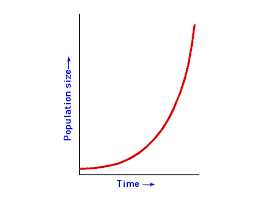
What is a population’s total fertility rate?
the number of births needed to keep a nation’s population stable
the average number of children a male member of a population has each year
the average number of children a female member of the population has during her lifetime
the total number of babies born in a population each generation
Which combination of factors will produce the highest rate of population growth?
high birth and death rates
low birth and death rates
high birth and low death rates
low birth and high death rates
What describes human world population in recent times?
Still increasing exponentially with no decrease in rate
Still increasing exponentially with slight decrease in rate
Still increasing exponentially with huge decrease in rate
The average number of years an individual is predicted to live is called
life expectancy
carrying capacity
growth rate
demography
The amount of people living in a given area is described as population
Population Size
Population Density
Population Distribution
The distribution of ages in a specific population
age structure
infrastructure
life expectancy
demographic transition
Have the highest birth rates
urbanization
developed countries
least-developed countries
arable land
land that can be used to grow crops
least-developed countries
demography
arable land
infrastructure
Movement of individuals into or out of a population.
demographic transition
infrastructure
urbanization
migration
An increase in water-borne diseases could possibly be alleviated by
adequate sewage treatment facilities for growing populations
very rapid growth of large cities
sufficient fuelwood
both a and b
The basic facilities and services that support a community.
arable land
demographic transition
infrastructure
urbanization
Which of the following is NOT one of the four factors that have the greatest effects on infant health
parent access to education
clean water
fuel
high-tech medical equipment
What is NOT one of the main reasons a plentiful supply of fuel wood is so important in developing countries?
to heat homes on cold nights
to cook
to boil water
The movement of people from rural areas to cities is known as
emigration
immigration
urbanization
population flight
Which of the following is the main source of fuel in most least developed countries?
coal
wood
gasoline
nuclear energy
Which statement correctly describes suburban sprawl?
Suburban sprawl only has positive effects since people are closer to developed businesses.
Often causes traffic jams, inadequate infrastructure, and loss of habitat
it is a problem in least developed countries


What type of mining would most likely be used if a resource is concentrated in deep pockets in ground that is safe for tunneling?
subsurface mining
mountaintop removal
solution mining
open pit mining
The process of heating an ore beyond its melting point and combining it with other substances is called
smelting.
dredging.
tailing.
frothing.
This type of mining involves pumping hot water into the earth and dissolves the ore is known as
deep well injection
solution mining
geothermal mining
crystallization differentiation

It is not uncommon for gold to have been concentrated by wind and water into surface deposit in streams. These deposits are known as
quarries
placer deposits
evaporites
smelting
Which substance listed below is mined through solar evaporation?
gold
quartz
salt
silver

