wayground logo

Free Printable Worksheets

Font size

S
M
L
XL
Worksheets

Chemistry First Semester Final Exam

Total questions: 57

Worksheet time: 2hrs 50mins

Name
Class
Date
1.

Using a periodic table, how many protons does Copper have?

a)

29

b)

63

c)

64

d)

35

2.

This is the largest category on the Periodic Table

a)

Metals

b)

Non Metals

c)

Metaloids

d)

Semi Metals

3.
In covalent bonds, atoms...
a)
share a pair of electrons
b)
share an electron
c)
transfer electrons
d)
have an electron sea
4.

What determines the identity of an atom?

a)

number of protons

b)

number of electrons

c)

number of neutrons

d)

number of valence electrons

5.
What charge will an atom have if it loses 2 electrons?
a)
+2
b)
-2
c)
0
d)
+1
6.
What charge will magnesium have once it reaches an octet?
a)
+2
b)
-2
c)
+12
7.

What type of bond forms between nonmetals only?

a)

covalent

b)

ionic

c)

metallic

d)

metalloid

8.

What type of bond forms between Na and O?

a)

ionic

b)

covalent

c)

metallic

d)

metalloid

9.
What is the mass number?
a)
the number of protons
b)
the number of protons and neutrons
c)
the number of neutrons
d)
the number of protons and electrons
10.

Valence electrons are the...

a)

Electrons farthest away from the nucleus

b)

Electrons closest to the nucleus

c)

Electrons that just come and go - they don't stay with the atom

11.
Cations are...
a)
Positive
b)
Negative
c)
Neutral
d)
Purring
12.
What is the formula for magnesium phosphide?
a)
Mg3P2
b)
Mg2P3
c)
Mg2(PO4)3
d)
Mg3(PO4)2
13.
When an atom loses a valence electron, it becomes a(n) _____________ ion.
a)
positive
b)
negative
c)
neutral
d)
polyatomic
14.

Metals are:

a)

Usually cations

b)

Usually anions

15.
What are ionic bonds?
a)
valence electrons transferred between atoms
b)
Inner most electrons transferred between atoms
16.
Why do ionic bonds form?
a)
so the number of protons equals the number of electrons
b)
to fill the outermost energy level
c)
so an atom can become unstable
17.
If an aluminum atom has 13 protons (+) and 10 electrons (-), what is it's charge?
a)
Al3+
b)
Al13+
c)
Al10+
d)
Al10-
18.
If an oxygen atom has 8 protons (+) and 10 electrons (-), what is it's charge?
a)
O10-
b)
O8+
c)
O2-
d)
O10+
19.
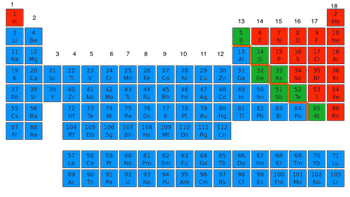
Where are metals located on the periodic table?
a)
Blue
b)
Green
c)
Red
20.
Where are the nonmetals located on the periodic table? 
a)
Blue
b)
Red
c)
Green
21.

Write the correct formula for Sodium Chloride.

a)

SC

b)

SCl

c)

NaCl

d)

NaCl2

22.

Mg3N2

a)

Magnesium nitride

b)

Magnesium (II) nitride

c)

Trimagnesium dinitrogen

23.

What is the proper name for CH4?

a)

Monocarbon hydride

b)

Carbon tetrahydride

c)

Monocarbon tetrahydride

24.

What is the proper name for S2O2?

a)

Sulfur oxide

b)

Sulfur dioxide

c)

Sulfur (II) oxide

d)

Disulfur dioxide

25.
4Si + S8 --> 2Si2S4
a)
Synthesis
b)
Decomposition
c)
Single displacement
d)
Double displacement
26.
3Ca + 2AlCl3 --> 3CaCl2 + 2Al
a)
Synthesis
b)
Decomposition
c)
Single diplacement
d)
Double displacement
27.
2Pb(NO3)2 --> 2PbO + 4NO2 + O2
a)
Synthesis 
b)
Decomposition
c)
Single displacement
d)
Combustion
28.
Which reaction type is the following: C5H10O4 + O2 --> CO2 + H2O
a)
Decomposition
b)
Single Replacement
c)
Combustion
d)
Double Replacement
29.

In this balanced equation, what is the coefficient of LiCl?
 __Li + __Cl2 -> __LiCl

30.
At the end of chemical reactions, what is the total mass of the reactants compared to the total mass of the products?
a)
the product is doubled
b)
the product is half the mass of the reactants
c)
the mass is the same
d)
the mass changes depending on the reaction
31.

Balance this reaction. Then, what is the coefficient of elemental oxygen?

NaClO--> NaCl + O2

32.
What is a reactant?
a)
a volatile chemical
b)
a dangerous substance
c)
the substances you start with in a chemical reaction
d)
the substances that are formed by a chemical reaction 
33.
What is a product?
a)
a fancy word for make-up
b)
a volatile chemical
c)
the substances you start with in a chemical reaction
d)
the substances that are formed by a chemical reaction
34.

Balance the following. What is the coefficient of elemental iron?

Fe + Cl2 → FeCl3

35.
What is the molar mass of C2H4O2?
a)
40g
b)
50g
c)
60g
d)
68g
36.

What would be the mass of 1.5mol H2O rounded to the nearest whole number?

Do not use labels.

37.

Select the correct molar ratio taken from this balanced equation:


4 Al + 3 O2 --> 2 Al2O3

a)

1 mol Al = 1 mol Al2O3

b)

4 Al = 2 Al2O3

c)

4 mol Al = 2 mol Al2O3

d)

4 mol Al = 2 mol Al

38.

Select the correct molar ratio taken from this balanced equation:


1 N­2 + 3 H2 --> 2 NH3

a)

1 N­2 = 3 H2

b)

1 mol N­2 = 2 mol NH3

c)

2 mol N­2 = 1 mol NH3

d)

3 mol N­2 = 3 mol NH3

39.

Given:

4 Al + 3 O2 --> 2 Al2O3

How many moles of Al2O3 will be produced from 250.0 g of Al? Round to the nearest whole number.

( 26.982 g Al = 1 mol Al)

40.
2 NaClO3 (s) --> 2NaCl (s) +3 O2 (g)  
12.00 moles of NaClO3 will produce how many grams of O2?
a)
256 g of O2
b)
576 g of O2
c)
288 g O2
d)

8 g O2

e)

None. The O2 is a myth like the Loch Ness Monster or the North American Yeti

41.

B2H6 + 3O2 -->2 HBO2 + 2 H2O
 What mass of O2 will be needed to burn 36.1 g of B2H6?

Round to the nearest whole number.

42.
Mole ratios are obtained from the
a)
balanced chemical equation
b)
periodic table
c)
molar mass
43.
What is the mole ratio of H2O to H3PO4 in the following chemical equation?   P4O10 + 6 H2O --> 4 H3PO
a)
6:4
b)
4:6
c)
1:3
d)
3:1
44.
When does a chemical reaction stop?
a)
When the lab is finished
b)
When the excess reactant is used up
c)
When the limiting reactant is used up
d)
Chemical reactions never stop
45.
Identify the limiting reagent when 6.00 g HCl combines with 5.00 g Mg to form MgCl2.
 
Mg +  2HCl --> MgCl2  +  H2   
 
a)
Mg
b)
H2
c)
MgCl2
d)
HCl
46.
What is a Excess Reagent?
a)
amount you end with
b)
what you run out of first
c)
what you have left over
d)
what you start with
47.
2H2   +   O2  →  2H2O
How many moles of water can be produced if 8 moles H2 are used?
a)
4 moles
b)
8 moles
c)
16 moles
d)
2 moles
48.

What is the correct formula for barium hydroxide?

a)

Ba(OH)2

b)

Ba2OH

c)

BaOH

d)

Ba2OH

49.
The chemical formula of dinitrogen textroxide is
a)
Ni₂O₄
b)
NiO
c)
N₂O₄
d)
NiO₂
50.

Which color on the image of the periodic table corresponds with the halogens.

a)

red

b)

black

c)

blue

d)

orange

51.

Which color on the image of the periodic table corresponds with the noble gases.

a)

red

b)

black

c)

blue

d)

orange

52.

Choose all of the subatomic particles found in the nucleus.

a)

proton

b)

neutron

c)

electron

d)

photon

e)

boson

53.

Categorize each of the following as either molecular or ionic.

Categorize the following

NaCl

CaCl2

Al2O3

CO2

CH4

SO2

ionic
molecular
54.

Categorize the properties of these subatomic particles

Categorize the following

Positive Charge

No Charge

Negative Charge

Determines the element

Changes to this make an isotope

Changes to this make an ion

Mass is so small it's negligible

Protons
Neutrons
Electrons
55.

This could be the dot diagram of

a)

Mg

b)

Cl

c)

C

d)

O

56.

What is the correct Lewis structure for NH3?

a)
b)
c)
d)
57.
How many covalent bonds does carbon need to form in order to have a full octet?
a)
2
b)
3
c)
4
d)
5