
 Worksheets
8th Grade 2nd Quarter Review
Total questions: 42
Worksheet time: 39mins

If we dropped a plastic ball with a density of 1.25 g/ml into this cup, where would settle?
In the Dawn Dish Soap
Between the dish soap and water
Between the dish soap and corn syrup
On the top of the honey


The reaction above is an ____ reaction.
endothermic reaction
exothermic reaction

The equation above is an ____ reaction.
endothermic
exothermic

At what point does the biker have the greatest Kinetic Energy?
Point A
Point B
Point C
Point D
At what point does the biker have the greatest Potential Energy?
Point A
Point B
Point C
Point D
_______________ is the amount of matter in an object or sample.
Melting Point
Property
Mass
Boiling Point
Substance
The one factor that a scientist changes during an experiment.
Controlled Variable
Dependent Variable
Independent Variable
The variable that is measured.
Controlled Variable
Dependent Variable
Independent Variable
The factors that stay the same or are constant throughout the experiment.
Controlled Variable
Dependent Variable
Independent Variable
In a controlled experiment, how many independent variables can be tested at a time?
one
none
two or more
how ever many makes sense.
Ben makes five paper helicopters with different wing lengths. He drops them the same way from a height of two meters for five trials each. He records the amount of time it takes for each helicopter to fall to the ground.
What is the independent variable?
Dropping the same way
Wing Length
Amount of time it takes the helicopter to hit the floor
Dropping from the same height
Ben makes five paper helicopters with different wing lengths. He drops them the same way from a height of two meters for five trials each. He records the amount of time it takes for each helicopter to fall to the ground.
What is the dependent variable?
Dropping the same way
Wing Length
Amount of time it takes the helicopter to hit the floor
Dropping from the same height
Ben makes five paper helicopters with different wing lengths. He drops them the same way from a height of two meters for five trials each. He records the amount of time it takes for each helicopter to fall to the ground.
What are two controlled variables? (Select 2 answers)
Dropping the same way
Wing Length
Amount of time it takes the helicopter to hit the floor
Dropping from the same height
Cindy wanted to find out how the amount of sunlight affects the growth of plants. She placed two tomato plants in 10 inch pots with potting soil and watered them ¼ cup each day. One plant was placed under a cardboard box and one was placed in the sunlight. She measured the growth of the plant each week for three weeks.
What is the independent variable?
Using the same type of plant
Each plant was placed in a 10 inch pot
The growth of the plant
One plant is in the sunlight and the other is under a box
Cindy wanted to find out how the amount of sunlight affects the growth of plants. She placed two tomato plants in 10 inch pots with potting soil and watered them ¼ cup each day. One plant was placed under a cardboard box and one was placed in the sunlight. She measured the growth of the plant each week for three weeks.
What is the dependent variable?
Using the same type of plant
Each plant was placed in a 10 inch pot
The growth of the plant
One plant is in the sunlight and the other is under a box
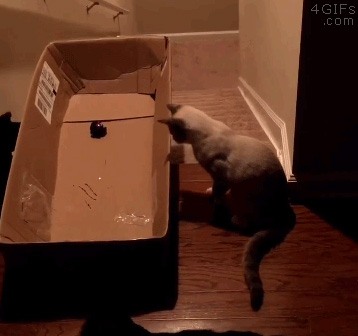
A box sliding down an inclined plane attains a velocity of 27 m/s in 3 seconds from rest. Find the acceleration (change in velocity over time).
30 m/s
24 m/s2
9 m/s2
81 km/hr
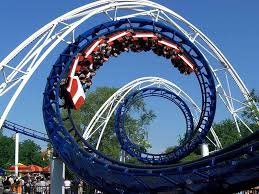
A roller coasters accelerates from an initial velocity of of 6.0 m/s to a final velocity of 70 m/s over 4 seconds. What's the acceleration (change in velocity over time)?
24 m/s2
18 m/s2
16 m/s2
16 m/s
When two equal forces act in opposite directions on an object, they are called ______________________.
frictional force
balanced force
centripetal force
gravitational force
According to Newton’s second law of motion, force is equal to mass times ______________________.
inertia
weight
acceleration
direction
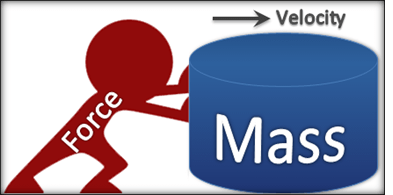
The picture is an example of Newton's...
1st Law
2nd Law
3rd Law
Acceleration is due to a force put on an objects mass.
1st Law
2nd Law
3rd Law


If 150 Joules of work is needed to move a box 10 meters, what force was used? Work = Force X Distance
1500 N
15 N
1.5 N
150 N
What makes elements and compounds different from mixtures? Elements & compounds-
have a constant composition (pure substances)
are made of gases
Will not change when heated
conduct electric current
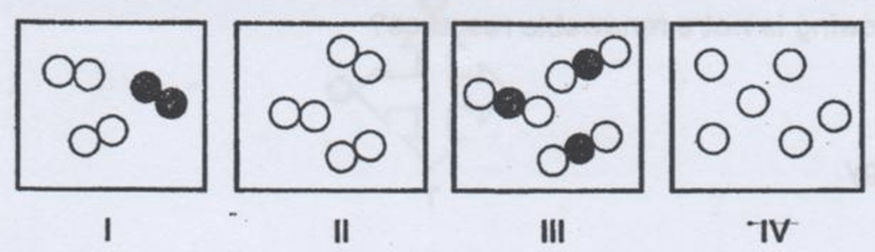
In the diagrams provided, the circles of different colors represent the atoms of different elements. Which diagram represents a mixture?
I
II
III
IV
Mixtures are different than pure substances because mixtures-
have lower boiling points
can be separated physically
are less dense than pure substances
contain only one type of atom


