wayground logo

Free Printable Worksheets

NEW

Font size

S
M
L
XL
Worksheets

8th Grade Chemistry Review

Total questions: 60

Worksheet time: 56mins

Name
Class
Date
1.

Anything that has mass and takes up space

a)

quark

b)

matter

c)

mixture

d)

solute

2.

mixture in which the individual substances are evenly mixed

a)

heterogeneous

b)

homogeneous

c)

element

d)

pure substance

3.

An element consists of just one type of

a)

atom

b)

mixture

c)

compound

d)

helium

4.

The number of protons can be found by reading what from the Periodic Table?

a)

atomic mass

b)

mass number

c)

energy level

d)

atomic number

5.

A compound is

a)

2 or more atoms of different elements chemically combined

b)

2 or more atoms chemically combined

c)

a mixture

d)

hydrogen

6.

Carbon dioxide and sodium chloride are examples of

a)

elements

b)

homogeneous mixtures

c)

compounds

d)

heterogeneous mixtures

7.

Which of the following is a physical change

a)

burning wood

b)

cutting paper

c)

photosynthesis

d)

apple browning

8.

If 4g of salt is dissolved in 200g of water, what would the mass of the solution be?

a)

200g

b)

204g

c)

208g

d)

196g

9.

Which of the following is evidence that a chemical change has occurred?

a)

melting

b)

boiling

c)

bubbling/fizzing

d)

change of size

10.
When trying to identify an unknown element, a scientist determines what other elements the unknown element reacts with chemically.  Which property of the unknown element determines the other elements it reacts with?
a)
The total number of neutrons in the unknown element
b)
The total number of particles in the nucleus of the unknown element
c)
The number of protons in the nucleus of the unknown element
d)
The number of valence electrons in the unknown element
11.
How many atoms of oxygen are in a molecule of glucose (C6H12O6)?
a)
12
b)
6
c)
18
d)
24
12.
The chemical equation shown represents a reaction that produces fuel for certain cars.  Which substance represented in this equation is classified as an element?CO + H2O --> CO+ H2
a)
CO
b)
H2O
c)
CO2
d)
H2
13.
Many processes occur in the digestive system.  Which process is best classified as a physical change?
a)
Saliva converting the starch molecules in crackers into simple sugars
b)
Digestive enzymes breaking down proteins into smaller fragments
c)
Bacteria converting lactose into simple sugars in the intestines
d)
Teeth grinding an almond into smaller pieces in the mouth
14.
An atom of a certain element has 36 protons, 36 electrons, and a mass number of 84.  At room temperature this element is a very stable gas.  How many neutrons are in this atom?
a)
58
b)
72
c)
120
d)
48
15.
Which of these formulas contain equal numbers of nitrogen atoms?
a)
Formulas I and III
b)
Formulas I and IV
Formulas I and IV
c)
Formulas II and III
Formulas II and III
d)
Formulas I, II, and V
Formulas I, II, V
16.
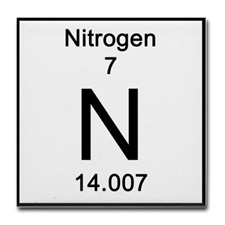
What is the number of protons that the element in this image contain?
a)
14
b)
7
c)
15
d)
18
17.
What is the atomic mass of "F"
a)
9
b)
18
c)
17
d)
19
18.
all matter is made of what 
a)
energy 
b)
atoms 
c)
electrons 
d)
compounds 
19.
The positive particles of an atom are 
a)
electrons 
b)
positrons 
c)
neutrons 
d)
protons 
20.
the central region of an atom where its neutrons and protons are is its 
a)
nucleus 
b)
electron cloud
c)
core 
d)
center 
21.
an atom with atomic number 6 would have how many protons 
a)
6
b)
12
c)
3
d)
cannot be determined 
22.
Which of the following is a subatomic particle with no charge that is found in the nucleus of an atom?
a)
Electron
b)
Proton
c)
Neutron
d)
Quark
23.
Where are electrons of an atom found?
a)
Nucleus
b)
Electron Cloud
c)
Some are in the nucleus and some in the electron cloud.
d)
They are moving everywhere.
24.
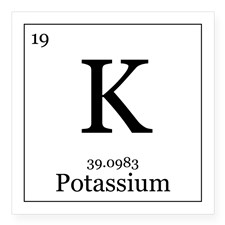
How many neutron are in the atom "K"?
a)
7
b)
2
c)
39
d)
12
25.
Something that is made up of only one kind of atom is known as _________________.
a)
a molecule
b)
a compound
c)
an element
d)
a proton
26.
A "group" is a ____________ on the periodic table.
a)
column
b)
row
27.
A "period" is a ____________ on the periodic table.
a)
column
b)
row
28.
The sum of the protons and neutrons in the nucleus of an atom
a)
Atomic Number
b)
Compound
c)
Electrons
d)
Mass Number (also called Atomic Mass)
29.
This picture represents which of the following?
a)
element
b)
compound
c)
mixture of elements
d)
mixture of compounds
30.
This picture represents which of the following?
a)
element
b)
compound
c)
mixture
31.
This picture represents which of the following?
a)
element
b)
compound
c)
mixture
32.
How many elements are represented in the compound?
Na2CO3
a)
1
b)
2
c)
3
d)
4
33.
Which one can be found on the periodic table?
a)
Compound 
b)
Element
34.
Is salt (NaCI) a compound or a element
a)
Compound
b)
element
35.
The red numbers in the image below represent ________
a)
subscripts
b)
coefficients
c)
I don't know, and don't want to try
d)
None of the answers are correct
36.
The blue numbers in the image below represent ________
a)
I don't know, and don't want to try
b)
coefficients
c)
subscripts
d)
none of the answers are correct
37.
In chemical reactions, what does the principle of conservation of mass mean?
a)
Matter is not created or destroyed.
b)
The total mass of the reactants is greater than the total mass of the products.
c)
The total mass of the reactants is less than the total mass of the products.
d)
Matter is not changed.
38.
What is the left part of a chemical equation called?
2H2 + O2 --> 2H2O
a)
Reactants
b)
Products 
c)
Yields 
d)
Chemical Equation 
39.
What is the right part of a chemical equation called...
2H2 + O2 --> 2H2O
a)
Reactants
b)
Products 
c)
Yields 
d)
Chemical Equation 
40.
Is the following equation balanced?...
Al + O2 --> 2Al2O3
a)
Yes!
b)
No!
41.
Is the following equation balanced?
4Fe + 3O2 --> 2Fe2O3
a)
yes
b)
no
42.
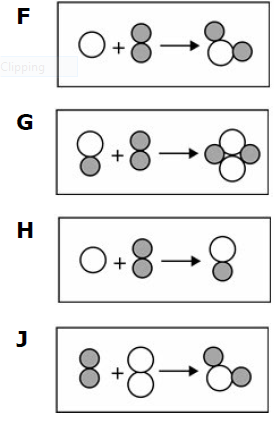
Which of the following models best demonstrates a balanced chemical equation?
a)
F
b)
G
c)
H
d)
J
43.

a copper penny turning greenish after a few years.

a)

Physical change

b)

Chemical change

44.

Which of the following IS a physical change?

a)

Getting a haircut

b)

Rusty metal

c)

sour milk

d)

A compound

45.
How many ATOMS of Oxygen are in 3Fe2O3
a)
2
b)
3
c)
6
d)
9
46.
What is the name of this element?
a)
Helium
b)
Hydrogen
c)
Argon
d)
Silver
47.

What element is represented in this Bohr Model?

a)

Carbon

b)

Hydrogen

c)

Aluminum

d)

Lithium

48.
What's a valence electron?
a)
electrons in the second energy level
b)
electrons in the outermost energy level
c)
the atomic number
d)
electrons in the first level
49.
How many valence electrons?
a)
2
b)
3
c)
5
d)
10
50.

The innermost energy level has a maximum of how many electrons?

a)

1

b)

2

c)

6

d)

8

51.

What does the Bohr Model represent?

a)

The structure of molecules

b)

The structure of the Solar System

c)

The structure of an atom

d)

The structure of East Hills

52.
How are electrons arranged in an atom?
a)
In groups of five
b)
In energy levels
c)
By color
d)
By shape
53.
Rows on the period table are called _____ while columns are called _____.
a)
groups, families
b)
groups, periods
c)
periods, groups
d)
families, groups
54.

What is a Lewis Dot Structure?

a)

It shows all of the particles in the atom.

b)

Contains protons and neutrons

c)

Only shows the element symbol and it's outer most electron shell

d)

Contains protons and electrons

55.
Hydrogen needs _____ electrons in its valence shell to be stable.
a)
4
b)
6
c)
8
d)
2
56.
A covalent bond is
a)
a bond that shares electrons metallicaly
b)
A bond that shares electrons with non metals
c)
Metalloids bonding
d)
metals and nonmetals bonding
57.

How many valence electrons does Oxygen have?

a)

8

b)

5

c)

6

d)

1

58.

How many connection points does carbon have to bond?

a)

2

b)

4

c)

6

d)

8

59.

Why do all bonds form?

a)

so the number of protons equals the number of electrons

b)

so an atom can become unstable

c)

to fill the outermost energy level

60.
What would you name this molecule?
a)
SNa3
b)
H3O
c)
NaCl
d)
H2O