wayground logo

Free Printable Worksheets

NEW

Font size

S
M
L
XL
Worksheets

SBI4U Homeostasis Questions

Total questions: 57

Worksheet time: 35mins

Name
Class
Date
1.
What is a disease where sufferers cannot control their blood glucose levels?
a)
Diabetes
b)
Influenza
c)
Cholera
d)
Cystic fibrosis
2.
What is involuntary contractions of voluntary muscles to warm up?
a)
Shivering
b)
Sweating
c)
Vasodilation
d)
Vasoconstriction
3.

What is an example of a positive feedback mechanism?

a)
b)
4.
The two types of feedback systems that help organisms maintain homeostasis are:
a)
positive and negative 
b)
receptor and effector
c)
static and dynamic
d)
minor and major
5.
Which system sends electrical messages that helps control the body's responses to internal and external changes?
a)
nervous
b)
endocrine
c)
reproductive
d)
integumentary
6.

What hormone is produced in the pancreas that lowers blood sugar?

a)

Insulin

b)

Glucagon

c)

Ketones

d)

Glucose

7.

Homeostasis for living organisms means...

a)

external environment stays the same when internal changes

b)

water diffuses through membrane by osmosis

c)

concentrations move from high to low

d)

internal environment stays the same when external changes

8.

These detect changes in the environment

a)

Control Center

b)

Sensors

c)

Communication System

d)

Target

9.

This takes the messages from the sensors and is known as the control center

a)

Brain

b)

Kidney

c)

Liver

d)

Heart

10.

Osmoregulation means....

a)

maintain water levels

b)

maintain temperature

c)

maintain heart rate

d)

maintain breathing

11.

Thermoregulation means?

a)

Maintain temperature

b)

Maintain water levels

c)

Maintain heart rate

d)

Maintain breathing

12.
What hormone prolongs and intensifies the sympathetic response during stress by increasing heart rate and raising blood glucose?
a)
Epinephrine
b)
Glucocorticoid
c)
T3 and T4
d)
ADH
13.
What hormone lowers blood calcium?
a)
Calcitonin
b)
PTH
c)
Glucagon
d)
Insulin
14.
What pituitary hormone stimulates growth of all organs?
a)
PTH
b)
GH
c)
T3 and T4
d)
TSH
15.
What hormone increases the amount of water absorbed by the kidneys thereby decreasing urine amount?
a)
Calcitonin
b)
Mineralocorticoids
c)
ADH
d)
ACTH
16.
What pancreatic hormone increase blood glucose levels?
a)
glucagon
b)
insulin
c)
glucocorticoid
d)
epinephrine
17.
What hormone lowers blood glucose levels?
a)
glucocorticoid
b)
insulin
c)
glucagon
d)
aldosterone
18.

What is the endocrine system?

a)

A system of vessels that circulates blood around the body.

b)

A group of bones and tissue that provides support and structure for the body.

c)

A group of glands that work together with the nervous system to coordinate all body functions

d)

A group of organs that is responsible for eliminating wastes.

19.

Produces the hormone insulin and glucagon, which controls the level of glucose in the blood.

a)

Thyroid Gland

b)

Pancreas

c)

Thymus Gland

d)

Pituitary Gland

20.
Where are the adrenal glands located?
a)
One on each side of the larynx
b)
On top of the kidneys
c)
Behind the orbital bone
d)
The inner ear
21.
targets the brain and make people sleepy when its dark
a)
melanin
b)
melanoma
c)
melatonin
d)
melons
22.
What element is needed to produce proper amounts of Thyronine (T3) and Thyroxine (T4)?
a)
Iodine
b)
Iron
c)
Calcium
d)
Zinc
23.
Insulin is secreted by:
a)
α-cells in the Islets of Langerhans
b)
β-cells in the Islets of Langerhans
c)
β-cells in the pancreatic medulla
d)
α-cells in the pancreatic cortex
24.
Glucagon is secreted by:
a)
α-cells in the Islets of Langerhans
b)
β-cells in the Islets of Langerhans
c)
β-cells in the pancreatic medulla
d)
α-cells in the pancreatic cortex
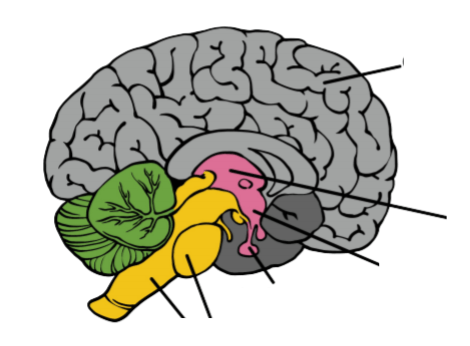
25.
What is the part highlighted in red?
a)
Cerebrum
b)
Cerebellum
c)
Brain Stem
d)
Diencephalon
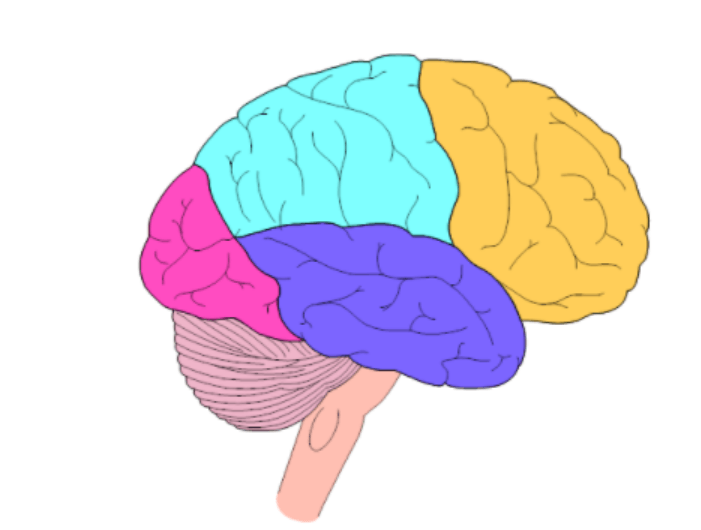
26.
Identify the lobe of the brain that is highlighted.  
a)
frontal
b)
temporal
c)
occipital
d)
parietal
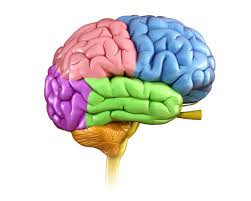
27.
Identify the lobe of the brain
a)
frontal
b)
temporal
c)
occipital
d)
parietal
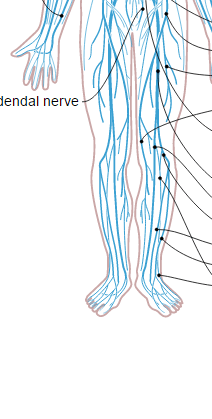
28.
This is a picture of the 
a)
peripheral nervous sysyem
b)
central nervous system
c)
respiratory system
d)
circulatory system
29.
The long, fiber like part of a neuron which the cell sends information to receiving neurons
a)
axon 
b)
dendrite
c)
axon terminal
d)
gene
30.
This insulating material forms a layer, around the axon of a neuron.  It enables electrical signals to travel down the axon at higher speeds.
a)
neuron
b)
myelin sheath
c)
dendrite
d)
neurotransmitter
31.
E
a)
Synapse
b)
Cell Body
c)
Axon 
d)
Dendrite
32.
The brain and brain stem make up the:
a)
Peripheral Nervous System
b)
Somatic Nervous System
c)
Autonomic Nervous System
d)
 Central Nervous System
33.

What structure is grey in this picture?

a)

Cerebrum

b)

Cerebellum

c)

Brain Stem

34.

The part of the PNS that controls involuntary actions

a)

autonomic nervous system

b)

somatic nervous system

c)

organic nervous system

d)

reflexive nervous system

35.
The part of the nervous system that consists of nerves that branch out from the CNS (central nervous system) and connect to other body parts
a)
Sympathetic
b)
Parasympathetic
c)
Autonomic
d)
Peripheral
36.
A chemical produced by neurons that carries messages to other neurons
a)
myelin sheath
b)
neurotransmitter
c)
axon
d)
axon terminal
37.
The tiny gap between neurons where nerve impulses are sent from one neuron to another.  It is where communication occurs between an axon and dendrite
a)
synapse
b)
axon terminal
c)
impulse
d)
myelin
38.

What does the nervous system do?

a)

Pumps blood from your heart to your body

b)

Carries messages back and forth between your brand and the rest of your body

c)

Breaks up food

d)

Secrete hormones.

39.

What makes up the Central Nervous System?

a)

Blood and Heart

b)

Spinal Cord

c)

Nerves

d)

Brain and Spinal Cord

40.

What is the Peripheral Nervous System consist of?

a)

The brain

b)

The spinal Cord

c)

The nerves that connect the CNS to all parts of the body.

d)

All of the above.

41.
What are your sensory organs?
a)
eyes, ears, nose, skin, tongue
b)
eyes, ears, heart, lungs, mouth
c)
sight, hearing, smelling, touching, tasting
d)
eyes, hearing, smelling, tongue, skin
42.
What does the somatic system do?
a)
controls voluntary muscles of the skeleton.
b)
carries messages from sense organs to the CNS.
c)
carries nerve impluses to internal organs
d)
controls internal organs and glands
43.
What is a neuron?
a)
a nerve cell
b)
a ganglia
c)
a synapse
d)
part of the brain
44.
What are the different types of neurons? 
a)
sensory, motor, and interneurons
b)
sensory, interneurons and muscle
c)
interneurons, motor and nephrons
d)
lymphatic, autonomic, and cerebrum
45.
What is the job of the sensory neurons? 
a)
they get information about what is happening outside the body
b)
they get information from other neurons
c)
they connect one neuron to another neuron
d)
they insulate the axon
46.
What is the function of the motor neurons?
a)
they get information about what happens inside and outside the body
b)
connect one neuron to another neuron in the central nervous system. 
c)
they get information from the dendrites
d)
they get information from other neurons and sends commands to muscles
47.
What is the function of the interneurons?
a)
they connect one neuron to another.
b)
they get information about what happens outside the body
c)
they get information about what happens inside the body
d)
they give information to the muscles to move
48.

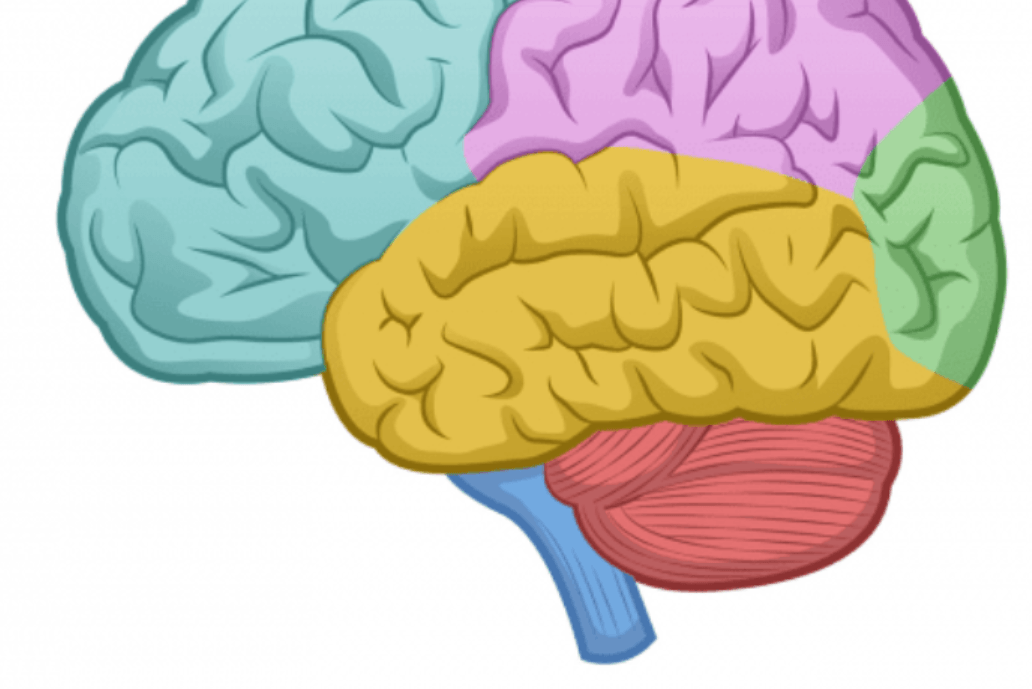
What lobe is orange in this picture?

a)

Frontal

b)

Parietal

c)

Temporal

d)

Occipital

49.

What lobe is bright pink in this picture?

a)

Frontal

b)

Parietal

c)

Temporal

d)

Occipital

50.

What lobe is pink in this picture?

a)

Frontal

b)

Parietal

c)

Temporal

d)

Occipital

51.

What structure is red in this picture?

a)

Cerebrum

b)

Cerebellum

c)

Brain Stem

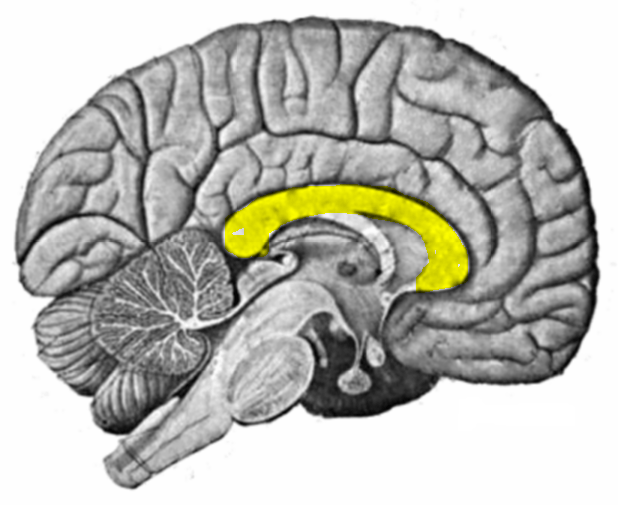
52.
a)
Corpus Callosum
b)
Amygdala
c)
Thalamus
d)
Hypothalamus
53.
What is structure labeled C in the picture?
a)
Dendrite
b)
Axon
c)
Cell Body
d)
Axon Terminal
54.
What is structure labeled B in the picture?
a)
Dendrite
b)
Axon
c)
Cell Body
d)
Axon Terminal
55.
What is structure labeled D in the picture?
a)
Dendrite
b)
Axon
c)
Cell Body
d)
Axon Terminal
56.
What is structure labeled E in the picture?
a)
Nucleus
b)
Schwann Cell
c)
Node of Ranvier
d)
Myelin Sheath
57.
Which structure is responsible for receiving signals?
a)
A
b)
B
c)
C
d)
D