

wayground logo

Free Printable Worksheets

Font size

S
M
L
XL
Worksheets

Earth's History Practice

Total questions: 50

Worksheet time: 2hrs 40mins

Name
Class
Date
1.

A dinosaur footprint

a)

True

b)

Cast

c)

Carbon Film

d)

Trace

2.
Hollow space left when a plant or animal decays
a)
True
b)
Cast
c)
Mold
d)
Trace
3.

Fossilized dinosaur tooth marks

a)

True

b)

Cast

c)

Carbon Film

d)

Trace

4.

Wooly mammoth skull

a)

Carbon Film

b)

Mold

c)

Cast

d)

Trace

5.

Impression of an ancient shell

a)

Carbon Film

b)

Mold

c)

Cast

d)

Trace

6.

Trilobite

a)

Trace

b)

Cast

c)

Mold

d)

True

7.

Bug in amber

a)

Cast Fossil

b)

Mold Fossil

c)

True Fossil

d)

Carbon Film Fossil

8.
Type of fossil?
a)
True
b)
Cast
c)
Mold
d)
Carbon Film
9.

Type of fossil?

a)

True

b)

Mold

c)

Cast

d)

Carbon Film

10.

Which is the oldest?

a)

A

b)

B

c)

C

d)

D

11.

Which is the youngest?

a)

B

b)

C

c)

D

d)

E

12.

Which of the following is the layers in order from OLDEST to YOUNGEST?

a)

A, B, C, D, E

b)

C, B, A, D, E,

c)

D, B, C, E, A

d)

E, A, B, C, D

13.
"E" is an example of what event?
a)
Fault
b)
Uplift
c)
Fracture
d)
Compaction
14.

Which rock layer in the diagram seems to be the oldest?
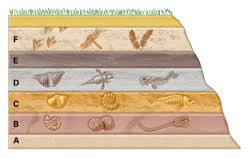
a)
F
b)
E
c)
B
d)
A
15.
The ___ parts of organisms are more likely to become fossils.
a)
hard
b)
soft
c)
outer
d)
inner
16.
Scientists who study fossils are called
a)
Geologists
b)
Paleontologists
c)
Fossil Scientists
d)
Meteorologists
17.
An organism that no longer exists on Earth is called
a)
Decayed
b)
Evolved
c)
Extinct
d)
Preserved
18.
Which rock layer contains the newest fossils?
a)
F
b)
E
c)
B
d)
C
19.
What is hardened tree sap called?
a)
coprolites
b)
index fossils
c)
gastroliths
d)
amber
20.
The age of something compared to the age of other things. (Not an exact age) 
a)
relative age 
b)
absolute age 
c)
superposition 
d)
index 
21.

How old is the Earth?

a)

2026 years old

b)

3.6 billion years old

c)

4.6 billion years old

d)

4.6 million years old

22.

this type of fossil is created when an organism's tissue is replaced by minerals

a)

cast

b)

carbon film

c)

amber

d)

petrified

23.
The soft parts of organisms are most likely to become fossils. 
a)
True
b)
False
24.

Stratigraphy is the ____.

a)

idea of walking in a straight line

b)

study of rock layers

c)

study of moving plates

d)

best way to make graphs

25.
The Principle of Cross-Cutting Relationships states that an igneous intrusion is 
a)
always younger than the layers it cuts across
b)
always older than the layers it cuts across
c)
the same age as the rock it melted
d)
none of the answers are correct
26.
What are the puzzle pieces of the Earth's surface called?
a)
Tectonic plates
b)
Puzzles
c)
Earthquakes
27.
What is the outermost layer of the Earth called?
a)
Core
b)
Mantle
c)
Crust
28.
The area around the Pacific Ocean where lots of earthquakes and volcanoes happen is called the ____________.
a)
Ring of Earth
b)
Ring of Fire
c)
Ring of Stone
d)
Ring of Diamond
29.

What type of boundary is shown in the diagram?

a)

Divergent

b)

Convergent

c)

Transform

30.

What type of boundary is shown in the diagram?

a)

Divergent

b)

Convergent

c)

Transform

31.

What type of boundary is shown in the diagram?

a)

Divergent

b)

Convergent

c)

Transform

32.
Convergent Plate Movement can create
a)
Rifts
b)
Mountains
c)
Ocean Ridges
d)
Radiation
33.
Divergent Plate movement can create
a)
Convection Currents
b)
Conduction
c)
Mountains
d)
Rifts and ocean ridges
34.
Where are most divergent boundaries located?
a)
Along the middle of most ocean floors
b)
Along the margins of most continents
c)
Across the middle of many continents
d)
All the above options are correct
35.
The Himalayan mountains have some of the highest peaks like Mt. Everest, on which type of convergent boundary are they located?
a)
Oceanic/Continental
b)
Oceanic/Oceanic
c)
Continental/Continental
d)
None of the above
36.
How is it possible for new crust to be formed without increasing the surface area of the Earth?
a)
Crust is destroyed at the same time it is created
b)
New crust is underwater where it sinks
c)
New crust breaks more easily than old crust
37.
The area where two tectonic plates meet.
a)
mantle
b)
focus
c)
plate boundary
d)
convection
38.
A subduction zone is formed...
a)
when one tectonic plate sinks below another
b)
at every type of convergent plate boundary
c)
at every type of divergent plate boundary
d)
at transform boundaries
39.
Who is the person credited with developing the theory of continental drift?
a)
Harry Hess
b)
Galileo
c)
Alfred Wegener
d)
Newton
40.

Which oceanic plate in the above picture must be more dense? LEFT or RIGHT

a)

The plate on the left (the plate with the volcano on it)

b)

The plate on the right (without the volcano)

41.

What is weathering?

a)

The movement of sediment

b)

The breaking of sediment

c)

The dropping of sediment

42.

What is erosion?

a)

The movement of sediment

b)

The breaking of sediment

c)

The dropping of sediment

43.

What is deposition?

a)

The movement of sediment

b)

The breaking of sediment

c)

The dropping of sediment

44.

Water carrying sediment down a hill is an example of...

a)

weathering

b)

erosion

c)

deposition

45.

Water freezing inside a rock and breaking it into smaller sediment is an example of...

a)

weathering

b)

erosion

c)

deposition

46.

After pieces of dirt in a lake slowly sink down through the water, they drop on the bottom of the lake

a)

weathering

b)

erosion

c)

deposition

47.

Who created new maps of the ocean floor and discovered underwater mountains and rift valleys?

a)

Alfred Wegener

b)

Marie Tharp

c)

Charles Darwin

d)

Marie Curie

48.

Earth's continents have always been in the exact same spots they are today

a)

True

b)

False

49.

Humans and dinosaurs lived at the same time

a)

True

b)

False

50.

Which of these is NOT a reason that Wegener believed all the continents used to be combined into supercontinent Pangea?

a)

The continents appear to fit together like puzzle pieces

b)

Rock layers on the edges of different continents matched up

c)

Locations of fossils of the same organisms were found on different continents

d)

The continents can float on water
