wayground logo

Free Printable Worksheets

NEW

Font size

S
M
L
XL
Worksheets

IB ESS Topic 8.1 Human Population

Total questions: 56

Worksheet time: 42mins

Name
Class
Date
1.

If a population grows larger than its environmental carrying capacity, then

a)

death rate may rise.

b)

death rate may fall significantly.

c)

birth rate may rise significantly.

d)

immigration rate may increase.

2.

Which correctly describes the term demographic transition?

a)

The transition from low birth rates and death rates to high birth rates and death rates as a country develops.

b)

The transition from high birth rates and death rates to low birth rates and death rates as a country develops.

c)

The transition from high birth rates to low death rates as a country develops.

d)

The transition from low birth rates to high death rates as a country develops.

3.

A Density Independent Limiting Factor is a limiting factor of a population that can affect population growth no matter what the population density. What is a density independent limiting factor that can affect the human population growth of North Carolina?

a)

disease

b)

hurricanes

c)

food supply

d)

water supply

4.

VOCAB: The average number of children a female member of a population has during her lifetime

a)

total fertility rate

b)

replacement fertility rate

c)

growth rate

d)

death rate

5.
VOCAB: describes the relative numbers of organisms of each age within a population and is often represented by a graph
a)
age structure diagram
b)
population growth rate
c)
demographic transition
d)
fertility rate
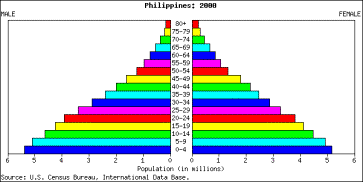
6.
According to the population pyramid of this country, its population is most likely...
a)
growing slowly.
b)
growing rapidly.
c)
decreasing.
d)
not changing.
7.
In recent years, the human population has 
a)
increased exponentially
b)
decreased exponentially
c)
decreased slowly
d)
increased slowy
8.
Countries with high growth rates usually have an age structure that has
a)
an even distribution over all ages
b)
more older people than young people
c)
more younger people than older people.
d)
more middle-aged people than younger people.
9.

Which of the following leads to a decrease in birthrates among women?

a)

Higher Education

b)

High Infant Mortality Rate

c)

No Prenatal Care

d)

No contraceptives

10.
Which of the following makes it difficult to reduce population growth?
a)
High literacy rates result in women wanting to have more children
b)
Population sizes will not decline until some people start having to do without food and other necessities of life
c)
Many people live in cities, where large families are an advantage
d)
Many people have low literacy and limited access to healthcare
11.
Which region of the world has the fastest growing population?
a)
Southeast Asia
b)
Eastern Europe
c)
Sub-Saharan Africa
d)
Latin America
12.
Which of the following is likely to be affected by a population of 7 billion?
a)
amount of land for agriculture
b)
amount of clean water
c)
number of people who are unemployed
d)
all of the above
13.

Which problem today is primarily the result of the Industrial Revolution?

a)

extensive air and water pollution

b)

increased transmission of disease between people living in close proximity

c)

decline in quality of agricultural soil

d)

erosion from deforestation as more fuel wood is harvested

14.
Population growth and fertility rates are lowest in
a)
upper-income countries
b)
upper- and middle-income countries
c)
middle- and low-income countries
d)
lower-income countries
15.
The number of babies out of 1,000 that die during their first year of life is called
a)
infant mortality
b)
growth rate
c)
demography
16.
another word for farming
a)
agriculture
b)
technology
c)
specialization
d)
shrine
17.

According to this graph, Which stage of the demographic transition has the highest level of population growth?

a)

pre-industrial

b)

transitional

c)

industrial

d)

post-industrial

18.

The human population is now about

a)

300 million

b)

1.3 billion

c)

7 billion

d)

12 billion

19.
According to the United Nations, at what number is world population expected to plateau?
a)
9-11 billion
b)
13-15 billion
c)
20-25 billion
d)
never
20.
Which has NOT been a major cause of the population explosion?
a)
modern preventive medicine
b)
increase in life expectancy
c)
improved sanitation
d)
increase in birth rates
21.
The number of live births per 1000 people is called the...
a)
growth rate.
b)
infant rate.
c)
baby total.
d)
birth rate.
22.
All of the following are demographic figures used in determining the total population of a country EXCEPT...
a)
immigration.
b)
birth rate.
c)
death rate.
d)
marriage rate.
23.
Deserts are usually....
a)
densely populated.
b)
sparsely populated.
c)
evenly populated.
d)
None of the above
24.
If a country has a death rate of 30 and a birth rate of 45 the natural rate of increase would show the population is ______.
a)
Increasing
b)
Decreasing
c)
Staying the same
d)
Fluctuating too much
25.
The movement by people from one place to another with the intention of settling temporarily or permanently in a new location. 
a)
pull factor
b)
push factor
c)
distribution
d)
migration
26.
The maximum population size of a species that the environment can sustain indefinitely, given the food, habitat, water and other necessities available in the environment.
a)
sparse population
b)
environmental
c)
carrying capacity
d)
dense population
27.
thinly scattered or distributed
a)
carrying capacity
b)
immigration
c)
dense population
d)
sparse population
28.
The average number of people living in a square kilometer is called...
a)
urbanization. 
b)
internal migration. 
c)
population density. 
d)
pull factors. 
29.
One reason for a rapid population growth is...
a)
an increase in pull factors.
b)
declining death rates. 
c)
a sparse population density. 
d)
internal migration.
30.
Moving from place to place in the same country 
a)
Urbanization 
b)
Internal Migration 
c)
Pull Factor 
d)
Declining death rates
31.
Something that attracts immigrants to another place 
a)
Declining death rates
b)
Urbanization 
c)
Pull Factor 
d)
Population Density 
32.
Areas close to rivers tend to be...
a)
Densely populated
b)
Sparsely populated
c)
Fairly populated.
d)
None of the above
33.
In the demographic transition, which factor decreases first?
a)
birth rates
b)
death rates
c)
growth rates
d)
total population
34.

In the 1800s, human population growth

a)

Suddenly fell because of an outbreak of bubonic plague.

b)

Began to level off for several decades.

c)

Increased because of a decline in death rates.

d)

Increased because of an increase in birth rates.

35.

The study of population is

a)

survivorship

b)

demography

c)

age structure

d)

migration

36.

Have the highest birth rates

a)

urbanization

b)

developed countries

c)

least-developed countries

d)

arable land

37.

The basic facilities and services that support a community.

a)

arable land

b)

demographic transition

c)

infrastructure

d)

urbanization

38.

An increase in water-borne diseases could possibly be alleviated by

a)

adequate sewage treatment facilities for growing populations

b)

very rapid growth of large cities

c)

sufficient fuelwood

d)

both a and b

39.

The Population Pyramid shown is most likely which country?

a)

Canada

b)

Japan

c)

Zimbabwea

d)

Algeria

40.

Which country is the best example of a country in stage 5 of the demographic transition model?

a)

Japan

b)

North Korea

c)

China

d)

Vietnam

41.

What did Thomas Malthus believe?

a)

The World population would be limited by the amount of food we can produce

b)

The World population would be limited by total land resources

c)

The World population would be limited by technological high marks

d)

The World population would be limited by cultural appropriation

42.

Which country should consider anti natalist policies?

a)

India

b)

Japan

c)

Latvia

d)

USA

43.

Which of the following is NOT a Pronatalist policy?

a)

Free Birth Control

b)

Free child care

c)

Free College tuition

d)

Free parenting classes

44.

In what way are refugees different from migrants?

a)

Refugees want a better life

b)

Refugees want beter jobs

c)

Refugees are escaping some sort of disaster

d)

Refugees are criminals

45.

What is birth rate?

a)

increase or decrease in infant mortality

b)

the number of live births per 1000 people

c)

the average life expectancy in a given location

d)

the number of deaths per 1000 people

46.

What does a higher life expectancy lead to?

a)

increases in birth rate

b)

increases in infant mortality rates

c)

decreases in birth rates

d)

decreases in the death rate

47.

How do you calculate the natural increase of a population?

a)

You divide the death rate by the life expectancy

b)

You multiply the death rate by the life expectancy

c)

You subtract the death rate from the birth rate

d)

You add the death rate to the birth rate

48.
If Mongolia has a fertility rate of 2.4, what does that mean?
a)
The average baby dies at 2.4 years old.
b)
2.4 people in each family can read.
c)
There are 2.4 doctors per 10,000 people.
d)
The average woman has 2.4 babies.
49.
Out of 1,000 babies born, the number that die before age 1 is called the _______________.
a)
Fertility Rate
b)
Infant Mortality Rate
c)
Death Rate
d)
Life Expectancy
50.
This population pyramid shows a country with a population that  is 
a)
growing
b)
staying the same
c)
decreasing
51.
This population pyramid shows a country that's population is 
a)
Growing
b)
Stable
c)
Shrinking
52.
This population pyramid shows a country with a population that is 
a)
Growing
b)
Stable (Staying the Same)
c)
Shrinking
53.
Which country has the most young people?
a)
2
b)
3
c)
4
54.
Which country has the most elderly people?
a)
1
b)
2
c)
3
55.
Which country has the highest death rates?
a)
1
b)
2
c)
3
d)
4
56.
Which country has the lowest birth rates?
a)
1
b)
2
c)
3
d)
4